
Promissory estoppel enforces a promise that was never bought. Where a promisor should reasonably have expected the promise to induce action, the promisee did act to its detriment, and injustice can be avoided only by enforcement, California will hold the promisor to the assurance even though no consideration passed.
The doctrine is a substitute for the bargain requirement, not a replacement for contract law. It rescues gratuitous promises, charitable pledges, assurances that an offer would be held open, and above all the subcontractor bid that a general contractor has already built into its own tender. This guide sets out the four elements, the remedy that usually follows, and the distinctions that most often trip people up.
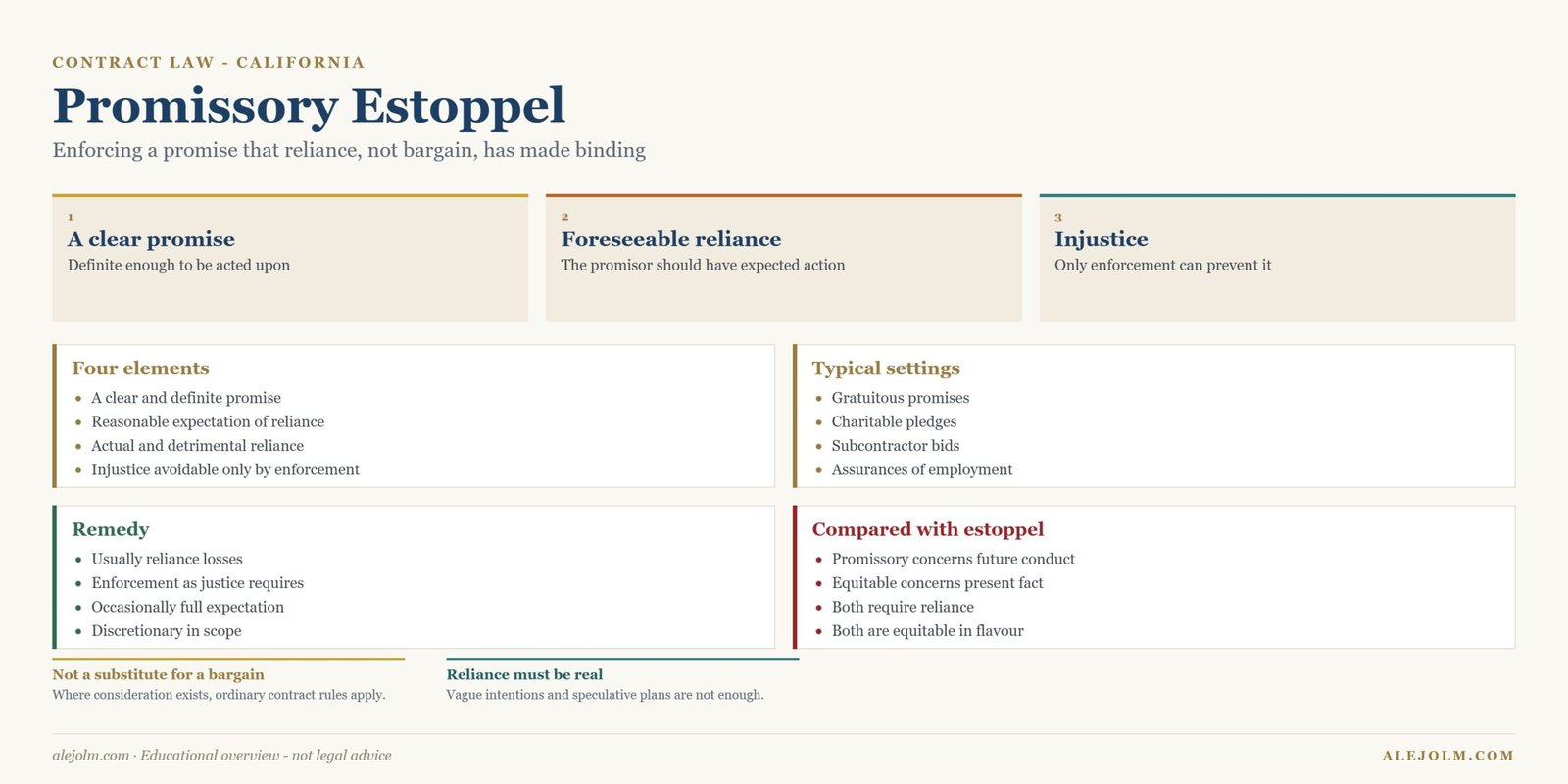
The four elements
Each element does independent work, and a claim that skips one will fail.
- A clear and definite promise. An expression of hope, an estimate or a statement that something might happen will not do.
- Reasonable expectation of reliance. The test is objective: would a reasonable promisor have foreseen action of this kind.
- Actual reliance. The promisee must genuinely have acted or refrained from acting because of the promise.
- Detriment. The reliance must have cost something real, whether money, an opportunity or a legal right.
- Reasonableness of the reliance. Acting on a promise that no sensible person would have trusted defeats the claim.
- Injustice. Enforcement must be the only adequate way to prevent an unfair result.
What the promisee actually recovers
The remedy is granted as justice requires, which makes it more flexible than an award for breach of contract. The usual measure is reliance loss: the promisee is restored to the position it occupied before the promise, recovering the money spent and the opportunities forgone. Where reliance loss is impossible to quantify, or where nothing short of full performance would be fair, a court may enforce the promise in full.
Promissory estoppel and equitable estoppel
The two doctrines are related but distinct. Promissory estoppel enforces a promise about what will happen. Equitable estoppel prevents a party from denying a representation about what is or was the case. California codifies the second idea in the Evidence Code, and the two are frequently pleaded together.
| Question | Ordinary contract | Promissory estoppel |
|---|---|---|
| Consideration required | Yes | No |
| Basis of liability | Bargain | Reliance |
| Usual measure | Expectation | Reliance loss |
| Discretion in remedy | Limited | Broad |
| Typical claimant | Party to a deal | Recipient of an assurance |
A worked example
A general contractor preparing a bid for a municipal project in Los Angeles receives a written quotation from an electrical subcontractor, uses that figure in its own tender and wins the contract. The subcontractor then discovers an error and tries to withdraw. Because the subcontractor should have expected the general contractor to rely on the number in exactly this way, and the general contractor is now locked into a price, the quotation is treated as irrevocable for a reasonable time.
Change the reliance. Suppose the general contractor had merely collected quotations for a project it never bid on, and no tender was submitted. There is no detrimental reliance, nothing has been lost, and the subcontractor is free to withdraw. The promise was identical; only what happened next was different.
Promissory estoppel in California and Los Angeles County in 2026
Construction bidding remains the doctrine most important commercial application in Los Angeles County, where public works timetables force general contractors to commit to subcontractor pricing long before any subcontract is signed. Employment is the second setting: an assurance that a role will be available, relied on by someone who resigns from existing employment and relocates, can support a claim even though the position was never formally offered.
California courts approach the doctrine cautiously in commercial settings where the parties are sophisticated and could have documented the arrangement. They are considerably more receptive where one side had no realistic opportunity to insist on a written contract before acting.
- Record the promise. A written assurance is far easier to prove than a conversation.
- Document the reliance. Contemporaneous notes of what was done and why carry real weight.
- Act promptly. Delay weakens both the reliance and the injustice arguments.
- Quantify the loss. Reliance damages must be proved, not asserted.
- Plead it alongside contract. The two theories are not inconsistent.
- Beware disclaimers. Wording that says a quotation is subject to contract undermines reliance.
For 2026, confirm the current California authority on promissory estoppel, reliance on bids and estoppel in employment directly with current authority, since these continue to develop.
Common mistakes to avoid
- Stopping at consideration. A promise that fails the bargain test may still be enforceable on reliance grounds.
- Relying on a vague statement. The promise must be clear and definite.
- Assuming full expectation damages. The usual award restores the reliance position.
- Confusing the two estoppels. One concerns future promises, the other present facts.
- Treating any inconvenience as detriment. The reliance must be substantial and real.
- Forgetting reasonableness. Unreasonable reliance defeats the claim however genuine it was.
Frequently asked questions
Can a promise without consideration ever be enforced in California?
Yes. Where the promisor should have foreseen reliance, the promisee actually relied to its detriment and injustice can only be avoided by enforcement, a court may enforce the promise.
What damages does promissory estoppel give?
Usually the cost of the reliance rather than the value of the promise, although a court may enforce the promise fully where nothing less would be just.
Does it apply to a subcontractor bid?
It is the classic application. A general contractor that uses a quotation in its own tender may be able to hold the subcontractor to the price for a reasonable period.
Can promissory estoppel get around a writing requirement?
Sometimes. Substantial reliance on an oral promise has in some circumstances persuaded courts to enforce an agreement that a statute would otherwise render unenforceable.
Is it the same as equitable estoppel?
No. Promissory estoppel enforces a promise about future conduct, while equitable estoppel prevents a party from contradicting a representation of existing fact.
Related guides
- Consideration in contract law
- The firm offer rule
- What counts as an offer
- Revocation and rejection
- Quasi-contract and restitution
- The statute of frauds
- Contract formation in California
- Remedies for breach of contract
Next steps
If you acted on an assurance that was never written into a contract, gather the evidence of what you did and when. Our guides to consideration and quasi-contract explain the alternative theories that often accompany a reliance claim.
For primary sources, read California Evidence Code section 623 and the civil jury instructions published by the Judicial Council of California.