
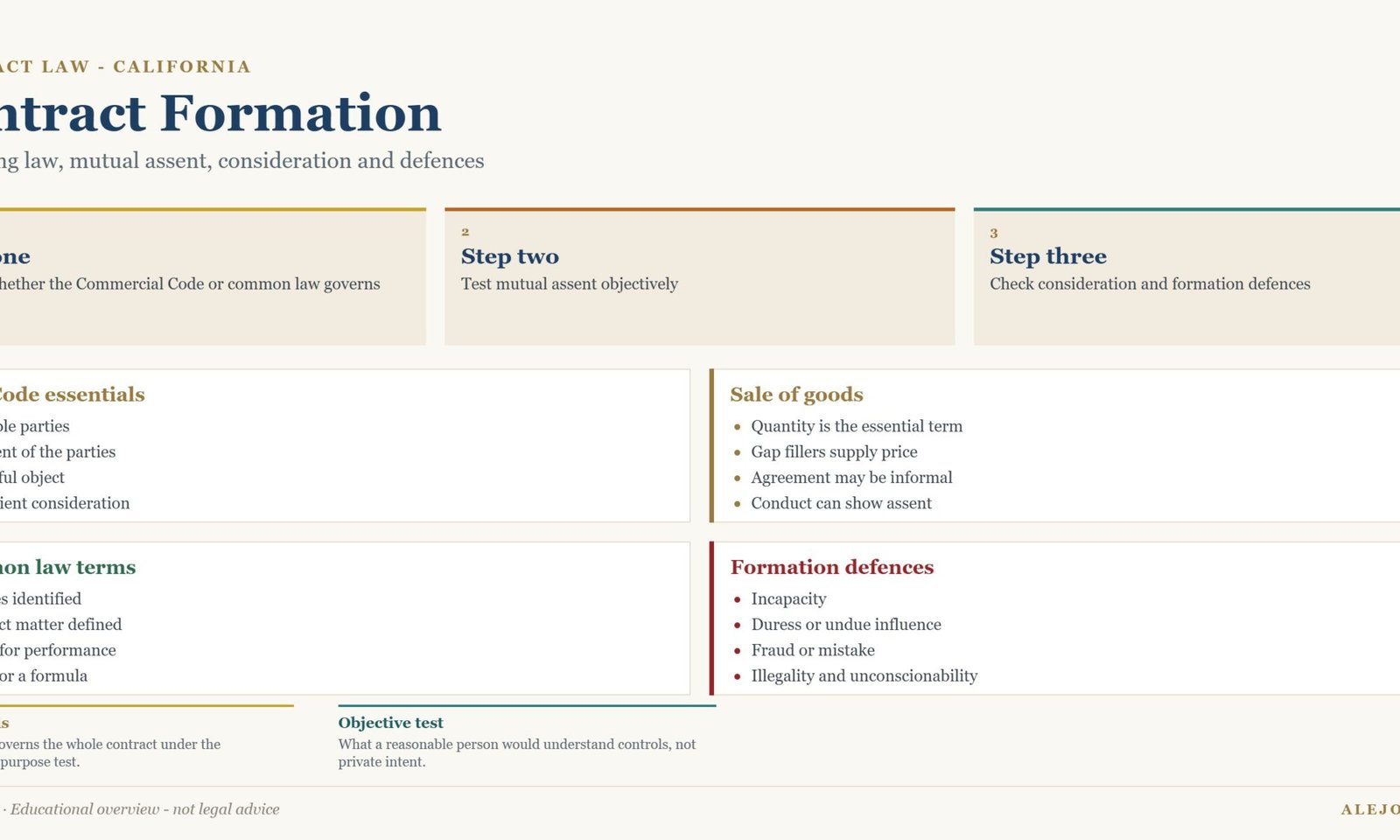
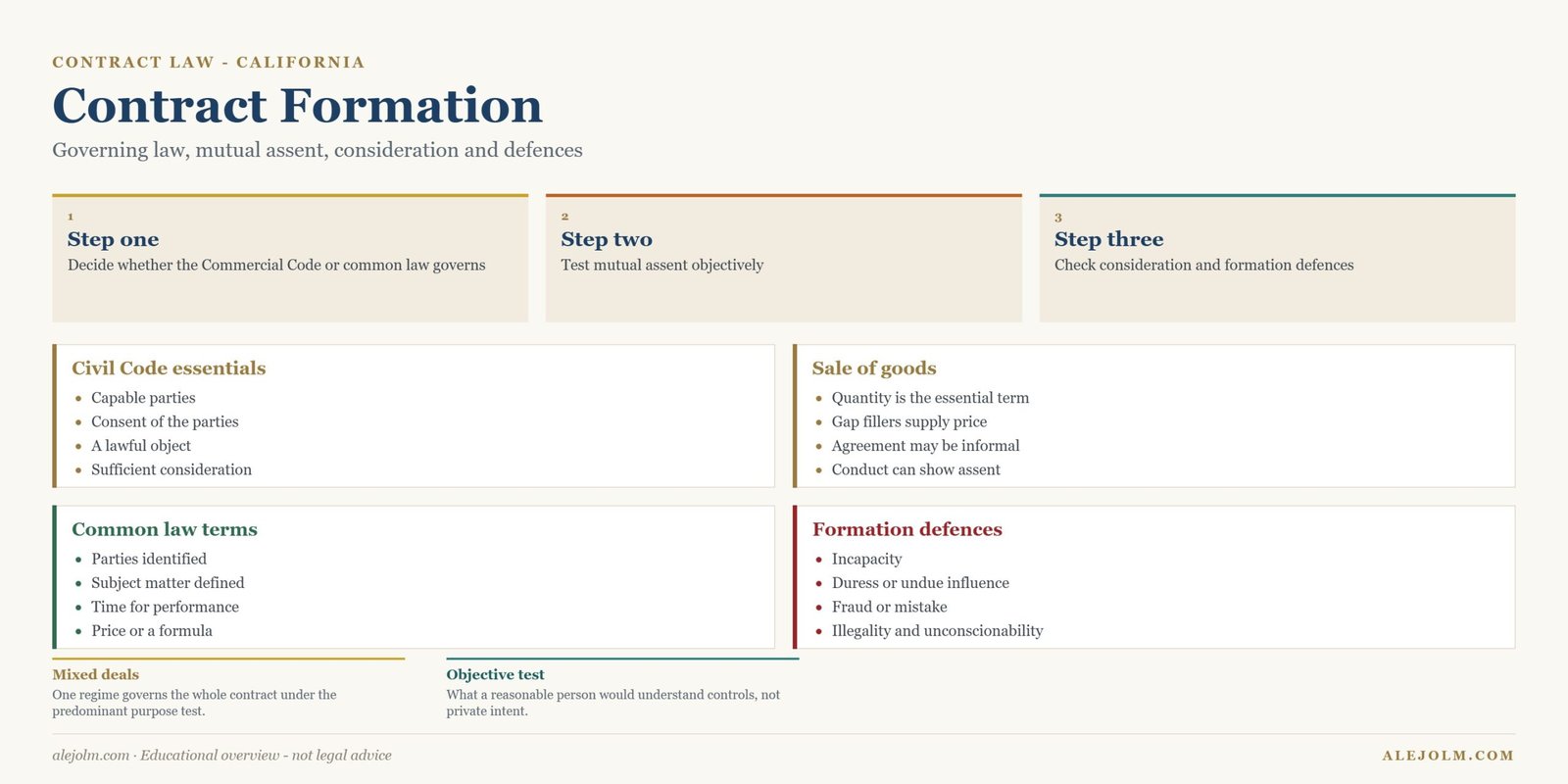
Contract formation is the process by which a proposal hardens into an enforceable obligation. California states the requirements compactly in the Civil Code: parties capable of contracting, their consent, a lawful object and sufficient consideration. Behind that short list sits a sequence of questions that decides most disputes long before anyone argues about breach.
The first question is which body of law applies, because a sale of goods is governed by the California Commercial Code while services, real property, employment and intangibles remain under the common law. This guide works through that threshold choice, then through mutual assent, definiteness, consideration and the defences that block formation, with the practical emphasis a Los Angeles County dispute demands.
Choosing the governing regime
Division 2 of the California Commercial Code governs transactions in goods, meaning things movable at the time they are identified to the contract. Everything else falls under the common law. The choice is not cosmetic: it changes which terms are essential, how closely acceptance must match the offer, what writing requirement applies and which remedies are available.
Mixed goods and services
Where a single agreement supplies both goods and labour, California applies the predominant purpose test and subjects the whole contract to one regime. A kitchen remodel dominated by the price of custom cabinetry is a goods contract; a consulting engagement that incidentally delivers a bound report is a services contract. Courts do not slice the agreement in two unless the parties themselves priced the components as separate deals.
Things attached to land
Standing timber, growing crops and unextracted minerals are part of the realty while they remain attached, so a sale made in that condition is a real property contract. Once severed they are movable goods and the Commercial Code applies. The physical state at the time of contracting is what counts.
Mutual assent, judged objectively
California measures agreement by outward manifestation. What a reasonable person in the position of the other party would have understood from the words and conduct used controls, and a secret reservation carries no weight. That is why a signed document is difficult to escape and why a joke that no reasonable listener would treat as a joke can bind.
- Present intent to be bound. Preliminary discussion, soft indications and invitations to negotiate do not qualify.
- Definite terms. The common law wants parties, subject matter, time and price; the Commercial Code wants quantity.
- Communication. An offer confers no power of acceptance until it reaches the offeree.
- A matching acceptance. The common law expects correspondence; the Commercial Code tolerates additional terms between merchants.
- Timing. Acceptance is generally effective on dispatch, while revocation and rejection are effective on receipt.
- No prior termination. Lapse, revocation, rejection, counteroffer, death or supervening illegality ends the power to accept.
| Issue | Common law | California Commercial Code |
|---|---|---|
| Essential terms | Parties, subject, time, price | Quantity |
| Missing price | May defeat definiteness | Reasonable price supplied |
| Acceptance must match | Closely | Additional terms tolerated |
| Writing threshold | Category based | Goods at or above the statutory sum |
| Typical subject | Services, land, employment | Movable goods |
A worked example
A Downey manufacturer emails a distributor offering to supply four thousand units at a stated price, and the distributor replies accepting but adding a request for palletised delivery. Under the Commercial Code a contract forms despite the extra term, because quantity was fixed and the reply expressed a definite acceptance. The delivery term is then analysed separately as a proposed addition.
Change the subject matter. The same exchange concerns architectural services for a Long Beach project with no stated fee or completion date. Now the common law applies, the missing price and timeline undermine definiteness, and a court may well conclude that the parties were still negotiating rather than contracting.
Contract formation in California and Los Angeles County in 2026
Formation disputes in Los Angeles Superior Court increasingly involve electronic exchanges: text messages, portal clicks and email chains that never produced a single signed document. California recognises electronic records and signatures for most purposes, so the analysis returns to the ordinary questions of intent, definiteness and assent rather than to the medium.
Consumer and employment contracts attract additional scrutiny. Terms buried in a link, presented after payment or drafted so that assent is inferred from silence face genuine difficulty, and the Civil Code requirement of a lawful object continues to void agreements that offend statute or public policy.
- State the governing regime first. It dictates every downstream rule.
- Fix quantity in goods deals. It is the one term the gap fillers cannot supply.
- Record assent clearly. A visible affirmative step is far stronger than terms hidden behind a footer link.
- Avoid open ended price language. Fair or appropriate rarely survives a definiteness challenge at common law.
- Confirm capacity. Minors and persons lacking capacity create voidable agreements.
- Check legality. An unlawful object defeats formation regardless of consent.
For 2026, confirm the current California authority on electronic assent, definiteness and formation defences directly with current authority, since these continue to develop.
Common mistakes to avoid
- Splitting a mixed contract. One regime governs the whole agreement unless the parties priced the parts separately.
- Relying on private intent. Unexpressed reservations do not defeat an objective manifestation of assent.
- Extending the dispatch rule. Only acceptance is effective on sending; revocation and rejection require receipt.
- Forgetting the writing requirement. A valid agreement can still be unenforceable without the required signed record.
- Confusing an advertisement with an offer. Most marketing is an invitation to deal.
- Ignoring the offer termination rules. A late acceptance is merely a new offer.
Frequently asked questions
What are the essential elements of a contract in California?
The Civil Code lists capable parties, their consent, a lawful object and sufficient consideration. Consent must be free, mutual and communicated between the parties.
Does a contract have to be in writing?
Not usually. Many oral agreements are enforceable, but certain categories, including most sales of goods above the statutory threshold and most land transactions, require a signed writing.
Can an email exchange create a binding contract?
Yes. Where the exchange shows present intent to be bound on definite terms, California will enforce it, and electronic signatures are generally treated as valid.
What happens if the price is left open?
In a sale of goods the Commercial Code supplies a reasonable price. At common law the omission is more dangerous and may show that no agreement was reached.
Is a signature always required?
No. Conduct alone can establish agreement, though a signature makes proof far easier and is essential where a writing requirement applies.
Related guides
- What counts as an offer
- Acceptance in contract law
- Consideration in contract law
- Capacity and legality
- The statute of frauds
- The mirror image rule
- Quasi-contract and restitution
- Unconscionability
Next steps
Before arguing about breach, settle whether a contract exists at all. Work through our guides to offers and acceptance to test each half of mutual assent against your own documents.
For primary sources, read California Civil Code section 1550 and the civil jury instructions published by the Judicial Council of California.