
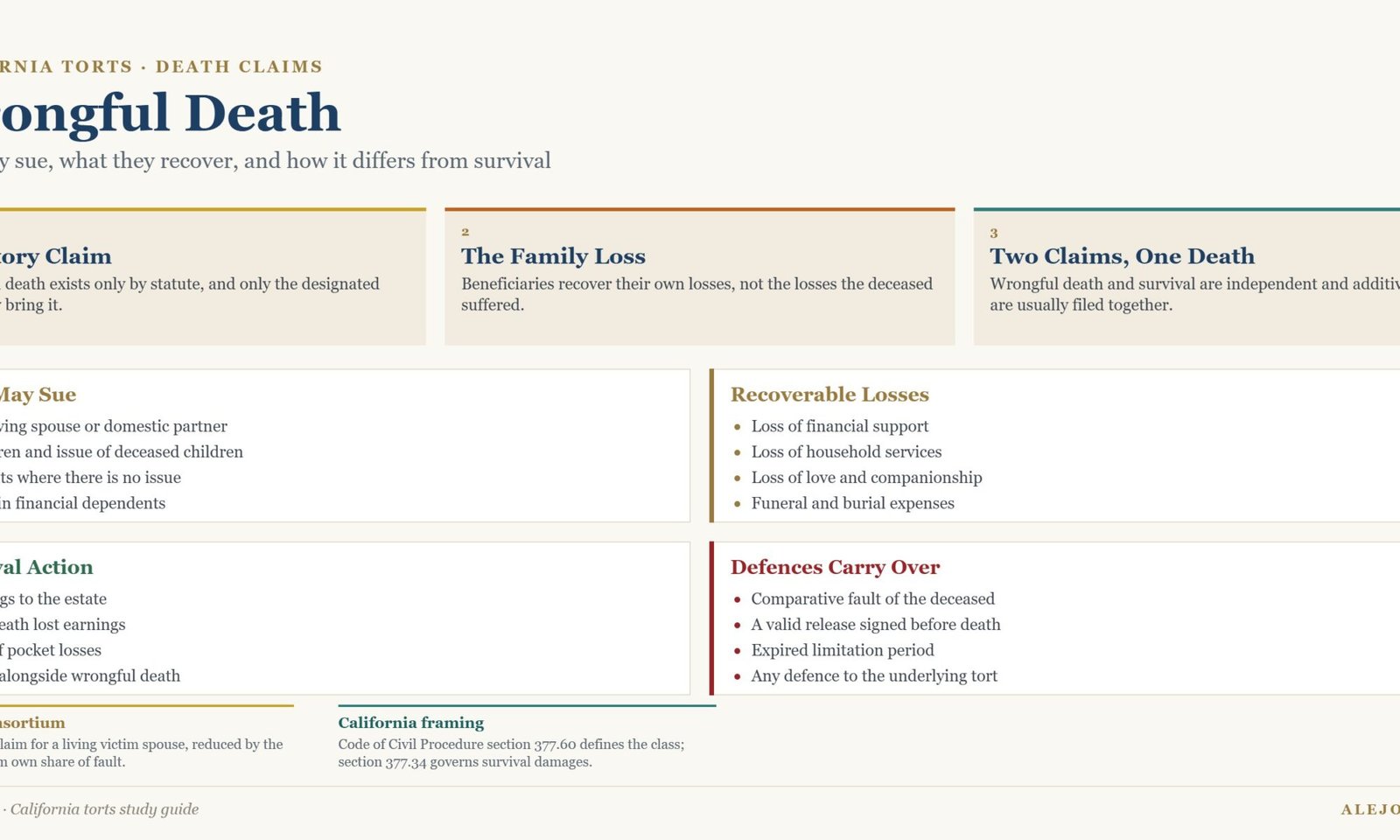
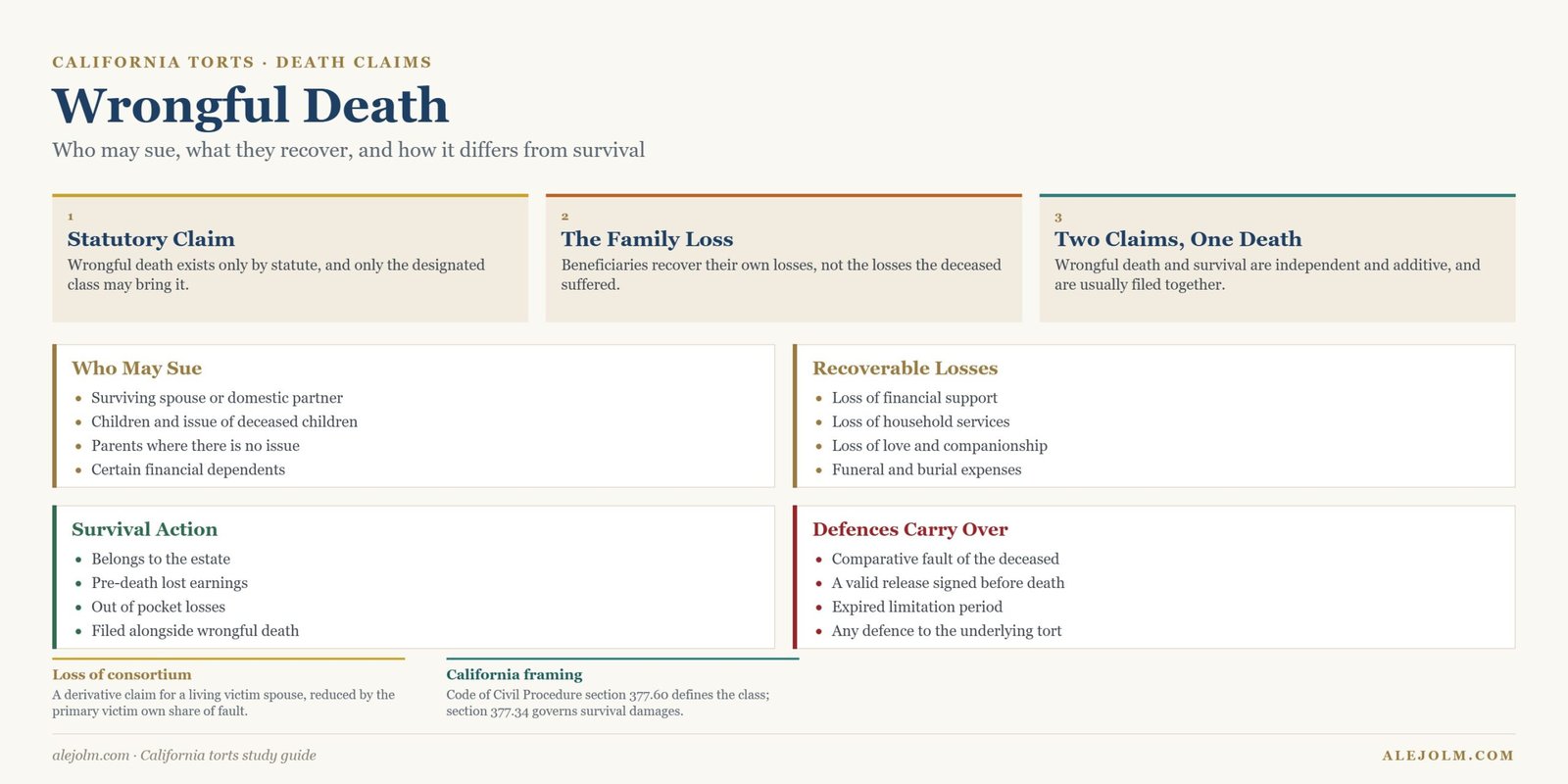
Wrongful death is a statutory claim brought by designated surviving family members for the losses they personally suffer because someone was killed by a tort. It is not the deceased claim passed on. It is a new claim, owned by the family, measured by what the family lost.
That ownership point governs everything. The class of people who may sue is fixed by statute rather than by sympathy, and the losses recoverable are the family losses rather than the suffering of the person who died. The deceased own claim survives separately, in the hands of the estate.
Who may bring the claim
Standing is defined by the statute and nowhere else. Surviving spouses and registered domestic partners, children, and the issue of deceased children are the core class. Where none of those exist, the claim generally passes to those who would inherit by intestacy, typically parents. Some statutes, California included, add people who were financially dependent on the deceased, such as a putative spouse, stepchildren or parents.
The corollary is unforgiving. An unmarried cohabiting partner who never registered, a close friend, a fiancé or a sibling in most circumstances has no claim, however genuine the loss. Blended families and long relationships that were never formalised are where these disputes arise.
Wrongful death or survival: whose loss?
The cleanest way to keep the two actions apart is to ask whose money it would have been. If the deceased could have recovered it had they lived, it belongs to the estate in the survival action. If the loss is felt by those left behind, it belongs to the family in the wrongful death claim. Both arise from a single death, both are usually filed together, and they recover different things.
| Feature | Wrongful death | Survival action |
|---|---|---|
| Owner of the claim | The statutory beneficiaries | The estate |
| Nature of the loss | The family own losses | The losses the deceased suffered |
| Typical damages | Support, services, companionship | Pre-death lost earnings and expenses |
| Trigger | The death itself | A claim the deceased already had |
What the family recovers
Damages are forward looking. The principal heads are loss of financial support, calculated from the earning capacity and life expectancy of the deceased, loss of household services, and loss of love, companionship, comfort, care, assistance, protection, affection, society and moral support. Funeral and burial expenses are usually recoverable. Traditional statutes excluded the beneficiaries own grief, and although the modern companionship head captures much of the same ground, grief as such is not a separate item.
Defences travel with the claim
The claim is derivative in one important sense: the defendant must have committed an actionable tort against the deceased. If the deceased own hypothetical claim would have failed, the family claim generally fails with it. A valid release signed before death, an expired limitation period, or the deceased own comparative fault will bar or reduce the family recovery in the same measure. Our guide to comparative negligence explains how the reduction is calculated.
Loss of consortium
Loss of consortium is a related but distinct derivative claim, and it concerns a living victim. A spouse of someone seriously injured may recover for the loss of society, companionship, services and the sexual relationship. It applies to all torts rather than to negligence alone, and because it is derivative it is reduced proportionately by the primary victim own fault and defeated by any defence good against them.
A worked example
A parent of two is killed in a collision caused by a negligent driver. The spouse and children bring a wrongful death claim for lost support over the working life the deceased would have had, the value of childcare and household work, and the loss of companionship and guidance. The estate separately brings a survival action for the medical expenses and lost earnings between the collision and the death, and for out of pocket losses.
Suppose the deceased was found twenty per cent responsible for the collision. Both claims are reduced by that share. Suppose instead the deceased had, months earlier, signed a valid release covering the defendant conduct. Both claims fail.
Wrongful Death in California and Los Angeles County in 2026
California defines the beneficiary class in Code of Civil Procedure section 377.60, which covers the surviving spouse, domestic partner, children and issue of deceased children, and, failing those, the persons who would be entitled to the property of the deceased by intestate succession. It also extends standing to a putative spouse and their children, to stepchildren, and to parents who were dependent on the deceased for support, and it makes provision for minors who lived in the household and depended on the deceased.
California also requires the claim to be brought as a single joint action, so all beneficiaries must be joined and the recovery apportioned among them by the court rather than by the jury. The general limitation period for wrongful death is two years from the death, with much shorter deadlines for claims against public entities under the Government Claims Act and separate rules for medical negligence. Survival damages are governed by section 377.34, and recent amendments to that provision have changed what the estate may claim.
- Section 377.60. Defines the beneficiary class, including domestic partners, putative spouses and certain dependents.
- One action rule. All beneficiaries must join in a single action, with apportionment decided by the court.
- Two year limit. The general period runs from the death, not from the injury that caused it.
- Public entities. A government claim must be presented within six months, and failure to do so bars the action.
- Survival damages. Section 377.34 controls what the estate may recover, and its scope has changed by amendment.
- Apportionment. The deceased comparative fault and any joint tortfeasor apportionment both affect the award.
For 2026, confirm the current text of sections 377.60 and 377.34, the applicable limitation periods and any changes to survival damages directly with current authority, since these continue to develop.
Common mistakes to avoid
- Assuming a partner has standing. Only the statutory class may sue, and an unregistered partner usually cannot.
- Awarding the deceased pain and suffering to the family. That belongs to the estate under the survival action, subject to statute.
- Forgetting the deceased defences. Comparative fault, a release or a time bar carries over to the family claim.
- Confusing consortium with wrongful death. Consortium concerns a living victim; wrongful death requires a death.
- Filing separately. California requires a single joint action with all beneficiaries joined.
- Missing the government deadline. Claims against public entities are barred long before the two year period runs.
Frequently asked questions
Who can file a wrongful death claim in California?
The surviving spouse or domestic partner, children and the issue of deceased children, and failing those the persons entitled to inherit by intestate succession, together with certain putative spouses, stepchildren and dependent parents.
What is the difference between wrongful death and a survival action?
Wrongful death compensates the family for their own losses after the death. A survival action belongs to the estate and recovers the losses the deceased personally sustained before dying.
What damages are available in a wrongful death claim?
Loss of financial support, loss of household services, loss of love, companionship, comfort and guidance, and funeral and burial expenses. The beneficiaries own grief is not a separate head.
How long do you have to file?
Two years from the date of death in the ordinary case, but only six months to present a claim against a public entity, and different rules apply to medical negligence actions.
Does the fault of the person who died reduce the claim?
Yes. The claim depends on the defendant having committed an actionable tort against the deceased, so the comparative fault of the deceased reduces the family recovery proportionately.
Related guides
 Joint Tortfeasors: Joint and Several Liability Explained
 Comparative Negligence in California: How Fault Is Split
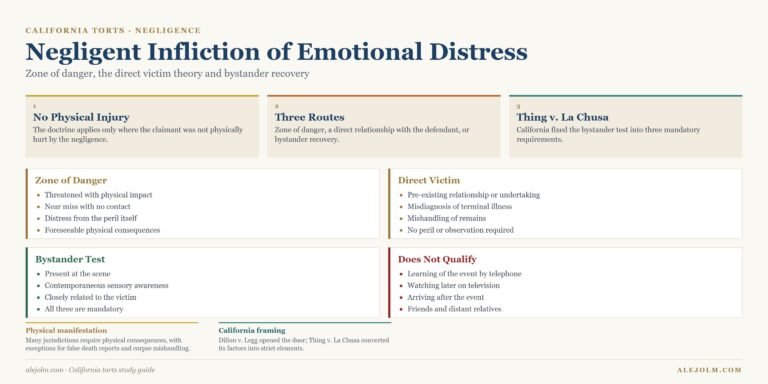 Negligent Infliction of Emotional Distress in California
- Premises Liability in California and Los Angeles County
- Vicarious Liability: Respondeat Superior and Scope of Work
- Products Liability: The Three Defect Theories Explained
- Proximate Cause: Foreseeability and Superseding Causes
- The Four Elements of Negligence: Bar Exam Breakdown
Next steps
Read our guide to comparative negligence to see how fault reduces a family recovery, then joint tortfeasors, which governs apportionment where several defendants caused the death.
For primary sources, read California Code of Civil Procedure section 377.60 and the wrongful death instructions published by the Judicial Council of California.