
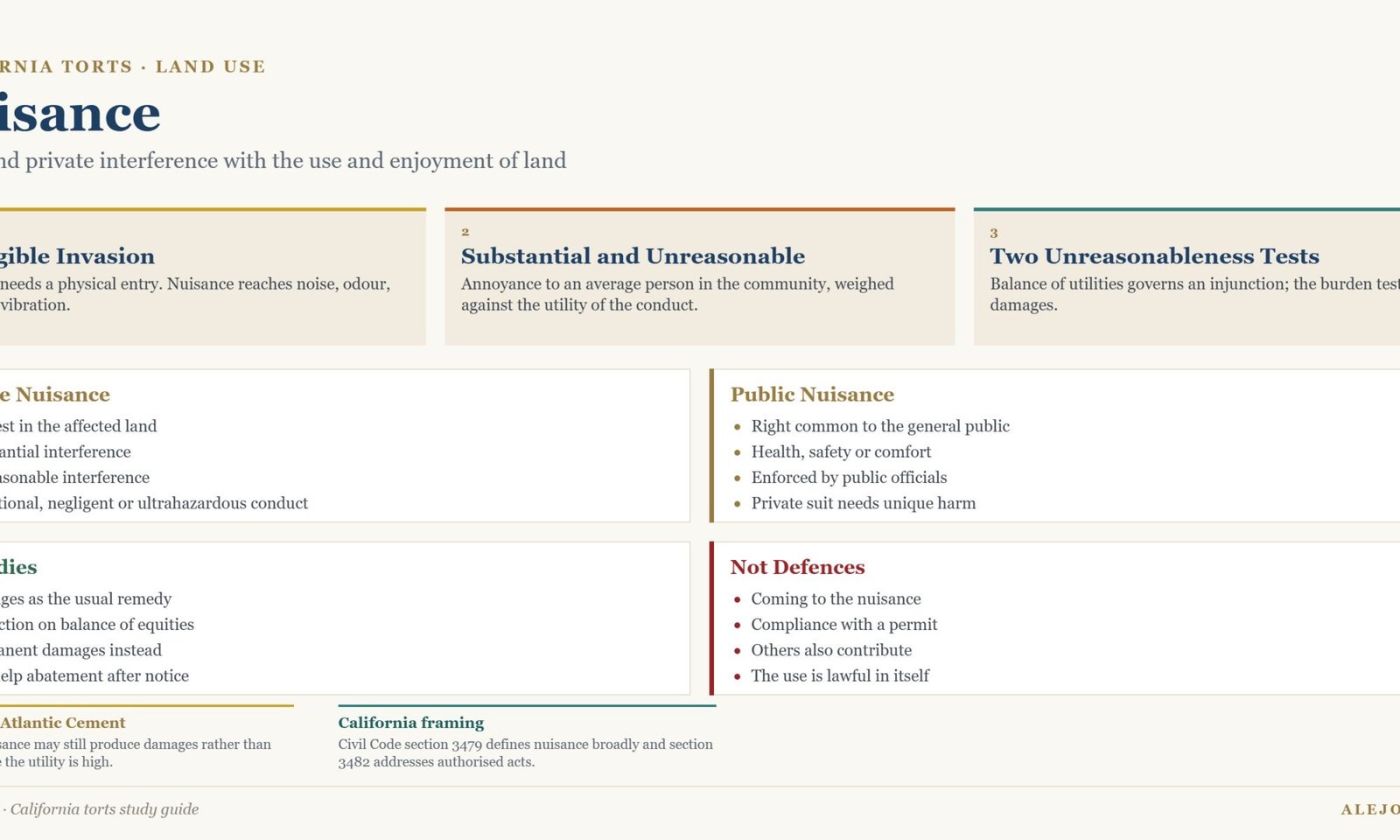
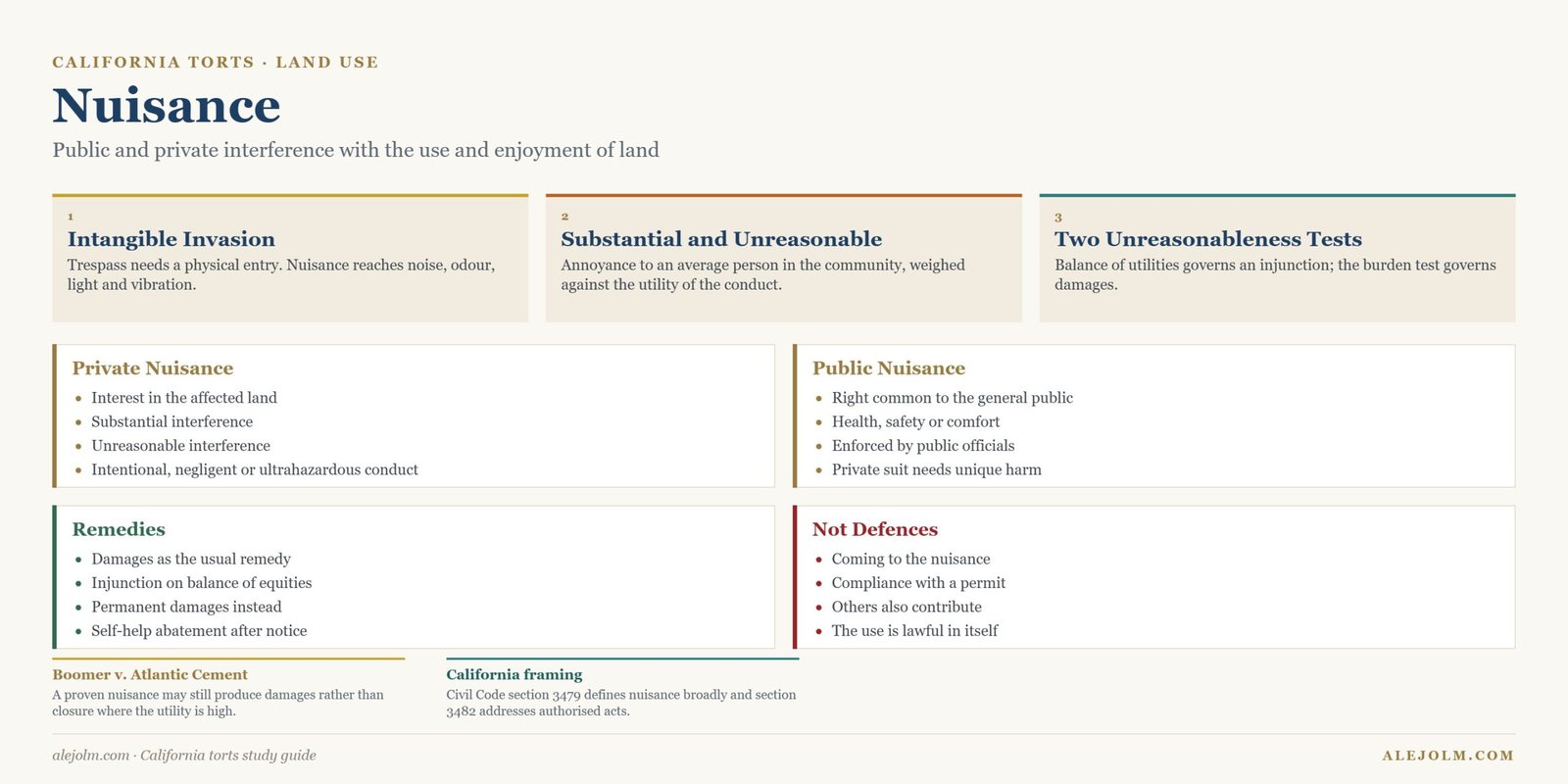
Nuisance protects the use and enjoyment of land rather than possession of it. Where trespass to land requires a tangible physical invasion, nuisance reaches the things that cross a boundary without ever quite arriving: noise, smell, smoke, dust, vibration, light and fear.
The tort divides into two. Private nuisance protects an individual occupier against interference with their own land. Public nuisance protects a right common to the community and is normally enforced by public authorities, with a private claimant admitted only where the harm suffered is different in kind from everyone else.
Private nuisance
A private nuisance is a substantial and unreasonable interference with the claimant use and enjoyment of land. Three points follow. The claimant must have an interest in the affected land, so a visitor or a passer-by cannot sue. The interference must be substantial, meaning offensive, inconvenient or annoying to an average person in the community rather than to an unusually sensitive one. And it must be unreasonable.
The defendant conduct must be intentional, negligent, or the kind of abnormally dangerous activity that attracts strict liability. Intentional here means only that the defendant knows the interference is occurring and continues, which is why an entirely lawful use of one own land can still be a nuisance. Spite makes the point sharply: playing music at the boundary or keeping a hundred barking dogs to annoy a neighbour is actionable even though the activity would be unremarkable in itself.
Two tests for unreasonableness
Unreasonableness is measured differently depending on what the claimant wants. For an injunction, courts weigh the gravity of the harm against the utility and social value of the defendant conduct. For damages, the question is whether the harm is greater than the claimant should be required to bear without compensation. The distinction matters, because a claimant may lose the injunction and still recover money.
| Remedy sought | Test applied | Typical outcome |
|---|---|---|
| Injunction | Harm to the claimant against utility of the conduct | Refused where the operation has high community value |
| Damages | Harm greater than the claimant should bear uncompensated | Awarded even where an injunction is refused |
| Abatement | Reasonable self-help after notice and refusal | Limited, and risky if force is used |
Public nuisance
A public nuisance is an unreasonable interference with a right common to the general public, such as public health, safety, peace or convenience. Blocking a highway, polluting a waterway and operating an unlawful and dangerous business are the standard examples, and enforcement usually belongs to public officials.
A private claimant may sue on a public nuisance only by showing harm different in kind from that suffered by the public generally. Degree is not enough. A commuter delayed longer than everyone else by a blocked road has no claim; a landowner whose well is contaminated by the same discharge that fouls a river has suffered a different sort of harm and may sue.
Remedies and the Boomer problem
Damages are the ordinary remedy. An injunction is available where damages are inadequate, but only after a balancing of the equities, and this is where a proven nuisance can still fail to close a factory. In Boomer v. Atlantic Cement the court refused to shut down a cement works that supported a local economy and awarded permanent damages instead, in effect requiring the operator to buy an easement to continue. Self-help abatement exists but is narrow: notice and a refusal to act come first, and only reasonable measures are permitted.
Defences that are not defences
Coming to the nuisance is the most misunderstood. Moving next to an existing activity is a factor in the reasonableness analysis, not a bar, and the only real exception arises where the claimant moved specifically in order to bring the action, the situation in Spur Industries v. Del E. Webb, where the developer succeeded but had to indemnify the relocation. Compliance with zoning or an environmental permit is evidence of reasonableness rather than immunity, and the fact that others contribute to the problem does not excuse any individual contributor.
A worked example
A bakery installs new extraction equipment that runs from three in the morning. A neighbouring household is woken every night by low frequency noise and the smell of hot fat. The interference is substantial by the standard of an ordinary person, and it is unreasonable given that quieter equipment and a later start were both available at modest cost. Damages follow, and an injunction limiting the hours is likely because the utility of the early start is small.
Change the defendant to a hospital generator that runs at night for patient safety, with no feasible alternative. The balance of utilities now points away from an injunction, and the neighbour is likely to be limited to damages for the harm they should not have to bear without compensation.
Nuisance in California and Los Angeles County in 2026
California defines nuisance unusually broadly. Civil Code section 3479 covers anything injurious to health, indecent or offensive to the senses, or an obstruction to the free use of property so as to interfere with the comfortable enjoyment of life or property. Section 3480 defines public nuisance as one affecting an entire community or neighbourhood, and section 3493 confines private actions on a public nuisance to those suffering special injury. Section 3482 provides that nothing done under express statutory authority is a nuisance, a provision the courts read narrowly.
In Los Angeles County the recurring subjects are noise from construction, entertainment and nightlife, odour and emissions from industrial operations, short term rentals, encampments and public health conditions, light spill from commercial premises and film production, and vibration from rail and heavy vehicle movements. Continuing nuisances are important in practice: where the interference can be abated, each day gives rise to a fresh claim, which changes how the limitation period operates.
- Section 3479. A broad statutory definition covering health, the senses, and comfortable enjoyment of property.
- Special injury. Section 3493 requires a private claimant on a public nuisance to show harm different in kind.
- Statutory authorisation. Section 3482 is construed narrowly and rarely defeats a claim outright.
- Continuing nuisance. Abatable interferences generate successive causes of action rather than a single accrual.
- Balance of equities. An injunction is discretionary, and high utility operations are often left to pay damages.
- Overlap. The same facts may support nuisance, negligence, trespass and strict liability, and pleading in the alternative is standard.
For 2026, confirm the current California authority on continuing versus permanent nuisance, the scope of section 3482, and local Los Angeles noise and land use ordinances directly with current authority and the relevant agency, since these continue to develop.
Common mistakes to avoid
- Assuming an injunction follows automatically. Courts balance the equities and often substitute permanent damages.
- Treating coming to the nuisance as a defence. It is only a factor except in the narrow Spur situation.
- Confusing degree with kind. A private claimant on a public nuisance needs harm of a different kind, not simply more of it.
- Requiring negligence. Intentional and unreasonable interference is a nuisance even where nobody was careless.
- Treating a permit as immunity. Compliance is evidence of reasonableness, not a complete answer.
- Measuring by the sensitive claimant. The standard is an average person in the community.
Frequently asked questions
What is the difference between nuisance and trespass?
Trespass requires a tangible physical invasion of land and protects possession. Nuisance covers intangible interferences such as noise, odour and vibration and protects use and enjoyment.
What makes an interference unreasonable?
For an injunction, the harm must outweigh the utility of the defendant conduct. For damages, the harm must be greater than the claimant should be expected to bear without compensation.
Can you sue if the activity was there first?
Usually yes. Coming to the nuisance is a factor in the reasonableness analysis, not a defence, unless the claimant moved to the area specifically in order to bring the claim.
Who can sue for public nuisance?
Public officials generally. A private claimant must show special injury different in kind from that suffered by the community, not merely a greater degree of the same harm.
Does a permit protect against a nuisance claim?
Not by itself. Compliance with zoning or an environmental permit is evidence that the conduct was reasonable, but California construes statutory authorisation narrowly.
Related guides
- Trespass to Land in California: Elements and Remedies
- Strict Liability in Tort Law: Liability Without Fault
- Abnormally Dangerous Activities: The Six Factor Test
- Premises Liability in California and Los Angeles County
- The Four Elements of Negligence: Bar Exam Breakdown
- Easements in California: Creation, Scope and Termination
- Specific Performance: When Damages Are Not Enough
- Comparative Negligence in California: How Fault Is Split
Next steps
Read our guide to trespass to land for the tangible invasion counterpart, then abnormally dangerous activities, which frequently arises on the same facts.
For primary sources, read California Civil Code section 3479 and the nuisance instructions published by the Judicial Council of California.