
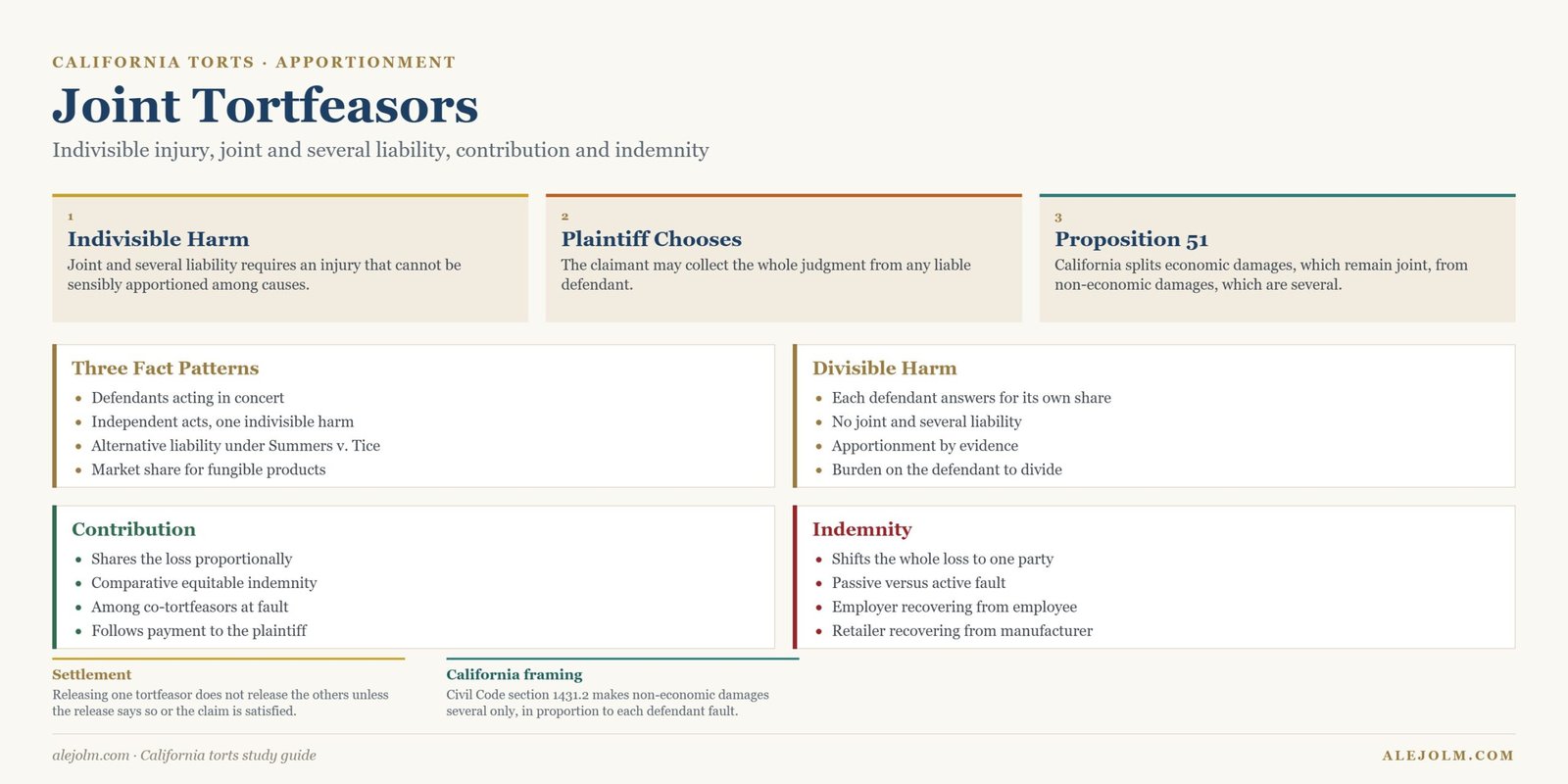
Joint tortfeasors are two or more defendants whose conduct produces a single injury that cannot sensibly be divided between them. Where that is so, each is liable for the whole of it, and the claimant may collect the entire judgment from whichever defendant is easiest to reach. The defendants then sort the money out among themselves.
The rule looks harsh until the alternative is considered. If the law required a claimant to prove exactly how much of an indivisible injury each wrongdoer caused, defendants would escape by pointing at each other. Joint and several liability places that risk on the parties who created it rather than on the person who was hurt.
The threshold question is divisibility
Everything begins with whether the harm can be apportioned. If one defendant broke the claimant arm and an unrelated defendant broke the claimant leg in a separate incident, there are two injuries and two separate claims. Joint and several liability never arises. It is reserved for harm that resists division, and the burden of showing that a single injury can be divided falls on the defendant seeking to limit its exposure.
Three recurring patterns
Acting in concert
Where defendants pursue a common enterprise, each answers for the whole. Two drivers racing on a public road are both liable when one of them strikes a pedestrian, whether or not the other car made contact. The agreement to race supplies the connection.
Independent acts, one indivisible injury
Two factories discharge pollutants into the same river. Neither discharge alone would have killed the fish stock, but together they did, and there is no way to say which molecules did the damage. Both are substantial factors in an indivisible harm, and both are liable for all of it. Our guide to actual cause explains the substantial factor test that carries this analysis.
Alternative liability and market share
Sometimes it is clear that only one of several negligent defendants caused the harm, but impossible to say which. Summers v. Tice shifts the burden to each defendant to disprove causation, and a defendant who cannot do so remains liable. Where the product is fungible and the manufacturer unidentifiable, Sindell v. Abbott Laboratories allows apportionment by share of the relevant market, a distinct doctrine that is easy to confuse with alternative liability.
| Pattern | Basis of liability |
|---|---|
| Concert of action | Common enterprise makes each responsible for the whole |
| Concurrent independent acts | Substantial factor in an indivisible injury |
| Alternative liability | Burden shifts to each negligent defendant to exonerate itself |
| Market share | Apportionment by share of the market for a fungible product |
Contribution and indemnity
Once the claimant has been paid, the loss is redistributed. Contribution spreads it among co-tortfeasors according to comparative fault, so a defendant who paid everything can recover the excess over its own share. Indemnity does something different: it shifts the entire loss to one party, typically because that party was actively at fault while the paying party was only passively or vicariously liable. An employer held liable under respondeat superior may seek indemnity from the employee, and a blameless retailer may seek it from the manufacturer.
Settlement with one defendant
A release given to one joint tortfeasor does not release the others. It does so only where the document says so or where the claimant has already received full satisfaction of the claim. What a settlement does do is reduce the amount recoverable from the remaining defendants and, in most systems, cut off contribution claims against the settling party where the settlement was made in good faith.
Joint Tortfeasors in California and Los Angeles County in 2026
California modified pure joint and several liability by initiative. Under Civil Code section 1431.2, enacted by Proposition 51, defendants remain jointly and severally liable for economic damages such as medical expenses and lost earnings, but are liable severally only, in proportion to their own percentage of fault, for non-economic damages such as pain and suffering. An answer that says each defendant is liable for the whole judgment is therefore half right in California and half wrong.
The apportionment machinery comes from American Motorcycle Association v. Superior Court, which introduced comparative equitable indemnity, allowing a defendant to seek partial indemnity from co-tortfeasors in proportion to relative fault rather than the old all or nothing rule. Good faith settlement determinations under the Code of Civil Procedure bar further contribution claims against a settling defendant, which is why they are contested so vigorously in multi-defendant Los Angeles County litigation.
- Section 1431.2. Economic damages remain joint and several; non-economic damages are several and tied to each defendant share of fault.
- Comparative equitable indemnity. Partial indemnity is available in proportion to comparative fault.
- Good faith settlements. A settlement approved as made in good faith bars contribution and indemnity claims against the settling party.
- Summers v. Tice. California is the source of alternative liability, and the burden shift survives.
- Market share. Sindell remains California law for fungible products where the specific manufacturer cannot be identified.
- Comparative fault of the claimant. The claimant own share reduces recovery under comparative negligence before apportionment among defendants.
For 2026, confirm the current California authority on the scope of section 1431.2, good faith settlement practice, and the survival of market share liability directly with current authority and the court, since these continue to develop.
Common mistakes to avoid
- Applying the doctrine to divisible harm. Separate injuries produce separate liabilities, not joint ones.
- Ignoring Proposition 51. In California, non-economic damages are several only.
- Confusing contribution with indemnity. One shares the loss; the other transfers all of it.
- Assuming a settlement releases everyone. It does not, absent express language or full satisfaction.
- Missing the burden shift. Uncertainty about which negligent defendant caused the harm does not always defeat the claim.
- Treating market share as alternative liability. They apply to different problems and produce different apportionments.
Frequently asked questions
What does joint and several liability mean?
Each liable defendant can be required to pay the entire judgment, and the claimant chooses who to collect from. The defendants then adjust the burden among themselves through contribution or indemnity.
When are defendants joint tortfeasors?
When they act in concert, or when their independent acts combine to produce a single injury that cannot reasonably be apportioned among the causes.
Does California still have joint and several liability?
Partially. Civil Code section 1431.2 keeps it for economic damages but makes non-economic damages several only, in proportion to each defendant percentage of fault.
What is the difference between contribution and indemnity?
Contribution divides the loss among co-tortfeasors according to fault. Indemnity shifts the whole loss to one party, usually the actively negligent one, and away from a passively or vicariously liable payer.
Does settling with one defendant end the case against the others?
No, unless the release says so or the claimant has been fully compensated. The settlement reduces what remains recoverable and, if made in good faith, bars contribution claims against the settling defendant.
Related guides
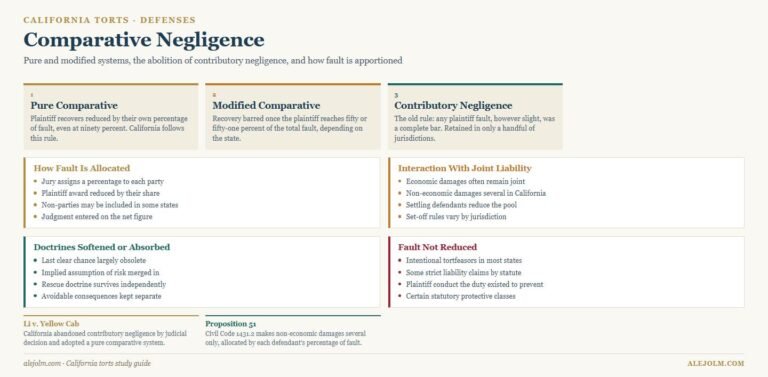 Comparative Negligence in California: How Fault Is Split
- Proximate Cause: Foreseeability and Superseding Causes
- Premises Liability in California and Los Angeles County
- Vicarious Liability: Respondeat Superior and Scope of Work
- Actual Cause in Negligence: But-For and Substantial Factor
- Products Liability: The Three Defect Theories Explained
- Strict Liability in Tort Law: Liability Without Fault
- The Four Elements of Negligence: Bar Exam Breakdown
Next steps
Read our guide to actual cause for the substantial factor test that makes concurrent causes actionable, then comparative negligence, which supplies the percentages that drive apportionment.
For primary sources, read California Civil Code section 1431.2 and the apportionment instructions published by the Judicial Council of California.