
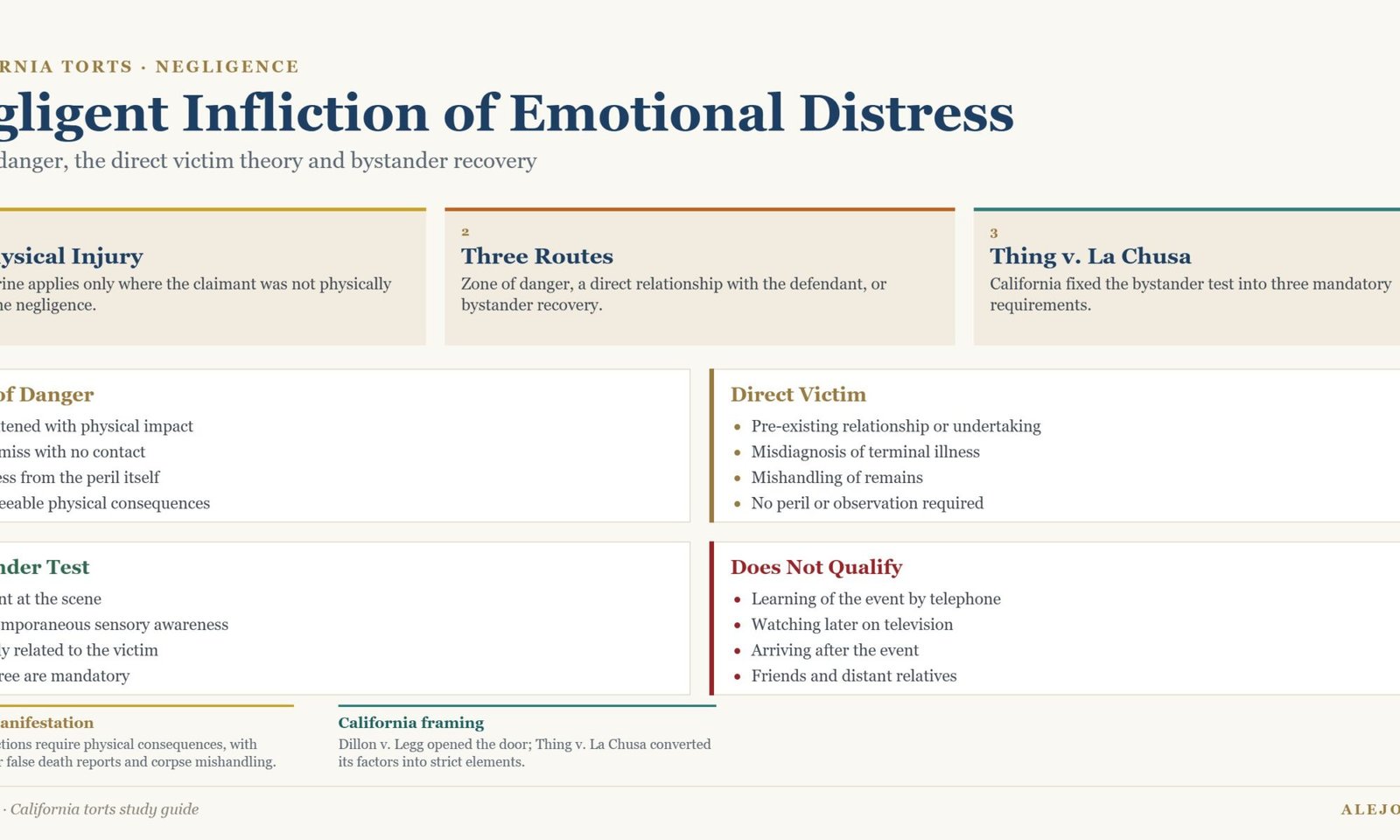
Negligent infliction of emotional distress is the claim for severe psychological harm caused by carelessness where the claimant suffered no physical injury. If there was a physical injury, no separate doctrine is needed at all: distress is simply an element of damages in an ordinary negligence action, as our guide to the elements of negligence explains.
The doctrine is deliberately narrow. Courts have worried since the beginning that emotional harm is easy to allege, hard to disprove, and capable of radiating outwards from a single incident to an unlimited number of claimants. The three recognised routes to recovery are each an attempt to draw a defensible boundary.
Route one: the zone of danger
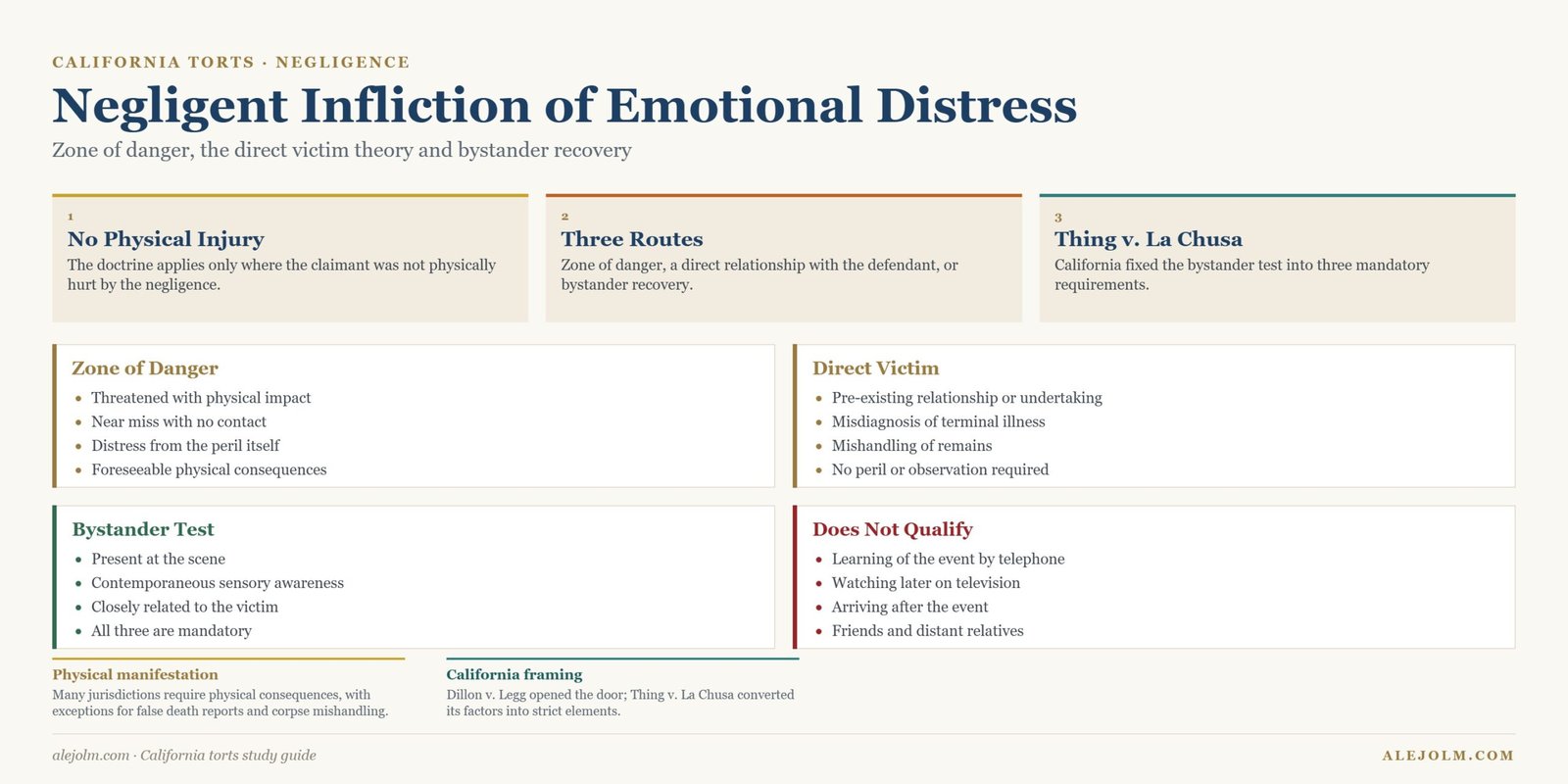
A claimant who was within the zone of foreseeable physical impact may recover for the distress caused by the near miss, even though nothing touched them. A car that mounts a pavement and stops inches away creates the classic case. The rationale is that the defendant already owed this person a duty not to injure them physically, so extending it to the fright caused by nearly doing so is a small step.
Route two: the direct victim theory
Here the duty comes from a pre-existing relationship or an undertaking between the claimant and the defendant, and neither physical peril nor observation of an accident is required. A doctor who negligently tells a patient she is terminally ill, a mortuary that mishandles remains, and a laboratory that misreports a test in circumstances where the emotional consequences for a closely connected person were foreseeable all fall within it.
California developed this branch in Molien v. Kaiser Foundation Hospitals and refined it in Burgess v. Superior Court. The key point is analytical: the direct victim theory is not a variant of bystander recovery. The defendant owed a duty to this claimant, so there is no need to ask whether the claimant watched something happen to someone else.
Route three: bystander recovery
The hardest branch concerns the claimant who is unhurt, outside the zone of danger, and traumatised by seeing harm done to another person. Dillon v. Legg first allowed it in 1968 using a flexible foreseeability test. Two decades later, in Thing v. La Chusa, the California Supreme Court concluded that the flexible approach was producing unpredictable and expanding liability, and converted the factors into three mandatory requirements.
- Presence at the scene. The claimant must have been present when the injury producing event occurred and aware that it was causing injury to the victim.
- Contemporaneous perception. The claimant must have directly observed or otherwise sensed the injury as it happened, not learned of it afterwards.
- Close relationship. The claimant must be closely related to the primary victim, meaning immediate family rather than friends or distant relatives.
All three are required, and the second one does most of the excluding. A parent told by telephone that a child has been killed does not qualify. Nor does a parent who sees the injured child at hospital hours later, or who watches footage of the accident on television. That severity is intentional.
| Route | Duty comes from | Key requirement |
|---|---|---|
| Zone of danger | Risk of physical impact to the claimant | Being within the range of harm |
| Direct victim | A relationship or undertaking with the defendant | Foreseeable emotional harm to this claimant |
| Bystander | A duty owed to the primary victim | Presence, contemporaneous perception and close relationship |
Physical manifestation
Many jurisdictions require the distress to have produced physical consequences, such as a cardiac event, a stroke or a miscarriage, on the theory that objective evidence guards against fabrication. Exceptions are recognised for an erroneous report of a relative death and for mishandling a corpse, both situations where genuine anguish is obvious and physical symptoms are beside the point.
A worked example
A mother is standing at a kerb when a lorry mounts the pavement and strikes her daughter a few feet away. She is untouched. She has two possible claims. As a person within the zone of physical danger, she may recover for the fright caused by the near miss. As a bystander, she satisfies all three elements of the strict test: she was present, she perceived the collision as it happened, and she is the victim mother.
Change the facts so that she was at work and received a phone call. Both routes close. She was never in danger, and she did not perceive the event. The distress is real and the law still denies recovery, which is the deliberate consequence of drawing a bright line.
NIED in California and Los Angeles County in 2026
California is the jurisdiction that built this area of law and then reined it in. Dillon v. Legg made the state the first to allow bystander recovery, and Thing v. La Chusa remains the controlling test, with its three requirements applied strictly rather than as factors to be weighed. The direct victim line runs in parallel and covers claims that have nothing to do with witnessing an accident.
Toxic exposure claims are governed by Potter v. Firestone Tire and Rubber Co., which limits standalone emotional distress recovery for fear of future illness, generally requiring the claimant to show that the feared illness is more likely than not to develop unless the defendant conduct was oppressive, fraudulent or malicious. In Los Angeles County these claims surface most often in medical negligence, mishandled remains, traffic collisions witnessed by family members, and environmental exposure litigation.
- Thing v. La Chusa. Presence, contemporaneous awareness and close relationship are mandatory elements, not factors.
- Direct victim claims. Molien and Burgess supply an independent route based on the defendant relationship with the claimant.
- Fear of cancer. Potter restricts recovery for fear of future illness absent a more likely than not showing.
- Close relationship. California confines the category to immediate family, and unmarried partners have historically struggled to qualify.
- Comparative fault. A claimant own negligence reduces recovery under comparative negligence.
- Medical negligence. Statutory limits on non-economic damages in professional negligence cases apply to these claims.
For 2026, confirm the current California authority on the close relationship requirement, the treatment of fear of future illness, and statutory caps in medical negligence actions directly with current authority, since these continue to develop.
Common mistakes to avoid
- Confusing it with IIED. Intentional infliction requires outrageous conduct and intent or recklessness. This claim requires only negligence.
- Using it where there was physical injury. Then distress is ordinary damages and no separate doctrine is needed.
- Treating the bystander factors as flexible. In California they are strict elements and all three must be met.
- Forgetting physical manifestation. Where required, subjective upset without symptoms will not do.
- Merging direct victim and bystander analysis. They rest on different duties and have different requirements.
- Assuming foreseeable conduct means foreseeable distress. The emotional harm itself must be foreseeable.
Frequently asked questions
What is negligent infliction of emotional distress?
It is a claim for severe emotional harm caused by another negligence where the claimant suffered no physical injury, available through the zone of danger, direct victim or bystander routes.
What are the three requirements for bystander recovery in California?
Presence at the scene when the injury producing event occurred, contemporaneous sensory awareness that it was injuring the victim, and a close family relationship with the victim. All three must be satisfied.
Can you recover for learning about an accident afterwards?
Not as a bystander. Thing v. La Chusa requires perception of the event as it happens, so a telephone call, later television footage or arrival at hospital afterwards will not support the claim.
What is the direct victim theory?
It allows recovery where the defendant owed the claimant a duty arising from a relationship or undertaking, such as a doctor and patient or a mortuary and a family, without any need for peril or observation.
Is a physical symptom always required?
No. Many jurisdictions require physical consequences, but exceptions apply for erroneous reports of a relative death and mishandling of remains, and the direct victim cases often proceed without them.
Related guides
 Negligence Per Se: Using a Statute to Prove Breach
 Intentional Infliction of Emotional Distress in California
 Joint Tortfeasors: Joint and Several Liability Explained
 Comparative Negligence in California: How Fault Is Split
- Duty of Care in Negligence: California Rules Explained
- Premises Liability in California and Los Angeles County
- The Four Elements of Negligence: Bar Exam Breakdown
- Proximate Cause: Foreseeability and Superseding Causes
Next steps
Read our guide to intentional infliction of emotional distress for the deliberate counterpart to this claim, then duty of care, where the policy limits that shape both doctrines are set out.
For primary sources, read California Civil Code section 1714 and the emotional distress instructions published by the Judicial Council of California.