
Negligence per se is the rule that lets a legislature, rather than a jury, set the standard of care. Where a safety statute applies and the defendant has violated it without excuse, the court substitutes the statutory command for the open-ended question of what a reasonable person would have done. It is the closest thing negligence law has to a shortcut, and it is narrower than most people expect.
The doctrine settles two elements and only two. Duty and breach come from the statute. Causation and damages still have to be proved in the ordinary way, and the two threshold requirements that let a plaintiff borrow the statute in the first place are where most claims fail.
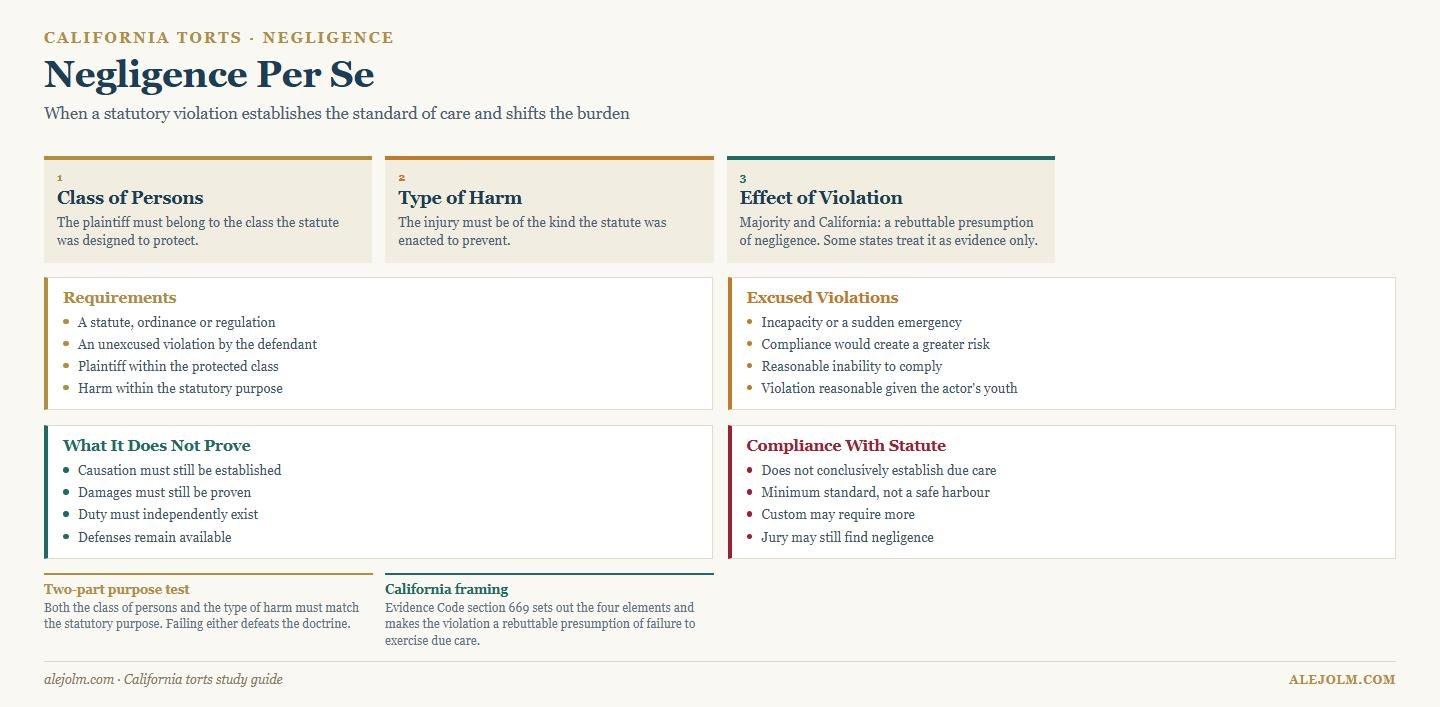
The two prongs
Before a statute can supply the standard of care, the plaintiff must clear two independent hurdles. Both must be satisfied. Failing either one takes the case out of negligence per se altogether, although the violation can usually still be put to the jury as ordinary evidence that the defendant was careless.
The class of persons
The plaintiff must belong to the group the statute was enacted to protect. A workplace safety regulation written for employees does not automatically protect a passing member of the public. A building code provision aimed at occupants may not extend to a contractor injured during construction. The question is who the legislature had in mind, not who happened to get hurt.
The type of harm
The injury must be the kind of injury the statute was designed to prevent. This is the prong examiners love, because it is easy to satisfy the first one and then stop reading. Take a health code requiring food handlers to wash their hands after using the restroom. An employee skips the sink, and the next customer is scalded because the tap was negligently set too hot. The customer is squarely within the protected class, yet negligence per se fails: the statute exists to prevent foodborne illness, not burns. The risk that materialised was not the risk the rule addressed.
| Requirement | What it asks |
|---|---|
| Class of persons | Was this plaintiff among those the statute protects? |
| Type of harm | Was this injury the kind the statute was meant to prevent? |
| Unexcused violation | Did the defendant breach the statute without a recognised excuse? |
| Causation and damages | Proved separately, exactly as in any negligence case |
What a violation actually establishes
In the majority position, and in California, an unexcused violation conclusively settles duty and breach. The jury is not asked whether the defendant behaved reasonably; it is told that the defendant did not. A minority of jurisdictions treat the violation as evidence of negligence only, leaving the jury free to find due care despite the breach. Fact patterns that flag a minority rule jurisdiction are testing exactly this difference.
What a violation never does is prove the rest of the case. The plaintiff must still show that the breach was both a but-for and a proximate cause of the injury, and must still prove damages. Our guides to actual cause and proximate cause set out those inquiries, and an unforeseeable intervening force can cut off liability even where the statutory breach is beyond argument.
Excused violations
A violation that is excused will not support the doctrine. The recognised categories are narrow but they decide real cases, and a well-drafted problem will bury one in the facts.
- Compliance would be more dangerous. The classic illustration is a pedestrian who walks on the wrong side of a road because facing traffic is safer, the reasoning of Tedla v. Ellman.
- Compliance was outside the defendant control. Sudden mechanical failure or an event no diligence would have prevented.
- Incapacity. Physical incapacity, or the youth of the actor, measured against what could reasonably be expected.
- Genuine emergency. A sudden emergency not of the defendant own making.
- Reasonable diligence. The defendant tried, with reasonable care, to comply and could not.
- Ignorance of the triggering facts. The defendant neither knew nor should have known of the circumstances that brought the statute into play, such as a tail light that failed moments earlier.
Compliance is a floor, not a ceiling
The doctrine runs one way. A defendant who obeyed the statute has not thereby proved due care. Statutes set minimums, and a reasonable person facing an obvious danger may have to do more than the code requires. Evidence of compliance is admissible and often persuasive, but the jury remains free to find that the circumstances demanded greater precautions.
A worked example
A driver whose licence has lapsed is involved in a collision at an intersection. The other motorist argues negligence per se on the strength of the licensing statute. The argument fails on the type of harm prong. Licensing rules exist to keep incompetent drivers off the road, so the relevant risk is unsafe driving, not the administrative fact of an expired card. Unless the lapse is tied to a want of competence that caused the crash, the statute supplies nothing, and the claim reverts to ordinary negligence.
Change the statute to a vehicle code provision requiring a driver to stop at a red light, and everything falls into place. The plaintiff is a motorist on the cross street, plainly within the protected class. The harm is a collision, plainly the risk the rule addresses. Duty and breach are settled, and the case moves straight to causation and damages, unless the defendant can show the brakes failed without warning.
Negligence Per Se in California and Los Angeles County in 2026
California codifies the doctrine at Evidence Code section 669, which creates a presumption that a person failed to exercise due care where four conditions are met: the person violated a statute, ordinance or regulation; the violation proximately caused death or injury to person or property; the injury resulted from the kind of occurrence the enactment was designed to prevent; and the injured person was among the class the enactment was intended to protect. The presumption affects the burden of proof and is rebuttable, principally by showing the violation was excused.
The statute does two useful things. It converts a common law doctrine into a checklist with the two prongs written on the face of the code, and it makes clear that proximate cause is part of the showing rather than an afterthought. In practice the fight in Los Angeles County cases is usually over the second and third conditions, with the vehicle code, the building code, and local health and safety ordinances supplying most of the raw material.
- Evidence Code section 669. Sets out the four conditions and makes the resulting presumption rebuttable rather than conclusive.
- Excuse. Rebuttal generally requires proof that the defendant did what might reasonably be expected of a person of ordinary prudence acting under similar circumstances who desired to comply with the law.
- Vehicle Code. The largest single source of per se claims, from right of way rules to speed and equipment requirements.
- Building and safety codes. Frequently combined with premises liability claims, where a code violation supports breach and the occupier still contests notice and causation.
- Comparative fault. A per se finding does not insulate the plaintiff, whose own statutory violation can reduce recovery under comparative negligence.
- No private right of action. Borrowing a statute for the standard of care is not the same as suing under it, and the distinction matters where the enactment provides its own remedy.
For 2026, confirm the current text of Evidence Code section 669, the Judicial Council instructions on presumed negligence, and any local Los Angeles ordinances relied on directly with current authority, since these continue to develop.
Common mistakes to avoid
- Using the doctrine to prove causation. It settles duty and breach. Causation and damages are still the plaintiff burden.
- Running only one prong. Class of persons and type of harm are independent, and problems are built around the one that looks obvious.
- Treating compliance as a defence. A statute is a minimum standard, and reasonable care can require more.
- Forgetting excuse. Both prongs can be satisfied and the claim still fail because the violation was excused.
- Ignoring the minority rule. In evidence only jurisdictions the jury may still find no negligence despite the violation.
- Confusing the doctrine with a statutory cause of action. Borrowing the standard of care creates no new claim.
Frequently asked questions
What does negligence per se actually prove?
An unexcused violation of an applicable safety statute establishes duty and breach. The plaintiff must still prove that the breach caused the injury and must still prove damages.
What are the two requirements for negligence per se?
The plaintiff must be within the class of persons the statute was designed to protect, and the injury must be of the type the statute was designed to prevent. Failing either takes the case outside the doctrine.
Is negligence per se conclusive in California?
Evidence Code section 669 creates a rebuttable presumption of failure to exercise due care rather than an irrebuttable rule. The defendant may rebut it, principally by establishing that the violation was excused.
Does obeying a statute mean a defendant was not negligent?
No. Statutory compliance is evidence of due care but never conclusive. A reasonable person may be required to take precautions beyond the statutory minimum.
Can a violation still help if negligence per se fails?
Usually yes. Where a prong is not met, the violation can generally still be introduced as evidence of negligence under the ordinary reasonable person standard.
Related guides
 Comparative Negligence in California: How Fault Is Split
- Assumption of Risk in California: Primary and Secondary
- Proximate Cause: Foreseeability and Superseding Causes
- The Four Elements of Negligence: Bar Exam Breakdown
- Premises Liability in California and Los Angeles County
- Duty of Care in Negligence: California Rules Explained
- Actual Cause in Negligence: But-For and Substantial Factor
- Products Liability: The Three Defect Theories Explained
Next steps
Read our guide to the elements of negligence to see where the doctrine fits in the wider structure, then proximate cause, which remains the plaintiff burden even after a statute has settled breach.
For primary sources, read California Evidence Code section 669 and the presumed negligence instructions published by the Judicial Council of California.