
The stream of commerce theory asks whether a manufacturer that never sold anything in California can still be sued here because its product travelled into the state through someone else’s distribution network. It is the hardest corner of personal jurisdiction doctrine, and it is unresolved at the Supreme Court level.
The question matters enormously in Los Angeles County, where an enormous share of imported goods enters the country through the ports of Los Angeles and Long Beach. When a defective component causes injury here, the retailer and the importer are easy targets. The overseas maker of the failed part is not, and the answer usually turns on which version of the stream of commerce test the court adopts.
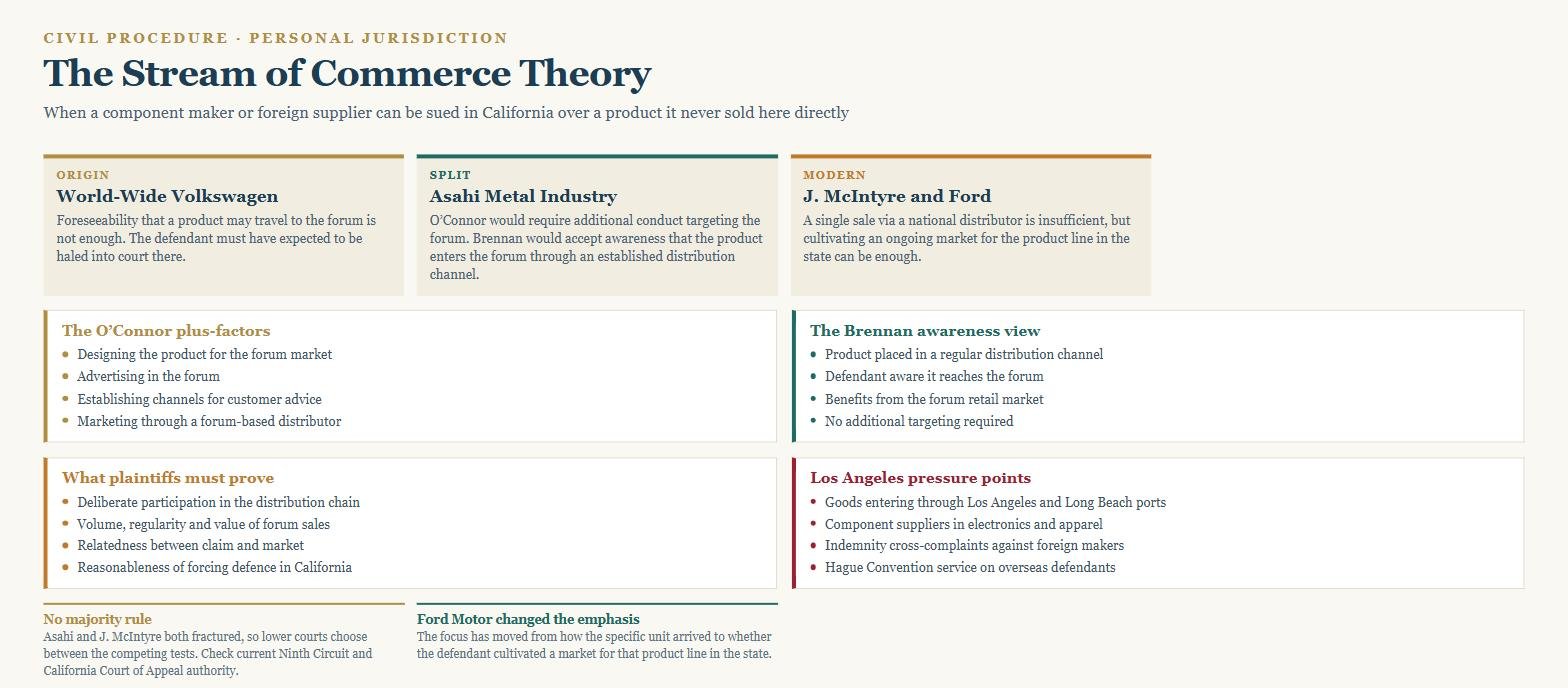
The starting point: foreseeability is not enough
World-Wide Volkswagen Corp. v. Woodson involved a car bought in New York that caught fire in Oklahoma. The regional distributor and dealer had no Oklahoma contacts. The Court held that the mere foreseeability that a mobile product might end up in a state does not create jurisdiction there. What matters is whether the defendant’s conduct and connection with the forum are such that it should reasonably anticipate being haled into court there.
But the same opinion contained a sentence that launched the whole doctrine: a forum may assert jurisdiction over a corporation that delivers its products into the stream of commerce with the expectation that they will be purchased by consumers in the forum state. Whether that sentence describes a rule or merely a possibility has occupied courts ever since.
Asahi and the unresolved split
The O’Connor plurality
In Asahi Metal Industry Co. v. Superior Court, a case that reached the Supreme Court from California, Justice O’Connor wrote that placing a product into the stream of commerce, without more, is not an act purposefully directed toward the forum. She required additional conduct: designing the product for the forum market, advertising there, providing customer service channels, or marketing through a distributor who has agreed to serve as a sales agent in the forum.
The Brennan concurrence
Justice Brennan disagreed. In his view, a defendant who places goods into an established distribution channel and is aware that the final product is being marketed in the forum has benefited economically from the forum and has notice that it may be sued there. No additional targeting should be required. Neither view commanded a majority, and both remain in circulation.
J. McIntyre and Ford Motor
J. McIntyre Machinery, Ltd. v. Nicastro fractured again. A plurality would have held that the defendant must target the forum specifically, and that selling through a nationwide distributor and attending national trade shows was not enough for New Jersey. Ford Motor Co. v. Montana Eighth Judicial District Court then shifted the emphasis away from tracing the path of the particular unit and toward whether the defendant systematically cultivated a market for that product line in the state.
| Question | O’Connor / plus-factors view |
|---|---|
| Core requirement | Conduct targeting the forum beyond mere sale |
| Nationwide distributor | Usually insufficient on its own |
| Advertising in California | Strong plus-factor |
| Component suppliers | Often escape jurisdiction |
| Plaintiff’s burden | Heavy; requires forum-specific evidence |
What plaintiffs actually need to prove
- Deliberate participation: evidence that the defendant knew and intended its goods to be resold in the United States and in California specifically.
- Volume and regularity: shipment records, customs data and sales figures showing a sustained flow rather than an isolated transaction.
- Forum-specific conduct: California-language packaging, Proposition 65 warnings, UL or CARB certifications sought for the California market.
- Service and support: warranty channels, spare-parts supply or technical assistance reaching California customers.
- Relatedness: the injury must arise from the product line that was cultivated here, not an unrelated business unit.
- Reasonableness: a serious answer to the burden a foreign defendant faces litigating in Los Angeles.
A worked example
A Taiwanese company manufactures lithium battery cells. It sells them exclusively to a South Korean assembler, which builds them into power tools sold under a US brand. The brand distributes nationally, and roughly eighteen percent of its sales occur in California, mostly through big-box retailers in Los Angeles and Orange Counties. A cell fails, a tool ignites, and a homeowner in Pasadena sues the cell maker along with everyone else in the chain. The cell maker moves to quash.
Under the Brennan approach the plaintiff likely wins: the cells travel through an established, high-volume channel and the maker plainly knows they reach California consumers. Under the O’Connor approach the plaintiff needs more, and the case turns on discovery. Did the cell maker design to California or US safety specifications? Did it participate in the brand’s marketing? Does it supply replacement cells to California service centres? This is why jurisdictional discovery, requested expressly in the opposition, is often the decisive tactical move rather than the briefing itself.
Stream of Commerce Doctrine in California and Los Angeles County in 2026
California courts reach as far as due process allows under Code of Civil Procedure section 410.10, so there is no state-law layer to argue about. The dispute is purely constitutional, and California appellate decisions have generally been receptive to stream of commerce arguments where the plaintiff can show a substantial and deliberate flow of goods into the state rather than a stray unit.
Los Angeles County is the natural venue for these fights. The San Pedro Bay port complex handles a large share of all containerised imports into the United States, and the county’s apparel, consumer electronics, automotive aftermarket and construction supply industries all depend on foreign component makers. The result is a steady stream of product liability actions in which the domestic retailer files an indemnity cross-complaint against an overseas supplier that then contests jurisdiction.
Practically, the overseas defendant must first be served, and that usually means the Hague Service Convention. Service on a defendant in Taiwan, Vietnam or China can take many months, which reshapes the case schedule long before the jurisdictional motion is heard. Plaintiffs who wait until the eve of trial to add a foreign supplier often find that the statute of limitations and the five-year rule under Code of Civil Procedure section 583.310 have overtaken them.
- Plead the flow, not the unit: allege sustained California sales volume rather than tracing one product’s route.
- Use customs and import records: bills of lading routed through Los Angeles and Long Beach are persuasive evidence.
- Look for California-specific compliance: Proposition 65 labels and CARB certifications show forum targeting.
- Request jurisdictional discovery early: Los Angeles judges commonly allow a limited round before ruling.
- Start Hague service immediately: translation and central authority delays routinely exceed six months.
- Watch the five-year rule: section 583.310 keeps running while a foreign defendant is being served.
For 2026, verify the current Ninth Circuit and California Court of Appeal position before relying on either Asahi formulation, because this area moves and no controlling majority rule exists. Confirm current Hague Convention central authority processing times for the relevant country as well. For the surrounding framework see minimum contacts and due process, specific versus general jurisdiction and the California long-arm statute.
Common mistakes to avoid
- Arguing foreseeability alone. World-Wide Volkswagen rejected it explicitly, and repeating the argument signals a weak record.
- Ignoring which test the court follows. Brief both Asahi formulations rather than assuming your preferred one applies.
- Failing to request jurisdictional discovery. A denial without discovery is far harder to attack on writ review.
- Treating the importer and the manufacturer alike. An importer with a California office is easy; the foreign maker is a separate analysis.
- Overlooking service logistics. Winning the jurisdictional argument is worthless if service was defective under the Hague Convention.
Frequently asked questions
What is the stream of commerce theory?
It is the argument that a manufacturer can be subject to jurisdiction in a state because it put its product into a distribution network that predictably carries the product into that state, even though it made no direct sale there.
Is there a single controlling test?
No. Both Asahi and J. McIntyre produced fractured opinions, so lower courts choose between requiring forum-targeting conduct and accepting awareness of distribution into the forum.
Does Ford Motor make jurisdiction easier?
It helps plaintiffs by removing any need to trace the specific unit, focusing instead on whether the defendant cultivated a market for the product line in the state.
Are component suppliers treated differently?
Often yes. A supplier of a small internal part usually has less forum-directed conduct than a finished-goods maker, which makes the O’Connor plus-factors harder to satisfy.
How long does Hague Convention service take?
It varies widely by country and can run from a few months to well over a year. Begin the process as soon as the defendant is identified and confirm current processing times with the destination central authority.
Related guides
 Joinder of Claims and Parties in California Lawsuits
 In Rem and Quasi In Rem Jurisdiction Explained
 The Erie Doctrine Explained: A 4-Step Bar Exam Guide
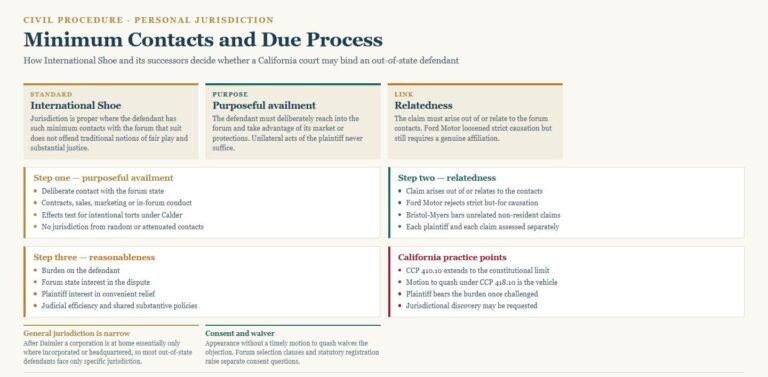 Minimum Contacts and Due Process in California Courts
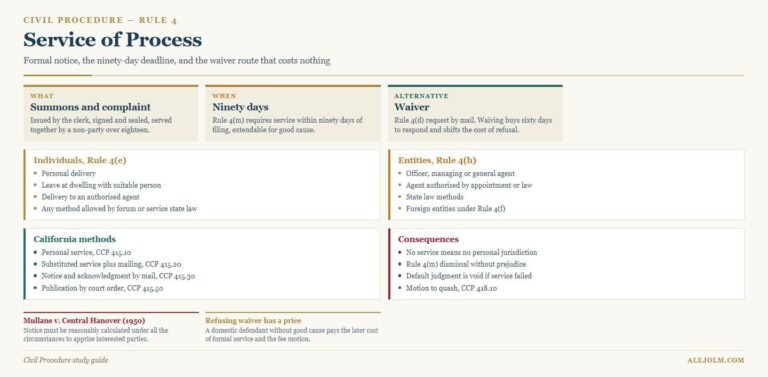 Service of Process Under Rule 4: Methods and Waiver
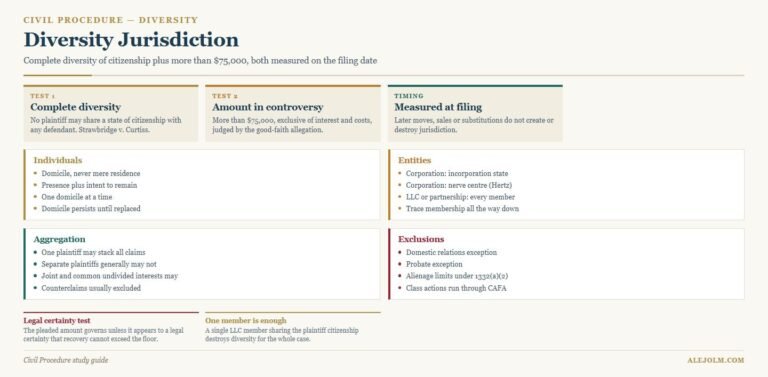 Diversity Jurisdiction: Citizenship and Amount Rules
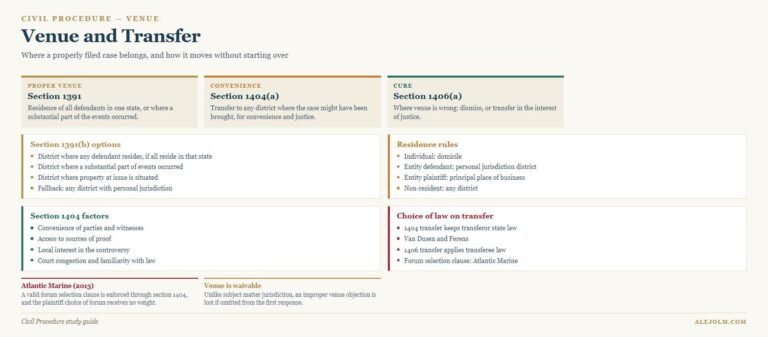 Federal Venue Rules and Transfer Under Section 1404
- The California Long-Arm Statute and Motion to Quash
- Forum Non Conveniens in California and Federal Courts
- Removal and Remand: Moving a Case to Federal Court
- Specific vs General Personal Jurisdiction Explained
Next steps
Start with the general framework in minimum contacts and due process, then read the California long-arm statute and motion to quash for the procedural vehicle. Port volume statistics that support a stream of commerce showing are published by the Port of Los Angeles, and the treaty text and country profiles are maintained by the Hague Conference on Private International Law.