
Forum non conveniens is the doctrine that allows a court with unquestioned jurisdiction and proper venue to decline to hear a case because another forum would be substantially more appropriate. It is discretionary, it is fact-intensive, and it is one of the few motions that can end a lawsuit without any ruling on the merits.
The doctrine matters most in Los Angeles County, where international trade, entertainment financing and cross-border manufacturing routinely produce disputes whose real centre of gravity lies in another country. This guide covers the federal framework, the distinct California version codified in Code of Civil Procedure section 410.30, and the tactical decisions that determine whether the motion succeeds.
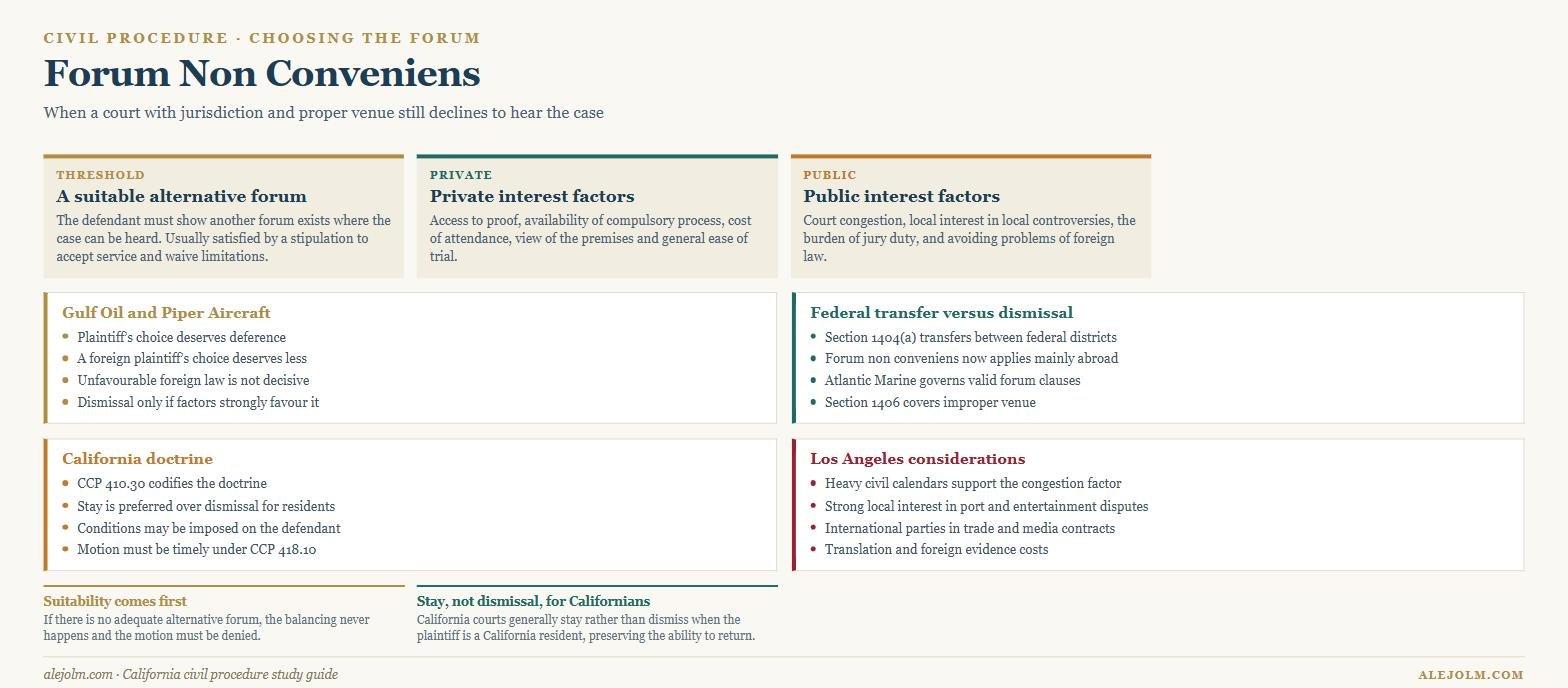
The threshold: a suitable alternative forum
Before any balancing occurs, the moving defendant must establish that an adequate alternative forum exists. This is usually satisfied by the defendant agreeing to submit to jurisdiction in the other forum and to waive any statute of limitations defence that arose while the first case was pending. If no such forum is available, the motion fails immediately regardless of how inconvenient the current one is.
Adequacy does not mean equivalence. Piper Aircraft Co. v. Reyno held that the possibility of a less favourable substantive law in the alternative forum is not, on its own, a reason to deny dismissal. Only where the remedy in the other forum is so clearly inadequate that it amounts to no remedy at all does the difference in law defeat the motion.
The private interest factors
Drawn from Gulf Oil Corp. v. Gilbert, these concern the litigants’ practical ability to try the case.
- Access to sources of proof: where the documents, records and physical evidence are located.
- Compulsory process: whether unwilling witnesses can be subpoenaed in each forum.
- Cost of attendance: travel expense and disruption for willing witnesses.
- View of the premises: whether the jury may need to see a site.
- Enforceability of judgment: whether a judgment from this forum can actually be collected.
- Practical problems: translation, foreign document authentication and time-zone difficulties.
The public interest factors
These concern the forum’s institutional interests rather than the parties’ convenience: administrative difficulties from congested dockets, the local interest in having localised controversies decided at home, the burden of imposing jury duty on a community with no connection to the dispute, and the desirability of trying a case in a forum familiar with the governing law rather than requiring a court to apply foreign law.
The plaintiff’s choice of forum is entitled to deference, but a foreign plaintiff’s choice receives substantially less.
Transfer versus dismissal in federal court
In the federal system, the doctrine has largely been displaced domestically. Where the more convenient forum is another federal district, the mechanism is transfer under 28 U.S.C. section 1404(a), which moves the case rather than ending it. Forum non conveniens now operates principally where the superior forum is a foreign country or a state court, since a federal court cannot transfer a case to either.
Atlantic Marine Construction Co. v. U.S. District Court added an important overlay. Where the parties agreed to a valid forum selection clause, the section 1404(a) analysis changes: the plaintiff’s choice receives no weight, the private interest factors are treated as having been waived by contract, and only public interest factors remain. In practice this means a valid clause is almost always enforced.
| Feature | Federal forum non conveniens |
|---|---|
| Typical outcome | Dismissal, usually conditional |
| Domestic alternative | Handled by section 1404(a) transfer |
| Deference to plaintiff | Strong for residents, weak for foreigners |
| Conditions imposed | Waiver of limitations and consent to service |
| Timing | Raised by motion, may be waived if delayed |
| Appellate review | Abuse of discretion |
A worked example
A Los Angeles based media company sues a Brazilian production partner in Los Angeles Superior Court over a failed co-production. The contract was negotiated partly in Sao Paulo and partly in Century City, the film was shot entirely in Brazil, the disputed payments moved through Brazilian banks, and most of the witnesses are Brazilian crew members. The defendant moves under section 410.30 to stay or dismiss in favour of Brazil.
The threshold is likely met if the defendant stipulates to jurisdiction in Brazil and waives limitations. The private factors favour Brazil: the evidence, the witnesses and the documents are there, and California has no compulsory process over Brazilian crew. But the plaintiff is a California resident, which is decisive under California practice, and the court will almost certainly stay rather than dismiss so the plaintiff can return if the Brazilian action proves inadequate. Note that if the case were in federal court on diversity grounds, dismissal rather than a stay would be the more typical outcome, which is one reason defendants sometimes remove before filing the motion.
Forum Non Conveniens in California and Los Angeles County in 2026
California codified the doctrine in Code of Civil Procedure section 410.30, which allows the court to stay or dismiss an action when it finds that in the interest of substantial justice the case should be heard in a forum outside this state. Unlike the federal doctrine, the California version is available whether the better forum is another state or another country, because California courts have no transfer mechanism reaching outside the state.
The critical California refinement concerns residents. Where the plaintiff is a California resident, the courts strongly prefer a stay over dismissal, so that jurisdiction is retained and the plaintiff can return if the alternative forum turns out to be unavailable or inadequate. A dismissal against a resident plaintiff is disfavoured and will be closely scrutinised on review. The motion must also be raised on or before the last day to plead under Code of Civil Procedure section 418.10, alongside any motion to quash, or it risks being treated as waived.
Los Angeles County offers both sides material. Defendants point to the sheer volume of the Superior Court’s civil calendar as a public interest factor favouring another forum. Plaintiffs point to the county’s genuine local interest in disputes touching the ports, the entertainment industry, the garment trade and the aerospace sector, all of which are concentrated here. Where the case is genuinely international, translation costs, apostille requirements and the practical impossibility of subpoenaing overseas witnesses tend to dominate the private factor analysis.
- CCP 410.30: the statutory basis, allowing either a stay or a dismissal in the interest of substantial justice.
- CCP 418.10: file on or before the last day to plead, together with any jurisdictional challenge.
- Resident plaintiffs: expect a stay rather than dismissal, with the court retaining jurisdiction.
- Conditions: ask the court to require consent to service, a limitations waiver and agreement to satisfy any judgment.
- Evidence by declaration: identify witnesses by name and describe their expected testimony and location.
- Foreign law: a declaration from a qualified foreign lawyer is usually needed to establish adequacy.
For 2026, confirm the current Los Angeles Superior Court reservation procedures and any department standing orders before filing, and verify current apostille and Hague Evidence Convention procedures for the country involved. Related reading: venue and transfer, forum selection clauses and minimum contacts and due process.
Common mistakes to avoid
- Skipping the threshold showing. Without a demonstrated adequate alternative forum, the balancing never begins.
- Arguing unfavourable foreign law. Piper Aircraft made clear this is rarely enough on its own.
- Filing late. Delay suggests the inconvenience is not real and in California may waive the motion entirely.
- Generic witness lists. Courts want names, locations and a summary of the testimony, not assertions.
- Seeking dismissal against a California resident. A stay is the realistic ask and a far more credible one.
Frequently asked questions
What does forum non conveniens mean?
It is a court’s discretionary power to decline to hear a case, despite having jurisdiction, because another available forum would be significantly more appropriate for the parties and the court system.
Is it the same as improper venue?
No. Improper venue means the case was filed somewhere the statute does not allow. Forum non conveniens assumes venue is proper and asks whether the case should nonetheless go elsewhere.
Does California dismiss or stay?
Both are available under Code of Civil Procedure section 410.30, but where the plaintiff is a California resident the courts strongly prefer a stay so the case can return if needed.
What if the other forum has weaker law?
That alone is generally not enough. Only if the alternative remedy is so inadequate as to amount to no remedy at all will the difference defeat the motion.
How does a forum selection clause affect the analysis?
Under Atlantic Marine, a valid clause removes the plaintiff’s choice from the equation and treats the private interest factors as waived, leaving only public interest factors.
Related guides
- Federal Venue Rules and Transfer Under Section 1404
- Forum Selection Clauses in California Contracts
- Minimum Contacts and Due Process in California Courts
- Specific vs General Personal Jurisdiction Explained
- Removal and Remand: Moving a Case to Federal Court
- Diversity Jurisdiction: Citizenship and Amount Rules
- Subject Matter Jurisdiction in Federal Court Explained
- In Rem and Quasi In Rem Jurisdiction in California
- Service of Process Under Rule 4: Methods and Waiver
- The Erie Doctrine Explained: A 4-Step Bar Exam Guide
- Stream of Commerce Jurisdiction in California Courts
Next steps
Read venue and transfer for the statutory alternatives to dismissal, then forum selection clauses for the contract route to the same result. Federal rules and statutes are published by the United States Courts, and section 410.30 is available from California Legislative Information.