
Survival of actions is the statutory mechanism that stops a tort claim from dying with the person. At common law a cause of action was extinguished when either party died, which produced the perverse result that seriously injuring someone was expensive while killing them cost nothing. Survival statutes closed that gap.
California preserves causes of action in its Code of Civil Procedure, allowing the personal representative or successor in interest to continue the claim the decedent already had. The claim is procedural rather than new, and it recovers only what the decedent personally suffered before death. This guide sets out what survives, what does not, and how the action differs from wrongful death.
A continuation, not a new claim
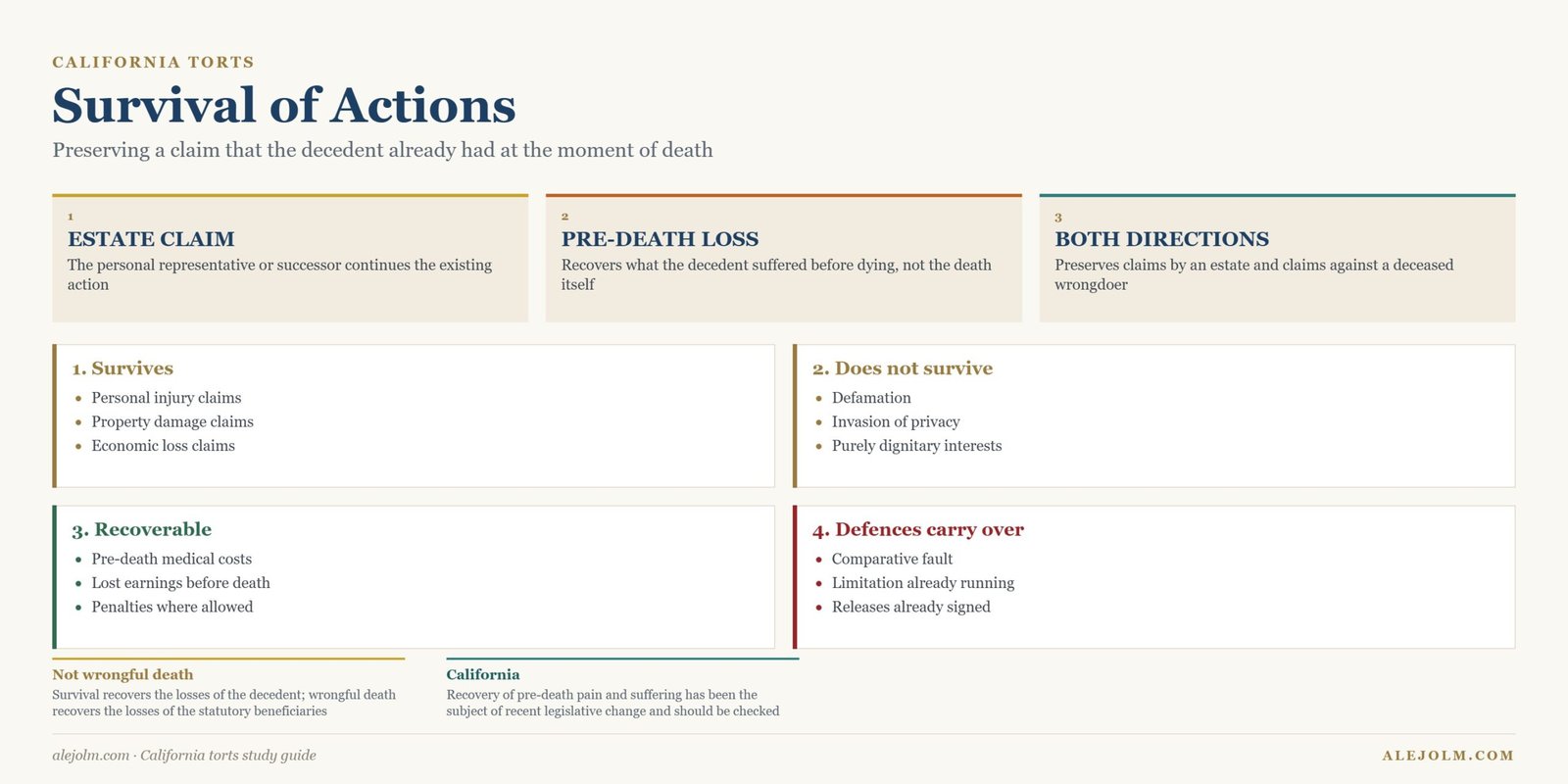
The survival action carries forward a right the decedent already held. Every element of the underlying tort must have accrued before death. If a person was injured by careless driving and survived for three days, the estate recovers the medical costs and losses incurred during those three days. It recovers nothing for the death itself, because that loss belongs to the wrongful death beneficiaries.
Because the claim is a continuation, it carries all the history of the decedent with it. Comparative fault attributable to the decedent still reduces the recovery, a limitation period that had already begun to run continues, and any release or settlement the decedent had signed remains binding.
Which claims survive
The traditional division turns on the interest protected. Claims for personal injury survive. Claims for damage to property survive. Claims protecting purely intangible personal interests generally do not, because the injury is bound up with the dignity of a living person.
- Personal injury — survives to the estate in full.
- Property damage — survives on ordinary principles.
- Economic torts — generally survive where the loss is financial.
- Defamation — traditionally does not survive.
- Invasion of privacy — traditionally does not survive.
- Mixed incidents — only the surviving components pass to the estate.
A fact pattern that combines a physical injury with a reputational one arising from the same events is testing exactly this line. The physical injury claim passes to the estate while the dignitary claim does not.
| Feature | Survival action | Wrongful death action |
|---|---|---|
| Who brings it | Personal representative or successor | Statutory beneficiaries |
| Whose losses | The decedent own losses before death | The losses of the survivors |
| Typical recovery | Medical costs and lost earnings before death | Loss of support, services and companionship |
| Relationship | Independent and additive | Independent and additive |
Both directions
Survival statutes operate in both directions. They preserve the claims of a deceased claimant against a living defendant, and they preserve claims against the estate of a deceased wrongdoer. A driver who causes a collision and then dies before proceedings begin can still be sued through the estate, subject to the procedural requirements for claims against estates.
A worked example
A pedestrian in Los Angeles is struck by a vehicle, spends two weeks in hospital and then dies of the injuries. The estate brings a survival action recovering the medical expenses and the earnings lost during those two weeks. The spouse and children separately bring a wrongful death claim for their own losses of support and companionship. The two claims are additive and are usually filed together.
Change the tort. Suppose the decedent had also been pursuing a defamation claim against a former colleague when the collision occurred. The personal injury claim passes to the estate, but the defamation claim traditionally does not survive, because the reputational interest is regarded as personal to the living claimant.
Survival of actions in California and Los Angeles County in 2026
California addresses the subject in the Code of Civil Procedure, which provides that a cause of action for or against a person is not lost by death and may be continued by or against the personal representative or successor in interest. The statute also governs what damages the estate may recover, and California historically excluded pre-death pain and suffering from a survival recovery.
That exclusion has been the subject of recent legislative change, with provisions allowing recovery of pre-death pain, suffering and disfigurement in defined circumstances and for defined periods, together with reporting requirements on such awards. Because the position has moved and includes dated provisions, it should be checked against the current statute rather than assumed.
- Statutory basis — the Code of Civil Procedure preserves causes of action on death.
- Who may sue — the personal representative or the successor in interest, with a supporting declaration.
- Damages measure — the statute defines what the estate may recover.
- Pain and suffering — subject to recent legislative change and dated provisions.
- Punitive damages — recoverable in a survival action where the underlying conduct supports them.
- Claims against estates — separate probate procedures apply to defendants who have died.
For 2026, confirm the current California authority on survival damages, pre-death pain and suffering and claims against estates directly with current authority, since these continue to develop.
Common mistakes to avoid
- Claiming for the death itself — that loss belongs to the wrongful death beneficiaries.
- Assuming all torts survive — defamation and privacy claims traditionally do not.
- Treating it as a fresh claim — the decedent defences and limitation history carry over.
- Forgetting the reverse direction — claims against a deceased wrongdoer are also preserved.
- Merging it with wrongful death — different claimants and different recoverable losses.
- Assuming the old damages rule — California provisions on pre-death pain and suffering have changed.
Frequently asked questions
Who brings a survival action in California?
The personal representative of the estate, or where no administration is pending, the successor in interest supported by the declaration the statute requires. The claimant is the estate rather than the family members individually.
Can the estate recover for pain and suffering?
California historically excluded pre-death pain and suffering from survival recoveries, and recent legislation has changed that position for defined periods and circumstances. Because the provisions include dates and conditions, the current statute should be checked directly.
Does a defamation claim survive death?
Traditionally no. The interest protected is reputation and personal dignity, which is regarded as belonging to the living person, so the claim generally does not pass to the estate.
Can a claim be brought against someone who has died?
Yes. Survival statutes preserve claims against the estate of a deceased wrongdoer, although the probate procedures for presenting claims against an estate must be observed alongside the ordinary limitation rules.
Are survival and wrongful death claims filed together?
Usually. They arise from the same death but belong to different claimants and cover different losses, so they are commonly pleaded in one action with the estate and the statutory beneficiaries appearing separately.
Related guides
- Wrongful Death
- Damages in Negligence
- Elements of Negligence
- Defamation
- Invasion of Privacy
- Statute of Limitations
- Joint Tortfeasors
- Comparative Negligence
Next steps
Read this with wrongful death to see how the two claims divide the losses, and then damages in negligence for the measures that apply to the surviving claim.
For primary sources, read California Code of Civil Procedure section 377.34 and the civil jury instructions published by the Judicial Council of California.