
Dram shop liability describes the responsibility of an alcohol server for harm later caused by the person served. Many states have enacted statutes imposing it on commercial providers, and a minority extend a narrower duty to private hosts. California went the other way, and understanding that reversal is essential to any claim arising in the state.
California legislatively restored near total immunity after its own courts had briefly recognised broader server liability. The statutes declare that the consumption of alcohol, rather than its furnishing, is the proximate cause of resulting injury. One narrow exception survives. This guide sets out the framework, the exception and the reasoning behind it.
The common law starting point
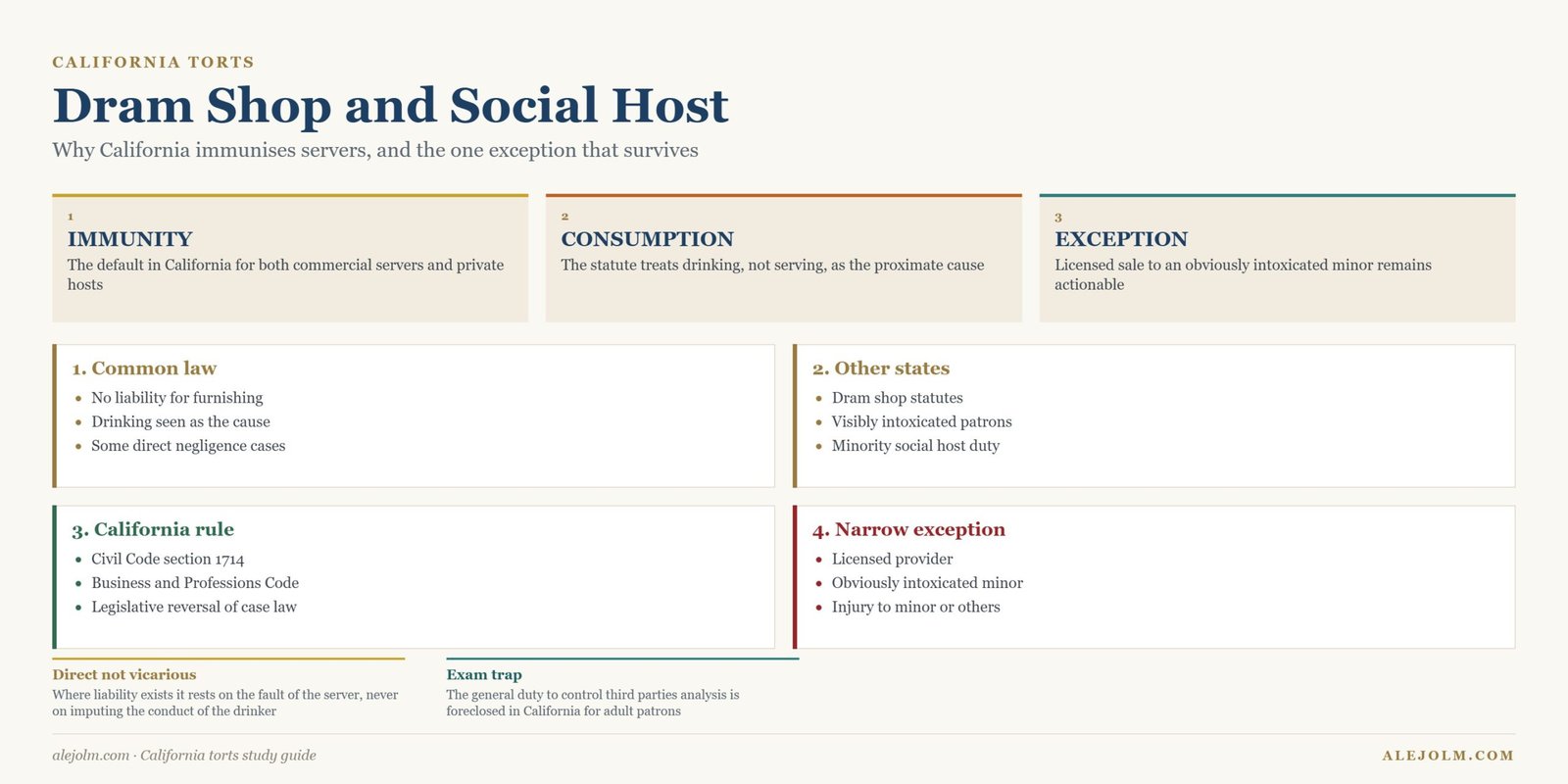
At common law there was no liability for serving alcohol. The reasoning was causal: the person who chose to drink and then to drive made the decision that produced the harm, and the act of pouring a drink was treated as too remote. Some courts nonetheless found direct negligence where a server supplied someone visibly intoxicated or a minor.
The modern position elsewhere
Most states have now enacted dram shop statutes making commercial establishments answerable where they sell to a visibly intoxicated person or a minor who subsequently injures someone. Social host liability is far more fragmented. A meaningful minority of states extend a duty to private hosts, usually where the guest was a minor or was obviously intoxicated and known to be about to drive, while the majority decline to do so absent a commercial relationship.
The California rule
California is the significant outlier and the most common source of error. Civil Code section 1714 and the Business and Professions Code together immunise both social hosts and commercial servers from civil liability for furnishing alcohol to an adult. The immunity applies even where the server knew the patron was obviously intoxicated and would shortly drive, because the statute fixes the proximate cause on the consumption rather than on the service.
That position was reached deliberately. California courts had recognised broader liability in a line of decisions, and the Legislature responded by abrogating them and restating the causal rule in statute. Any analysis that reaches for a general duty to control third parties in a California adult patron case has missed that the question has already been answered.
| Scenario | California outcome | Basis |
|---|---|---|
| Bar serves an obviously intoxicated adult | No civil liability | Statutory immunity |
| Private host serves an intoxicated adult guest | No civil liability | Statutory immunity |
| Licensed provider sells to an obviously intoxicated minor | Liability available | Statutory exception |
| Injury caused by the drinker | Full liability of the drinker | Ordinary negligence |
The surviving exception
The statutes preserve a claim where a person licensed to sell alcohol sells or furnishes it to an obviously intoxicated minor, and that furnishing is the proximate cause of injury to the minor or to a third party. The exception is confined to licensed providers, and the conditions are cumulative: the person served must be a minor and must be obviously intoxicated at the time.
- Licensed provider — the exception applies to those licensed to sell, not to private hosts in the same terms.
- Minor — the person served must be under the legal drinking age.
- Obvious intoxication — visible signs at the time of service are required.
- Proximate cause — the sale must be causally connected to the injury.
- Any victim — the minor or a third party may claim.
- Narrow reading — courts have applied the conditions strictly.
Direct, not vicarious
Where liability exists, whether under a dram shop statute elsewhere or under the California exception, it rests on the fault of the server. Nothing is imputed from the conduct of the intoxicated person. That distinguishes the theory from negligent entrustment, which requires handing over a specific chattel, and from respondeat superior, which requires an employment relationship.
A worked example
A restaurant in Los Angeles continues to serve an adult customer who is plainly drunk. He drives home and injures a pedestrian. The pedestrian has a straightforward claim against the driver, but none against the restaurant. The statutory immunity applies regardless of how obvious the intoxication was, because the customer was an adult.
Change the age. Suppose the customer was under the legal drinking age and was obviously intoxicated when served by the licensed premises. Now the statutory exception is engaged, and the pedestrian and the minor alike may pursue the provider, subject to proving that the sale was a proximate cause of the collision.
Dram shop and social host liability in California and Los Angeles County in 2026
The controlling provisions sit in Civil Code section 1714 and in the Business and Professions Code, which together declare the immunity and set out the exception for licensed sales to obviously intoxicated minors. California has also legislated separately in relation to adults who knowingly furnish alcohol at a residence to a minor, which is an area worth checking carefully because the provisions and the case law differ from the commercial rule.
In Los Angeles County the practical result is that claims arising from alcohol related collisions concentrate on the driver, on any employer where the driving was work related, and on insurance coverage, rather than on the venue that served the drinks.
- Statutory immunity — furnishing alcohol to an adult is not a basis for civil liability.
- Causal declaration — the statutes fix proximate cause on consumption.
- Licensed minor exception — the one route that survives for commercial providers.
- Residential provisions — separate rules address adults furnishing alcohol to minors at a home.
- Regulatory consequences — licensing sanctions are distinct from civil liability.
- Focus on the driver — ordinary negligence and vehicle owner statutes carry most claims.
For 2026, confirm the current California authority on the statutory immunity, the minor exception and the residential provisions directly with current authority, since these continue to develop.
Common mistakes to avoid
- Assuming the modern trend applies — California immunises servers rather than following the dram shop pattern.
- Missing the minor exception — a licensed sale to an obviously intoxicated minor remains actionable.
- Treating the liability as vicarious — where it exists it rests on the fault of the server.
- Applying a duty to control analysis — the statute forecloses it for adult patrons in California.
- Merging commercial and social host rules — the provisions and case law differ.
- Ignoring regulatory exposure — licensing consequences can follow even where civil liability does not.
Frequently asked questions
Can a California bar be sued for over serving an adult?
Generally no. Civil Code section 1714 and the Business and Professions Code immunise licensed servers and social hosts from civil liability for furnishing alcohol to an adult, treating consumption rather than service as the proximate cause of any resulting injury.
What is the exception for minors?
A person licensed to sell alcohol who sells or furnishes it to an obviously intoxicated minor can be liable where that furnishing is a proximate cause of injury to the minor or to a third party. Both the age and the obvious intoxication must be established.
Are private hosts treated the same as bars?
For adult guests, yes, both are immunised. California has separate provisions dealing with adults who knowingly furnish alcohol at a residence to a minor, and those should be checked directly because they differ from the commercial rule.
Why did California adopt immunity?
The Legislature responded to decisions that had recognised broader server liability by restating the causal principle in statute. The policy judgement was that responsibility should rest with the person who chose to drink and then to act dangerously.
Who can be sued after an alcohol related collision?
The driver is the primary defendant, and any employer may be exposed where the driving was work related. Vehicle owner provisions can add a capped claim against an owner who permitted the use, and negligent entrustment may apply where keys were handed to a person known to be unfit.
Related guides
- Duty to Control Third Parties
- Negligent Entrustment
- Duty of Care
- Proximate Cause
- Superseding Cause
- Elements of Negligence
- Comparative Negligence
- Wrongful Death
Next steps
Read this with duty to control third parties for the framework the statute displaces, and then negligent entrustment for the enabling theory that does survive in California.
For primary sources, read California Business and Professions Code section 25602 and the civil jury instructions published by the Judicial Council of California.