
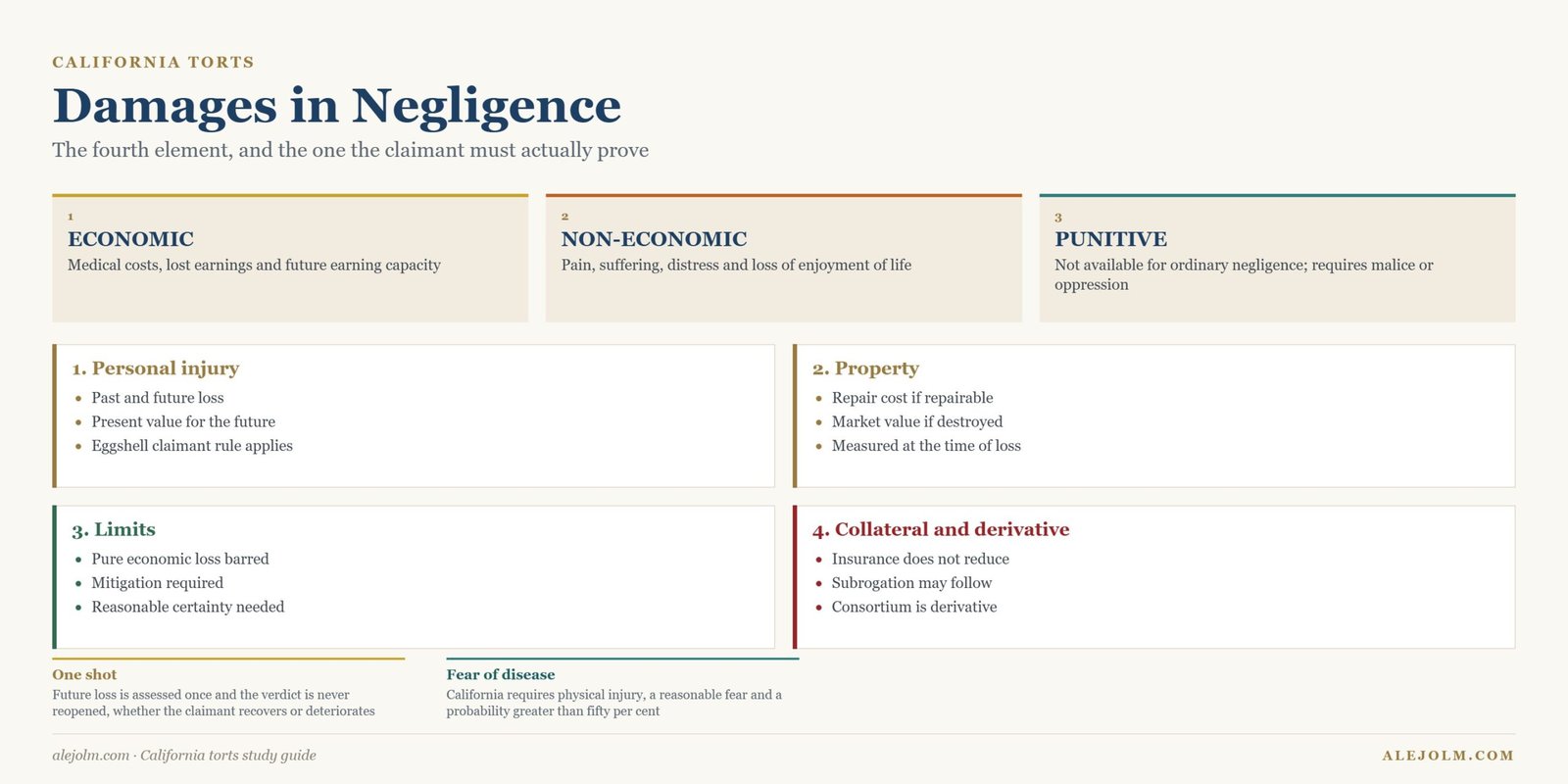
Damages in negligence form the fourth element of the claim and the one that carries a real evidentiary burden after liability is established. Harm is never presumed. The claimant must prove actual loss with reasonable certainty, and the guiding principle is restorative rather than punitive: to place the injured person, so far as money can, in the position they would have occupied had the wrong not occurred.
California layers a number of specific rules on top of that principle, including a statutory test for punitive awards, its own approach to fear of future disease, and a collateral source rule that has been modified in the medical context. This guide sets out the categories of recoverable loss, the significant limits, and how each plays out in a Los Angeles County claim.
Personal injury losses
A claimant recovers past, present and prospective economic losses, including medical expenses, lost earnings and diminished future earning capacity. Non-economic losses cover pain and suffering, emotional distress flowing from the injury and loss of enjoyment of life. The eggshell claimant rule applies to the extent of those losses, so a defendant takes the claimant as found and answers for the full consequences of the injury even where an unusual vulnerability made them severe.
The one shot rule
Future losses are assessed once, at judgment, using a present value estimate. The award is not revisited afterwards. If the claimant later dies of unrelated causes the defendant recovers nothing back, and if the injury worsens the claimant cannot return for more. That finality is what makes accurate expert projection so important.
Property losses
Where property is damaged but repairable, the measure is the reasonable cost of repair. Where it is destroyed or beyond economic repair, the measure is fair market value at the time of the accident. Loss of use may be recoverable in addition, but the two principal measures are not combined to produce more than the property was worth.
Punitive damages
Punitive damages are unavailable for ordinary negligence. California requires clear and convincing proof of oppression, fraud or malice, which in practice means conduct that was despicable, wilful or in conscious disregard of the rights and safety of others. A fact pattern that describes conduct only as negligent has signalled that punitive damages are off the table.
Constitutional limits also apply. The federal due process cases establish that ratios of punitive to compensatory damages in the single digits will generally be acceptable while very high ratios are presumptively unconstitutional, and courts assess reprehensibility, the ratio and comparable civil penalties.
| Category | Measure | Proof required | California note |
|---|---|---|---|
| Economic loss | Actual pecuniary loss, past and future | Reasonable certainty | Future loss reduced to present value |
| Non-economic loss | Jury assessment | Injury and its effects | Statutory caps apply in medical claims |
| Property damage | Repair cost or market value | Valuation evidence | Measured at the time of loss |
| Punitive | Jury discretion within limits | Clear and convincing malice | Civil Code section 3294 governs |
Limits on recovery
Pure economic loss
Financial harm unaccompanied by physical injury to person or property is generally not recoverable in negligence. A business that loses trade because a road was blocked has no claim. Two routes around the rule exist: where the claimant also suffered physical harm in the same event, and where a special relationship such as accountant and client or solicitor and client supports a duty extending to purely economic loss.
Fear of future disease
California addressed this in Potter v Firestone Tire and Rubber. Recovery for fear of contracting a disease after a toxic exposure generally requires that the claimant suffered a physical injury from the exposure, that the fear is reasonable, and that it is more likely than not that the disease will actually develop.
Mitigation
A claimant must take reasonable steps to limit the loss, and a failure to do so reduces recovery for the avoidable portion. The law nevertheless respects bodily autonomy. Declining a minor and low risk treatment may reduce damages, while declining surgery is generally treated as reasonable and does not.
The collateral source rule
Payments from a collateral source such as health insurance or disability cover do not reduce what the tortfeasor must pay. The insurer may instead have subrogation rights against the recovery. California has qualified the rule in the medical context, limiting recovery of past medical expenses to amounts actually paid or incurred rather than the sums originally billed.
Loss of consortium
Loss of consortium is a separate but derivative claim, usually by a spouse, for the loss of household services, companionship and the marital relationship caused by the injury to the primary victim. Because it is derivative, it is reduced or defeated by the comparative fault of the injured person, and it is available across torts rather than only in negligence.
A worked example
A cyclist in Los Angeles is struck by a driver who ran a red light and suffers a fractured hip. She recovers medical expenses actually paid or incurred, earnings lost during recovery, the reduction in her future earning capacity, and non-economic damages for pain and loss of enjoyment. Her health insurer paid most of the treatment, which does not reduce the award against the driver but may give the insurer a right of recoupment.
Change the conduct. Suppose the driver had been racing at high speed through a busy intersection with conscious disregard for the danger. That conduct may support a punitive award under the California statute, which requires clear and convincing proof of malice, and the award would then be tested against the constitutional guideposts on reprehensibility and ratio.
Damages in negligence in California and Los Angeles County in 2026
California addresses punitive damages in Civil Code section 3294 and requires clear and convincing evidence of oppression, fraud or malice. Medical negligence claims are subject to their own statutory scheme, including a cap on non-economic damages that has been placed on a scheduled series of annual increases following legislative reform, with separate figures for wrongful death claims.
California also allocates non-economic damages several rather than jointly among defendants, so each defendant pays only its own share of that component while remaining jointly liable for economic loss.
- Punitive standard — Civil Code section 3294 requires clear and convincing proof of oppression, fraud or malice.
- Medical caps — non-economic damages in medical negligence claims are capped and adjusted annually.
- Several liability — non-economic damages are apportioned by fault among defendants.
- Medical expense measure — recovery of past medical costs is tied to amounts paid or incurred.
- Present value — future losses are discounted, with expert economic evidence in most substantial claims.
- Comparative fault — pure comparative negligence reduces the award in proportion to the claimant own responsibility.
For 2026, confirm the current California authority on punitive damage standards, medical damage caps and the collateral source rule directly with current authority, since these continue to develop.
Common mistakes to avoid
- Claiming speculative loss — damages must be proved with reasonable certainty rather than estimated loosely.
- Seeking punitive damages for negligence — California requires clear and convincing proof of malice, oppression or fraud.
- Ignoring mitigation — avoidable losses are not recoverable, subject to respect for bodily autonomy.
- Deducting insurance payments — the collateral source rule prevents that, though California qualifies it for medical expenses.
- Pursuing pure economic loss — without physical harm or a special relationship there is generally no claim.
- Forgetting consortium is derivative — the fault of the primary victim reduces or defeats it.
Frequently asked questions
Are punitive damages available in a California negligence case?
Not for ordinary negligence. Civil Code section 3294 requires clear and convincing evidence of oppression, fraud or malice, which describes conduct well beyond carelessness, such as a conscious disregard of the safety of others.
Does health insurance reduce what a defendant pays?
Generally no, because of the collateral source rule. California has narrowed this for past medical expenses, limiting recovery to amounts actually paid or incurred, and the insurer may have subrogation rights against the recovery.
Can a claim be reopened if the injury gets worse?
No. Future losses are assessed once at judgment on a present value basis, and the verdict is final. That is why careful expert projection of future care and earnings is central to any serious claim.
Is pure financial loss recoverable in negligence?
Usually not. Financial harm without accompanying physical injury to person or property falls outside the ordinary negligence claim, unless the claimant was also physically harmed in the same event or a special relationship supports a duty covering economic loss.
Who can bring a loss of consortium claim?
Principally a spouse, for the loss of services, companionship and the marital relationship following injury to the primary victim. The claim is derivative, so any comparative fault attributed to that victim reduces it proportionately.
Related guides
- Elements of Negligence
- Eggshell Plaintiff
- Wrongful Death
- Survival of Actions
- Comparative Negligence
- Negligent Infliction of Emotional Distress
- Actual Cause
- Proximate Cause
Next steps
Read this with elements of negligence to see where damages fit in the claim, and then eggshell plaintiff for the rule that governs their extent.
For primary sources, read California Civil Code section 3294 and the civil jury instructions published by the Judicial Council of California.