
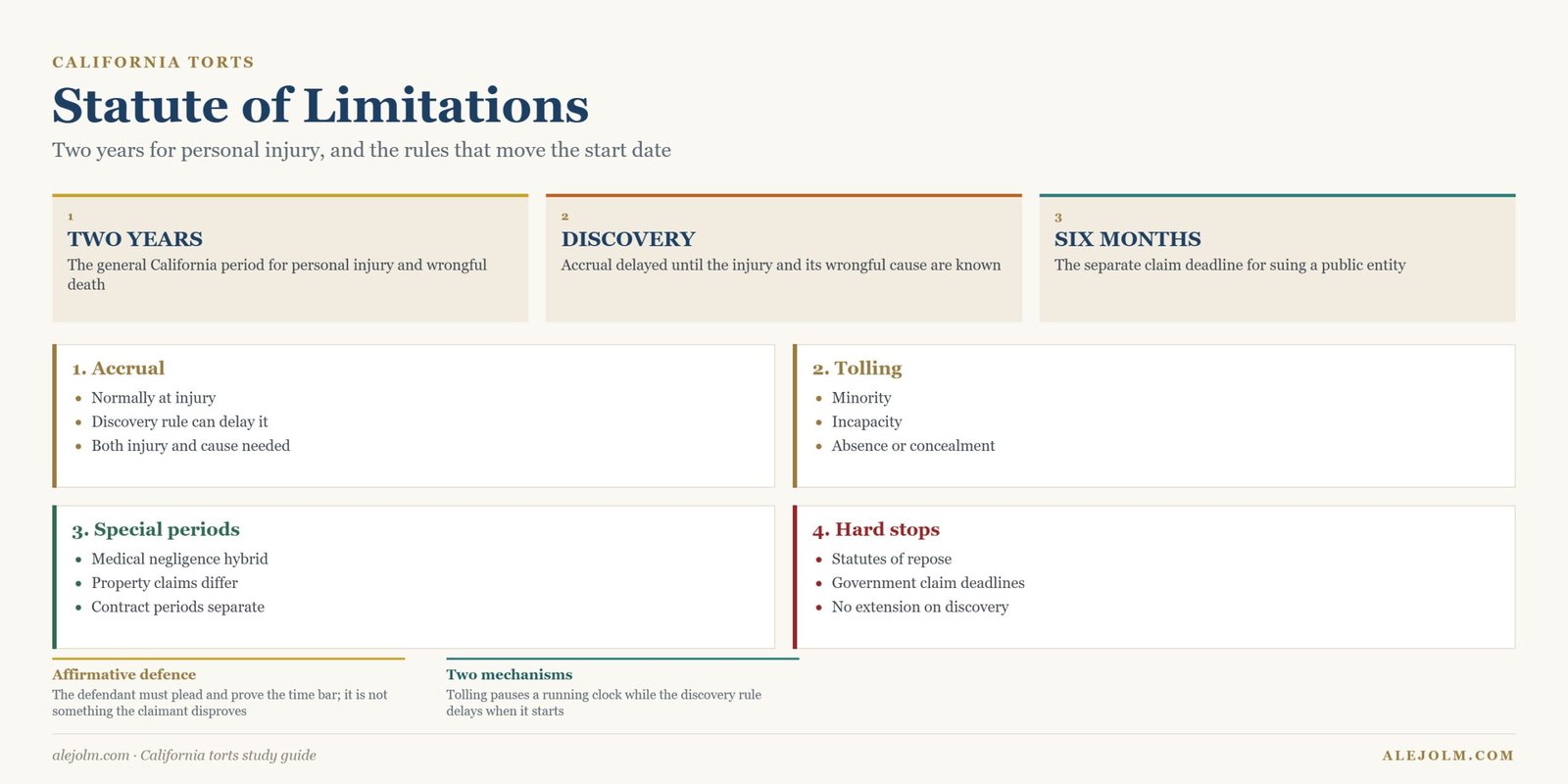
Statute of limitations is the deadline that ends a claim regardless of its merits. It is one of the principal defences to a tort action, alongside claimant fault and assumption of risk, and it is an affirmative defence that the defendant must plead and prove.
California applies a two year period to most personal injury claims, but that headline figure hides a great deal. The discovery rule can move the start date, tolling can pause the clock, medical negligence has its own hybrid period, and any claim against a public entity carries a much shorter and independently fatal deadline. This guide sets out each of those layers.
When the clock starts
The ordinary rule is that a cause of action accrues when the injury occurs, and the period runs from that moment. That works well for a collision or an assault, where the harm is immediate and obvious, and it works poorly for harm that is hidden.
The discovery rule
Where the injury is not reasonably discoverable, accrual is delayed until the claimant discovers, or through reasonable diligence should have discovered, both the injury and its wrongful cause. Both limbs matter. Knowing that something is wrong is not enough if there is no reason to connect it to anyone conduct, and suspecting a cause is not enough without an injury.
The classic applications are latent disease following exposure and undiscovered professional error, such as a retained surgical item found years later. The rule asks what a reasonably diligent person in the position of the claimant would have known and when, not what this particular claimant happened to realise.
Tolling is different
Tolling pauses a clock that has already started. Minority, incapacity, absence of the defendant from the jurisdiction and fraudulent concealment can each suspend the running of the period. It is a distinct mechanism from the discovery rule, and both can appear in the same case, so they should be analysed separately rather than merged.
| Mechanism | Effect | Typical trigger | Applies to |
|---|---|---|---|
| Discovery rule | Delays accrual | Hidden injury or hidden cause | Latent harm cases |
| Tolling | Pauses a running clock | Minority, incapacity, concealment | Many claims |
| Statute of repose | Absolute outer limit | Time from a defined event | Construction and similar claims |
| Claim presentation | Separate prerequisite | Claim against a public entity | Public defendants |
Statutes of repose
A statute of repose is an absolute outer boundary measured from a fixed event rather than from injury or discovery. Because it is not a limitation period in the ordinary sense, the discovery rule does not extend it. A claim can therefore be barred by repose even though the claimant could not possibly have known of the harm within the period.
California periods
California applies a general two year period to actions for assault, battery and other injury to or death of an individual caused by the wrongful act or neglect of another. Property damage claims carry their own period, and contract based theories such as warranty claims run on a different schedule that usually begins at delivery rather than at injury.
Medical negligence has a hybrid rule. The action must be brought within three years of the date of injury or one year after the claimant discovers, or through reasonable diligence should have discovered, the injury, whichever occurs first, subject to defined extensions for fraud, concealment and foreign bodies.
Claims against public entities
A claim against a California public entity carries a separate and much shorter requirement. A written claim relating to death, injury to the person or injury to personal property must be presented within six months of accrual, with a longer period for most other claims. That deadline runs independently and usually expires long before the general limitation period, and a failure to comply bars the action entirely.
A worked example
A pedestrian in Los Angeles is injured by a driver in March. The injury and its cause are obvious immediately, so accrual occurs at once and the general two year period applies. Nothing delays the start date and no claim presentation requirement arises, because the defendant is a private individual.
Change the defendant. Suppose the same collision involved a vehicle operated by a public agency. The two year period still applies to the eventual lawsuit, but a written claim must be presented to the entity within six months. A claimant who waits a year, comfortable that the limitation period has not run, will find the action barred by the earlier requirement.
Limitation periods in California and Los Angeles County in 2026
The general personal injury period sits in the Code of Civil Procedure, with medical negligence, professional negligence, defamation and property claims each carrying their own provisions. Los Angeles County practice adds no separate deadline, but the number of public entities involved in transport, education and healthcare means the claim presentation requirement arises frequently and is easily missed.
- Two year general period — for personal injury and wrongful death claims.
- Discovery rule — delays accrual until injury and wrongful cause are known or knowable.
- Medical negligence — three years from injury or one year from discovery, whichever is first.
- Defamation — a shorter period applies to libel and slander claims.
- Public entities — six months to present a written claim for personal injury.
- Tolling — minority, incapacity and concealment can suspend the running of time.
For 2026, confirm the current California authority on limitation periods, the discovery rule and claim presentation deadlines directly with current authority, since these continue to develop.
Common mistakes to avoid
- Assuming one period fits all — California applies different periods to different claims.
- Applying only half the discovery test — both the injury and its wrongful cause must be known or knowable.
- Confusing tolling with discovery — one pauses a running clock, the other delays the start.
- Treating repose like limitation — a repose period is not extended by later discovery.
- Missing the government deadline — six months is independently fatal and runs first.
- Forgetting it is a defence — the defendant must plead and prove the bar.
Frequently asked questions
How long do I have to bring a personal injury claim in California?
Generally two years from accrual under the Code of Civil Procedure. The date of accrual can be later than the date of the incident where the discovery rule applies, and shorter deadlines apply where a public entity is involved.
What is the discovery rule?
A rule delaying accrual until the claimant discovers, or through reasonable diligence should have discovered, both the injury and the fact that it was wrongfully caused. It applies where the harm or its cause could not reasonably have been identified earlier.
Is medical negligence treated differently?
Yes. California applies a hybrid period of three years from the date of injury or one year from discovery, whichever occurs first, with defined extensions for fraud, intentional concealment and the presence of a foreign body.
What happens if I miss the government claim deadline?
The action is barred unless an application for leave to present a late claim succeeds. The requirement runs on its own schedule and expires well before the general limitation period, so it must be dealt with immediately.
Can the period be paused?
Yes, through tolling. Minority, legal incapacity, absence of the defendant from the state and fraudulent concealment can each suspend the running of time, and more than one mechanism may apply on the same facts.
Related guides
- Governmental Immunity
- Elements of Negligence
- Comparative Negligence
- Assumption of Risk
- Survival of Actions
- Wrongful Death
- Damages in Negligence
- Fraud
Next steps
Read this with governmental immunity because the claim presentation deadline usually controls the timetable, and then elements of negligence for the claim the defence is layered on to.
For primary sources, read California Code of Civil Procedure section 335.1 and the civil jury instructions published by the Judicial Council of California.