
Marbury v. Madison is the case that made constitutional law enforceable. Decided in 1803, it established that courts may measure a statute against the Constitution and refuse to apply it, and that Congress cannot rewrite the Supreme Court’s original jurisdiction by ordinary legislation. Nothing in Article III says so expressly, which is precisely why the reasoning matters.
This guide explains the three holdings, the textual route to judicial review, the crucial difference between original and appellate jurisdiction, and the mistakes that turn an easy Marbury question into a lost one.
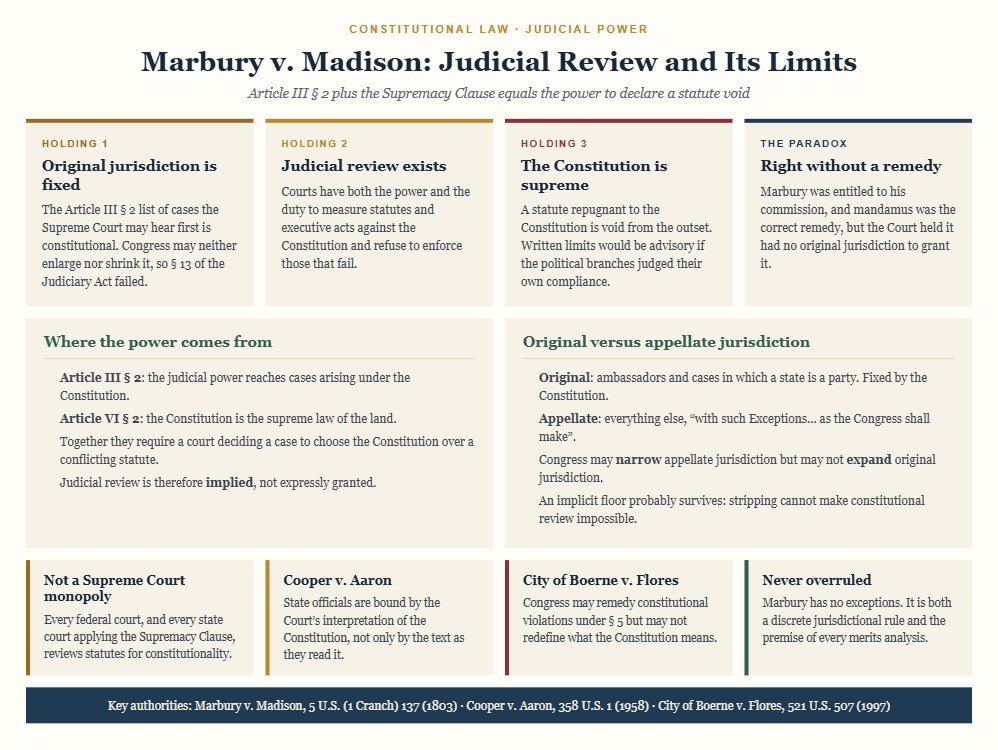
The dispute in one paragraph
William Marbury had been appointed a justice of the peace in the closing hours of the Adams administration. His commission was signed and sealed but never delivered, and the incoming Secretary of State, James Madison, refused to hand it over. Marbury went straight to the Supreme Court and asked for a writ of mandamus under section 13 of the Judiciary Act of 1789, which purported to give the Court original jurisdiction to issue such writs.
Chief Justice Marshall answered three questions in order: did Marbury have a right to the commission, did the law give him a remedy, and could this Court supply it. Yes, yes, and no. The third answer is where the constitutional law lives.
The three holdings
Congress cannot expand original jurisdiction
Article III § 2 lists the cases the Supreme Court may hear in the first instance: those affecting ambassadors and other public ministers, and those in which a state is a party. Marshall read that list as constitutionally fixed. Because section 13 purported to add mandamus actions to it, the statute was unconstitutional as applied and could not support the Court’s jurisdiction.
Courts have the power and the duty of judicial review
Deciding the jurisdictional question required the Court to choose between a statute and the Constitution. Marshall reasoned that a court faced with that conflict must apply the superior law, and that saying what the law is falls within the judicial function. Judicial review was thus presented not as a novel power grab but as an unavoidable consequence of deciding cases.
A repugnant statute is void
If a law contrary to the Constitution could nonetheless be enforced, the written limits on government would be advice rather than law. The Constitution binds the legislature, and a statute that exceeds those bounds has no legal effect at all.
The textual basis you must cite
Judicial review is inferred from two provisions read together. Article III § 2 extends the judicial power to cases arising under the Constitution, which puts constitutional questions squarely within the judicial function. Article VI § 2 makes the Constitution the supreme law of the land. A court resolving a conflict between the two sources therefore has no choice: the Constitution prevails and the statute yields.
Answers that assert judicial review without naming those two clauses read as conclusory. Name them, then apply them.
Original jurisdiction is fixed; appellate jurisdiction is not
This is the distinction examiners test most often. Marbury protects original jurisdiction from congressional enlargement. It says nothing against congressional control of appellate jurisdiction, which Article III § 2 expressly subjects to “such Exceptions, and under such Regulations as the Congress shall make”.
| Congressional action | Target | Constitutional? |
|---|---|---|
| Adding a category of case to the Supreme Court’s original docket | Original jurisdiction | No. The Article III list is fixed — the Marbury holding |
| Removing a category from the original docket | Original jurisdiction | No. Congress may neither enlarge nor contract the list |
| Narrowing appellate review of a class of cases | Appellate jurisdiction | Generally yes, under the Exceptions Clause |
| Eliminating all review of an entire constitutional question | Appellate jurisdiction | Doubtful. Marbury’s premise implies a floor |
Exam tip: when a statute gives the Supreme Court power to hear something first, the answer is Marbury and the statute fails. When a statute takes appellate review away, switch frameworks to the Exceptions Clause before concluding.
Why the Court gave up jurisdiction to gain power
The political genius of the opinion is that the Court ruled against the litigant it sympathised with. Ordering Madison to deliver the commission risked open defiance from an administration hostile to the federal bench. By holding that it lacked jurisdiction, the Court avoided a confrontation it could not win while asserting a power it has exercised ever since.
The contrast with Chisholm v. Georgia ten years earlier is instructive. There the Court asserted broad jurisdiction over a state and provoked a constitutional amendment in response. Marbury took the opposite route and kept the doctrine.
Judicial review is not a Supreme Court monopoly
Every federal court passes on the constitutionality of the statutes it applies, and state courts do the same under the Supremacy Clause. What is distinctive about the Supreme Court is finality, not the existence of the power.
That finality has consequences for other actors. Cooper v. Aaron held that state officials are bound by the Court’s interpretation of the Constitution and cannot substitute their own reading. City of Boerne v. Flores applied the same premise to Congress: the § 5 enforcement power allows remedial legislation but not redefinition of the underlying right.
Two worked hypotheticals
First, a statute grants the Supreme Court original jurisdiction over all constitutional challenges to federal legislation, letting any citizen sue directly in that Court. Article III § 2 confines original jurisdiction to ambassador cases and cases where a state is a party. The statute adds a category. Under Marbury it is unconstitutional, and the reasoning takes three sentences.
Second, a statute declares that the Supreme Court shall have no appellate jurisdiction over challenges to federal environmental legislation. Now the Exceptions Clause governs, and Congress’s power is real. But if no court can review the statute for constitutionality, the supremacy premise that justifies judicial review starts to fail. The better answer is that a total withdrawal of review over a constitutional question exceeds the Exceptions Clause, while a narrower channelling of review does not.
Common mistakes that cost points
- Confusing original jurisdiction, which Congress cannot touch, with appellate jurisdiction, which the Exceptions Clause makes adjustable.
- Saying Congress has no power over the Supreme Court’s jurisdiction at all.
- Asserting judicial review without citing Article III § 2 and the Supremacy Clause.
- Treating judicial review as belonging to the Supreme Court alone.
- Forgetting that the Court held Marbury had a right and a remedy, and lost only on the forum.
- Assuming the Exceptions Clause is unlimited and that any jurisdiction-stripping statute is valid.
- Using Marbury as a general answer to standing or political question problems, which are separate doctrines.
Frequently asked questions
Did Marbury invent judicial review?
It was the first time the Supreme Court struck down an act of Congress, but the idea was already familiar from state practice and from the ratification debates. Marbury’s contribution was to fix the power in a holding that later courts could cite.
Could Congress abolish the Supreme Court’s appellate jurisdiction entirely?
The text of the Exceptions Clause is permissive, and Congress has narrowed appellate review before. A complete abolition is a different matter, because it would leave constitutional limits unenforceable and contradict the premise on which Marbury rests. The question has never been squarely resolved.
What is the difference between judicial review and judicial supremacy?
Judicial review is the power to decline to enforce an unconstitutional law in a case. Judicial supremacy is the stronger claim that the Court’s interpretation binds the other branches and the states, which is what Cooper v. Aaron asserts. Bar answers should keep the two labels distinct.
Judicial review in California: Auto Equity and county ordinances, 2026
Marbury v. Madison established that courts determine what the law is and may refuse to apply legislation repugnant to the Constitution. California courts exercise the same authority under article VI of the California Constitution, and they apply it to state statutes, county ordinances and administrative action alike. What differs is the internal hierarchy, and the California rule is stricter than most students expect.
In Auto Equity Sales v. Superior Court (1962) the California Supreme Court held that all superior courts are bound by every published decision of any California Court of Appeal, not merely the district in which they sit. A judge in the Los Angeles Superior Court must therefore follow a published opinion from any appellate district, and where districts conflict the trial court may choose between them. There is no California equivalent of the federal practice under which a district court follows only its own circuit.
How judicial review reaches county action:
- Ordinances are reviewed for conflict and authority. A Los Angeles County ordinance may be invalidated as preempted by state law or as exceeding the county’s charter powers.
- Quasi-legislative decisions get ordinary mandamus. Section 1085 of the California Code of Civil Procedure supplies the writ, and review asks whether the decision was arbitrary or beyond jurisdiction.
- Quasi-judicial decisions get administrative mandamus. Section 1094.5 applies where a hearing was required, with a different record and standard.
- Unpublished opinions cannot be cited. California prohibits citation of unpublished decisions except in narrow circumstances, unlike federal practice.
- Federal decisions are persuasive, not binding. Only United States Supreme Court holdings on federal questions bind California courts.
- Death penalty appeals go directly up. Automatic appeal to the California Supreme Court is a structural feature with no federal analogue.
For 2026, check whether any published appellate decision anywhere in California governs your point before assuming the question is open. Read with Supreme Court jurisdiction, the political question doctrine and standing.
Next steps
Marbury is best learned alongside the doctrines that decide whether a court will reach the merits at all. Pair it with the structural analysis in The Youngstown Framework: Presidential Power in 3 Zones, the tiers applied once a court does reach the merits in 3 Levels of Scrutiny in Constitutional Law Explained, and the answer discipline in The IRAC Method: How to Structure a Bar Exam Answer.
For primary sources, read Marbury v. Madison itself, then Cooper v. Aaron and City of Boerne v. Flores. Cornell’s note on judicial review is a useful one-page refresher.
Related guides
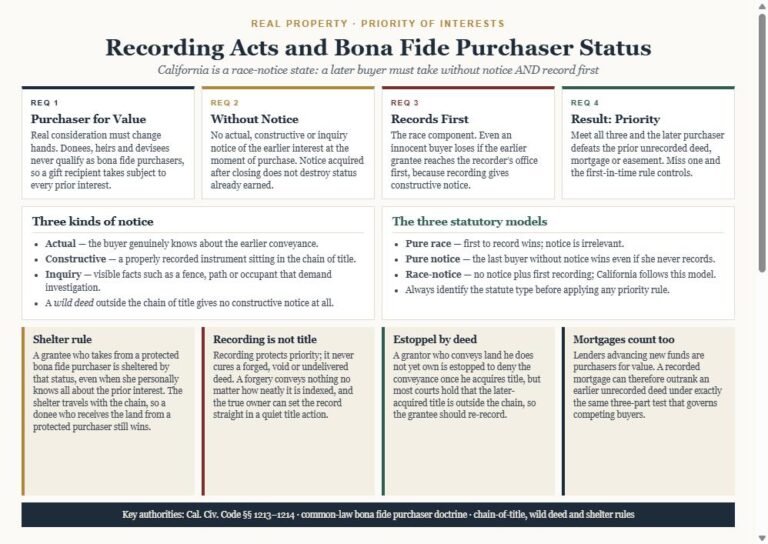 Recording Acts: Race, Notice and Race-Notice Explained
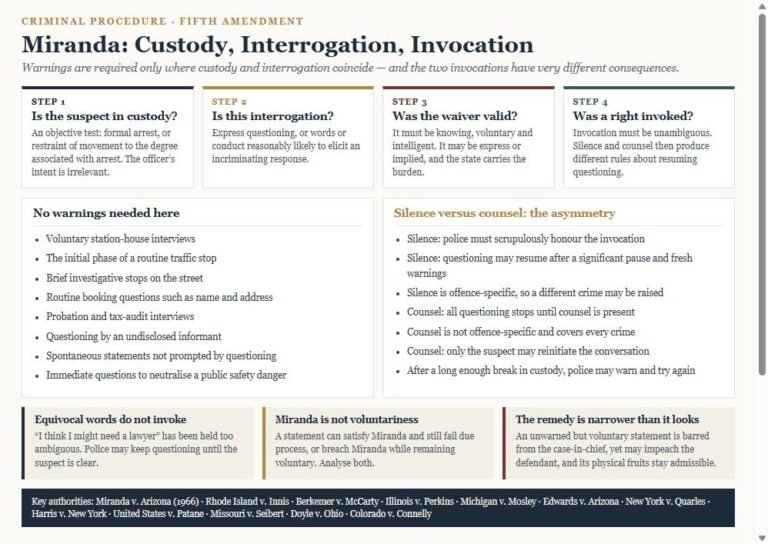 Miranda Rights: Custody, Interrogation and Invocation
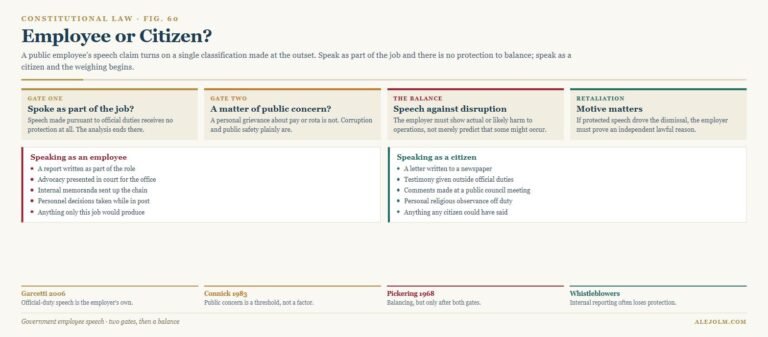 Government Employee Speech: Garcetti and Pickering Rules
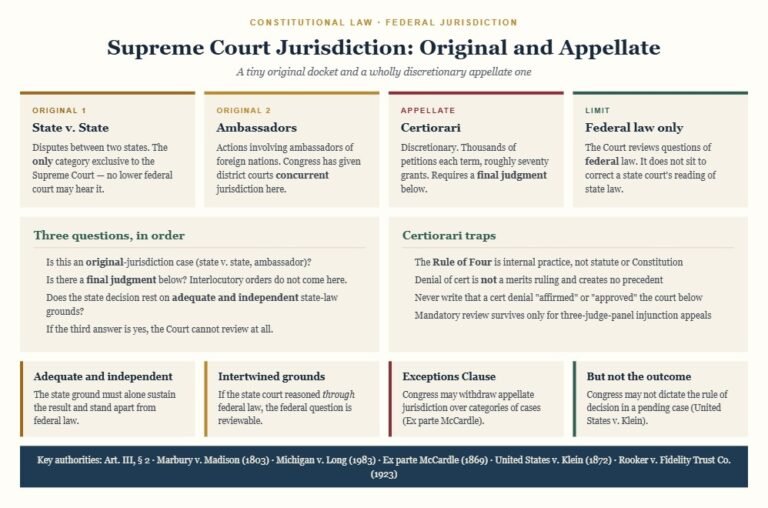 Supreme Court Jurisdiction: Original vs Appellate Power
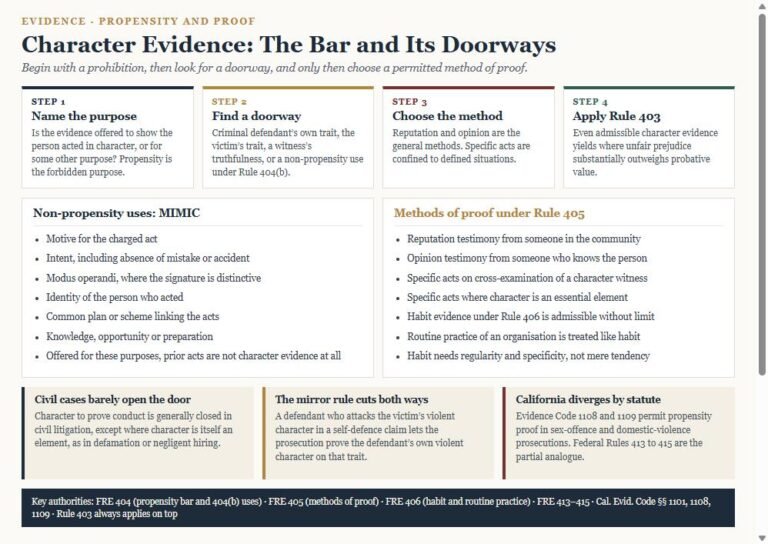 The Character Evidence Rules: Propensity Bar and Doorways
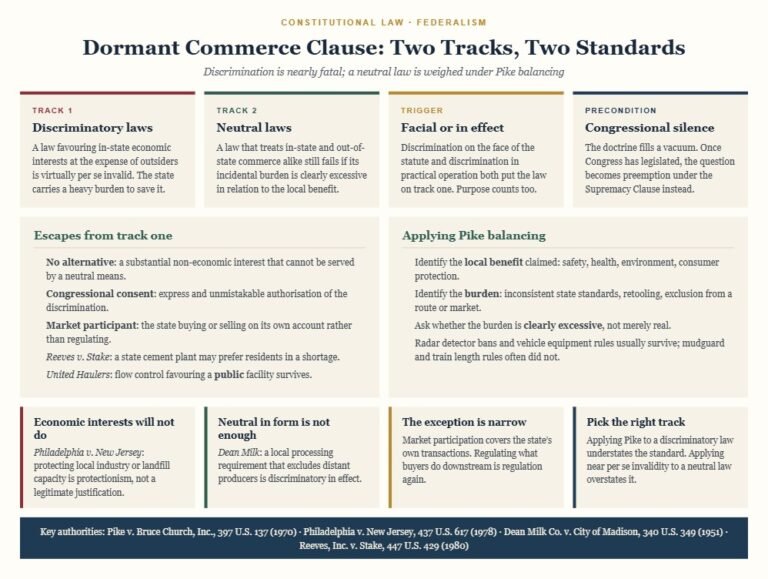 Dormant Commerce Clause: Discrimination vs Pike Balancing
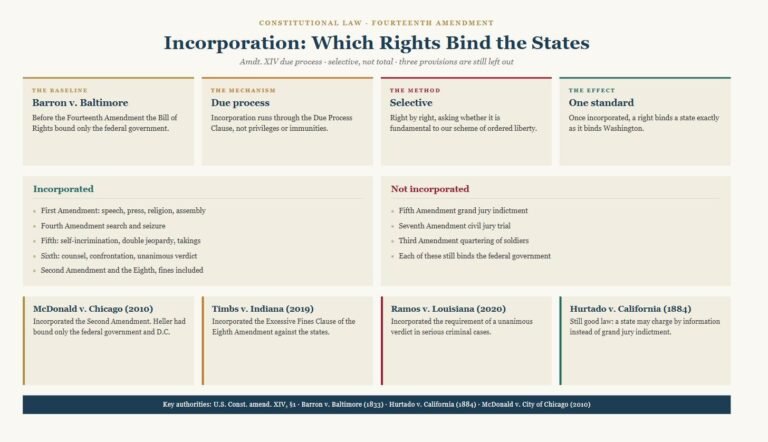 Incorporation Doctrine: Which Rights Bind the States
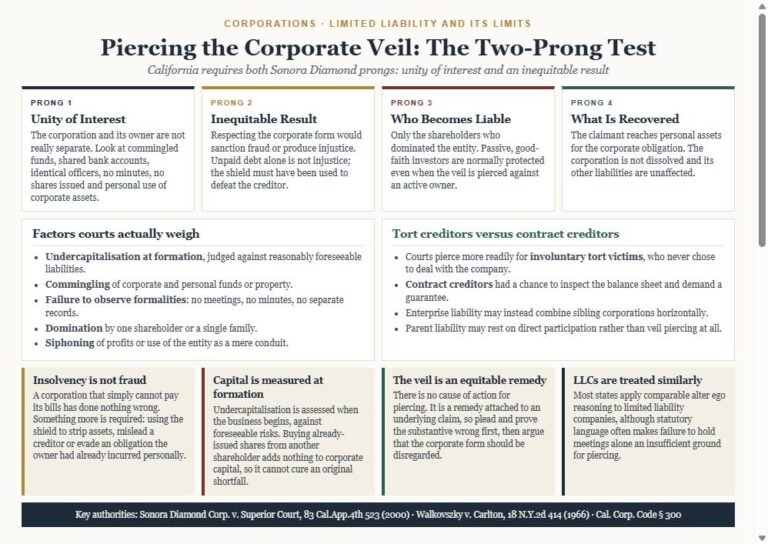 Piercing the Corporate Veil: A Two-Prong Alter Ego Test
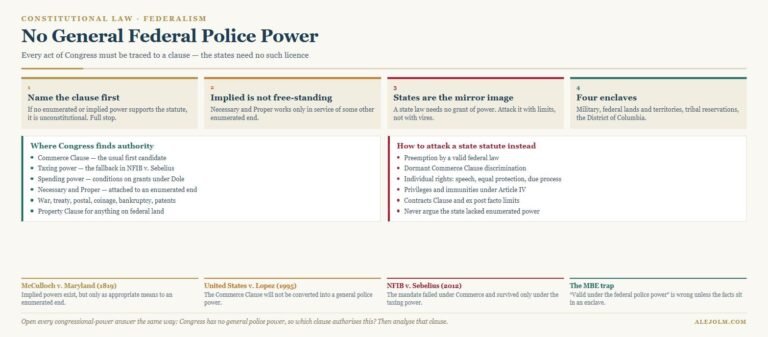 No Federal Police Power: Enumerated Powers and Enclaves
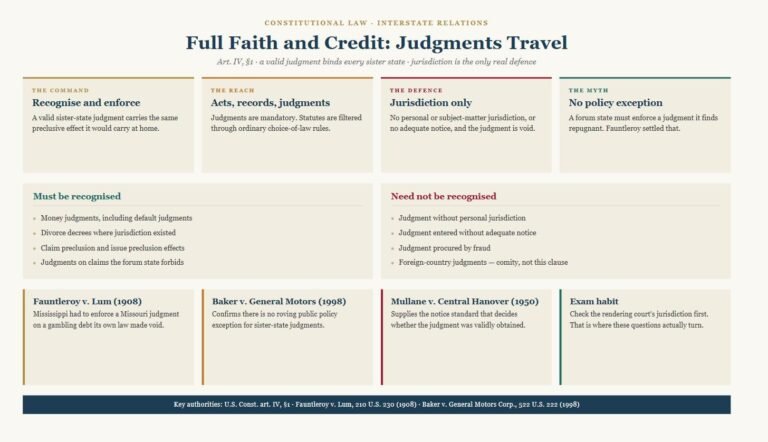 Full Faith and Credit: Recognising Sister-State Judgments
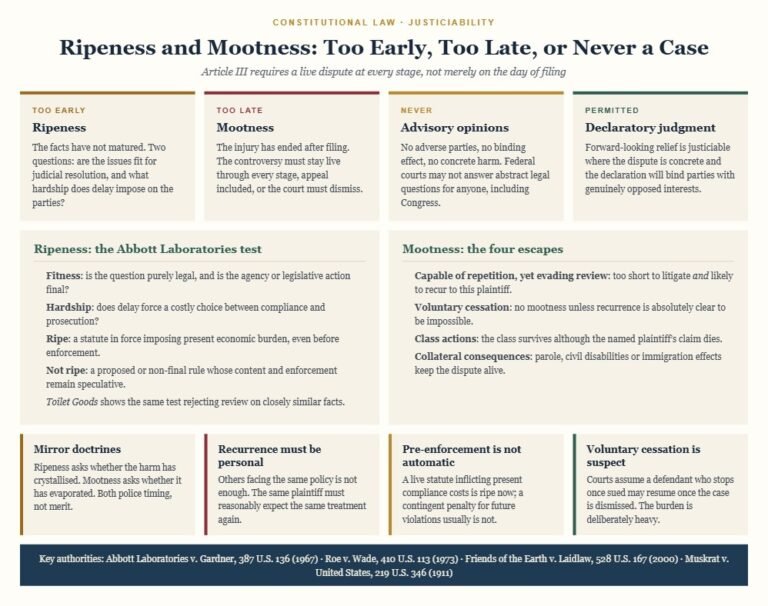 Ripeness and Mootness: Timing Rules in Federal Court
 Easements Explained: Creation, Scope and Termination