
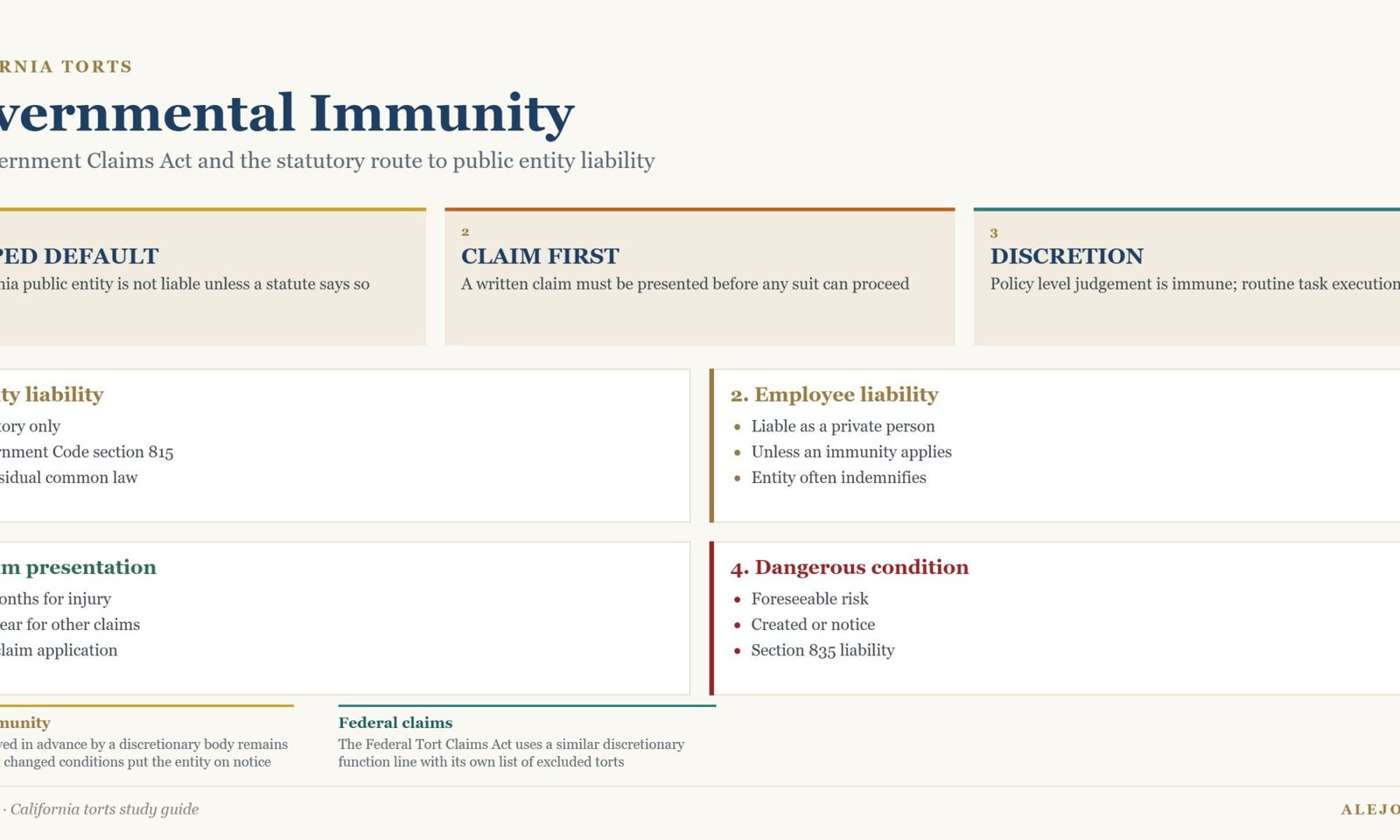
Governmental immunity once barred any claim against the state without its consent. That absolute bar has been substantially dismantled, but what replaced it is not ordinary tort law. It is a statutory scheme with its own definitions, its own immunities and, most importantly, its own deadlines.
California takes a distinctive approach. The Government Claims Act reverses the common law default, so a public entity is not liable for injury except as provided by statute. A claimant who treats a public entity like any other defendant will usually lose on procedure long before the merits are reached. This guide sets out the framework, the deadlines and the principal routes to liability.
The California starting point
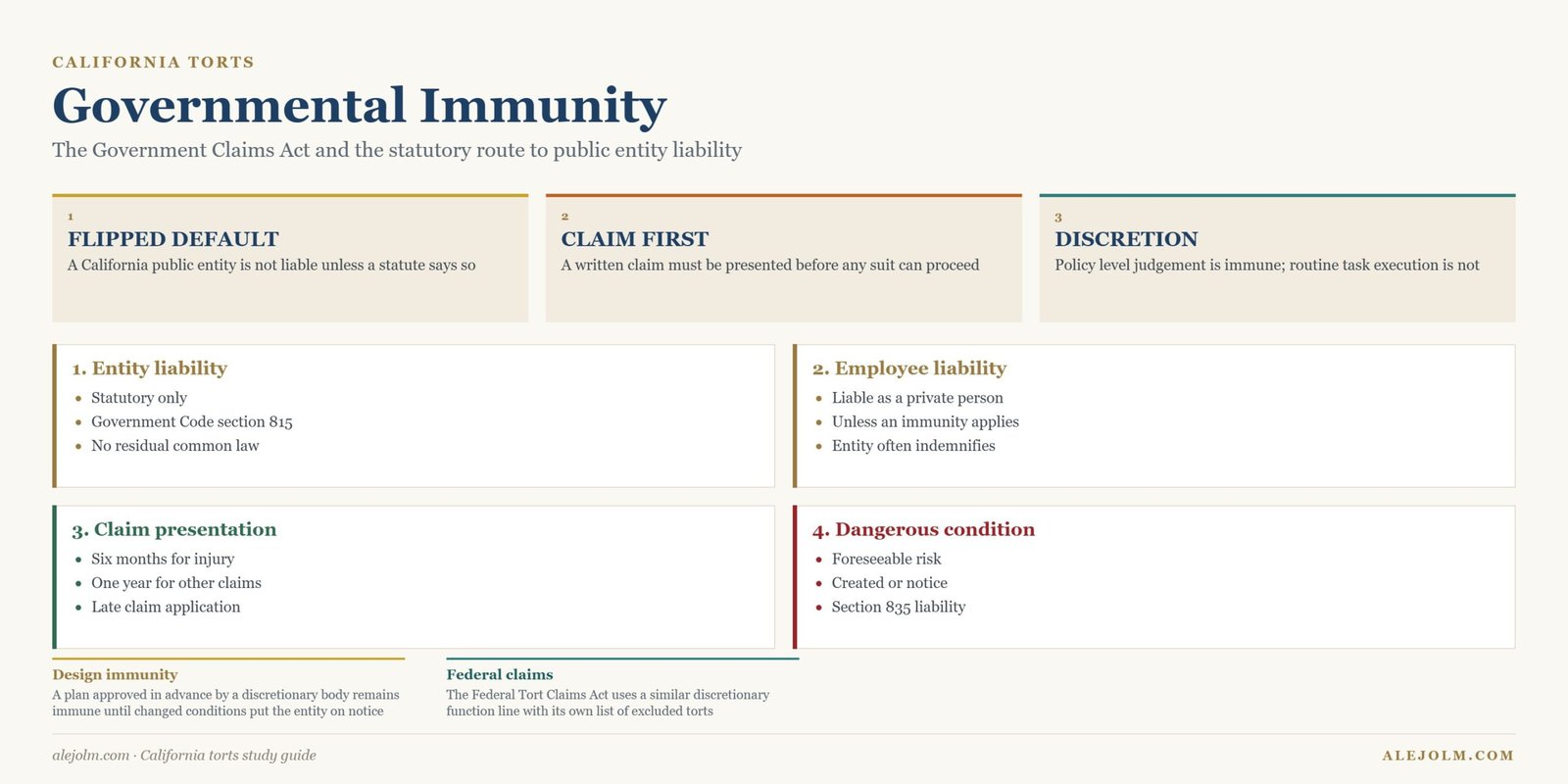
Government Code section 815 states that a public entity is not liable for an injury except as provided by statute. There is no residual common law tort liability against public entities in California. The correct question is never whether the entity behaved unreasonably but which statute makes it answerable for what happened.
Individual public employees are treated differently. They are liable for their own torts to the same extent as private persons unless a specific statutory immunity applies, and the entity is generally liable for employee acts within the scope of employment on that derivative basis.
The claim presentation requirement
Before suing a California public entity a claimant must present a written claim to that entity. For claims relating to death, injury to the person or injury to personal property, the claim must be presented within six months of accrual. Other claims, including damage to real property, generally carry a one year deadline.
Suit is barred until the claim has been presented and rejected or deemed rejected. A late claim requires a separate application for leave, and a failure to present a proper claim in time is a complete bar regardless of how strong the underlying case is. This is the single most common reason meritorious claims against California public entities fail.
Discretionary and ministerial acts
Government Code section 820.2 immunises a public employee, and derivatively the entity, from liability for an injury resulting from the exercise of discretion, even where that discretion was abused. The federal scheme draws the same line through its discretionary function exception.
The distinction is between deciding and doing. Choosing how to allocate a limited resource, setting a policy or weighing competing public objectives is discretionary and immune. Carrying out a prescribed task carelessly is ministerial and is not. The classification attaches to the specific conduct rather than to the department or the seniority of the actor.
| Conduct | Classification | Immunity | Example |
|---|---|---|---|
| Setting a policy on resource allocation | Discretionary | Immune | Deciding priority for a limited supply |
| Approving a design in advance | Discretionary | Design immunity | Road layout approved before construction |
| Executing a routine task | Ministerial | Not immune | Careless handling causing damage |
| Failing to remedy a known hazard | Statutory | Section 835 liability | Dangerous condition with notice |
Dangerous condition of public property
Government Code section 835 is the most important affirmative source of public entity liability. An entity is liable where the property was in a dangerous condition at the time of injury, the condition proximately caused the injury, the condition created a reasonably foreseeable risk of that kind of injury, and either a public employee created the condition negligently or the entity had actual or constructive notice long enough beforehand to have taken protective measures.
California also retains design immunity. A plan or design approved in advance by a legislative or other discretionary body remains immune even if it later proves dangerous, until changed conditions put the entity on notice that the approved design has become hazardous. Weather condition and recreational use immunities apply in their own defined areas.
The federal scheme
The Federal Tort Claims Act waives immunity for ordinary torts of federal employees within the scope of employment, treating the United States as a private person would be treated under the law of the state where the act occurred. It excludes a list of intentional torts including assault, battery, false imprisonment, malicious prosecution, abuse of process, defamation and misrepresentation, and it excludes discretionary functions. A proviso restores several of the excluded torts where they are committed by investigative or law enforcement officers.
A worked example
A cyclist in Los Angeles County is injured by a deep and long standing depression in a public roadway that the maintaining authority had received repeated reports about. Section 835 supplies the route to liability: the condition was dangerous, it created a foreseeable risk of exactly this injury, and the entity had notice with ample time to act. The claimant must nevertheless present a written claim within six months of the accident.
Change the facts. Suppose the injury arose from the layout of the junction itself, approved in advance by the responsible body before construction, with no evidence of any subsequent change in conditions. Design immunity applies and the claim fails even though a different layout would have been safer.
Governmental immunity in California and Los Angeles County in 2026
The Government Claims Act governs claims against the state, counties, cities, school districts and other public entities in California. In Los Angeles County the practical consequence is that the claim presentation step must be handled immediately, because six months passes quickly and the entity concerned is not always obvious where several bodies share responsibility for a road, a facility or a service.
- Statutory liability only — section 815 removes residual common law liability for entities.
- Six month deadline — for death, personal injury and personal property claims.
- One year deadline — for most other claims including damage to real property.
- Discretionary immunity — section 820.2 protects policy level judgement.
- Dangerous condition — section 835 provides the main affirmative route to liability.
- Design immunity — protects approved plans until notice of changed conditions.
For 2026, confirm the current California authority on claim presentation deadlines, discretionary immunity and design immunity directly with current authority, since these continue to develop.
Common mistakes to avoid
- Assuming immunity is absolute — the modern position is statutory liability with defined immunities.
- Missing the six month deadline — it is far shorter than the general limitation period and is a complete bar.
- Confusing discretionary with ministerial — classify the specific conduct, not the actor or department.
- Treating California as immune unless waived — the statute instead denies liability except as provided.
- Overlooking section 835 — the dangerous condition route is the most commonly available claim.
- Extending immunity to contractors — a private contractor does not inherit public employee immunity automatically.
Frequently asked questions
How long do I have to claim against a California public entity?
Six months from accrual for claims involving death, injury to the person or injury to personal property, and generally one year for other claims. The written claim must be presented to the entity before any lawsuit, and a missed deadline requires an application for leave to file late.
What is the discretionary act immunity?
Government Code section 820.2 protects a public employee from liability for injury resulting from the exercise of discretion, even where the discretion was abused. It covers policy level judgement rather than the careless performance of a routine task.
Can a city be sued for a pothole?
Potentially, under the dangerous condition provisions. The claimant must show a dangerous condition that created a foreseeable risk of the injury suffered, and either that an employee created it negligently or that the entity had notice in time to act.
What is design immunity?
Protection for a plan or design approved in advance by a legislative or other discretionary body. It survives even if the design later proves dangerous, until changed conditions give the entity notice that the approved design has become hazardous.
Are federal claims handled the same way?
No. The Federal Tort Claims Act has its own procedure, its own list of excluded intentional torts and its own discretionary function exception, together with a proviso restoring several excluded torts where law enforcement officers are involved.
Related guides
 Privilege of Arrest
 Statute of Limitations
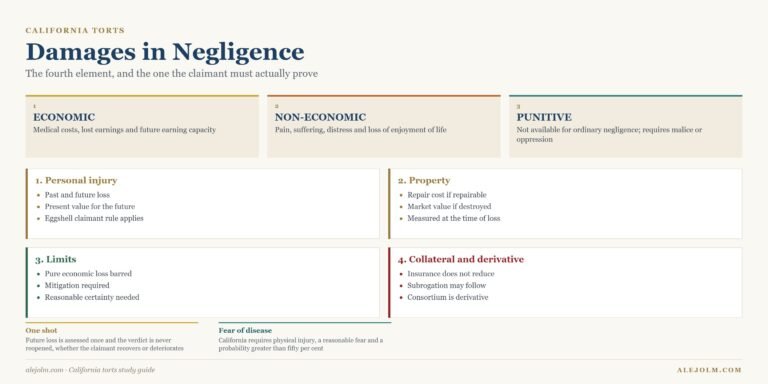 Damages in Negligence
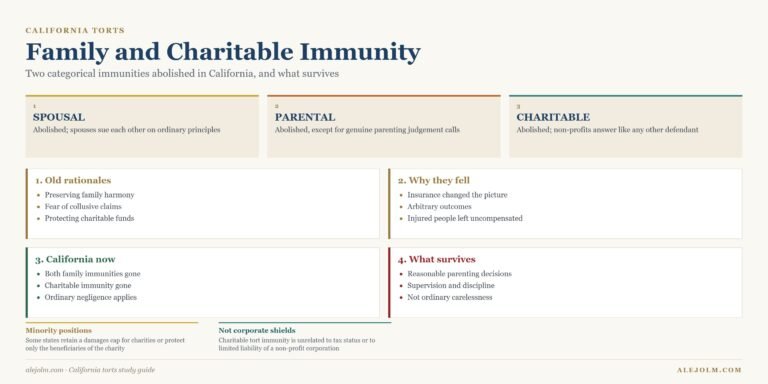 Family and Charitable Immunity
- Elements of Negligence
- Duty of Care
- The Firefighter Rule
- Premises Liability
Next steps
Read this with statute of limitations because the claim presentation deadline sits on top of the ordinary limitation rules, and then premises liability for the standards that shape dangerous condition claims.
For primary sources, read California Government Code section 815 and the civil jury instructions published by the Judicial Council of California.