
The federal spending power shares Article I, § 8, cl. 1 with the taxing power, but it reaches further. Congress may spend for any public purpose that rationally serves the general welfare, even where no other enumerated power would support direct regulation of the same subject. What it may not do is regulate in the name of the general welfare.
This guide explains why the power is broader than the taxing power, how the five conditional-spending requirements work, why the anti-coercion prong added by NFIB v. Sebelius has become the decisive one, and how spending interacts with the rule against commandeering the states.

Broad in purpose, narrow in method
Two ideas do all the work. The first is breadth of purpose: Congress may appropriate money for defence, education, healthcare, infrastructure or research without demonstrating that another enumerated power authorises federal control of the field. The general welfare language gives it enormous discretion to define what serves the nation.
The second is narrowness of method. That same language authorises taxing and spending only. It creates no freestanding power to command private conduct or to regulate a field directly. Congress reaches regulatory objectives indirectly, by attaching conditions to the money it offers.
Exam tip: the spending power is about purchase, not command. If the statute orders rather than offers, you are in commandeering territory instead.
The five conditions on conditional spending
South Dakota v. Dole supplied four requirements for conditions attached to federal grants, and NFIB v. Sebelius added a fifth. All five must be satisfied.
- The spending must be for the general welfare, a requirement almost always met given the deference courts extend.
- The condition must be stated unambiguously, so that a state can knowingly accept or refuse the bargain.
- The condition must relate to the federal interest in the particular programme funded.
- The condition must not require the state to violate an independent constitutional provision.
- The condition must not be unduly coercive, which is the anti-coercion limit drawn from NFIB.
Relatedness is programme-specific
The third prong is often mishandled. It asks whether the condition relates to the programme receiving the money, not whether it advances some general federal aim. A drink-driving condition attached to highway funds relates to highway safety. The same condition attached to a library grant would not.
The anti-coercion limit
Dole itself involved highway funds conditioned on raising the drinking age, with roughly five per cent of a state’s highway allocation at stake. The Court described that as relatively mild encouragement rather than compulsion, while acknowledging that pressure could in principle turn into compulsion.
NFIB v. Sebelius identified the line. The Affordable Care Act told states that declining the Medicaid expansion would cost them all of their existing Medicaid funding. That was a gun to the head: no state could realistically refuse, so the choice was not a choice at all. The expansion condition was therefore unconstitutional as applied, although the remedy was to make participation genuinely optional rather than to strike down the programme.
The distinction that emerges is between new money and existing money. Offering fresh funds for a new programme is inducement. Threatening the withdrawal of a large, established funding stream to force acceptance of new obligations is coercion. The mnemonic is bribery versus blackmail.
| Condition | Prong at issue | Result |
|---|---|---|
| Highway funds conditioned on a minimum drinking age | Relatedness and coercion | Valid: related, and a small share of funds (Dole) |
| New education grant conditioned on curriculum standards | Coercion | Valid: only the new grant is at risk |
| All existing Medicaid funds conditioned on accepting expansion | Coercion | Invalid: no realistic choice (NFIB) |
| Grant condition requiring the state to censor speech | Independent violation | Invalid on the fourth prong |
| Condition buried in ambiguous statutory language | Unambiguity | Invalid: the state never knowingly accepted |
Worked example: the driving age
Congress offers ten billion dollars in new highway construction money on condition that recipient states raise the minimum driving age from sixteen to eighteen. Run the prongs. Highway safety serves the general welfare. The condition is clearly stated. It relates to the highway programme, since the programme concerns roads and the condition concerns who may use them. Raising the driving age violates no constitutional right. And a state that refuses loses only the new grant, so the pressure is real but not irresistible. The condition is valid.
Change one fact. Congress now provides that a refusing state loses not only the new ten billion but also fifty billion in existing highway maintenance funding it has received for decades. The threat is directed at established money on which every state depends, and no rational state could decline. The condition becomes unconstitutionally coercive even though the first four prongs are still satisfied.
Spending and the anti-commandeering rule
The two doctrines are complementary. Congress cannot order state legislatures to enact a programme or require state executive officers to administer federal law. It can, however, offer money and attach conditions, which is why conditional spending has become the main engine of cooperative federalism.
The boundary matters when a condition looks less like a term of a bargain and more like a direct command. A condition that a state must pass a specified statute, enforced by the threat of losing unrelated existing funds, raises both a coercion problem and a commandeering problem, and both should be discussed.
Common mistakes that cost points
- Treating the spending power as a power to regulate. It authorises spending and conditions, not commands.
- Concluding that any conditional grant is coercive. Every condition applies pressure; only extreme pressure is unconstitutional.
- Missing the new-money versus existing-money distinction that decided NFIB.
- Testing relatedness against general federal interests rather than the funded programme.
- Forgetting the unambiguity prong, which protects the state’s ability to accept knowingly.
- Overlooking the fourth prong, which blocks conditions requiring an independent constitutional violation.
- Failing to analyse commandeering alongside coercion when the condition commands state action.
- Assuming invalidity means the whole statute falls. In NFIB the remedy was to make the expansion optional.
Frequently asked questions
How much funding pressure is too much?
There is no numerical rule. Dole involved about five per cent of highway funds and was permissible; NFIB involved the entirety of a state’s largest grant programme and was not. The question is whether refusal remains a genuine option.
Can Congress attach conditions to grants for private parties?
Yes, and the analysis is similar, though the federalism concerns that drive the coercion prong are strongest where the recipient is a state.
Is the general welfare requirement ever a real obstacle?
Rarely. Courts defer heavily to congressional judgments about what serves the general welfare, so the first prong is almost never the reason a condition fails.
The spending power, California grants and Los Angeles County in 2026
Because Congress cannot order California to administer federal programmes, conditional funding becomes the instrument of choice, and the limits recognised in South Dakota v. Dole (1987) and NFIB v. Sebelius (2012) are what stand between persuasion and compulsion. California has litigated those limits more than any other state.
When federal authorities sought to withhold criminal justice grant money from jurisdictions that limited cooperation with immigration enforcement, California and several cities prevailed largely on a narrower ground than coercion: the conditions had not been authorised by Congress in the relevant statute, so the executive lacked power to impose them. That is worth remembering, because the strongest spending-power argument is often statutory rather than constitutional.
The stakes in Los Angeles County are substantial, since county services depend heavily on federal transfers:
- Health and social programmes dominate. Medicaid participation, administered in California as Medi-Cal, funds a large share of county health services, which is why the coercion holding in NFIB mattered so much.
- Homelessness funding is conditioned. Federal housing grants carry compliance requirements that shape county programme design directly.
- Transport money drives infrastructure. Federal contributions to county transit projects come with labour, environmental and reporting conditions.
- Conditions must be unambiguous. A state cannot be penalised for failing a requirement it could not clearly have known about when it accepted the funds.
- Relatedness limits the reach. A condition must bear some relation to the federal interest in the programme being funded.
- New programmes may be declined. Offering additional money on new terms is permissible; threatening existing entitlements to force acceptance is where coercion begins.
For 2026, run the Dole factors and then ask separately whether the agency actually had statutory authority to attach the condition. Read with anti-commandeering, the taxing power and unconstitutional conditions.
Next steps
Spending sits beside the other Article I powers, so revise them together. Read Congress’s Taxing Power: When a Penalty Is Really a Tax, then The Necessary and Proper Clause: Congress’s Multiplier and The Commerce Clause: 3 Categories and 2 Hard Limits.
For primary sources, read South Dakota v. Dole and NFIB v. Sebelius at Justia, the annotation to the taxing and spending clause at Cornell LII, and the examination scope published by the State Bar of California.
Related guides
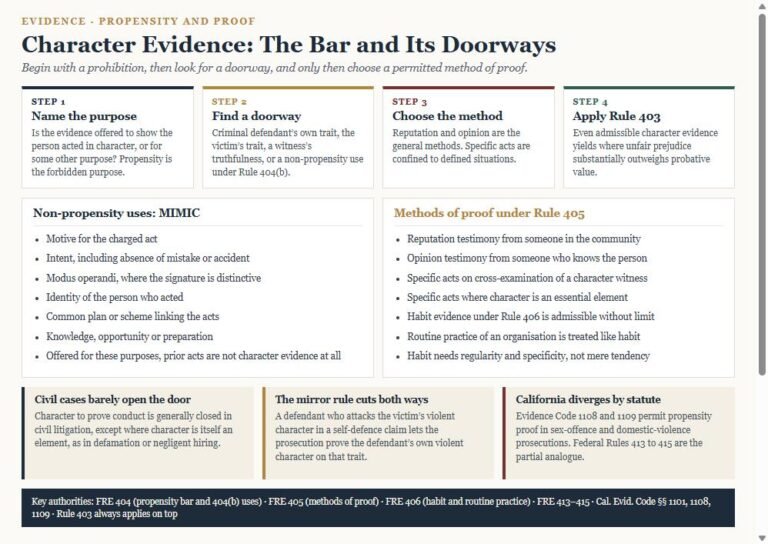 The Character Evidence Rules: Propensity Bar and Doorways
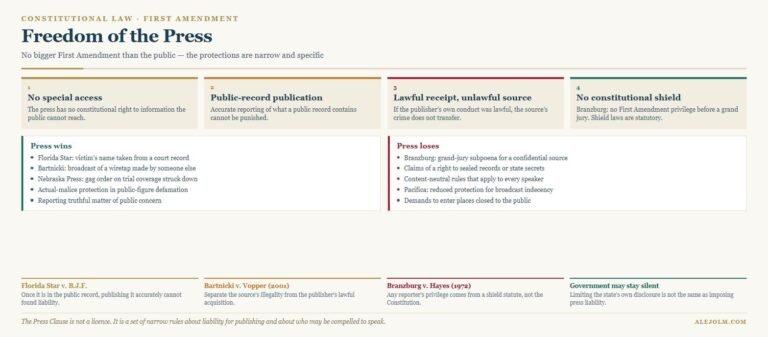 Freedom of the Press: Publication Liability and Limits
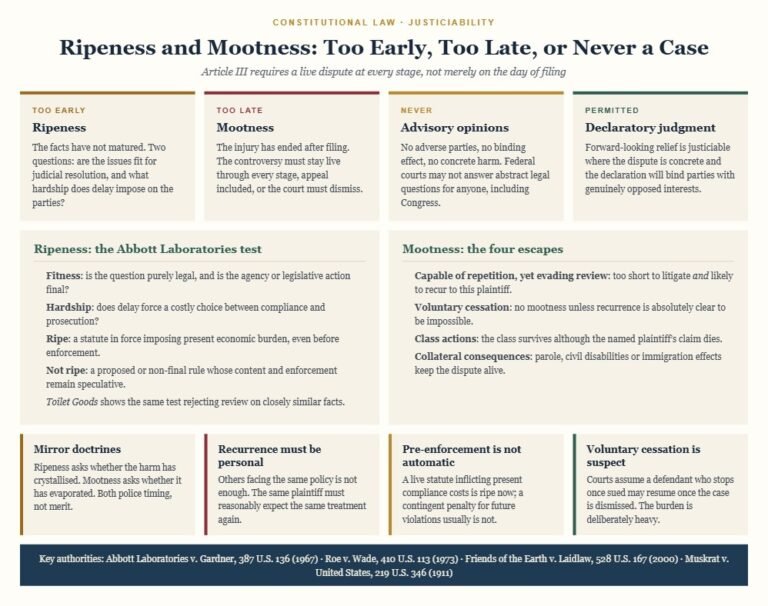 Ripeness and Mootness: Timing Rules in Federal Court
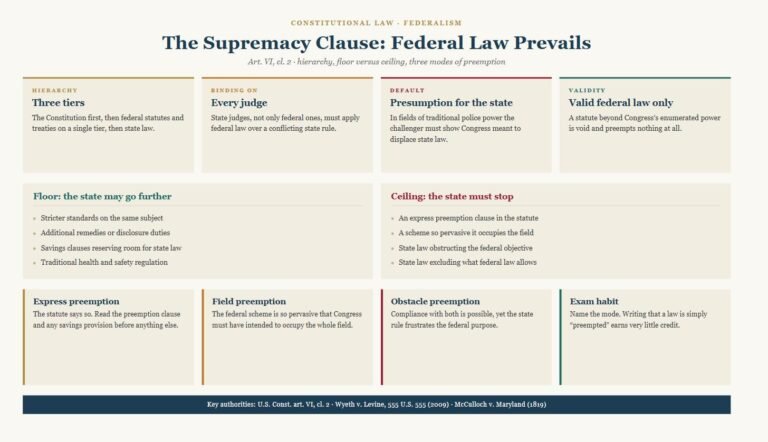 The Supremacy Clause: Floors, Ceilings and Preemption
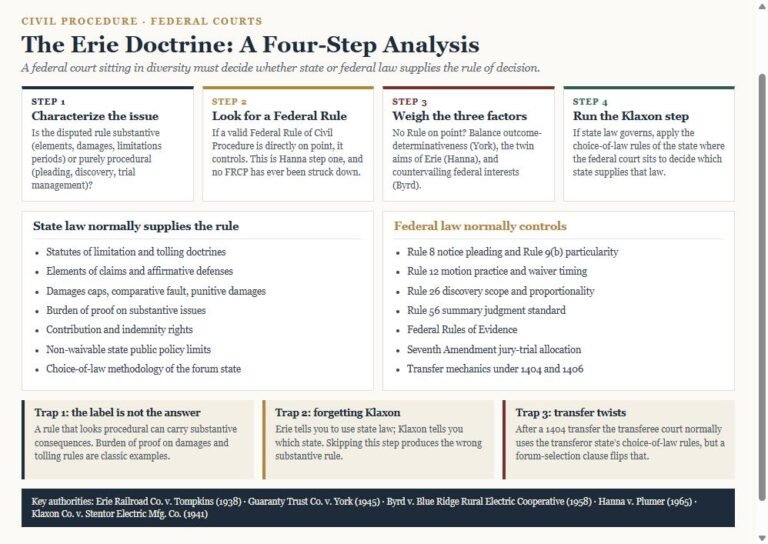 The Erie Doctrine Explained: A 4-Step Bar Exam Guide
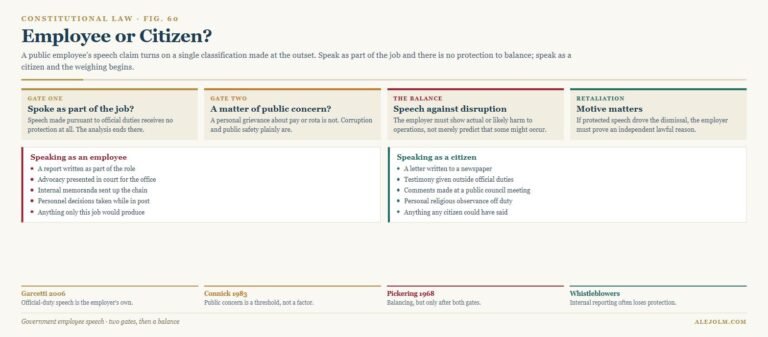 Government Employee Speech: Garcetti and Pickering Rules
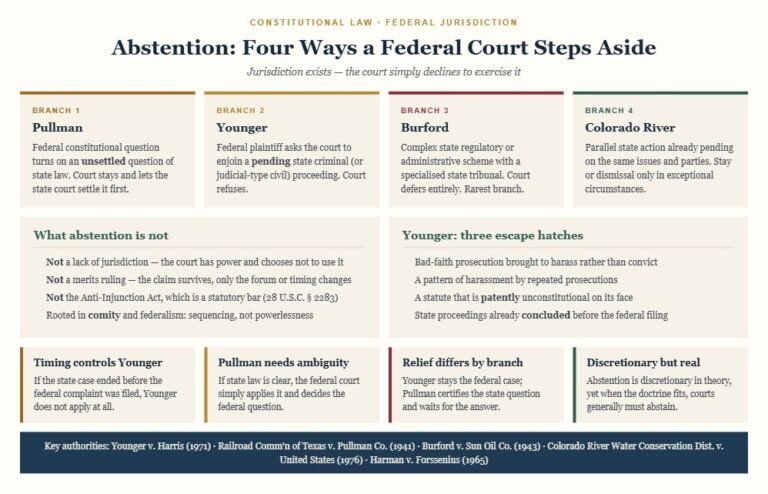 Abstention Doctrine: 4 Ways Federal Courts Step Aside
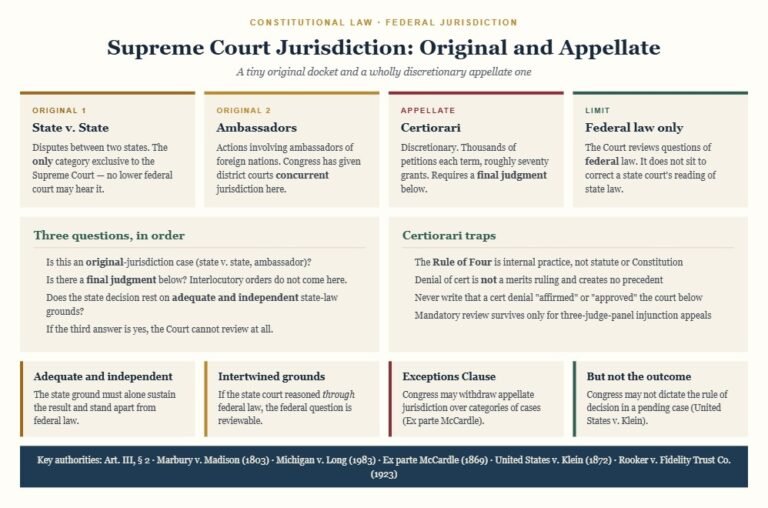 Supreme Court Jurisdiction: Original vs Appellate Power
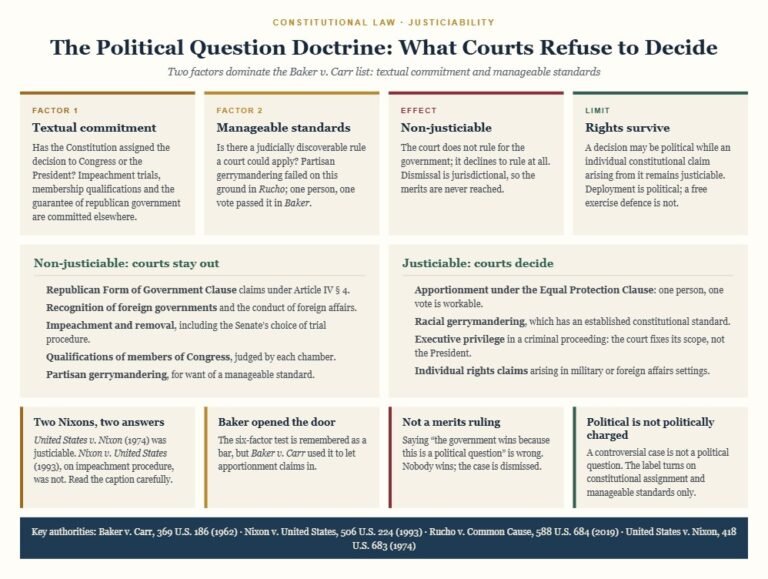 Political Question Doctrine: What Courts Will Not Decide
 3 Levels of Scrutiny in Constitutional Law Explained
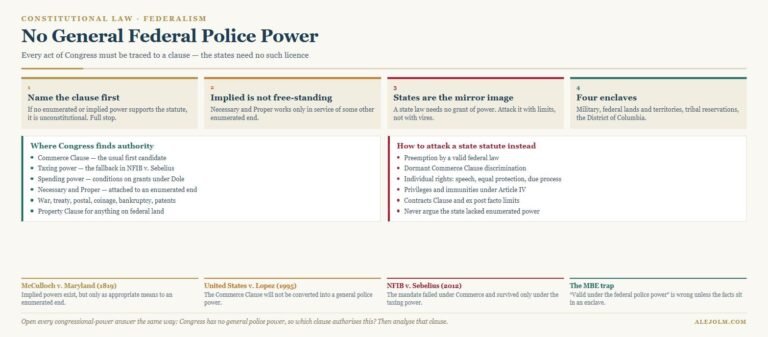 No Federal Police Power: Enumerated Powers and Enclaves
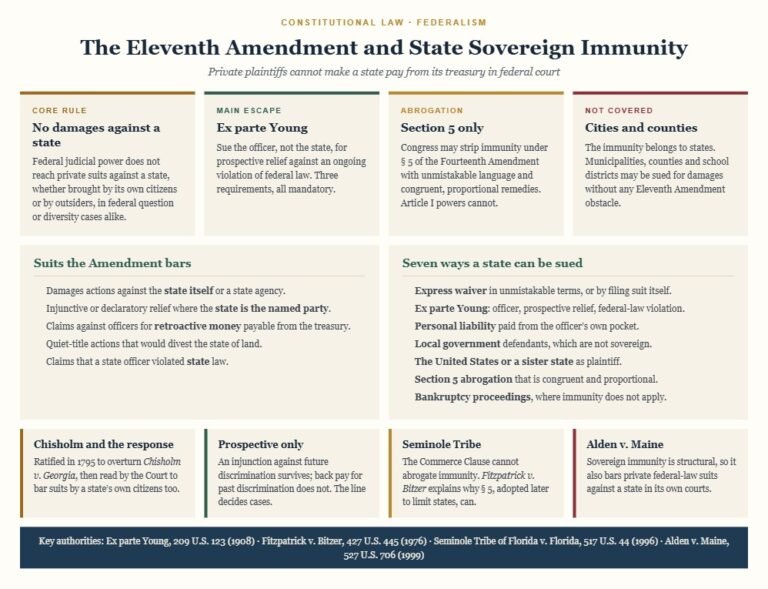 The Eleventh Amendment and State Sovereign Immunity