
The federal taxing power comes from Article I, § 8, cl. 1, which lets Congress lay and collect taxes for the common defence and general welfare. Courts review tax measures with unusual deference: a tax is generally sustained if it bears a reasonable relationship to revenue production, or if Congress independently has power to regulate the activity being taxed.
This guide explains the three structural limits that still constrain the power, the functional test that separates a genuine tax from a penalty, why a regulatory motive does not invalidate a tax, and how NFIB v. Sebelius made the taxing power the most important fallback argument in federal power analysis.
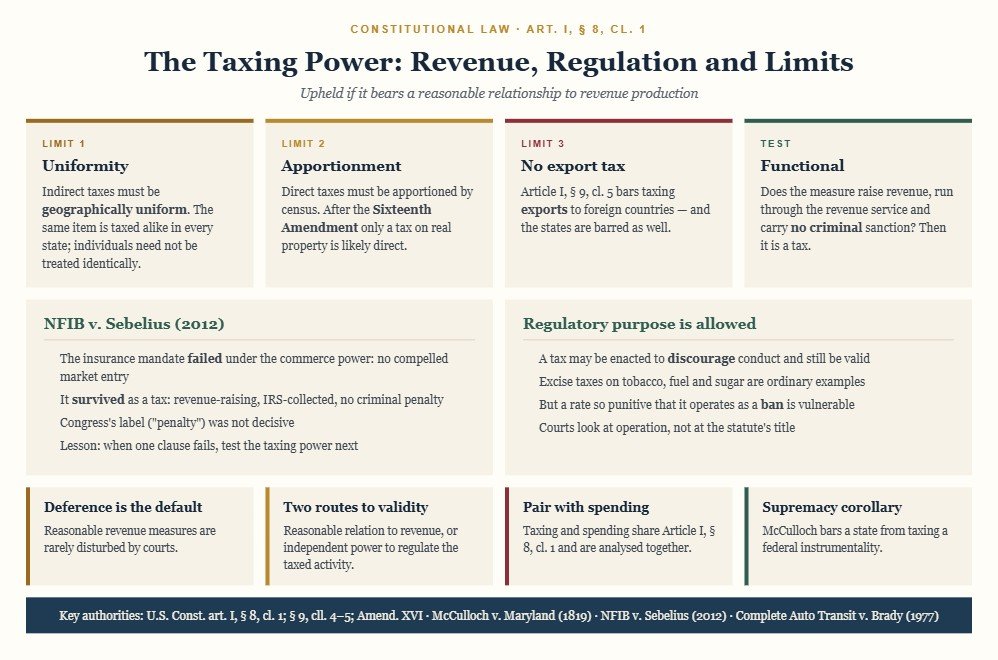
Three structural limits
Uniformity for indirect taxes
Indirect taxes, which include duties, imposts and excises, must be uniform throughout the United States. Uniformity is geographic: the same article must be taxed at the same rate wherever it is found. It does not require that individuals be treated identically, so graduated rates and exemptions are permissible.
Apportionment for direct taxes
Direct taxes must be apportioned among the states according to the census under Article I, § 9, cl. 4. The Sixteenth Amendment removed income taxation from this requirement, which leaves the clause largely vestigial. A tax on real property remains the clearest surviving candidate for direct taxation.
No tax on exports
Article I, § 9, cl. 5 forbids Congress to tax articles exported from any state, and Article I, § 10 restricts the states similarly. The prohibition is absolute rather than a balancing test, so identifying an export tax ends the analysis.
Exam tip: run the three structural limits before reaching the tax-versus-penalty question. An export tax fails no matter how it operates.
Tax or penalty: the functional test
Because Congress may tax but may not exercise a general police power, the characterisation of a charge can decide a case. Courts look past the statutory label to how the measure operates. Three features point towards a tax: it raises revenue, it is collected through the ordinary tax administration, and non-payment carries no criminal sanction.
NFIB v. Sebelius is the working example. The Affordable Care Act’s individual mandate could not be sustained under the commerce power, because Congress may regulate commerce but may not compel people to enter a market. The same provision survived under the taxing power: the payment produced revenue, was collected by the Internal Revenue Service, and exposed no one to prosecution. Congress had called it a penalty, and the label made no difference.
Regulatory purpose does not spoil a tax
A tax may be enacted precisely to discourage behaviour. Excise taxes on tobacco, alcohol and motor fuel are all designed in part to change conduct, and their validity has never seriously been doubted. The taxing power permits Congress to pursue revenue and regulation at the same time.
The limit appears when the rate is so extreme that the measure ceases to raise revenue at all. A charge set at a level that eliminates the taxed activity produces no revenue by design and looks like a prohibition rather than a tax. That is where a court is most likely to say Congress has used a tax label to reach conduct it cannot otherwise regulate.
| Measure | Analysis | Likely result |
|---|---|---|
| Insurance mandate payment collected by the IRS | Revenue-raising, no criminal sanction | Valid tax (NFIB) |
| Fifty per cent excise on high-calorie foods | Raises substantial revenue despite health purpose | Valid tax |
| One thousand per cent charge that ends civilian ownership | Operates as a ban, raises no revenue | Vulnerable as a penalty |
| Duty imposed only on goods leaving one state for abroad | Export tax | Invalid under § 9, cl. 5 |
| Excise applied at different rates in different states | Not geographically uniform | Invalid under the uniformity rule |
Worked example: the calorie excise
Congress imposes a fifty per cent excise on high-calorie packaged foods, describes it publicly as an obesity measure, and directs the Internal Revenue Service to collect it. Begin with structure. The excise is indirect and applies at the same rate nationwide, so uniformity is satisfied. It is not a direct tax and it is not an export tax.
Now apply the functional test. The charge is collected through tax administration, it will raise substantial revenue from a large market, and non-payment triggers a monetary liability rather than prosecution. The regulatory purpose is irrelevant, because taxes may be both revenue-raising and regulatory. The excise is valid.
Raise the rate to a level at which the products disappear from the market. The measure now generates no revenue, which is the strongest indication that it functions as a prohibition. That is the version of the statute most likely to fall.
Common mistakes that cost points
- Assuming a regulatory motive defeats a tax. NFIB confirms that a tax may regulate and raise revenue at once.
- Trusting the statutory label. A charge called a penalty may still be a tax, and vice versa.
- Skipping the structural limits, especially the export prohibition, which is absolute.
- Treating uniformity as an individual guarantee. It is geographic, so graduated rates are fine.
- Forgetting the Sixteenth Amendment and analysing an income tax under the apportionment rule.
- Using the taxing power only as an afterthought. When taxation is the subject of the statute, analyse it directly.
- Ignoring that a criminal sanction for non-payment pushes a measure towards being a penalty.
- Failing to note that a valid tax must still respect independent constitutional limits such as the First Amendment.
Frequently asked questions
Why did the mandate fail under the commerce power but survive as a tax?
Because the two clauses ask different questions. Commerce analysis asked whether Congress may compel entry into a market, and the answer was no. Tax analysis asked whether the payment operated as a tax, and the answer was yes.
Can Congress tax an activity it cannot regulate?
Yes, within limits. That is the practical significance of the taxing power, provided the measure genuinely operates as a revenue measure rather than as a disguised prohibition.
Are user fees taxes?
Not necessarily. A charge tied to a specific service received is often analysed as a fee, which does not raise the same uniformity and apportionment questions.
Taxing power: federal limits and California rules in 2026
There are really two separate enquiries hiding behind this heading, and Los Angeles County practice makes the distinction unavoidable. The federal question is how far Congress may go, and after NFIB v. Sebelius (2012) the answer is that an exaction may be sustained as a tax even when Congress labelled it a penalty, provided it produces revenue, is not prohibitively punitive and is collected through ordinary tax machinery.
The California question is almost the opposite: state and local taxing authority is unusually constrained by the California Constitution because voters have repeatedly narrowed it. Proposition 13 caps ad valorem property tax at one per cent of assessed value and limits annual increases in assessed value, Proposition 218 requires voter approval for local taxes and property-related assessments, and Proposition 26 defines “tax” broadly so that many charges a county might call a fee are treated as taxes requiring approval.
What that means for county revenue measures:
- Special taxes need a supermajority. A tax dedicated to a specific purpose generally requires two-thirds voter approval, while a general tax needs a simple majority.
- Fee or tax is the whole battle. Under Proposition 26 the county bears the burden of showing a charge is a permissible fee bearing a reasonable relationship to the payer’s burdens or benefits.
- Los Angeles County has used ballot measures repeatedly. Sales tax measures funding transport and homelessness services were enacted by voters precisely because the constitutional route requires it.
- Reassessment follows change of ownership. Proposition 13’s acquisition-value system makes transfer planning central to property tax exposure.
- Federal apportionment rules are narrow. Direct taxes must be apportioned, but the category has been read restrictively, and income taxation rests on the Sixteenth Amendment.
- Regulatory purpose does not invalidate a tax. A federal tax may influence behaviour and remain a tax.
In 2026, name which government you are analysing before you start, because the federal power is broad and the California power is narrow. Read with the spending power, the Commerce Clause and the Takings Clause for exactions that behave like charges.
Next steps
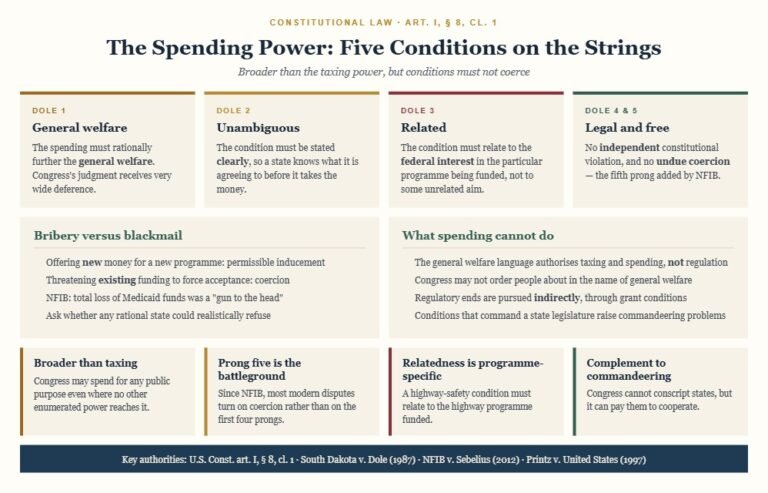
Taxing and spending are two halves of the same clause, so study them together. Read The Spending Power and the Five Dole Test Conditions, then The Commerce Clause: 3 Categories and 2 Hard Limits and The Necessary and Proper Clause: Congress’s Multiplier to see how the powers are argued in the alternative.
For primary sources, read NFIB v. Sebelius and McCulloch v. Maryland at Justia, the annotations to the taxing and spending clause and the Sixteenth Amendment at Cornell LII, and the examination scope published by the State Bar of California.
Related guides
 The Erie Doctrine Explained: A 4-Step Bar Exam Guide
 Will Execution Requirements: Formalities and Rescue
 The Spending Power and the Five Dole Test Conditions
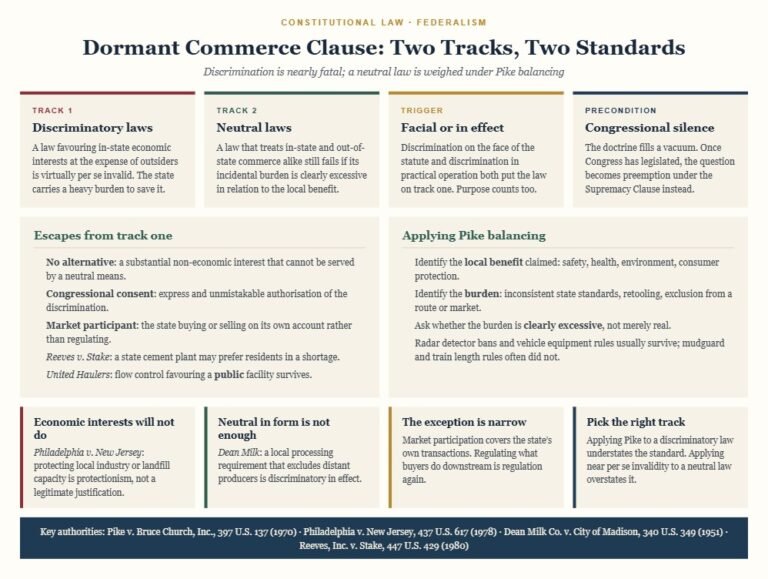 Dormant Commerce Clause: Discrimination vs Pike Balancing
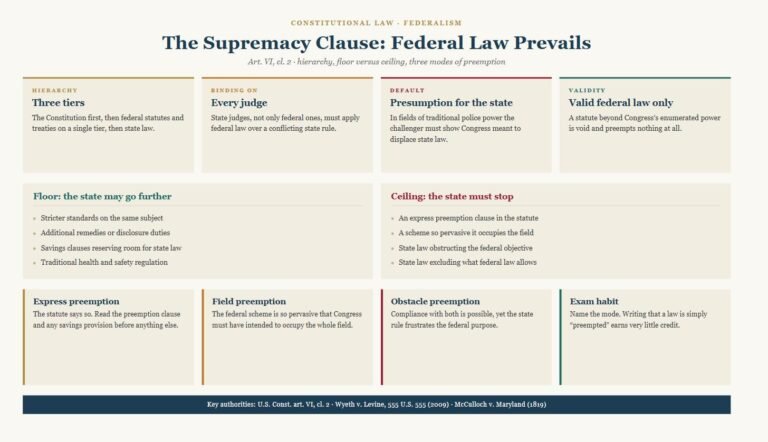 The Supremacy Clause: Floors, Ceilings and Preemption
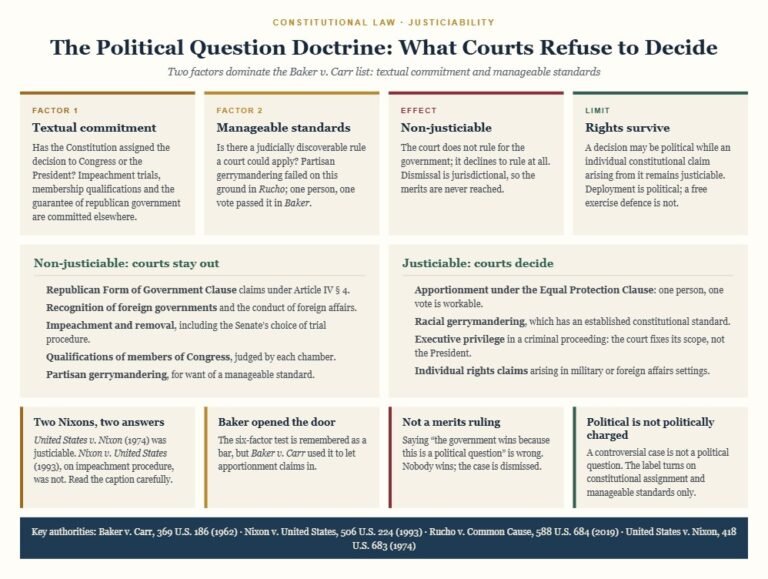 Political Question Doctrine: What Courts Will Not Decide
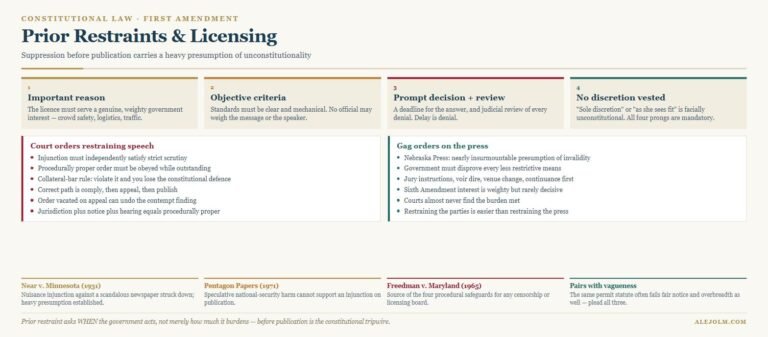 Prior Restraint and Licensing: The Freedman Safeguards
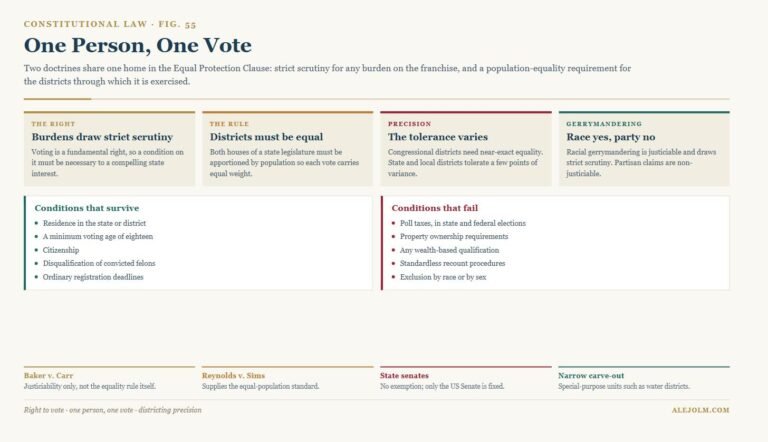 One Person, One Vote: Voting Rights Under Equal Protection
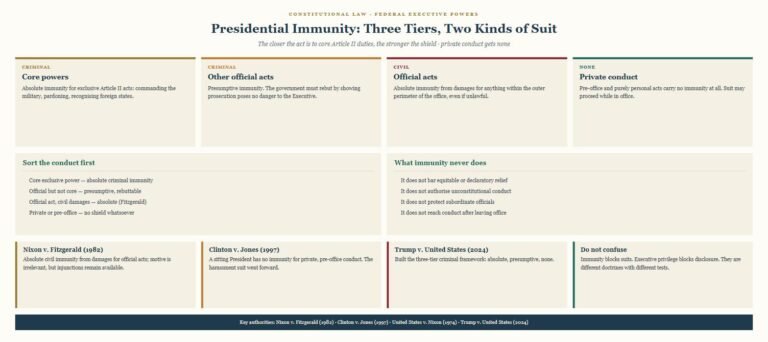 Presidential Immunity: Criminal, Civil and Private Acts
 3 Levels of Scrutiny in Constitutional Law Explained
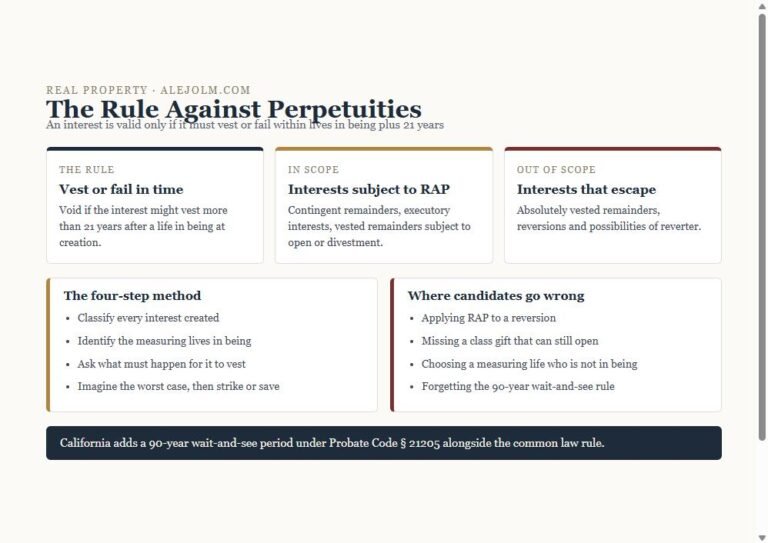 The Rule Against Perpetuities Explained Step by Step
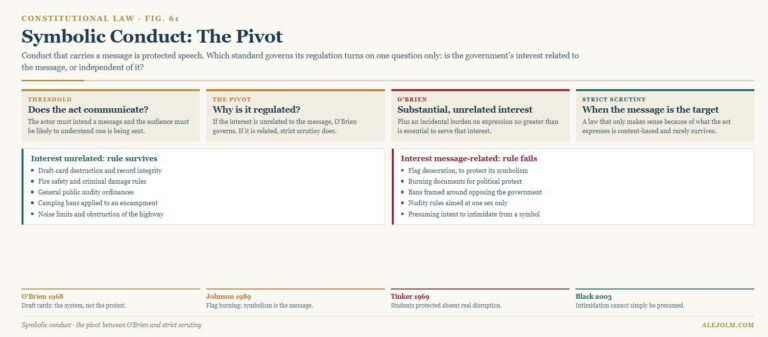 Symbolic Conduct and the O’Brien Test: The Pivot Question