
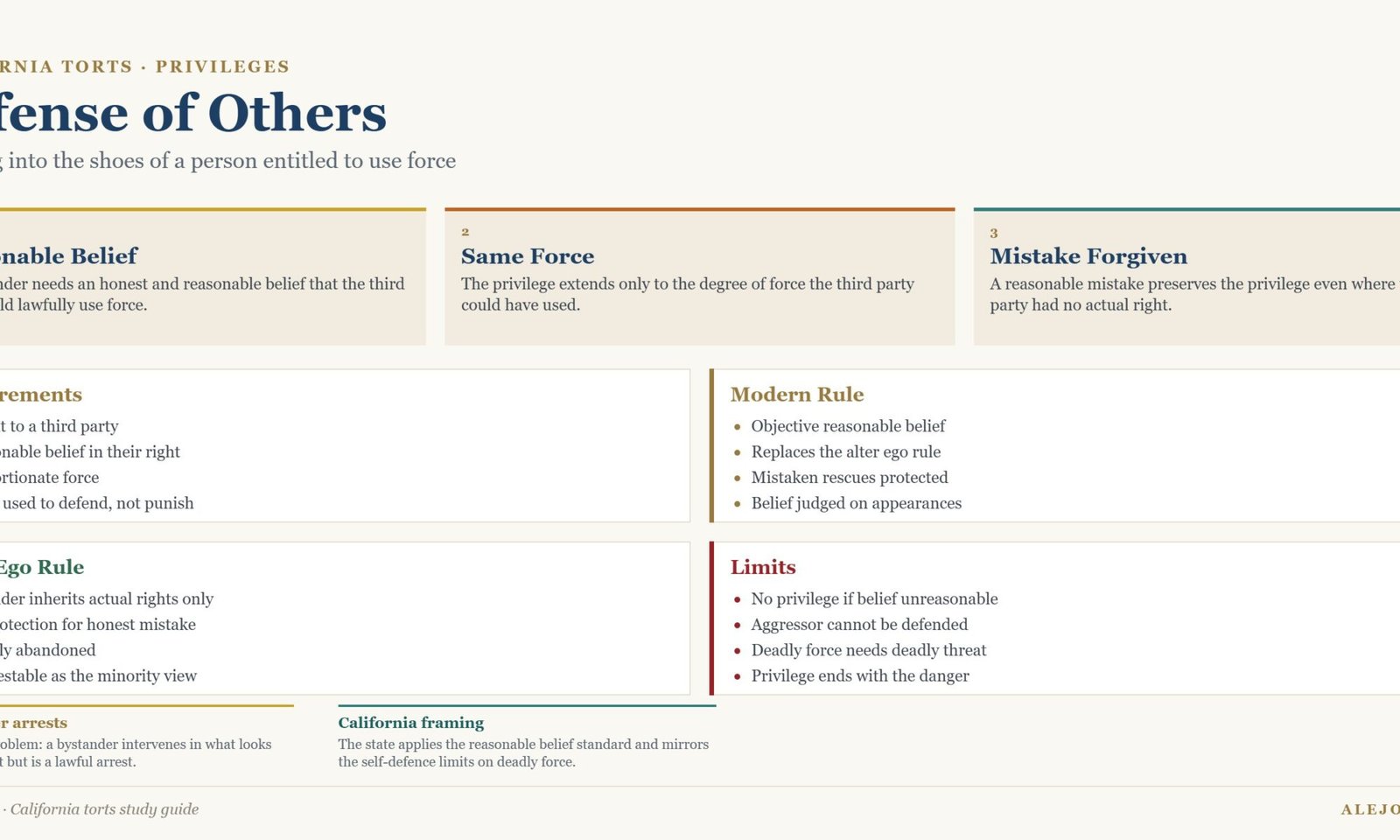
Defense of others lets a person use force to protect someone else. It borrows the whole architecture of self-defence and adds one question on top: did the defender reasonably believe that the person being protected was entitled to use force at that moment?
That extra question is where the doctrine has changed most. The old rule tied the defender to whatever rights the third party actually had, so a well-intentioned rescuer who misread the situation was simply liable. Modern law asks instead whether the rescuer belief was reasonable, and that shift decides most of the interesting cases.
The modern reasonable belief standard
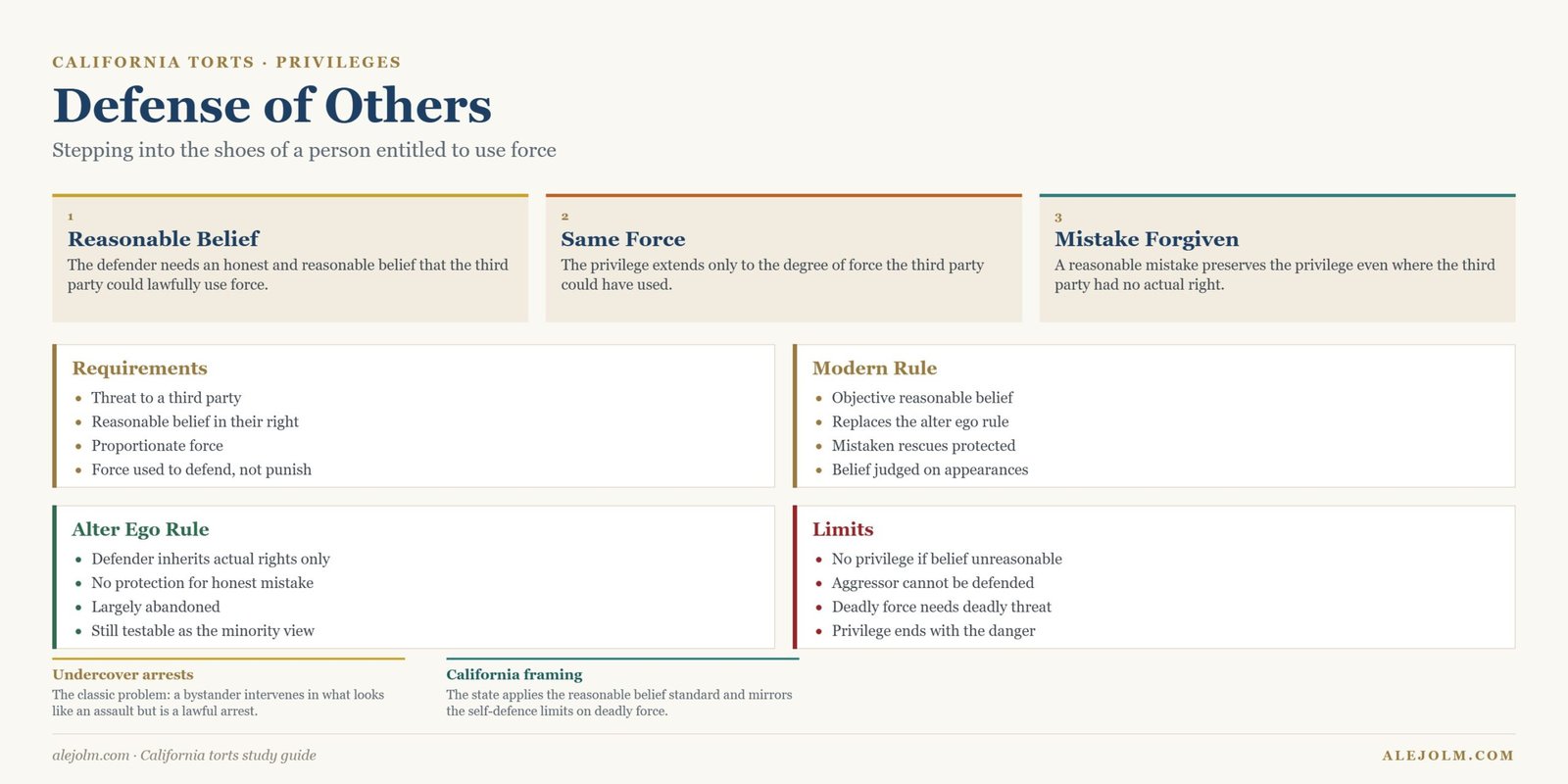
A defender is privileged where they honestly and reasonably believe that a third party is facing an unlawful threat and would be entitled to use force in response. Correctness is not required. The belief is judged objectively against what the situation appeared to be, which means a rescuer who acts on plausible but mistaken appearances keeps the privilege.
The signature fact pattern involves plain clothes officers. A bystander sees two men forcing a third to the ground and intervenes, not knowing that the men are police making a lawful arrest. The arrestee had no right to resist, so under the old rule there was nothing for the bystander to step into and the bystander was liable in battery. Under the modern rule the bystander is protected, provided the mistake was one a reasonable person could have made.
The alter ego rule
The traditional approach treated the defender as standing exactly in the shoes of the person defended. If that person had no right to use force, neither did the defender, however reasonable the intervention looked. The rule had the virtue of simplicity and the vice of punishing good citizenship, and virtually all modern jurisdictions have abandoned it. It remains worth knowing because problems still flag minority rule jurisdictions.
| Question | Alter ego rule | Modern rule |
|---|---|---|
| Third party actually entitled to use force | Required | Not required |
| Reasonable mistake by the defender | No protection | Protected |
| Force available | What the third party could use | What the perceived threat reasonably required |
| Practical effect | Discourages intervention | Protects reasonable rescuers |
Proportionality and deadly force
The privilege is capped by what the perceived threat reasonably required. A defender who responds to a shove with a weapon has exceeded it. Deadly force is available only where the defender reasonably perceives a threat of death or serious bodily harm to the person being protected, exactly as in self-defence. The imminence requirement carries across too, so intervening after the danger has passed is not defence but retaliation.
When the privilege fails
Two situations defeat it. The first is unreasonable belief: if no sensible observer would have thought the third party was under unlawful attack, the defender is simply an assailant. The second is defending the aggressor. Where the person protected started the confrontation and had no right to use force, the defender inherits that problem unless the appearances genuinely suggested otherwise.
A worked example
A woman sees a man dragging a struggling teenager towards a car in a supermarket car park and tackles him. The man is the teenager father, removing an unruly child. Whether the woman is liable in battery turns entirely on reasonableness. If the scene looked like an abduction, with the teenager shouting for help and no indication of a family relationship, the belief was reasonable and the privilege applies. If the two had plainly been arguing about homework for ten minutes in full view, it was not.
Defense of Others in California and Los Angeles County in 2026
California applies the modern reasonable belief standard. A defender may use the force that appears reasonably necessary to protect another from imminent harm, and a mistaken but reasonable perception does not destroy the privilege. The state framework mirrors self-defence throughout, including the requirement that deadly force be reserved for a reasonably perceived threat of death or great bodily injury and the rule that the privilege ends when the danger does.
There is no general duty to rescue in California, so the doctrine is permissive rather than obligatory. What it does is protect the person who chooses to intervene. Practically, the questions that arise in Los Angeles County litigation involve security personnel, licensed premises, school and campus incidents, and interventions during arrests, where the reasonableness of what the defender perceived is a jury question and rarely resolved on the papers.
- Reasonable belief. California protects the defender whose perception was reasonable, even if the third party had no actual right to use force.
- Proportionality. Force is limited to what the perceived threat reasonably required, with deadly force reserved for deadly threats.
- Imminence. The threat must be immediate. Intervention after the event is not privileged.
- No duty to act. There is no general obligation to rescue, subject to the special relationship exceptions.
- Aggressors. Defending someone who provoked the confrontation generally fails unless appearances suggested otherwise.
- Overlap with criminal law. The tort privilege runs parallel to the criminal justification, and the analyses inform one another.
For 2026, confirm the current California authority on the scope of defence of others, the limits on force by private security personnel, and the interaction with criminal justification directly with current authority, since these continue to develop.
Common mistakes to avoid
- Applying the alter ego rule. Modern law asks about the defender belief, not the third party actual rights.
- Ignoring proportionality. A justified intervention can still involve excessive force.
- Missing the aggressor problem. There is nothing to defend where the protected person started it and appearances made that clear.
- Forgetting imminence. The privilege protects prevention, not revenge.
- Confusing it with defence of property. Deadly force is available here in the right circumstances and never is for property alone.
- Assuming intervention is required. The doctrine permits rescue; it does not compel it.
Frequently asked questions
Can you use force to protect a stranger?
Yes. The privilege does not depend on any relationship. It requires only a reasonable belief that the person is facing an unlawful threat and would be entitled to defend themselves.
What happens if the rescuer was wrong?
Under the modern rule the privilege survives a reasonable mistake. Only an unreasonable belief destroys it, so the question is what a sensible observer would have concluded from the appearances.
Is deadly force ever allowed in defence of another?
Yes, but only where the defender reasonably perceives a threat of death or serious bodily harm to the person being protected. The limits are the same as in self-defence.
What is the alter ego rule?
The traditional approach under which the defender had only the rights the third party actually had, so an honest mistake produced liability. Most jurisdictions, including California, have abandoned it.
Does a bystander have to intervene?
No. There is no general duty to rescue. The doctrine protects those who choose to help; it does not create an obligation to do so.
Related guides
 Intentional Infliction of Emotional Distress in California
 Consent as a Defense in Tort Law: The California Rules
- Transferred Intent in Tort Law: Rules and Limits Explained
- Assault in Tort Law: Apprehension of Imminent Harm
- False Imprisonment in California: Elements and Defenses
- Battery in Tort Law: Elements, Defenses and Damages
- Strict Liability in Tort Law: Liability Without Fault
- Self-Defense in Tort Law: Reasonable and Deadly Force
Next steps
Read our guide to self-defence for the proportionality and imminence framework this privilege borrows, then consent, the other major answer to an intentional tort claim.
For primary sources, read California Penal Code section 693 and the justification instructions published by the Judicial Council of California.