
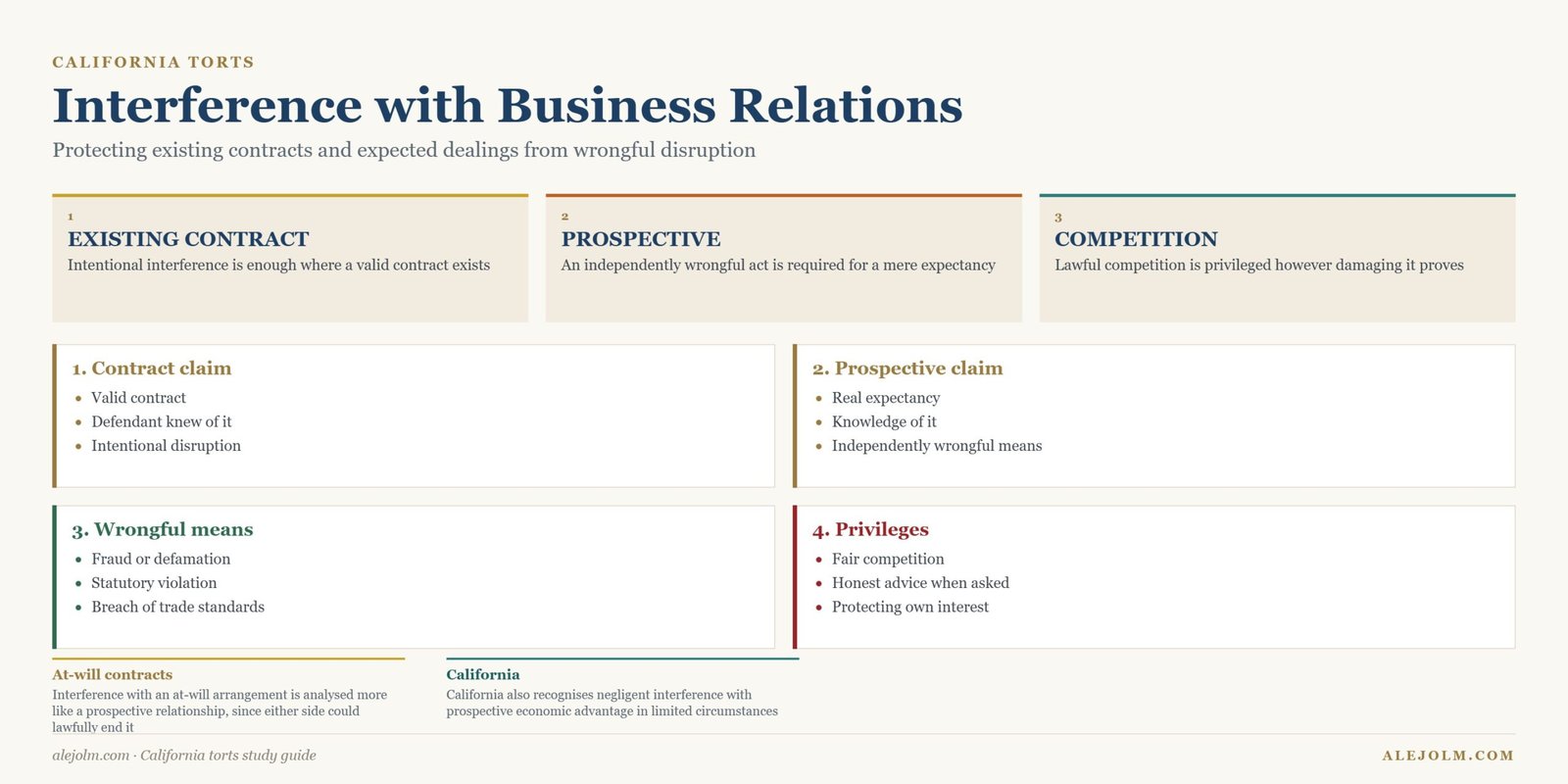
Interference with business relations covers two related economic torts. One protects an existing contract from intentional disruption by an outsider. The other protects a reasonably expected future relationship, and it demands more of the claimant, because otherwise every successful competitor would be a defendant.
The dividing question is always whether a valid contract already exists or whether the claimant had only an expectancy. California recognises both torts and goes further than most states by allowing a negligent version of the prospective claim in defined circumstances. This guide sets out the elements, the independently wrongful act requirement and the privileges that most often decide the outcome.
Intentional interference with contract
The claimant must show a valid contract or business relationship, that the defendant knew of it, that the defendant intentionally interfered, that the interference caused a disruption, and that loss followed. Because a binding contract already existed, the law protects it against deliberate disruption without requiring the claimant to characterise the means as independently unlawful.
Interference with prospective economic advantage
Where no contract has been concluded, the claimant must show a real relationship or expectancy, knowledge of it, and an act of interference that was intentional and independently wrongful. That last requirement is the central limiting principle of the tort, and it exists to keep ordinary competition outside the reach of the courts.
- Another tort — fraud, defamation or intentional infliction of emotional distress used as the means.
- Statutory violation — conduct breaching competition, unfair practices or similar legislation.
- Trade standards — a breach of an established standard of a trade or profession.
- Misuse of confidential material — inducing the taking of trade secrets or protected data.
- Threats or coercion — pressure that is unlawful independently of the interference.
- Not mere competition — better prices, better terms or a superior product never qualify.
Why competition is protected
Offering a customer a better deal is the point of a market. A rule that made the loss of an expected sale actionable would convert competition into litigation, so courts require the claimant to identify something wrongful beyond the fact of losing the business. However aggressive the competition and however severe the damage, lawful competitive conduct is privileged.
| Feature | Existing contract | Prospective relationship |
|---|---|---|
| What is protected | A concluded contract | A reasonable expectancy |
| Interference required | Intentional | Intentional and independently wrongful |
| Competition defence | Narrower | Very strong |
| At-will arrangements | Analysed like a prospective claim | Same |
The at-will wrinkle
An at-will contract sits between the two categories. Because either party could lawfully terminate at any time, courts treat interference with such an arrangement much like interference with a prospective relationship and expect the claimant to show wrongful means. Recruiting an at-will employee with a better offer is ordinarily lawful; inducing that employee to take confidential material is not.
Privileges
Several privileges recur. A competitor acting to advance its own legitimate business interests is protected. So is a person who gives honest advice in good faith when it is sought. So is a party protecting an existing economic interest of its own, such as a landlord declining to consent to an arrangement that would damage its own position. Each of these survives even though the interference was deliberate.
A worked example
A logistics company in Los Angeles has a two year supply contract with a distributor. A rival, knowing of the contract, offers the distributor a payment to walk away from it early. The contract was valid, the rival knew of it and deliberately induced the breach, and loss followed. Interference with contract is established.
Change the stage. Suppose there was no contract, only a long standing course of dealing the company expected to continue, and the rival simply offered better rates and won the business. There is an expectancy and knowledge of it, but the means were ordinary competition rather than anything independently wrongful, so the prospective claim fails.
Interference claims in California and Los Angeles County in 2026
California requires an independently wrongful act for the prospective claim, meaning conduct proscribed by some constitutional, statutory, regulatory, common law or other determinable legal standard. California also recognises a negligent form of interference with prospective economic advantage in limited circumstances, which most states do not.
Employment disputes are shaped by the California rule that contracts restraining a person from engaging in a lawful profession or trade are generally void. That policy makes competitive recruitment particularly difficult to attack, and claims tend to be built instead around trade secret misuse or misrepresentation.
- Independently wrongful standard — the conduct must breach a determinable legal standard.
- Negligent interference — recognised in California in defined circumstances.
- Restraint of trade policy — non-compete arrangements are generally void in California.
- Trade secret overlay — statutory trade secret claims often supply the wrongful act.
- Anti-SLAPP — claims arising from protected activity can be challenged early.
- Overlapping claims — fraud, defamation and unfair competition are commonly pleaded together.
For 2026, confirm the current California authority on the independently wrongful act requirement, negligent interference and restraint of trade policy directly with current authority, since these continue to develop.
Common mistakes to avoid
- Treating the two torts as one — only the prospective claim requires independently wrongful means.
- Suing over lost competition — winning business lawfully is never tortious.
- Ignoring the at-will point — at-will arrangements attract the stricter prospective analysis.
- Overlooking privileges — legitimate self interest and honest advice defeat many claims.
- Failing to plead the wrongful act — the underlying tort or breach must be identified specifically.
- Assuming non-competes help — California treats most restraints on trade as void.
Frequently asked questions
Can a competitor be sued for taking my customers?
Not for competing lawfully. Where there was no binding contract, the claimant must show that the competitor used independently wrongful means such as fraud, defamation, a statutory violation or misuse of confidential information.
What counts as an independently wrongful act in California?
Conduct that is proscribed by some determinable legal standard, whether constitutional, statutory, regulatory or common law. Aggressive but lawful commercial behaviour does not qualify however damaging it proves.
Does interference with an at-will contract count?
It is analysed more like interference with a prospective relationship, because either party could have ended the arrangement lawfully at any time. That means wrongful means will usually be required.
Is negligent interference actionable?
In California, in limited circumstances, negligent interference with prospective economic advantage is recognised. Most jurisdictions require intentional conduct, so the California position is unusual and should be checked against current authority.
Can the same facts support several claims?
Frequently. The independently wrongful act is often itself a tort, so fraud, defamation or trade secret misuse can be pleaded alongside the interference claim, with damages assessed to avoid double recovery.
Related guides
- Negligent Misrepresentation
- Fraud
- Defamation
- Defamation Privileges
- Malicious Prosecution
- Abuse of Process
- Trespass to Chattels
- Conversion
Next steps
Read this with fraud and negligent misrepresentation, which frequently supply the independently wrongful act on which a prospective claim depends.
For primary sources, read California Business and Professions Code section 16600 and the civil jury instructions published by the Judicial Council of California.