
Two rules govern the same conduct. One comes from Congress, the other from a state legislature, and they do not sit comfortably together. Almost every federalism question eventually reduces to that situation, and the provision that resolves it is a single sentence long.
Article VI, Clause 2 declares the Constitution, federal statutes made in pursuance of it, and treaties of the United States to be the supreme law of the land, and binds the judges of every state to them. The sentence does two jobs: it ranks the sources of American law, and it makes every judge in the country an enforcer of that ranking. Everything we call preemption grows out of it.
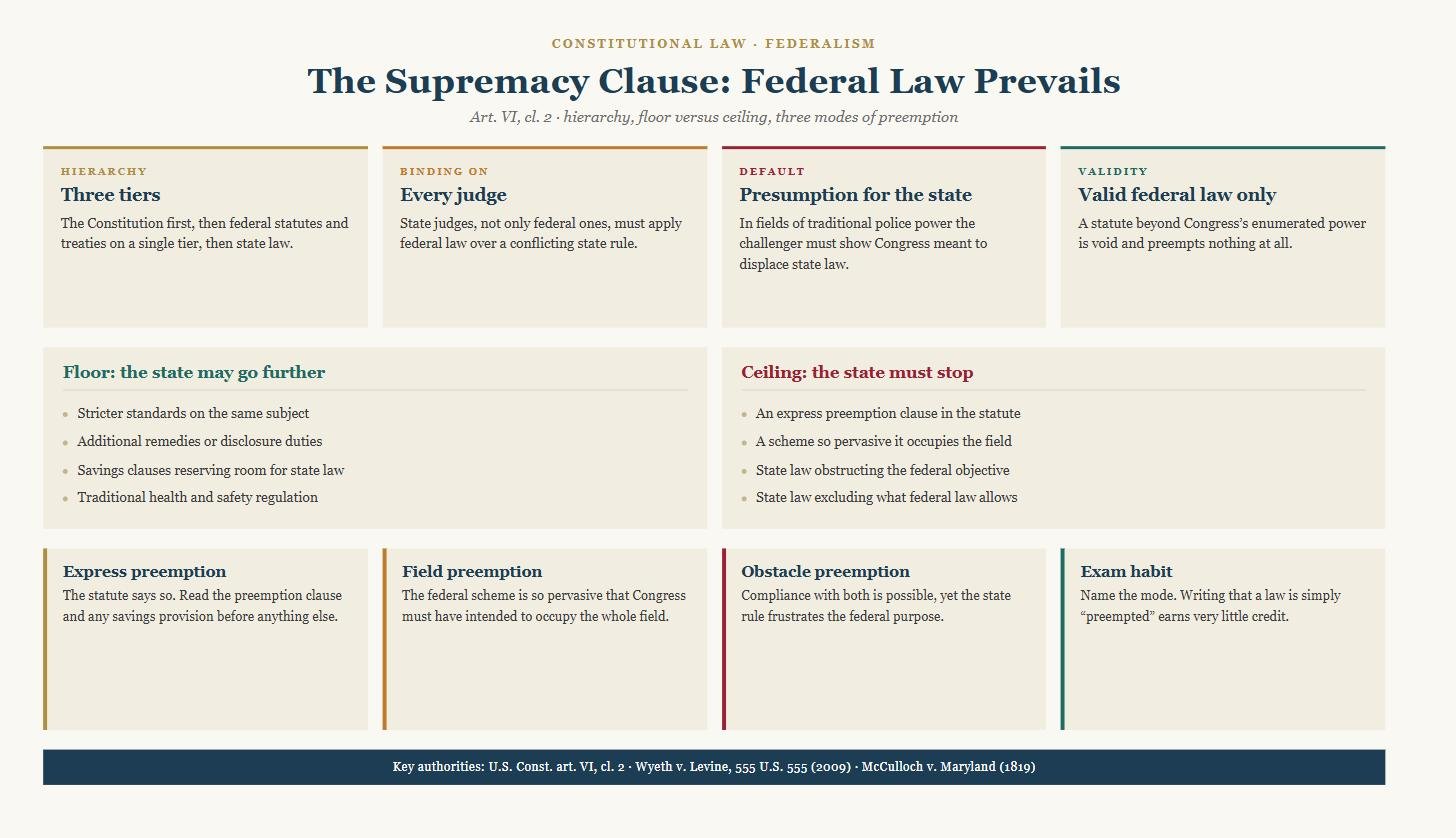
What Article VI actually establishes
The clause creates three tiers. The Constitution sits at the top. Federal statutes and treaties share the second tier. State law occupies the third, and that includes state constitutions, which are state law for these purposes and yield like any state statute.
A crucial qualifier hides in the phrase “in pursuance thereof”. Only valid federal law is supreme. A statute that exceeds Congress’s enumerated powers does not displace state rules, because it is not law at all. That gives the analysis a fixed order: first ask whether the federal statute rests on an enumerated power, then ask whether it displaces the state rule. Answers that skip the first step end up defending a statute that never needed defending.
Floors, ceilings and the question that decides most cases
The most expensive mistake in this area is assuming that a federal statute on a subject automatically clears the field. It usually does not. Most federal legislation sets a minimum standard — a floor — and leaves states free to be stricter. Environmental and consumer-protection statutes routinely include savings clauses that say so expressly, and states build on top of them all the time.
Some statutes do set a ceiling, occupying the field and leaving no room for supplementation. The choice belongs to Congress, so the question is one of intent, inferred from the text, the structure and the pervasiveness of the federal scheme. Where the subject is one of traditional state concern — health, safety, family law, professional licensing — courts begin from a presumption against preemption and require reasonably clear evidence that Congress meant to displace state law. Wyeth v. Levine (2009) is the modern statement of that presumption.
| Fact pattern | Result |
|---|---|
| State sets a stricter standard and the statute contains a savings clause | Valid — the federal rule is a floor |
| State adds a disclosure duty that reinforces the federal purpose | Usually valid |
| Statute contains an express preemption clause covering the state rule | Preempted expressly |
| Federal scheme is pervasive and leaves no room for supplementation | Preempted by field occupation |
| Compliance with both is possible, but the state rule frustrates the federal aim | Preempted as an obstacle |
| Federal statute exceeds Congress’s enumerated power | Nothing is preempted; the statute is void |
The three modes of preemption
Express preemption. The statute contains a clause displacing state regulation of the subject. Read it narrowly, and read it together with any savings clause; the two provisions jointly draw the boundary, and the savings clause often preserves more state room than the preemption clause first suggests.
Field preemption. Congress may occupy a field without saying so, where the federal scheme is so comprehensive that any state supplementation would disturb it. Immigration enforcement and nuclear safety are the standard illustrations.
Conflict preemption, which comes in two forms. Impossibility preemption applies where a party cannot obey both commands at once. Obstacle preemption is broader and far more litigated: dual compliance is technically possible, yet the state rule stands in the way of what Congress was trying to achieve.
Exam tip: never write that a law is simply “preempted”. Name the mode, then prove it. Express, field, impossibility or obstacle — each has a different trigger and a different kind of evidence.
State judges are bound too
The clause binds “the Judges in every State”. A state court hearing a state-law claim must apply federal law where the two conflict, and cannot decline on the ground that federal law is somebody else’s business. Without that duty a state could insulate its residents from federal law simply by keeping disputes in its own courts. Read together with Article III and Marbury v. Madison, the clause supplies the authority for judicial review of state legislation.
One caveat is worth remembering. Supremacy is not a solvent for every state protection. Alden v. Maine (1999) held that Congress cannot use a federal cause of action to subject an unconsenting state to private damages suits in its own courts. The clause tells a court which law wins in a conflict; it does not by itself create a forum or dissolve sovereign immunity.
Worked example
Congress enacts a statute setting a national minimum standard for gasoline composition and labelling, and adds a clause providing that states may impose additional requirements that do not frustrate federal objectives. State X then requires lower sulphur content than the federal minimum and mandates two extra labelling disclosures. Distributors sue, arguing preemption.
The distributors lose. The savings clause settles the intent question on the face of the statute: Congress set a floor. The stricter sulphur limit does not make federal compliance impossible, because a distributor meeting the state limit necessarily meets the federal one. The additional disclosures serve the same consumer-information purpose as the federal labelling rules, so they obstruct nothing. Neither express, field nor conflict preemption applies.
Change one fact. Suppose the statute instead declares the federal composition standard to be the exclusive standard for fuels sold in interstate commerce. Now the state limit is expressly preempted, and the fact that it is stricter and well intentioned is beside the point.
Common mistakes that cost points
- Assuming that any federal statute on the subject clears the field. Most statutes set floors, not ceilings.
- Skipping the validity step. Only law made in pursuance of the Constitution is supreme, so an ultra vires statute preempts nothing.
- Ignoring savings clauses. They frequently preserve exactly the state rule the question is testing.
- Treating supremacy as a federal-court doctrine. State judges are bound by the clause by its own terms.
- Confusing supremacy with the dormant Commerce Clause. The first requires a federal statute; the second operates in the silence of Congress.
- Concluding that a law is preempted without naming and proving a mode of preemption.
Frequently asked questions
Do treaties outrank federal statutes?
No. Both occupy the same tier of supreme law. As a matter of domestic law the later enactment generally controls, so a self-executing treaty can be superseded by a subsequent statute and a statute can be superseded by a later treaty.
Can a state constitution override a federal statute?
No. State constitutions are state law for supremacy purposes and yield to valid federal law exactly as an ordinary state statute would.
Is the Supremacy Clause the same thing as preemption?
Not quite. The clause is the constitutional source; preemption is the body of doctrine courts have built to decide when federal law displaces state law. Every preemption argument is ultimately an Article VI argument.
The Supremacy Clause in California practice, 2026
The Supremacy Clause makes federal law binding on state judges notwithstanding anything in state law, and California furnishes unusually clean illustrations because the state so often takes a different substantive view from Washington. The clause resolves the hierarchy; it does not decide how much federal law actually says.
Three points drive California practice. First, state courts must hear federal claims: the Los Angeles Superior Court cannot refuse jurisdiction over a section 1983 action merely because it arises under federal law. Second, the California Constitution yields where it conflicts with valid federal law, though it may grant broader individual rights where federal law sets only a floor. Third, and most importantly, supremacy is not the same as commandeering. California may refuse to lend its own officers to federal enforcement, which is why its limits on local cooperation with immigration authorities largely survived challenge.
Where the clause bites in Los Angeles County:
- Cannabis is the standing example. State licensing under Proposition 64 does not repeal the federal Controlled Substances Act, so licensed county operators remain federally unlawful.
- State courts apply federal law faithfully. A Los Angeles judge is bound by United States Supreme Court holdings, though not by lower federal court decisions.
- Broader state rights are permitted. California may give more speech, privacy or criminal procedure protection than the federal minimum, and frequently does.
- Federal officers enjoy immunity from state regulation. Intergovernmental immunity bars the county from regulating federal operations directly.
- Federal enclaves follow federal law. Portions of military and federal installations in the county operate under a distinct legal regime.
- Treaties count as supreme law. Self-executing treaty provisions bind California courts on the same terms as statutes.
The 2026 instruction is to separate three questions that students routinely merge: whether federal law is valid, whether it conflicts, and whether it compels state assistance. See preemption for the conflict analysis, anti-commandeering for the compulsion limit, and intergovernmental immunity.
Next steps
Read this next to intergovernmental immunity, the categorical cousin of preemption, then the Commerce Clause and the Necessary and Proper Clause for the validity question that comes first, the dormant Commerce Clause for what happens when Congress has said nothing, and Marbury v. Madison for the source of judicial review.
For primary sources, read the text of Article VI on Cornell Legal Information Institute, review Wyeth v. Levine on Justia, and confirm current subject coverage with the State Bar of California.
Related guides
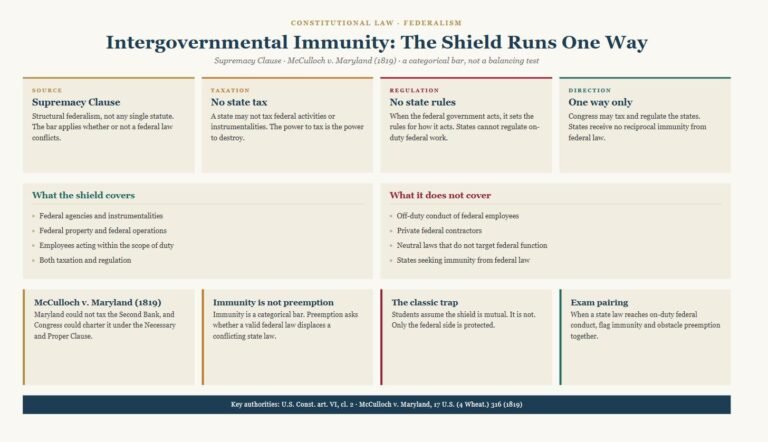 Intergovernmental Immunity: The Shield Runs One Way
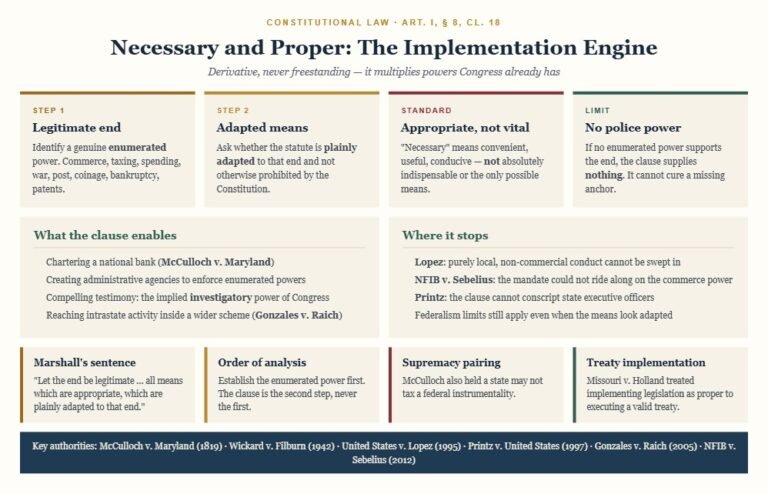 The Necessary and Proper Clause: Congress’s Multiplier
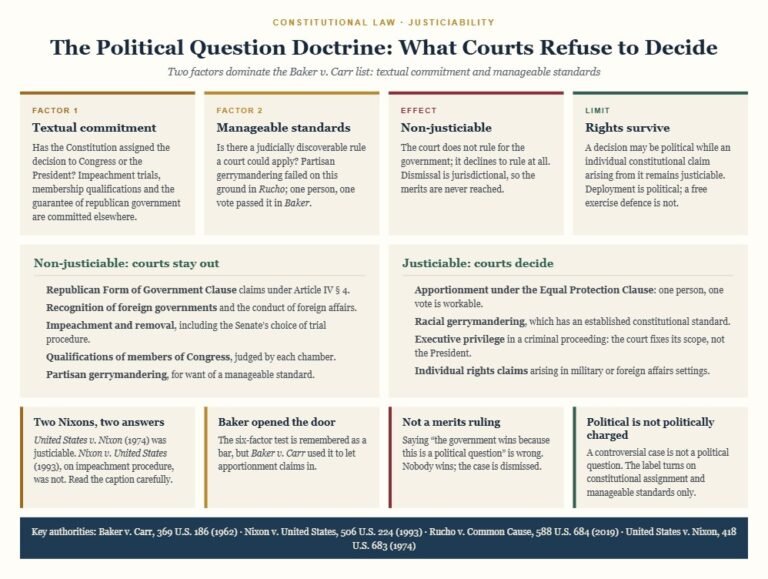 Political Question Doctrine: What Courts Will Not Decide
 The Rule Against Perpetuities Explained Step by Step
 The Treaty Power: Senate Advice and Consent Explained
 Contracts Clause: When States May Impair Agreements
 3 Levels of Scrutiny in Constitutional Law Explained
 Full Faith and Credit: Recognising Sister-State Judgments
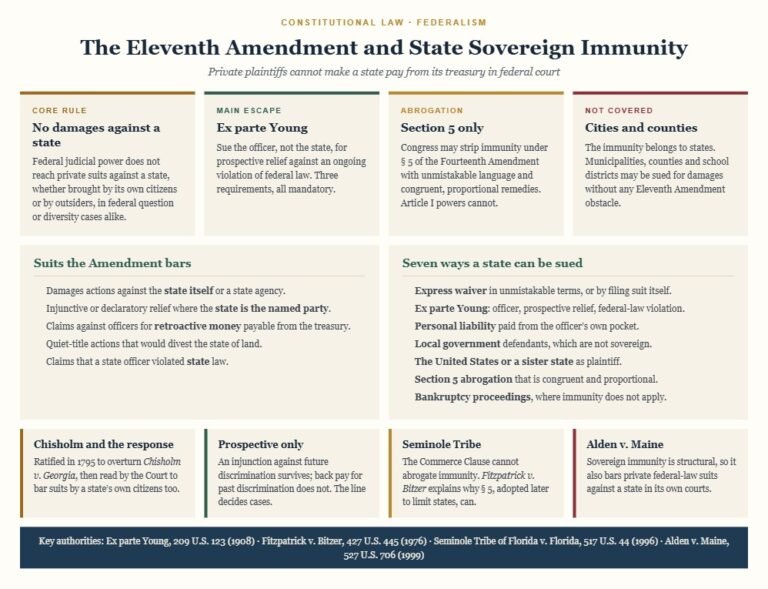 The Eleventh Amendment and State Sovereign Immunity
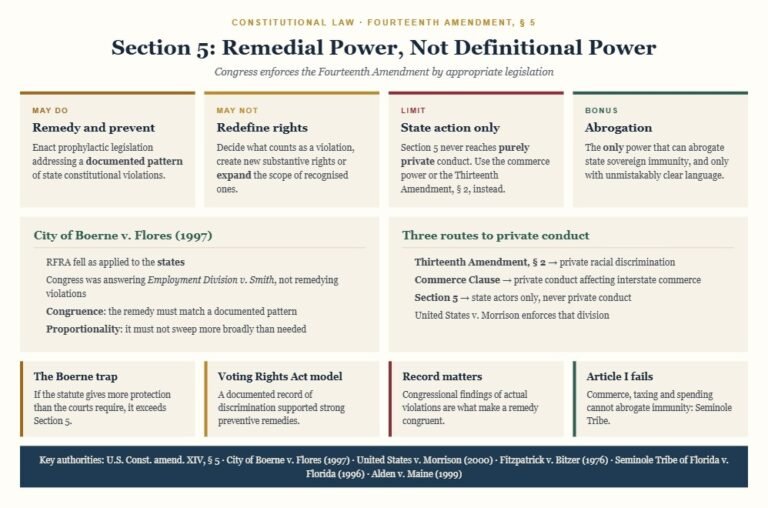 Section 5 Enforcement Power: Remedy, Do Not Redefine
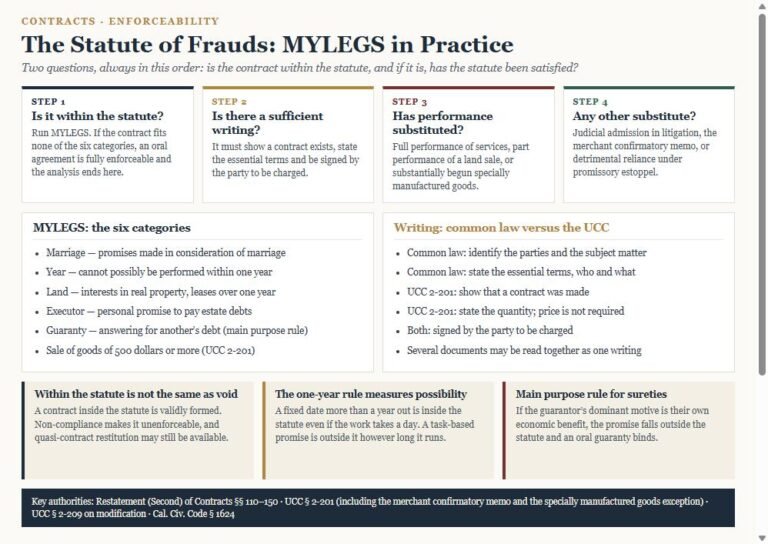 The Statute of Frauds: MYLEGS and How to Satisfy It
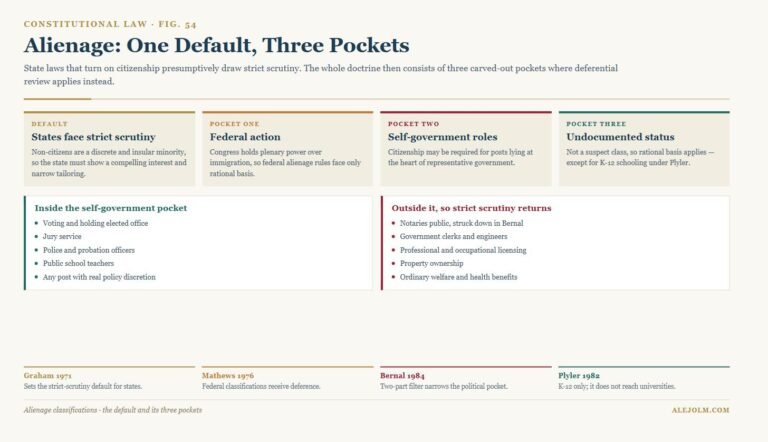 Alienage Classifications: Strict Scrutiny and Its Pockets