
Public figure status is the classification that decides how hard a defamation claim will be to win. Before any court examines whether a statement was false or damaging, it asks what kind of claimant is suing. A public figure must prove actual malice, meaning knowledge of falsity or reckless disregard for the truth, while a private claimant faces a far lighter burden.
The category comes from constitutional defamation law and applies in California courts alongside the state statutes on libel and slander. This guide sets out the two kinds of public figure, the three-part test for limited-purpose status, the treatment of people dragged into the news against their will, and the timing rule that decides status as of the date of publication.
Why the classification comes first
Defamation law balances reputation against speech. The compromise the courts reached was not to change what counts as a defamatory statement, but to change how much fault the claimant must prove depending on who the claimant is and what the statement is about. That makes classification the gateway question in every case.
Get it wrong and the rest of the analysis is wasted. A claimant wrongly labelled a public figure faces an almost insurmountable burden. A defendant wrongly denied the actual malice protection loses a defence the Constitution guarantees.
All-purpose public figures
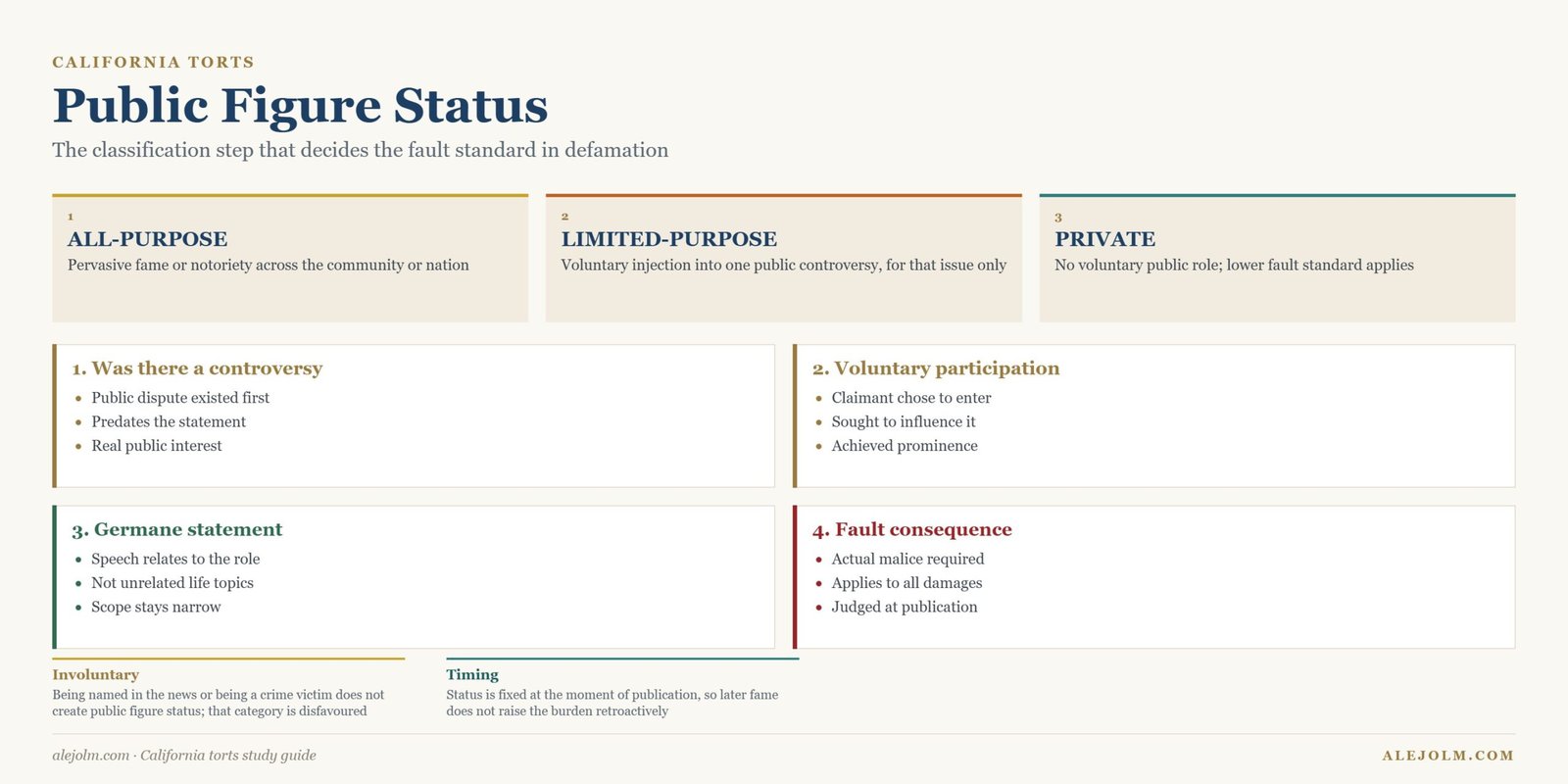
An all-purpose public figure has pervasive fame or notoriety, the kind that makes the name recognisable across the community or the nation. National politicians, major celebrities and prominent sports figures fall into this group. The test is genuinely demanding, and general prominence within a profession or a local area usually does not reach it.
For an all-purpose public figure, actual malice is required to recover anything at all, whether presumed, punitive or actual damages. The status attaches to the person rather than the subject, so the standard applies whatever the statement was about.
Limited-purpose public figures
The limited-purpose category covers a person who voluntarily enters a particular public controversy and becomes prominent within it. That person is a public figure for that issue and for nothing else. Courts approach the question through a three-part inquiry.
- A public controversy existed before the statement complained of.
- The claimant voluntarily and prominently participated in that controversy.
- The participation aimed to influence the outcome rather than being incidental.
- The statement is germane to the role the claimant took in the dispute.
- Prominence was actually achieved, not merely sought.
- Scope stays narrow, covering the controversy and not the whole life of the claimant.
What voluntary participation looks like
A physician who campaigns publicly for a particular treatment protocol becomes a limited-purpose public figure for that medical debate. A resident who repeatedly addresses a city council about a development project becomes one for the land use dispute. In both cases the person chose the platform and sought to shape the result.
Where the status ends
The status is tied to the controversy. Criticism of the campaigning physician on an unrelated personal matter is judged by the private claimant standard. Most courts also treat the status as fading once the controversy is genuinely over, although authority on that point is not uniform.
Involuntary public figures
Being thrust into the news does not make a person a public figure. A crime victim, a bystander named in a report, or an employee mentioned in coverage of a company scandal has not chosen any public role. Some older decisions recognised a narrow involuntary category, but modern courts apply it rarely and many reject it outright.
| Claimant type | Fault required | Applies to | Practical difficulty |
|---|---|---|---|
| All-purpose public figure | Actual malice | All damages | Very high |
| Limited-purpose public figure | Actual malice, within the controversy | All damages on that issue | Very high |
| Private claimant, public concern | Negligence for actual damages | Actual damages; malice for presumed or punitive | Moderate |
| Private claimant, private matter | Lowest common law standard | All damages | Lowest |
Burden of proof and damages
A public figure must prove both that the statement was false and that the defendant published it with actual malice, established by clear and convincing evidence. Falsity is not presumed, so the burden shifts to the claimant in a way it does not in ordinary private disputes.
Private claimants suing over statements on matters of public concern still face a heightened standard. They must show at least negligence to recover actual damages, and they must show actual malice before presumed or punitive damages become available. Only a private claimant suing over a purely private matter escapes the constitutional overlay entirely.
A worked example
A Los Angeles restaurateur speaks at several public hearings opposing a new street closure, gives interviews and organises a petition. A local news site then publishes a claim that the restaurateur secretly took money from a developer to oppose the closure. That claim is germane to the controversy the restaurateur voluntarily entered, so limited-purpose public figure status applies and actual malice must be proved.
Change the statement. Suppose the same site instead published a false claim that the restaurateur had cheated on a tax return years earlier, with no connection to the street closure. The subject is unrelated to the controversy, so the limited-purpose status does not reach it and the ordinary private claimant analysis applies.
Public figure status in California and Los Angeles County in 2026
California defines libel and slander by statute in the Civil Code, and those definitions operate alongside the constitutional fault standards. The Judicial Council civil jury instructions give separate charges for public officials, public figures and private claimants, which is the clearest practical guide to how a Los Angeles County jury will be told to approach the question.
California also has an active anti-SLAPP procedure, which allows early dismissal of claims arising from protected speech on matters of public interest unless the claimant can show a probability of prevailing. That makes classification a question litigated at the very start of a case rather than at trial.
- Statutory definitions — the Civil Code sets out libel and slander and the categories treated as actionable without proof of special damage.
- Jury instructions — separate Judicial Council charges exist for public official, public figure and private claimant cases.
- Anti-SLAPP motions — status and fault are commonly tested at an early special motion to strike.
- Clear and convincing proof — actual malice must be shown to that heightened standard.
- Retraction rules — statutory retraction demands can limit recoverable damages against certain publishers.
- Timing — courts assess status as of the date of publication, not the date of trial.
For 2026, confirm the current California authority on public figure classification, anti-SLAPP procedure and retraction demands directly with current authority, since these continue to develop.
Common mistakes to avoid
- Treating fame as enough — general prominence in a profession or town rarely creates all-purpose status, which needs pervasive notoriety.
- Finding voluntary injection without a choice — mere involvement in a newsworthy event does not create limited-purpose status.
- Stretching the controversy — limited-purpose status covers the specific dispute entered, not every later topic.
- Overlooking private claimants on public issues — they still face a negligence standard rather than the old no-fault rule.
- Applying status retroactively — later fame does not raise the burden for an earlier publication.
- Reviving the involuntary category — most modern courts reject it, so it should not be the first argument.
Frequently asked questions
Who counts as an all-purpose public figure?
Someone with pervasive fame or notoriety across the community or the nation. The category is narrow and generally reaches household names rather than people who are simply well known within an industry or a neighbourhood.
Can a private person become a public figure by accident?
Almost never. The doctrine requires a voluntary decision to enter a public controversy and seek to influence it. Being named in coverage or being the victim of a widely reported crime does not qualify.
Does public figure status ever expire?
Limited-purpose status is tied to a controversy, and many courts treat it as ending when that controversy genuinely ends. Courts are divided, and all-purpose status tends to persist as long as the underlying fame does.
What must a public figure prove about the statement?
Both falsity and actual malice, meaning the defendant knew the statement was false or acted with reckless disregard for its truth. Actual malice must be established by clear and convincing evidence.
Why does anti-SLAPP matter to this question?
Because California allows a defendant to challenge a claim arising from protected speech at an early stage. Classification and fault are therefore often decided on motion, long before trial, which raises the practical stakes of getting the category right.
Related guides
 Intentional Infliction of Emotional Distress
- Defamation Privileges
- Fraud
- Defamation
- Abuse of Process
- Invasion of Privacy
- Malicious Prosecution
- Actual Malice Standard
Next steps
Read this alongside defamation for the underlying elements, then move to the actual malice standard to see what the heightened fault requirement demands in practice.
For primary sources, read California Civil Code section 45 and the civil jury instructions published by the Judicial Council of California.