
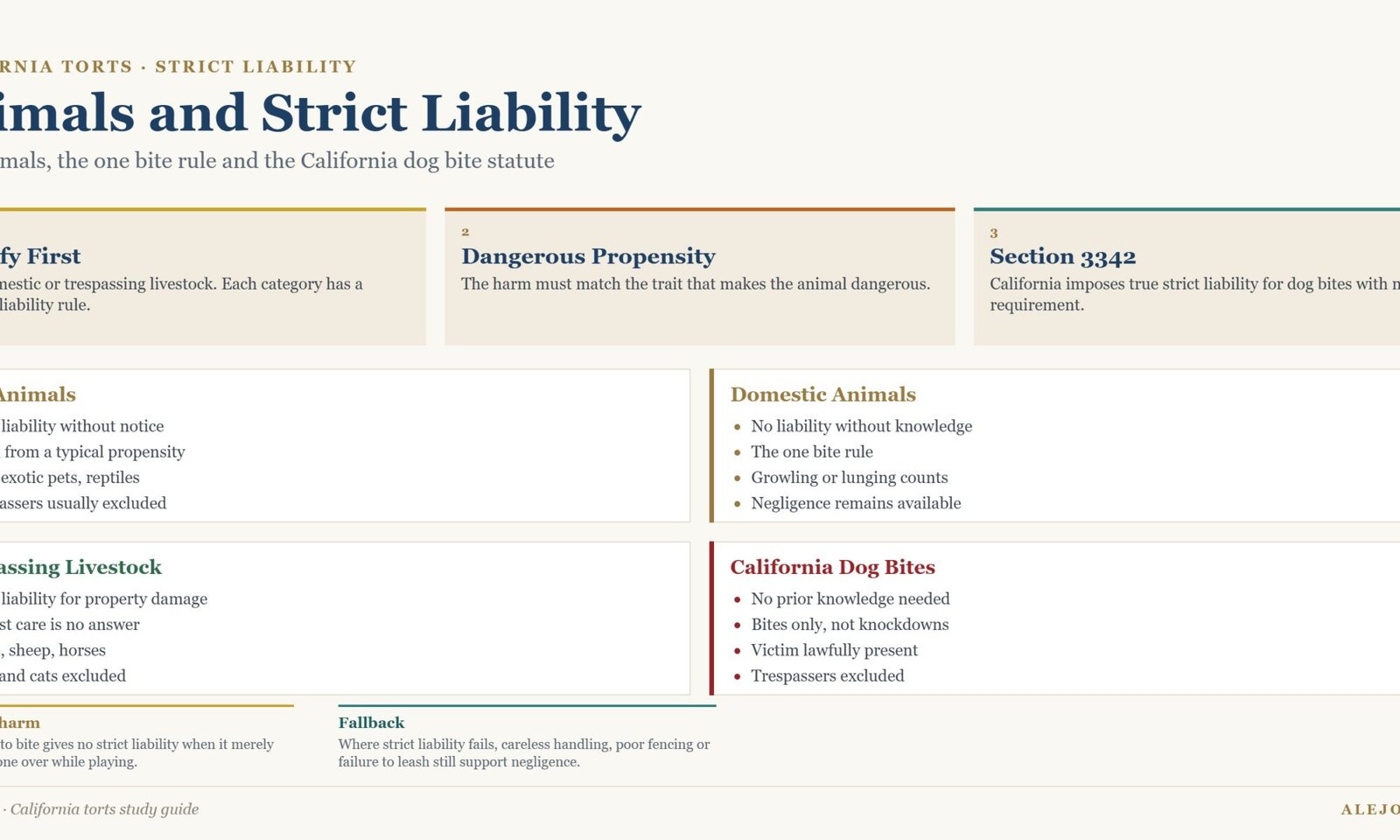
Animals and strict liability is a small doctrine with an unusual number of traps, because the rule depends entirely on classification. A tiger that escapes a zoo, a family dog that bites a postal worker, and a bull that wanders onto a neighbour field are governed by three different rules, and choosing the wrong one destroys the analysis before it begins.
Two ideas run through all of them. The keeper of an animal answers for the danger that is characteristic of that animal, and for domestic animals the law adds a knowledge requirement that California has removed for dog bites by statute.
Wild animals
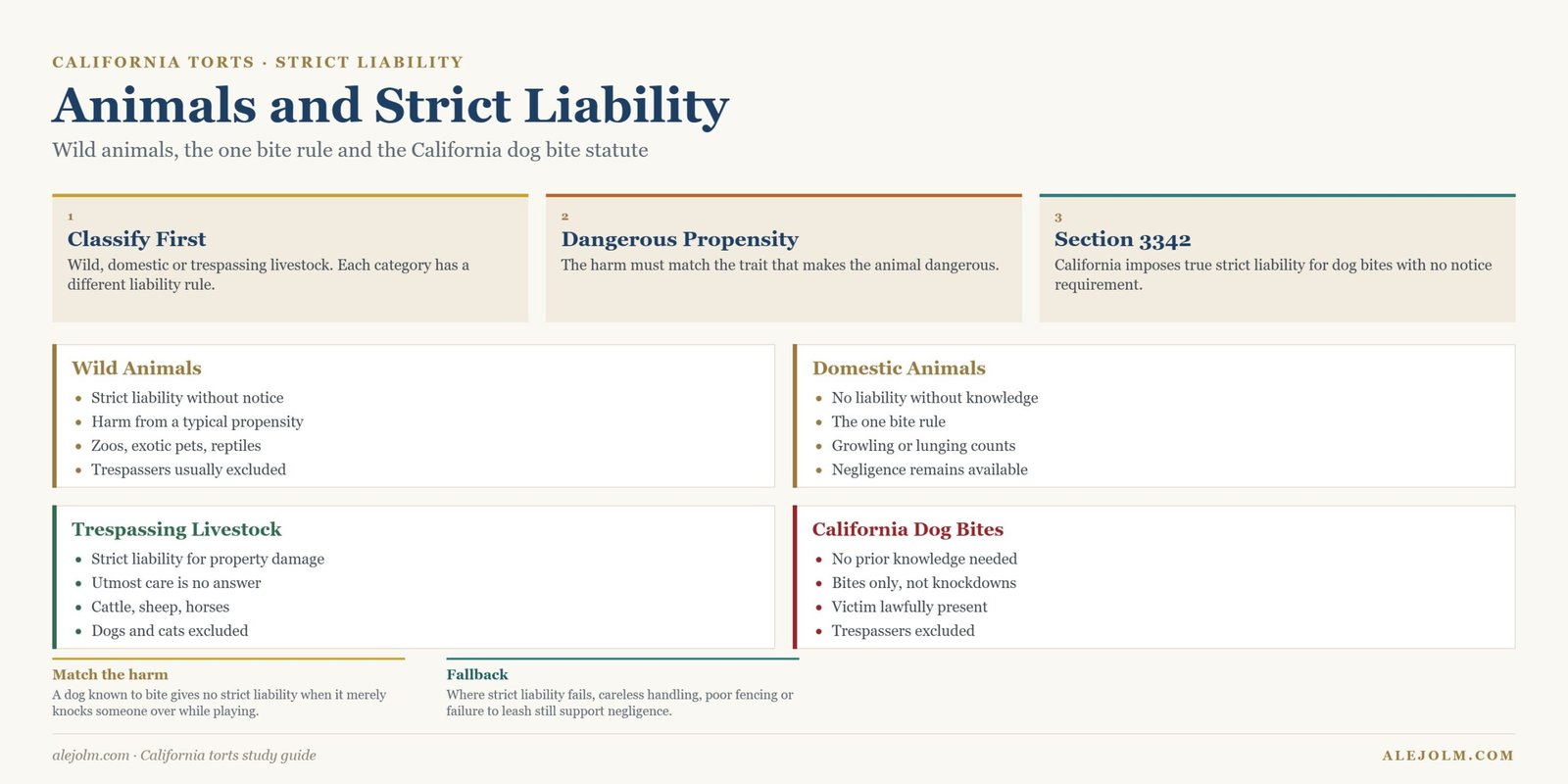
A person who keeps a wild or abnormally dangerous animal is strictly liable for harm caused by the animal dangerous propensity, and no notice or knowledge is required. Big cats, bears, primates, venomous snakes and similar creatures fall within it. The keeper cannot argue that this particular animal was tame, because the law treats the species characteristics as sufficient warning.
The limitation is that the harm must flow from the propensity typical of the animal. A venomous snake that bites engages the rule. The same snake that causes a car to crash by becoming tangled in the steering does not, and the case reverts to negligence. A bear that mauls is within it; a bear that tramples a flower bed is not.
Domestic animals and the one bite rule
There is no strict liability for a domestic animal unless the keeper knows or has reason to know that it has a dangerous propensity abnormal for its kind. That is the origin of the phrase one bite, which is misleading in two ways. No actual bite is required, since growling, lunging, snapping or any prior aggression that puts the owner on notice will do. And once notice exists, the owner keeps the animal at their peril.
Ordinary animal behaviour does not count. A friendly dog that jumps up, or a horse that startles at a loud noise, is doing what such animals do, and any claim lies in negligence for careless handling rather than in strict liability.
Trespassing livestock
The owner of livestock and most other animals, with dogs and cats excluded, is strictly liable for property damage caused when the animals stray onto another person land. Utmost care is no answer. The exclusion of dogs and cats reflects the reality that they are not kept penned and are expected to roam, and it is the reason a wandering rabbit can generate liability that a wandering cat cannot.
| Animal | Liability | Knowledge required | Propensity must match |
|---|---|---|---|
| Wild animal | Strict | No | Yes |
| Domestic animal | Only with knowledge | Yes | Yes |
| Abnormally dangerous domestic animal | Strict | Yes, knew or should have known | Yes |
| Trespassing livestock | Strict for property damage | No | Not applicable |
Trespassers
Strict liability generally does not run in favour of a trespasser injured by a dangerous animal, because the presence of the intruder was not something the keeper was bound to anticipate. The point connects to the wider law of premises liability, and it also limits the California dog bite statute, which applies only where the victim was lawfully present.
A worked example
A neighbour keeps a serval, a wild cat, in a garden enclosure. It escapes and bites a passer-by. Strict liability applies without any inquiry into the enclosure or the animal history, because a wild animal has caused harm through the very propensity that makes it wild. Suppose instead the escaped serval startles a cyclist who falls. That harm does not flow from the biting or clawing propensity, so strict liability is doubtful and the claim proceeds in negligence over the enclosure.
Animals and Strict Liability in California and Los Angeles County in 2026
California departs sharply from the common law for dog bites. Civil Code section 3342 makes the owner of a dog liable for damages suffered by any person bitten in a public place or lawfully on private property, regardless of the former viciousness of the dog or the owner knowledge of it. That is true strict liability, and the one bite rule simply does not apply to bites in California.
The statute is narrower than people assume. It covers bites and nothing else, so a dog that knocks a cyclist over, chases a horse, or frightens a child into the road is outside it, and those claims run in negligence or under local leash ordinances through negligence per se. It also requires lawful presence, so trespassers are excluded, and there are limited provisions for governmental and military dogs.
- Section 3342. Strict liability for dog bites, no prior knowledge required, victim must be lawfully present.
- Bites only. Knockdowns, scratches and fright fall outside the statute and are litigated in negligence.
- Leash ordinances. Local rules frequently supply a statutory standard of care in non-bite cases.
- Dangerous dog procedures. Administrative processes for declaring a dog dangerous run alongside civil liability.
- Wild and exotic animals. Possession is heavily restricted by permit, and unlawful possession strengthens a negligence claim.
- Comparative fault. Provocation and a claimant own carelessness reduce recovery under comparative negligence.
For 2026, confirm the current California authority on section 3342, local leash and dangerous dog ordinances in Los Angeles County, and exotic animal permitting directly with current authority, since these continue to develop.
Common mistakes to avoid
- Applying the one bite rule in California. Section 3342 removes the notice requirement for bites entirely.
- Treating ordinary behaviour as a dangerous propensity. Only abnormal, known tendencies support strict liability for domestic animals.
- Failing to match harm to propensity. A biter that knocks someone over is not a strict liability case.
- Requiring notice for wild animals. Keepers of wild animals are strictly liable regardless of what they knew.
- Forgetting trespassers. Strict liability generally does not extend to them, and the dog bite statute requires lawful presence.
- Stopping at strict liability. Negligence remains available for poor fencing, careless handling and leash violations.
Frequently asked questions
What is the one bite rule?
The common law principle that a keeper of a domestic animal is strictly liable only once on notice of a dangerous propensity. No actual bite is needed; any prior aggression that alerts the owner is enough.
Does California follow the one bite rule?
Not for bites. Civil Code section 3342 imposes strict liability on dog owners for bites regardless of any prior knowledge, provided the victim was in a public place or lawfully on private property.
Are owners of wild animals always liable?
They are strictly liable for harm caused by the dangerous propensity typical of the animal, without any notice requirement, but not for harm unrelated to that propensity.
What happens if a dog knocks someone over rather than biting?
Section 3342 does not apply. The claim proceeds in ordinary negligence, often supported by a local leash ordinance used as a statutory standard of care.
Can a trespasser recover for a dog bite?
Generally not under the statute, which requires the victim to have been lawfully present. A negligence claim remains theoretically possible but faces the usual limits on duties owed to trespassers.
Related guides
- Strict Liability in Tort Law: Liability Without Fault
- Abnormally Dangerous Activities: The Six Factor Test
- Negligence Per Se: Using a Statute to Prove Breach
- Premises Liability in California and Los Angeles County
- The Four Elements of Negligence: Bar Exam Breakdown
- Comparative Negligence in California: How Fault Is Split
- Assumption of Risk in California: Primary and Secondary
- Trespass to Land in California: Elements and Remedies
Next steps
Read our guide to strict liability for the umbrella doctrine, then negligence per se, which supplies the standard of care in most non-bite animal cases.
For primary sources, read California Civil Code section 3342 and the animal liability instructions published by the Judicial Council of California.