
The necessary and proper clause of Article I, § 8, cl. 18 lets Congress make all laws needed to carry its other powers into execution. It is the most consequential sentence in the article and the most misunderstood, because it grants no power of its own. It multiplies powers Congress already holds.
This guide explains the two-part test drawn from McCulloch v. Maryland, why the word necessary means appropriate rather than indispensable, what the clause makes possible in practice, and the points at which Lopez, Printz and NFIB v. Sebelius mark its outer boundary.
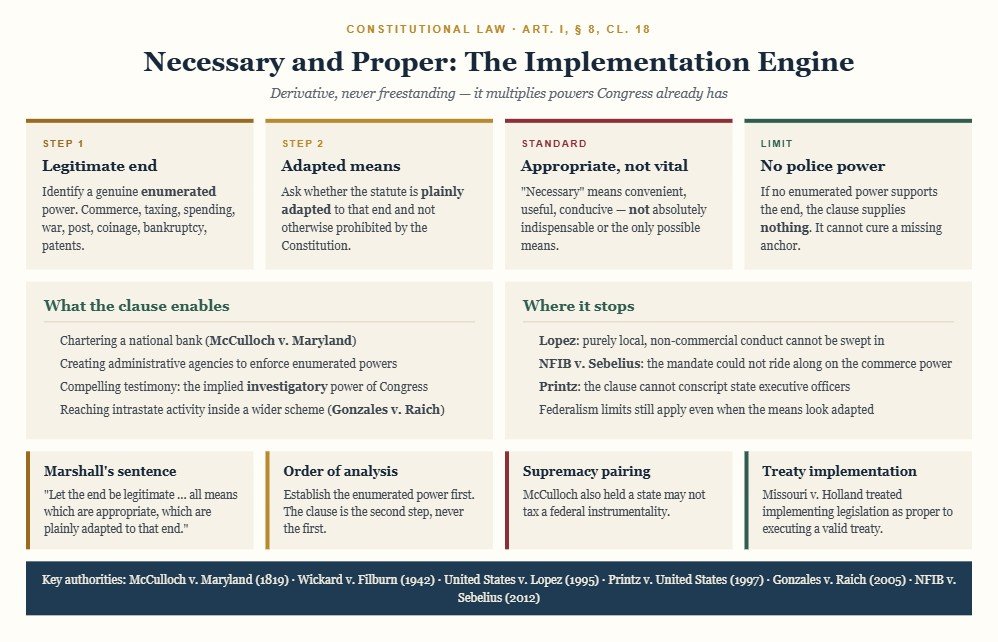
A derivative power, not a freestanding one
The text is explicit: Congress may make laws necessary and proper for carrying into execution the foregoing powers. The clause therefore attaches to something else. Without an enumerated anchor there is nothing to carry into execution and nothing for the clause to authorise.
This is why the order of analysis matters so much. Establish the primary power first, then ask whether the chosen means are appropriate. An answer that opens with the necessary and proper clause has skipped the only step that can fail.
Exam tip: the clause is the amplifier, not the foundation. If the enumerated power is doubtful, the clause cannot rescue the statute.
The McCulloch test
Chief Justice Marshall’s formulation remains the black-letter rule. Let the end be legitimate and within the scope of the Constitution, and all means which are appropriate, which are plainly adapted to that end, which are not prohibited but consist with the letter and spirit of the Constitution, are constitutional.
That single sentence supplies a two-part inquiry. First, is the end an enumerated power? Second, are the means plainly adapted to it and not independently forbidden? The second step is deliberately deferential: Congress chooses among many possible implementations and courts do not second-guess the choice.
Necessary means appropriate
McCulloch rejected the argument that necessary means absolutely indispensable. It means convenient, useful and conducive to the enumerated end. Many different statutes can be necessary and proper to the same power, which is precisely the point of an implementation clause.
What the clause makes possible
Without it, the enumerated powers would be hollow. Congress could regulate interstate commerce but could not create an agency to administer the regulation, could tax but could not build a collection apparatus, and could legislate but could not compel the testimony needed to legislate intelligently.
- Chartering a national bank as a means of executing the taxing, spending and war powers, which was the actual holding of McCulloch.
- Creating regulatory agencies and giving them enforcement tools.
- Exercising the implied investigatory power, including compelling witnesses before committees.
- Reaching intrastate activity where doing so is essential to a broader regulatory scheme, as in Gonzales v. Raich.
Where the clause runs out
The hard cases separate a genuine means from a statute that usurps a power Congress does not have and invokes the clause as cover. United States v. Lopez struck down the Gun-Free School Zones Act because possession of a firearm near a school was neither commerce nor economic activity, so no amount of implementation language could supply the missing anchor.
NFIB v. Sebelius made the same point about the individual mandate: because compelling people to enter a market exceeded the commerce power, the mandate could not be sustained as a necessary and proper adjunct to it. Printz v. United States added a structural limit, holding that the clause cannot be used to conscript state executive officers into administering a federal programme.
| Statute | Anchor power | Outcome |
|---|---|---|
| Charter of the Second Bank of the United States | Taxing, spending, war | Valid: an appropriate means (McCulloch) |
| Wheat quotas reaching home consumption | Commerce | Valid: means adapted to a market-wide scheme (Wickard) |
| Federal control of intrastate marijuana | Commerce | Valid: essential to a comprehensive scheme (Raich) |
| Guns near schools | None established | Invalid: no commercial anchor (Lopez) |
| Individual insurance mandate | Commerce | Invalid on that basis (NFIB), later upheld as a tax |
| Duty on local sheriffs to run background checks | Commerce | Invalid: commandeering state officers (Printz) |
Worked example: the federal education agency
Congress creates a Federal Education Agency and sets minimum curricular standards for schools nationwide, justifying the statute as necessary and proper to the spending power. Start with the anchor. Congress may spend for the general welfare and may attach conditions to federal grants, so the spending power is genuine. Are curriculum standards plainly adapted to how federal education money is used? Plausibly yes.
The analysis does not end there. Even a statute that satisfies the McCulloch test must survive the independent federalism limits, including the conditional-spending conditions and the anti-commandeering rule. A standard offered as a condition of a grant stands on a different footing from a standard imposed as a direct command to states.
Change the anchor and the answer flips. If Congress asserted a general power to improve education without tying the statute to spending or commerce, there would be no enumerated end at all, and the clause would supply nothing.
Common mistakes that cost points
- Treating the clause as an independent grant of power. It is derivative and requires an anchor.
- Reading necessary as indispensable. McCulloch expressly rejected that reading.
- Using the clause to repair a failed enumerated-power argument, which Lopez and NFIB forbid.
- Skipping the second half of Marshall’s sentence, which requires that the means not be otherwise prohibited.
- Forgetting that federalism doctrines apply independently, so a technically adapted statute can still fall.
- Ignoring Printz, which blocks implementation through state executive officers.
- Overlooking the implied investigatory power, a favourite context for testing the clause.
- Analysing the clause first instead of identifying the primary power first.
Frequently asked questions
Is the clause the same as the general welfare clause?
No. The general welfare language in Article I, § 8, cl. 1 defines the purposes of taxing and spending. The necessary and proper clause supplies means for executing any enumerated power.
How much deference do courts give to the means chosen?
Considerable. The question is whether the means are rationally adapted to the end, not whether they are the best or least intrusive means available.
Can the clause support a federal police power?
No. The absence of a general federal police power is the reason the clause must always be tethered to an enumerated end.
The Necessary and Proper Clause in California, 2026
The clause does not create free-standing power; it lets Congress choose the means of executing powers granted elsewhere, and since McCulloch v. Maryland the test has been whether the means is rationally adapted to a legitimate end rather than strictly indispensable. California supplies two illustrations that repay study.
The first is drug enforcement. In Gonzales v. Raich (2005), which arose from medical cannabis cultivation authorised by California law, the Court sustained federal reach over purely local activity partly on the reasoning that closing loopholes was a necessary and proper means of making a comprehensive interstate regulatory scheme work. The second is the federal courts’ supervision of California’s prison system, where relief ultimately extended to a court-ordered reduction in the state prison population, illustrating how far implementing authority can travel once a valid federal end is established.
Points that matter in Los Angeles County practice:
- Identify the anchor power first. The clause is always parasitic, so name the commerce, taxing, postal or war power it is executing before arguing about means.
- Rationality is the standard, not necessity. Courts ask whether the means plausibly serves the end, which is a deferential enquiry.
- Great substantive powers cannot be smuggled in. NFIB v. Sebelius confirmed the clause cannot supply authority Congress otherwise lacks.
- Federal facilities depend on it. Courthouses, postal operations and federal detention in the county rest on implementing legislation rather than express textual grants.
- State law is displaced, not consulted. Where the means is valid, California’s contrary policy choice is irrelevant to the power question.
- Structural limits still apply. The clause cannot authorise commandeering state officers or violating individual rights.
For 2026, treat this as a two-step: valid end, then rationally adapted means. Read with the Commerce Clause, the taxing power and the nondelegation doctrine.
Next steps
The clause is almost always paired with another power, so revise it alongside them. Read The Commerce Clause: 3 Categories and 2 Hard Limits, then Congress’s Taxing Power: When a Penalty Is Really a Tax and Dormant Commerce Clause: Discrimination vs Pike Balancing for the state-side mirror image.
For primary sources, read McCulloch v. Maryland and United States v. Lopez at Justia, the annotation to the necessary and proper clause at Cornell LII, and the examination scope published by the State Bar of California.
Related guides
 Alienage Classifications: Strict Scrutiny and Its Pockets
 3 Levels of Scrutiny in Constitutional Law Explained
 Full Faith and Credit: Recognising Sister-State Judgments
 Supreme Court Jurisdiction: Original vs Appellate Power
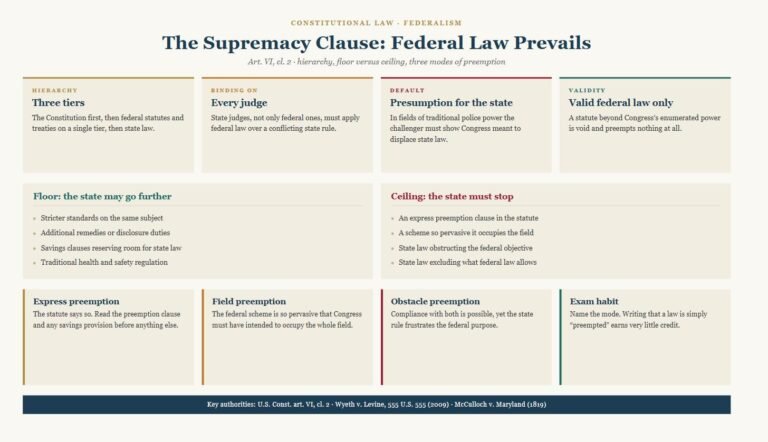 The Supremacy Clause: Floors, Ceilings and Preemption
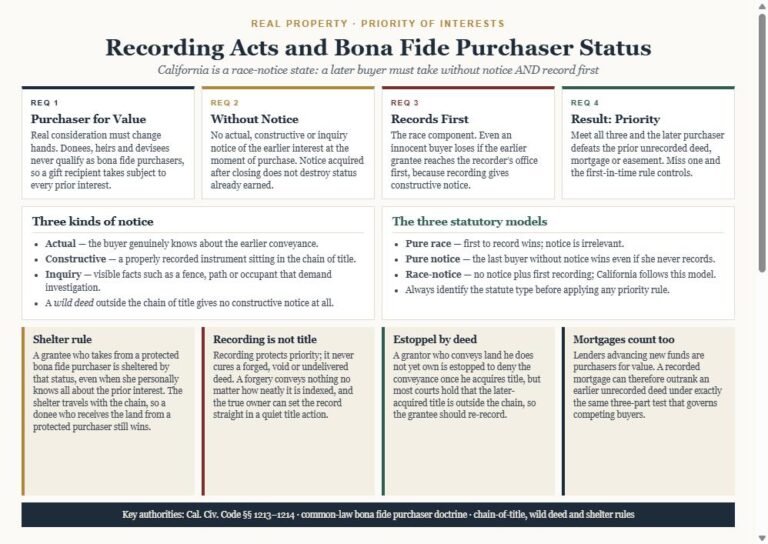 Recording Acts: Race, Notice and Race-Notice Explained
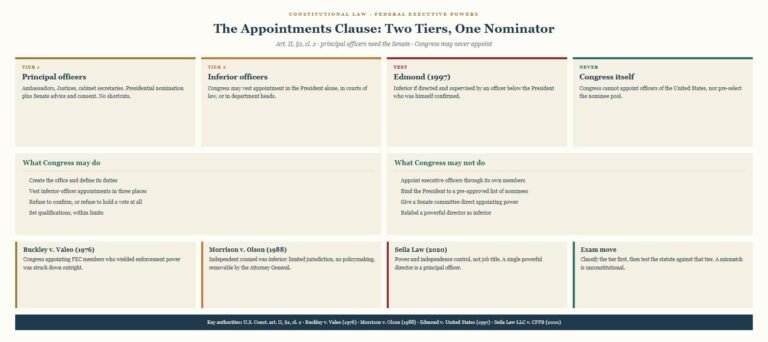 The Appointment Power: Principal and Inferior Officers
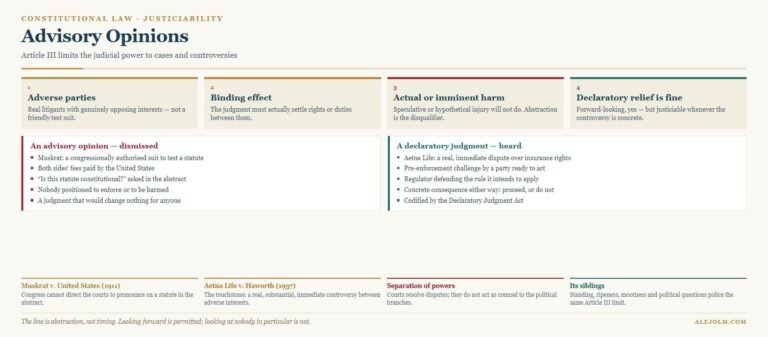 Advisory Opinions: Article III and Declaratory Relief
 The Rule Against Perpetuities Explained Step by Step
 The Statute of Frauds: MYLEGS and How to Satisfy It
 Contracts Clause: When States May Impair Agreements
 Symbolic Conduct and the O’Brien Test: The Pivot Question