
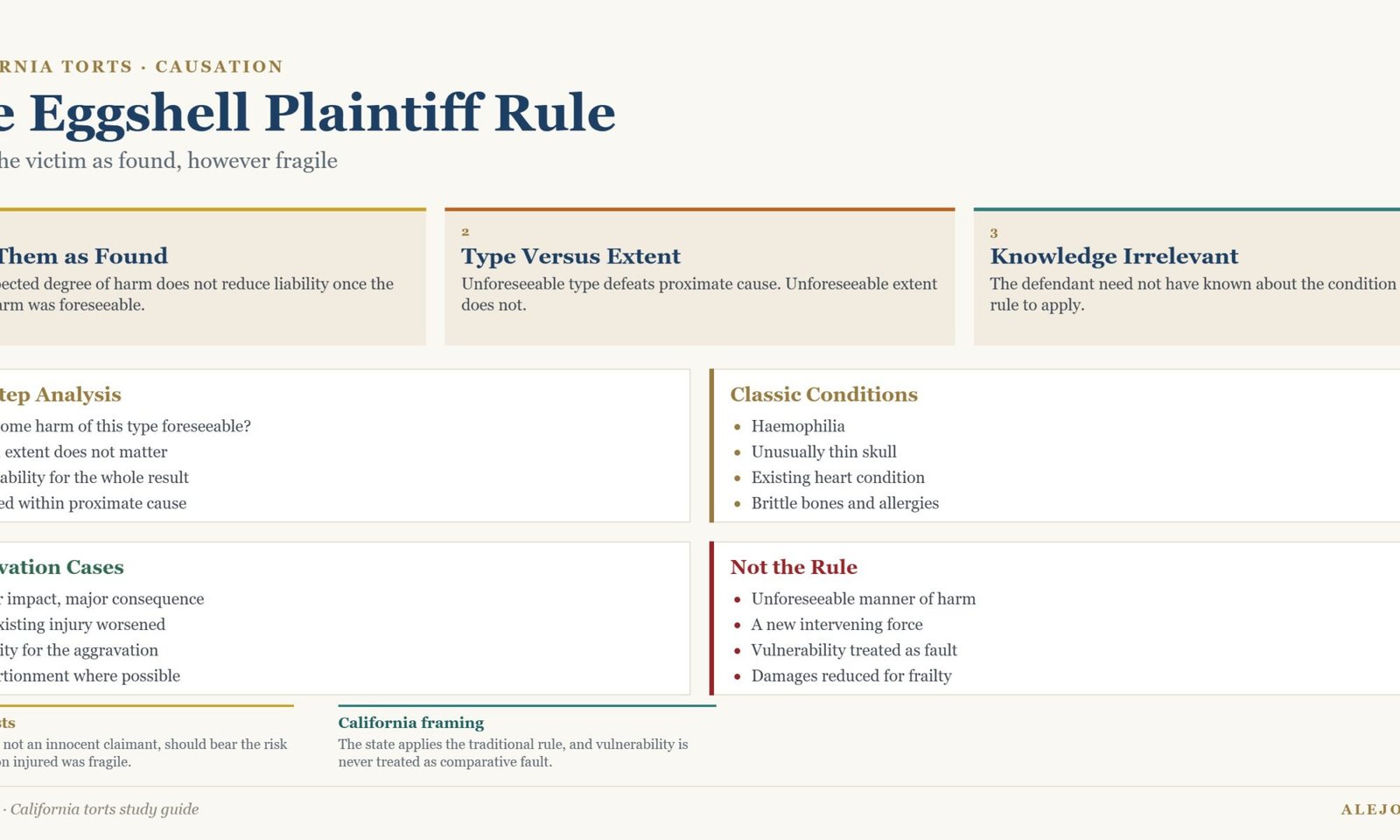
The eggshell plaintiff rule says that a defendant takes the victim as found. Where the type of harm was foreseeable but the claimant particular fragility turned a modest injury into a catastrophic one, the defendant answers for all of it. Neither ignorance of the condition nor the sheer improbability of the outcome reduces the bill.
The rule has an obvious moral logic. Someone must bear the risk that the person on the other end of a careless act happens to be unusually vulnerable, and the law places it on the party who behaved badly rather than on the person who was simply unlucky in their physiology.
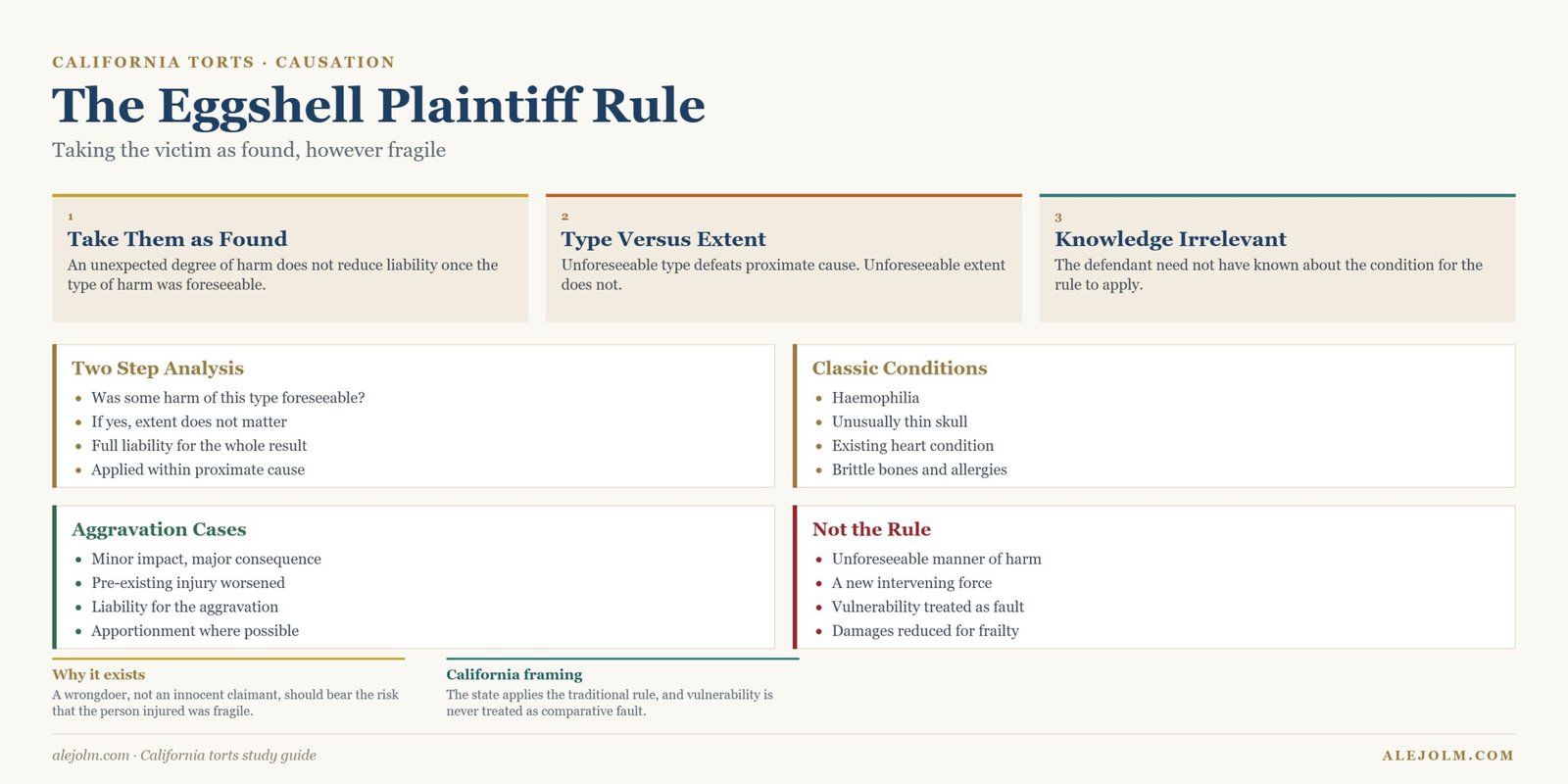
Type of harm and extent of harm
The whole doctrine turns on a distinction that is easy to state and easy to misapply. If the type or manner of harm was unforeseeable, proximate cause fails and the defendant is not liable at all. If only the extent was unforeseeable, proximate cause is satisfied and the defendant is liable for the entire result.
Two illustrations make the difference concrete. A person who negligently drops a loaded firearm and injures a foot by the weight of the object alone has caused a foreseeable kind of harm; an argument that the weapon might have discharged is beside the point. By contrast a motorist who speeds and is then struck by a falling boulder has not caused a harm of a foreseeable type, because speeding does not increase the risk of rockfall, and no amount of eggshell reasoning bridges that gap.
| What was unforeseeable | Doctrine engaged | Result |
|---|---|---|
| The type or manner of the harm | Proximate cause | No liability for that harm |
| The extent or severity of the harm | Eggshell plaintiff | Full liability for the whole extent |
| A new actor or force in the sequence | Superseding cause | Depends on foreseeability of that force |
The classic cases
A haemophiliac grazed by a slowly moving car bleeds to death. A person with an unusually thin skull suffers a catastrophic brain injury from a blow that would have bruised anyone else. A minor wound becomes infected and the infection proves fatal. In each the type of harm, physical injury from the defendant conduct, was entirely foreseeable, and only the magnitude was extraordinary. The defendant pays for the death.
Aggravation of an existing condition
The most commonly litigated version is not exotic at all. A low speed collision aggravates a claimant existing spinal injury into permanent disability, where an uninjured person would have walked away. The defendant is liable for the aggravation. Where the evidence permits, courts separate the pre-existing baseline from the worsening caused by the accident, so the defendant pays for the deterioration rather than for the underlying condition itself.
What the rule is not
It is not a rule about intervening events. The superseding cause analysis asks whether a new force entered the sequence; the eggshell rule concerns the same event producing a larger result. It is also not a reason to reduce damages. A claimant vulnerability is not carelessness, so it never counts against them under comparative negligence. And it does not depend on knowledge: a defendant who had no idea the claimant was fragile is in exactly the same position as one who did.
A worked example
A cyclist is knocked off a bicycle in a low speed collision and lands awkwardly on a shoulder. An average person would have a bruise. This claimant has a rare bone disorder, and the fall causes multiple fractures, a lengthy hospital admission and permanent loss of function. Physical injury from being knocked off a bicycle is a foreseeable type of harm, so causation is established, and the driver pays for the whole outcome including the disability.
Change the mechanism. Suppose the collision caused no impact injury at all, but the claimant, distressed, missed a business meeting and lost a contract. That is a different type of harm, and the analysis moves to whether economic loss of that kind was within the risk. The eggshell rule has nothing to contribute.
The Eggshell Plaintiff Rule in California and Los Angeles County in 2026
California applies the traditional rule without modification. A defendant is liable for the full extent of harm caused, even where the severity is attributable to a pre-existing physical or emotional condition, and the jury is instructed that a person who has a condition making them more susceptible to injury is entitled to recover for the harm actually suffered. Vulnerability is never treated as fault.
Where a claimant had a genuine pre-existing condition, California practice separates aggravation from baseline. The defendant is responsible for the worsening and for any acceleration of an inevitable decline, but not for the condition the claimant already had. In Los Angeles County this is the battleground in most soft tissue and spinal injury litigation, fought through medical records, prior imaging and competing expert testimony rather than through legal argument.
- Traditional rule. California follows the eggshell doctrine in full, for both physical and emotional vulnerabilities.
- Aggravation. The defendant answers for the worsening of an existing condition, not for the condition itself.
- No offset for frailty. A claimant susceptibility does not reduce damages and is not comparative fault.
- Knowledge irrelevant. The defendant need not have known or been able to discover the condition.
- Proof. Prior medical records usually decide the apportionment between baseline and aggravation.
- Emotional vulnerability. The principle extends to psychological susceptibility in appropriate cases.
For 2026, confirm the current California instructions on pre-existing conditions and aggravation, and Los Angeles Superior Court practice on medical record discovery, directly with current authority, since these continue to develop.
Common mistakes to avoid
- Using it for an unforeseeable type of harm. That is a proximate cause failure and the claim fails.
- Requiring knowledge of the condition. The rule applies whether or not the defendant could have known.
- Confusing it with intervening cause. There is no new force here, only an unusual reaction to the same event.
- Treating vulnerability as fault. Susceptibility is not negligence and never reduces the award.
- Forgetting the baseline. The defendant pays for the aggravation, not for the condition that already existed.
- Limiting it to physical conditions. Emotional and psychological vulnerability can engage the same principle.
Frequently asked questions
What is the eggshell plaintiff rule?
The principle that a defendant takes the victim as found and is liable for the full extent of harm caused, even where a pre-existing condition made the injury far worse than it would ordinarily have been.
Does the defendant have to know about the condition?
No. Foreseeability of the condition is irrelevant. What matters is whether some harm of the general type suffered was foreseeable from the defendant conduct.
What is the difference between type and extent of harm?
An unforeseeable type of harm defeats proximate cause and there is no liability. An unforeseeable extent of a foreseeable type of harm is exactly what the eggshell rule covers, and full liability follows.
Can damages be reduced because the claimant was already unwell?
Not for vulnerability as such. Where a pre-existing condition can be separated from the aggravation caused by the accident, the defendant pays for the aggravation rather than the underlying condition.
Does the rule apply to emotional harm?
In appropriate cases yes. Courts have applied the principle to psychological susceptibility as well as physical fragility, though the foreseeability threshold for emotional harm is itself narrower.
Related guides
 Joint Tortfeasors: Joint and Several Liability Explained
 Comparative Negligence in California: How Fault Is Split
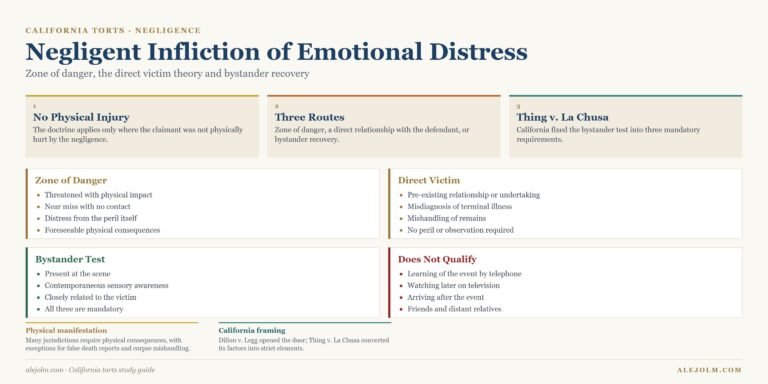 Negligent Infliction of Emotional Distress in California
- Superseding Cause: When the Chain of Causation Breaks
- Proximate Cause: Foreseeability and Superseding Causes
- Actual Cause in Negligence: But-For and Substantial Factor
- Duty of Care in Negligence: California Rules Explained
- The Four Elements of Negligence: Bar Exam Breakdown
Next steps
Read our guide to proximate cause for the framework the rule sits inside, then superseding cause, the doctrine it is most often confused with.
For primary sources, read California Civil Code section 3333 and the damages instructions published by the Judicial Council of California.