
Forum selection clauses are the provisions in a contract that tell the parties where any dispute must be litigated. They look like boilerplate and they are treated as boilerplate right up until a dispute arises, at which point they frequently determine the entire economics of the case.
California enforces them, but with a set of statutory exceptions that are broader than in most states and that catch a great many employment, construction and franchise agreements. This guide covers the enforcement standard, the federal procedural mechanism, the California carve-outs, and how to draft a clause that survives a challenge in Los Angeles.
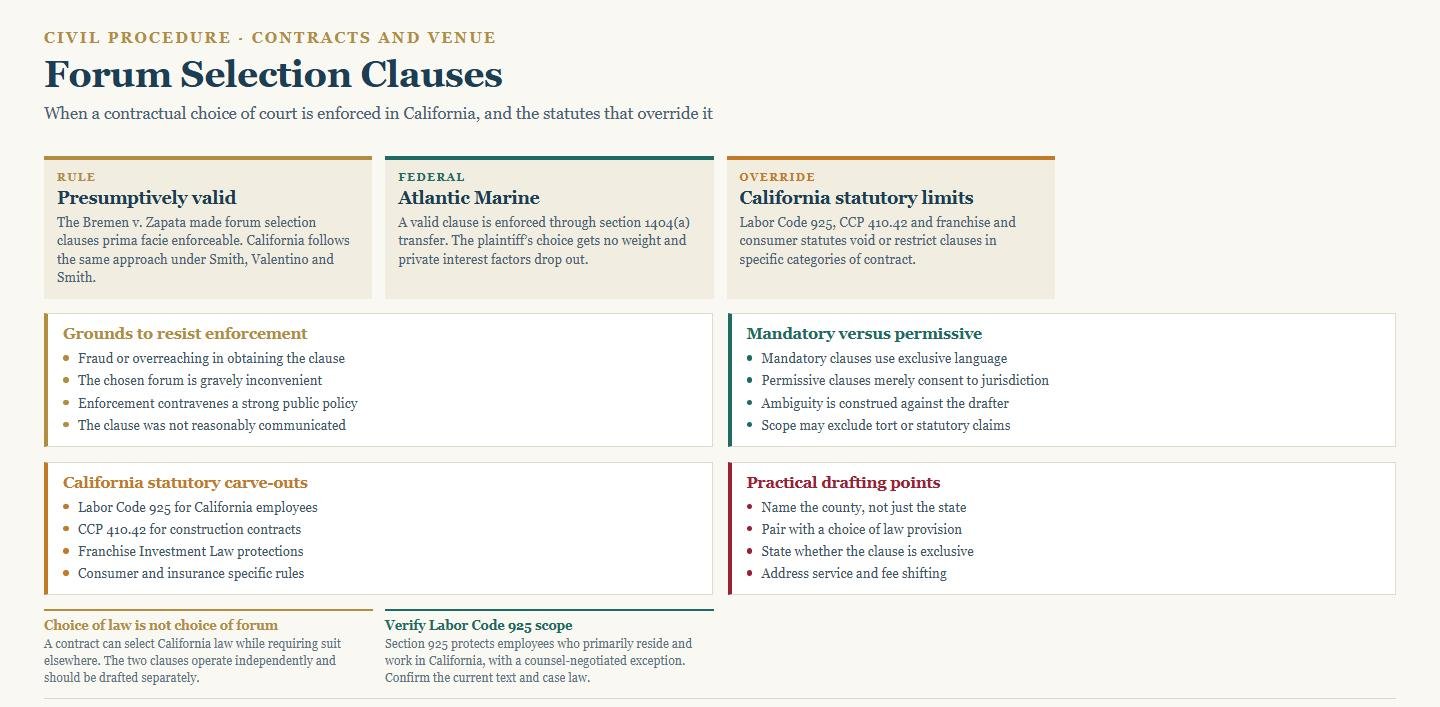
The general rule: presumptively valid
Courts once treated agreements about where to sue as improper attempts to oust judicial jurisdiction. The Bremen v. Zapata Off-Shore Co. ended that in 1972, holding that a forum selection clause in an arm’s length commercial contract is prima facie valid and should be enforced unless the resisting party shows enforcement would be unreasonable under the circumstances. California adopted the same approach in Smith, Valentino and Smith, Inc. v. Superior Court.
The burden therefore sits on the party trying to escape the clause, and it is a heavy one. Courts do not ask whether the chosen forum is the best forum, only whether enforcing the bargain would be unreasonable.
Grounds for resisting enforcement
- Fraud or overreaching: the clause itself, not merely the contract generally, must have been procured by improper means.
- Grave inconvenience: the chosen forum is so seriously inconvenient that the resisting party would effectively be deprived of its day in court.
- Public policy: enforcement would contravene a strong public policy of the forum where suit was brought.
- Lack of notice: the clause was buried, in an unreadable format, or never reasonably communicated to the party.
- Scope: the claims asserted fall outside the language of the clause, which is a construction question rather than an enforceability one.
- Statutory prohibition: a statute voids the clause for that category of contract, which is the most common winning argument in California.
Mandatory versus permissive clauses
A mandatory clause designates an exclusive forum and forecloses litigation anywhere else. Language such as “shall be brought exclusively in” or “the sole and exclusive venue shall be” achieves this. A permissive clause merely records the parties’ consent to jurisdiction in a particular place without excluding other courts. Language such as “the parties consent to the jurisdiction of the courts of” is permissive and does not support a motion to dismiss or transfer.
Ambiguity is generally construed against the drafter, which in adhesion contracts means against the party seeking enforcement. Careful drafting also has to address scope: a clause covering claims “arising under this agreement” may not reach tort or statutory claims, whereas “arising out of or relating to” is read considerably more broadly.
The federal mechanism after Atlantic Marine
Atlantic Marine Construction Co. v. U.S. District Court for the Western District of Texas settled how federal courts implement a valid clause. The vehicle is a motion to transfer under 28 U.S.C. section 1404(a) when the chosen forum is another federal district, and forum non conveniens when it is a state or foreign court. Three adjustments follow: the plaintiff’s choice of forum gets no weight, the private interest factors are deemed to have been waived by the contract, and the transferee court applies its own choice-of-law rules rather than importing the transferor’s.
| Question | Without a valid clause |
|---|---|
| Weight given to plaintiff’s choice | Substantial |
| Private interest factors | Fully weighed |
| Public interest factors | Weighed |
| Likely outcome | Case stays where filed |
| Choice-of-law rules applied | Transferor court’s rules follow the case |
A worked example
A software engineer who lives in Glendale and works from an office in Burbank signs an employment agreement with a Delaware-incorporated employer headquartered in Austin. The agreement requires all disputes to be litigated in Travis County, Texas, and selects Texas law. Two years later she is terminated and sues in Los Angeles Superior Court for wrongful termination and unpaid wages. The employer moves to enforce the clause.
Under general contract principles the clause would be enforced. But California Labor Code section 925 provides that an employer may not require an employee who primarily resides and works in California, as a condition of employment, to agree to adjudicate a California claim outside California or to apply another state’s law. A clause violating the section is voidable by the employee. If she was not individually represented by her own counsel in negotiating the provision, she can void it and keep the case in Los Angeles. Note the carve-out: where the employee was represented by counsel who negotiated the terms, the clause can stand, so the outcome depends on facts about the hiring process rather than on the contract text alone.
Forum Selection Clauses in California and Los Angeles County in 2026
California’s baseline is enforcement, but the legislature has carved out categories where the bargaining imbalance was thought too great. Labor Code section 925 covers employment contracts entered into, modified or extended with employees who primarily reside and work in California. Code of Civil Procedure section 410.42 voids clauses requiring a California construction subcontractor to litigate outside California over work performed in the state. The Franchise Investment Law and various consumer and insurance provisions add further restrictions.
Where no statute applies, the resisting party must show that enforcement would contravene a strong California public policy. California courts have been more receptive to this argument than many jurisdictions, particularly where enforcing the clause would also mean applying another state’s law and thereby waiving unwaivable California statutory rights. The distinction between a clause that merely relocates the trial and one that effectively eliminates a statutory remedy is where these motions are usually won and lost.
Procedurally, a defendant in Los Angeles Superior Court enforces a clause designating another forum by a motion to stay or dismiss under Code of Civil Procedure section 410.30, filed on or before the last day to plead. Where the clause designates a California county other than the one where suit was filed, the vehicle is instead a motion to transfer venue under section 397. Los Angeles County is itself a very common designated forum in entertainment, apparel and real estate agreements, so local practitioners see the argument from both directions.
- Labor Code 925: voidable by California employees unless individually represented by their own counsel in the negotiation.
- CCP 410.42: void for out-of-state forums in construction contracts covering California work.
- CCP 410.30: the motion to stay or dismiss when the clause points outside California.
- CCP 397: the venue transfer motion when the clause names a different California county.
- Name the county: “Los Angeles County, California” is enforceable; “California” alone invites a venue fight.
- Unwaivable rights: clauses that would strip California statutory protections face the strongest public policy challenge.
For 2026, confirm the current text of Labor Code section 925 and the developing case law on whether it reaches arbitration agreements and independent contractors, since this has been actively litigated. Verify current Los Angeles Superior Court filing and motion reservation procedures as well. See also forum non conveniens, venue and transfer and consideration in contract law.
Common mistakes to avoid
- Attacking the contract instead of the clause. Fraud must relate to the forum provision specifically, not to the deal generally.
- Assuming permissive language is mandatory. “Consent to jurisdiction” does not exclude other courts.
- Naming only a state. Without a county, the clause may not resolve an intrastate venue dispute.
- Ignoring Labor Code 925. Employers routinely reuse out-of-state templates that are voidable for California staff.
- Forgetting choice of law is separate. A clause can validly choose California law while requiring suit in Texas, and the two provisions must be analysed independently.
Frequently asked questions
Are forum selection clauses enforceable in California?
Yes, they are presumptively valid and the party resisting bears a heavy burden. The main exceptions are statutory: Labor Code section 925 for employees and Code of Civil Procedure section 410.42 for construction subcontractors, among others.
What is the difference between a mandatory and a permissive clause?
A mandatory clause makes the named court the exclusive forum. A permissive clause only confirms that the named court has jurisdiction and does not prevent suit elsewhere.
Can my employer make me sue in another state?
Generally not, if you primarily reside and work in California. Labor Code section 925 lets you void such a clause unless you were individually represented by your own lawyer when it was negotiated.
How does a court enforce the clause procedurally?
In federal court, by transfer under section 1404(a) or by forum non conveniens. In California state court, by a motion to stay or dismiss under section 410.30, or a venue transfer motion under section 397 for an intrastate clause.
Does a forum clause also decide which law applies?
No. Choice of forum and choice of law are separate provisions. A contract can select California law and still require litigation in another state, and each clause is tested on its own terms.
Related guides
- Forum Non Conveniens in California and Federal Courts
- Federal Venue Rules and Transfer Under Section 1404
- Minimum Contacts and Due Process in California Courts
- Consideration in Contract Law: Rules and Exceptions
- The Parol Evidence Rule: Integration and Exceptions
- Removal and Remand: Moving a Case to Federal Court
- Subject Matter Jurisdiction in Federal Court Explained
- Diversity Jurisdiction: Citizenship and Amount Rules
- The Erie Doctrine Explained: A 4-Step Bar Exam Guide
- Specific vs General Personal Jurisdiction Explained
- Joinder of Claims and Parties in California Lawsuits
Next steps
Compare the contractual route with the discretionary one in forum non conveniens, and review the statutory venue rules in venue and transfer. The Labor Code and Code of Civil Procedure are published at California Legislative Information, and wage-and-hour guidance is available from the California Division of Labor Standards Enforcement.