
The minimum contacts test is the constitutional gatekeeper for personal jurisdiction. Before a court in Los Angeles can enter a binding judgment against a company in Texas or a supplier in Guangdong, the Due Process Clause requires that the defendant have built a real relationship with California — not that it simply caused harm to someone who happens to live here.
That distinction is the whole ballgame. Plaintiffs lose otherwise strong cases because they sued a defendant the forum cannot reach, and defendants waive the objection by filing the wrong paper first. This guide walks through the doctrine as the Ninth Circuit and the California Court of Appeal actually apply it, then translates it into the motion practice you will see in the Los Angeles Superior Court and the Central District of California.
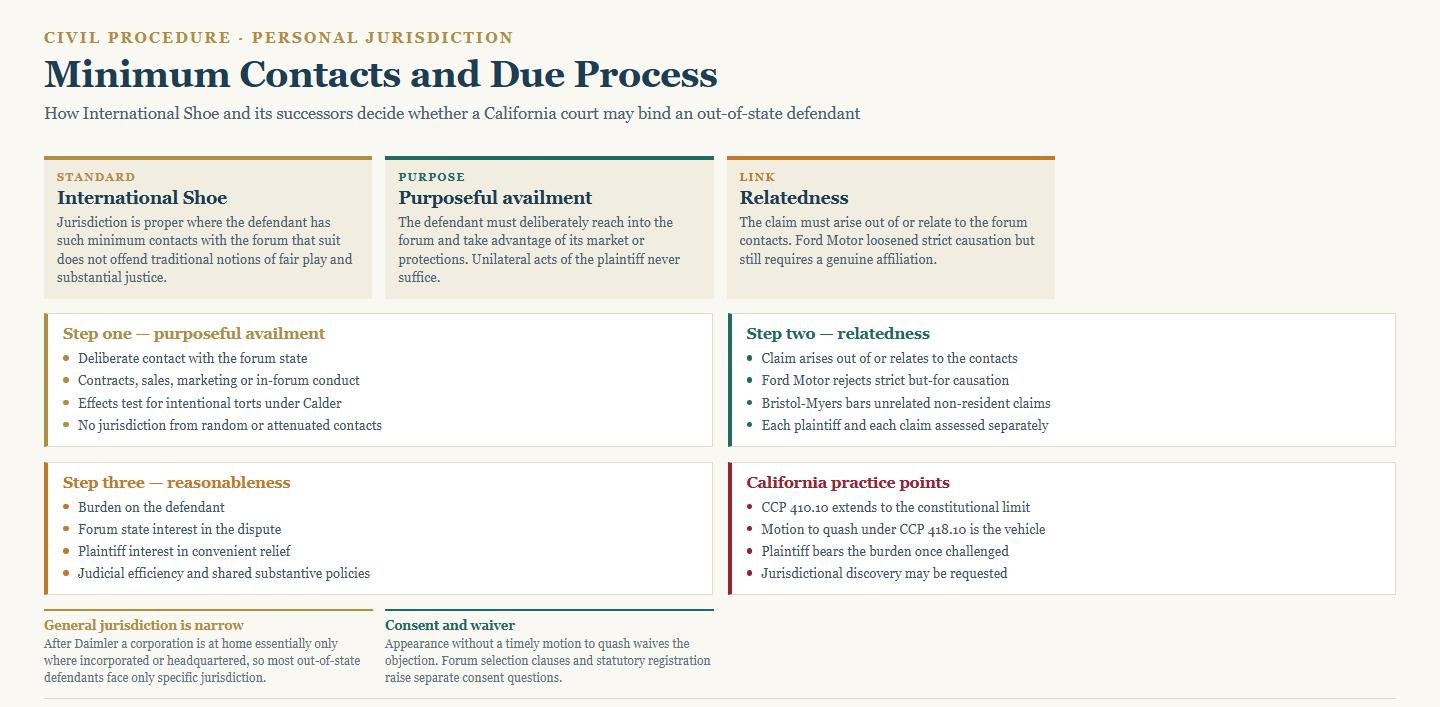
Where the minimum contacts test came from
For most of the nineteenth century, jurisdiction was territorial. A court had power over people and property physically inside its borders and nothing else. That worked when commerce was local and collapsed once corporations began selling nationally without ever setting foot in most states.
International Shoe Co. v. Washington replaced the territorial rule in 1945 with a relational one. A state may exercise jurisdiction where the defendant has such contacts with the forum that maintaining the suit does not offend, in the Court’s phrase, “traditional notions of fair play and substantial justice.” Everything decided since then is an attempt to give that sentence workable content.
Minimum contacts is not a counting exercise. One deliberate, claim-related contact can support jurisdiction, while a hundred incidental ones cannot.
The three-part framework
Step one: purposeful availment
The defendant must have deliberately directed conduct at California and thereby taken advantage of the privilege of doing business here. Selling into the California market, signing a contract with performance in Los Angeles, maintaining a sales force, or running a website that transacts with California customers all qualify. What never qualifies is the unilateral activity of the plaintiff: moving to California after an injury does not drag the defendant along.
For intentional torts the analysis shifts to the effects test from Calder v. Jones. The defendant must have committed an intentional act expressly aimed at the forum, knowing the harm would be felt there. Walden v. Fiore tightened this considerably — the defendant’s own conduct must connect to the forum, not merely to a plaintiff who lives in the forum.
Step two: relatedness
The claim must arise out of or relate to the defendant’s forum contacts. Ford Motor Co. v. Montana Eighth Judicial District Court made clear that strict but-for causation is not required: a manufacturer that cultivates a market for a vehicle model in California can be sued here over that model even though the specific car was designed, built and first sold elsewhere. The relationship must still be genuine, not a loose thematic resemblance.
The limit runs the other way in Bristol-Myers Squibb Co. v. Superior Court, a case that came out of California. Non-resident plaintiffs could not join their claims to a California action merely because the defendant sold the same drug here. Each plaintiff and each claim needs its own jurisdictional footing.
Step three: reasonableness
Once the plaintiff establishes availment and relatedness, the burden shifts to the defendant to show that jurisdiction would nonetheless be unreasonable. Courts weigh the burden on the defendant, the forum state’s interest, the plaintiff’s interest in convenient relief, efficient resolution of the controversy, and shared substantive policies among states. Defendants rarely win here, and a foreign defendant facing litigation in a distant legal system has the strongest argument.
| Feature | Specific jurisdiction |
|---|---|
| Basis | Claim-related contacts with California |
| Typical proof | Sales, contracts, targeted conduct |
| Scope of claims | Only claims tied to the contacts |
| Governing case | International Shoe, Ford Motor |
| Frequency in LA practice | The overwhelming majority of disputes |
Contacts that count and contacts that do not
- Counts: a distribution agreement naming a California retailer, with shipments arriving in Los Angeles County.
- Counts: advertising campaigns bought specifically for the Los Angeles media market.
- Counts: an interactive website that takes orders, payment and delivery addresses from California buyers.
- Does not count: a passive brochure website viewable everywhere but targeted nowhere.
- Does not count: a single unsolicited purchase by a California resident who travelled out of state to make it.
- Does not count: the plaintiff’s own decision to relocate to California and feel the loss here.
A worked example
A Nevada equipment manufacturer sells forklifts through independent dealers. It has no office, employees or property in California. Over three years it shipped 2,400 units to two Los Angeles County dealers, ran trade advertising in a Southern California logistics magazine, and sent technicians to Long Beach twice a year for warranty training. A warehouse worker in Vernon is injured when a forklift mast fails and sues in Los Angeles Superior Court. The manufacturer moves to quash for lack of personal jurisdiction.
The motion should fail. The shipments and regional advertising are deliberate exploitation of the California market, which satisfies purposeful availment. The claim concerns the very product line cultivated here, so relatedness is met under Ford Motor even though this particular forklift may have passed through a dealer’s inventory. On reasonableness, Nevada is adjacent, California has a strong interest in compensating workers injured within its borders, and the evidence and witnesses sit in Los Angeles County. Note that general jurisdiction is not available — the company is at home in Nevada — so the plaintiff must plead and prove the specific-jurisdiction theory rather than assuming continuous sales are enough on their own.
Minimum Contacts in California and Los Angeles County in 2026
California does not have a jurisdictional statute with independent content. Code of Civil Procedure section 410.10 simply extends the courts’ reach to the full limit permitted by the state and federal constitutions. The practical consequence is that in California the statutory question and the due process question are the same question, and the entire fight is over minimum contacts.
In Los Angeles County the challenge is brought as a motion to quash service of summons under Code of Civil Procedure section 418.10. Timing is unforgiving: the motion must be filed on or before the last day to plead, and filing a demurrer or answer first is generally treated as a general appearance that concedes jurisdiction. If the motion is denied, the defendant has a short window to petition the Court of Appeal for a writ, and that deadline is measured in days rather than weeks.
Los Angeles Superior Court hears these motions in the assigned independent calendar department, and personal jurisdiction disputes appear constantly in the county’s entertainment, apparel, logistics and technology cases. Because so much foreign manufacturing flows through the ports of Los Angeles and Long Beach, stream-of-commerce arguments involving component makers and overseas suppliers are a routine feature of local motion practice rather than an academic curiosity.
- Section 410.10: California reaches to the constitutional maximum, so cite due process authority, not statutory text.
- Section 418.10: file the motion to quash on or before the last day to plead, or the objection is waived.
- Burden shifting: the plaintiff must prove jurisdictional facts by a preponderance once the defendant challenges service.
- Jurisdictional discovery: request it expressly in the opposition; Los Angeles judges will often permit a limited round.
- Evidence, not argument: support the motion with declarations, because unverified assertions carry no weight.
- Removal interplay: removing to the Central District preserves the objection, but the federal deadline then governs.
For 2026, confirm the current version of the Los Angeles Superior Court local rules and the applicable department’s reservation system before calendaring anything, because hearing-reservation procedures and page limits have changed repeatedly in recent years. Also verify the current state of the law on registration-as-consent, which courts around the country have been revisiting since Mallory v. Norfolk Southern. If you are working through the surrounding doctrine, read the companion guides on the California long-arm statute, specific versus general jurisdiction and service of process.
Common mistakes to avoid
- Treating volume as availment. Large sales figures mean nothing if the defendant never aimed at California; conversely, modest but deliberate targeting is enough.
- Confusing harm in the forum with conduct toward the forum. After Walden, the defendant must connect to California, not merely to a Californian.
- Filing an answer before the motion to quash. That is a general appearance and the objection is gone.
- Assuming a nationwide website confers jurisdiction everywhere. Interactivity and targeting matter far more than accessibility.
- Skipping the reasonableness factors. They are the defendant’s best argument in cases involving foreign manufacturers and should be briefed, not assumed.
Frequently asked questions
What are minimum contacts in simple terms?
They are the deliberate connections a defendant has built with a state that make it fair for that state’s courts to hear a case against it. The connections must be the defendant’s own choices, not accidents caused by where the plaintiff lives.
Does California have a separate long-arm test?
No. Code of Civil Procedure section 410.10 extends jurisdiction to the constitutional limit, so the statutory analysis collapses into the federal due process analysis in every case.
Can one contact create jurisdiction?
Yes, if it is purposeful and the claim arises from it. A single contract negotiated and performed in Los Angeles can support specific jurisdiction over a dispute about that contract.
Who bears the burden of proof?
The plaintiff must establish jurisdictional facts by a preponderance of the evidence once the defendant files a motion to quash. The burden then shifts to the defendant only on the reasonableness factors.
What happens if the motion to quash is denied?
The case proceeds, but the defendant can seek immediate appellate review by writ petition within a very short statutory window. Missing that window generally means waiting for an appeal from the final judgment.
Related guides
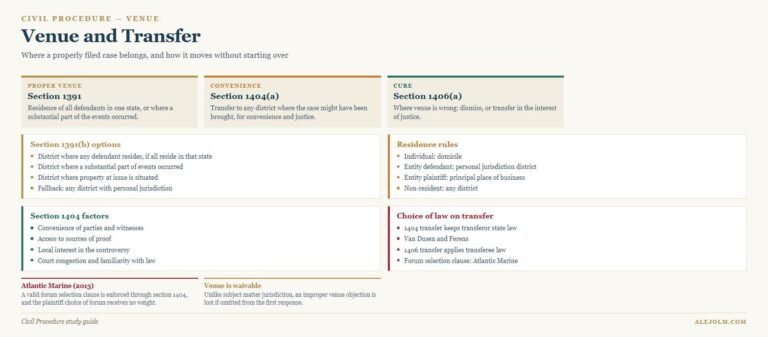 Federal Venue Rules and Transfer Under Section 1404
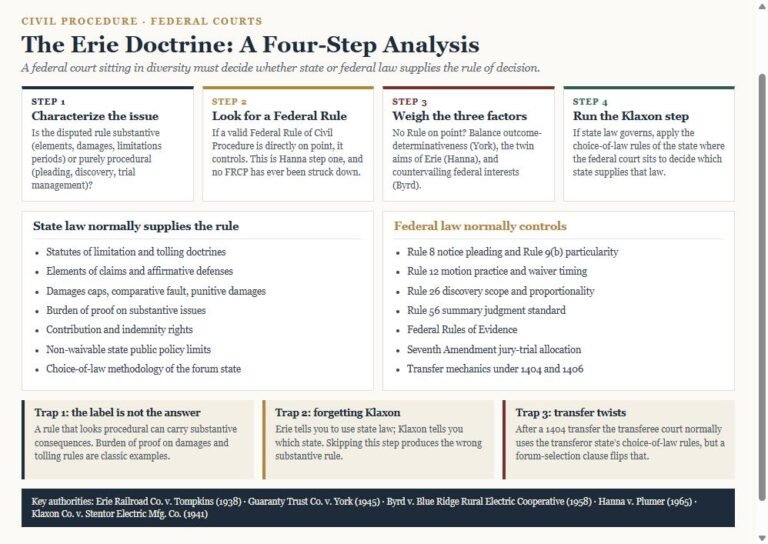 The Erie Doctrine Explained: A 4-Step Bar Exam Guide
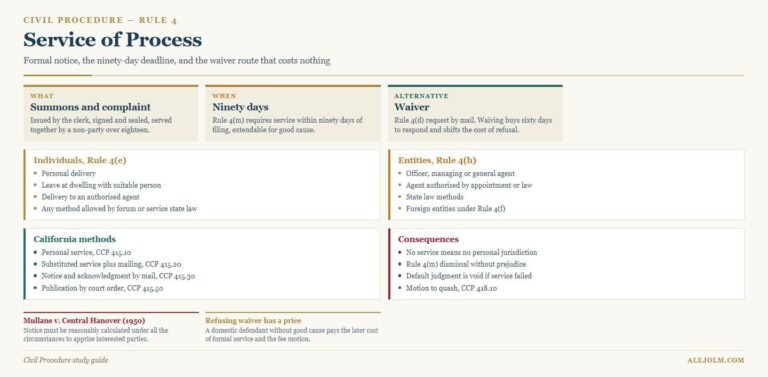 Service of Process Under Rule 4: Methods and Waiver
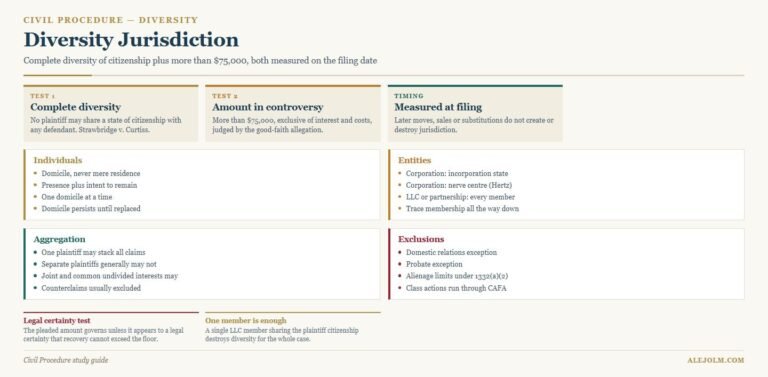 Diversity Jurisdiction: Citizenship and Amount Rules
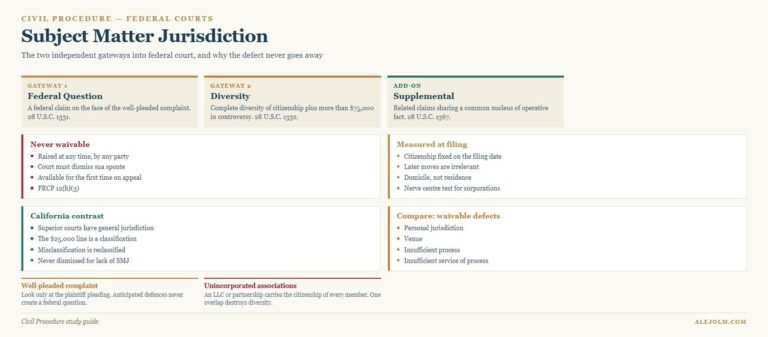 Subject Matter Jurisdiction in Federal Court Explained
- Specific vs General Personal Jurisdiction Explained
- The California Long-Arm Statute and Motion to Quash
- Procedural Due Process: Notice, Hearing and Mathews
- Limited vs Unlimited Civil Cases in California Courts
- Removal and Remand: Moving a Case to Federal Court
- Federal Pleading Standards After Twombly and Iqbal
Next steps
Work through the mechanics of challenging jurisdiction in the California long-arm statute and motion to quash, then compare the two categories of jurisdictional power in specific versus general jurisdiction. The full text of the governing statutes is available from the California Legislative Information site, and the Central District’s standing orders are posted at the U.S. District Court for the Central District of California.