
Discovery is where most civil cases are actually decided. The federal discovery rules in Rules 26 through 37 give each side access to the other’s evidence before trial, on the theory that surprise is a poor substitute for preparation. The scope is wide, but since 2015 it has been expressly limited by proportionality.
This guide covers the scope test, the six proportionality factors, the required disclosures, each discovery tool and its limits, the two great protections of privilege and work product, expert discovery, and the sanctions regime including the special rule for lost electronic information.
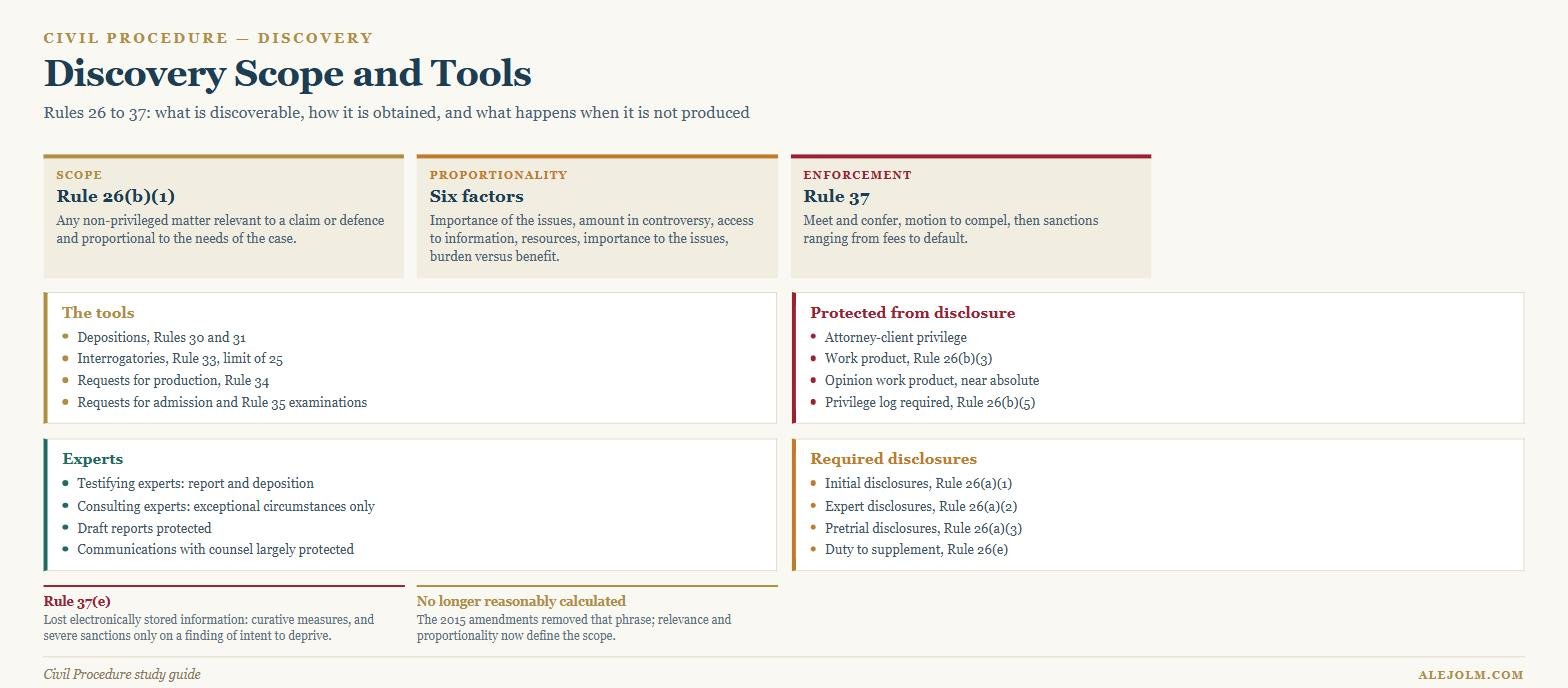
The scope of discovery
Rule 26(b)(1) permits discovery of any non-privileged matter that is relevant to any party’s claim or defence and proportional to the needs of the case. Two changes made in 2015 matter enormously. Relevance is now tied to claims and defences rather than to the broader subject matter, and the old phrase about information reasonably calculated to lead to the discovery of admissible evidence was deleted because it had been misused as an independent test.
Proportionality is assessed against six factors: the importance of the issues at stake, the amount in controversy, the parties’ relative access to relevant information, the parties’ resources, the importance of the discovery in resolving the issues, and whether the burden or expense outweighs the likely benefit. Information within the scope need not be admissible to be discoverable.
Required disclosures
- Initial disclosures, Rule 26(a)(1). Witnesses and documents a party may use to support its claims or defences, a damages computation, and applicable insurance agreements — all without waiting for a request.
- Expert disclosures, Rule 26(a)(2). Identity of testifying experts, and a written report from retained experts covering opinions, bases, facts considered, exhibits, qualifications, publications, prior testimony and compensation.
- Pretrial disclosures, Rule 26(a)(3). Witnesses, deposition designations and exhibits, generally at least thirty days before trial.
- Supplementation, Rule 26(e). A continuing duty to correct and complete disclosures and responses.
The tools
| Tool | Rule |
|---|---|
| Oral deposition | Rule 30 |
| Written deposition | Rule 31 |
| Interrogatories | Rule 33 |
| Production of documents and ESI | Rule 34 |
| Requests for admission | Rule 36 |
| Physical or mental examination | Rule 35 |
Privilege and work product
The attorney-client privilege protects confidential communications made for the purpose of obtaining or providing legal advice; it protects the communication, never the underlying facts. Work product under Rule 26(b)(3) protects documents and tangible things prepared in anticipation of litigation, and it is qualified: an opponent may obtain ordinary work product on a showing of substantial need and undue hardship. Opinion work product — the mental impressions, conclusions, opinions and legal theories of counsel — receives near absolute protection, a distinction traced to Hickman v. Taylor (1947).
A party withholding material must expressly claim the protection and describe the withheld items well enough for the other side to assess the claim, which in practice means a privilege log. Federal Rule of Evidence 502 limits the consequences of inadvertent disclosure and allows a court order that disclosure does not waive protection in any other proceeding.
Sanctions
Rule 37 escalates. A party first confers in good faith, then moves to compel, and the losing side normally pays the reasonable expenses of the motion. Failure to obey an order can produce directed findings, evidence preclusion, striking of pleadings, contempt, or a default or dismissal. Rule 37(e) governs lost electronically stored information: if reasonable steps to preserve were not taken and the information cannot be restored, the court may order measures no greater than necessary to cure prejudice — and may give an adverse inference instruction or dismiss only on a finding that the party acted with the intent to deprive another of the information.
A worked example
A plaintiff serves a request for every email sent or received by twenty custodians over nine years in a case worth about $300,000. The defendant estimates review costs of $900,000.
Relevance is not really the problem; proportionality is. The amount in controversy, the burden and the marginal value of the last seven years all point the same way. The right response is a proportionality objection with a supporting declaration quantifying the burden, coupled with a counter-proposal: five custodians, three years, agreed search terms, with a mechanism to expand on a showing of need. Courts reward parties who arrive with a narrower alternative rather than a flat refusal.
Discovery in California and Los Angeles County in 2026
California discovery is governed by the Civil Discovery Act, Code of Civil Procedure sections 2016.010 and following, and it differs from the federal system in ways that surprise counsel moving between them. There are no mandatory initial disclosures in the federal sense for most cases, so nothing happens until someone serves something. The scope is defined by relevance to the subject matter and by whether the request appears reasonably calculated to lead to the discovery of admissible evidence — the very phrase deleted from Rule 26 in 2015 — which makes California’s written scope broader on its face.
The numerical structure is also different. Unlimited civil cases carry a presumptive limit of thirty-five special interrogatories, thirty-five requests for admission and thirty-five demands for production, each expandable by a declaration of necessity under section 2030.050. Judicial Council form interrogatories do not count against the limit and are used in almost every Los Angeles case. Limited civil cases are far more restricted, which is one of the practical consequences of the limited and unlimited classification. Depositions are presumptively capped at seven hours by section 2025.290, with exceptions for complex and employment cases.
Enforcement is where California is toughest. Sanctions are mandatory against a party or attorney who unsuccessfully makes or opposes a discovery motion, absent substantial justification. Practical points for a Los Angeles case in 2026:
- Calendar the discovery cut-off from the trial date. California measures it backwards from trial rather than forwards from filing, and a continuance of trial does not automatically reopen discovery.
- Meet and confer in writing and keep it. A separate statement and a declaration describing the effort are prerequisites for most Los Angeles discovery motions.
- Use form interrogatories first. They are free of the numerical limit and cover most of the ground in a routine case.
- Expect mandatory sanctions. Opposing a motion to compel without substantial justification costs money, which changes the calculus on marginal objections.
- Handle electronically stored information under section 2031.060. California has its own safe harbour and its own cost-shifting provisions for information not reasonably accessible.
- Verify current limits and informal discovery conference procedures. Numerical limits, deposition hour caps and the Los Angeles Superior Court informal conference practice have all changed in recent years.
For 2026, the safest working assumption in Los Angeles is that the California rules are broader in scope, stricter in procedure and harsher in sanctions than their federal counterparts. Continue with summary judgment, pleading standards and the hearsay rule.
Common mistakes to avoid
- Using the retired reasonably calculated phrase. In federal court it is no longer part of the scope test.
- Boilerplate objections. Rule 34 requires objections to state whether responsive material is being withheld on their basis.
- Forgetting the privilege log. Withholding without describing risks waiver.
- Skipping the meet and confer. A motion to compel filed without it will usually be denied outright.
- Assuming spoliation always means an adverse inference. Under Rule 37(e) that requires a finding of intent to deprive.
Frequently asked questions
What is the current scope of federal discovery?
Any non-privileged matter relevant to a claim or defence and proportional to the needs of the case, assessed against the six factors in Rule 26(b)(1).
What is the difference between privilege and work product?
Privilege protects confidential lawyer-client communications absolutely. Work product protects materials prepared in anticipation of litigation and is qualified, though opinion work product receives near absolute protection.
How many interrogatories may be served in federal court?
Twenty-five, including all discrete subparts, unless the court or a stipulation allows more.
What happens when electronic evidence is destroyed?
Rule 37(e) allows measures no greater than necessary to cure prejudice, and permits an adverse inference or dismissal only where the party acted with the intent to deprive another of the information.
Are California discovery limits the same?
No. California allows thirty-five special interrogatories, requests for admission and production demands in unlimited civil cases, expandable by declaration, and form interrogatories do not count against the limit.
Related guides
 Service of Process Under Rule 4: Methods and Waiver
 The Character Evidence Rules: Propensity Bar and Doorways
 Federal Venue Rules and Transfer Under Section 1404
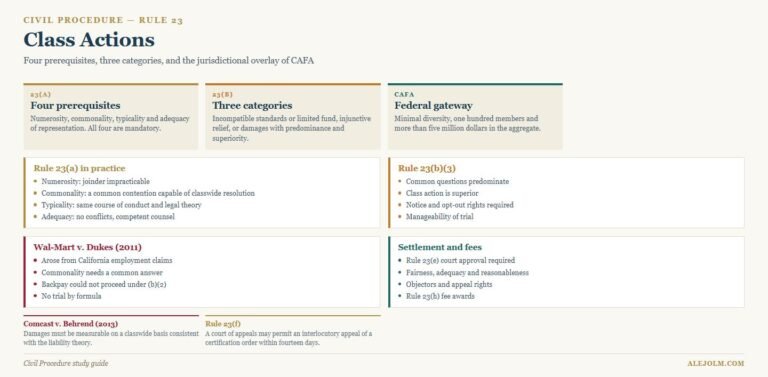 Class Actions Under Rule 23: Certification Explained
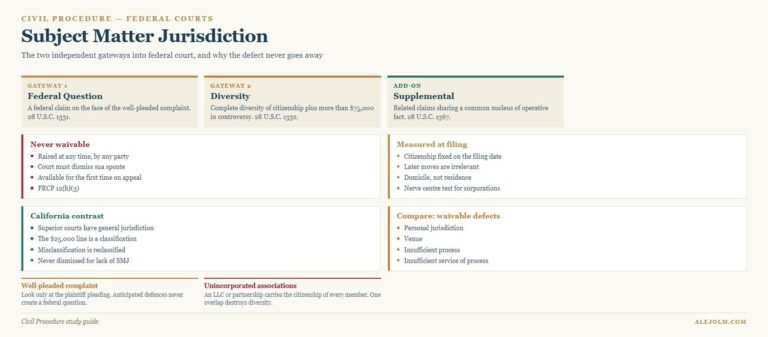 Subject Matter Jurisdiction in Federal Court Explained
- The IRAC Method: How to Structure a Bar Exam Answer
- Summary Judgment Under Rule 56: Standard and Proof
- Federal Pleading Standards After Twombly and Iqbal
- Res Judicata vs Collateral Estoppel: Bar Exam Guide
- Conflicts of Interest: A 6-Step Decision Tree for the Bar
- The Hearsay Rule Explained: Exceptions and Exemptions
Next steps
Discovery in an individual case is difficult enough. Multiply it across thousands of claimants and the procedural questions change entirely. Read class actions under Rule 23 next, then summary judgment.