
The statute of frauds is one of the few contract doctrines that punishes disorganised answers more than it punishes ignorance. Most candidates can recite the six categories; far fewer keep the two questions separate. Is the contract within the statute, and if it is, has the statute been satisfied? Merge those questions and the analysis collapses.
This guide keeps them apart. You will find the MYLEGS categories with the traps built into each one, the writing requirements under both the common law and the UCC, the four ways to satisfy the statute without a signed document, and what actually happens when nothing satisfies it.
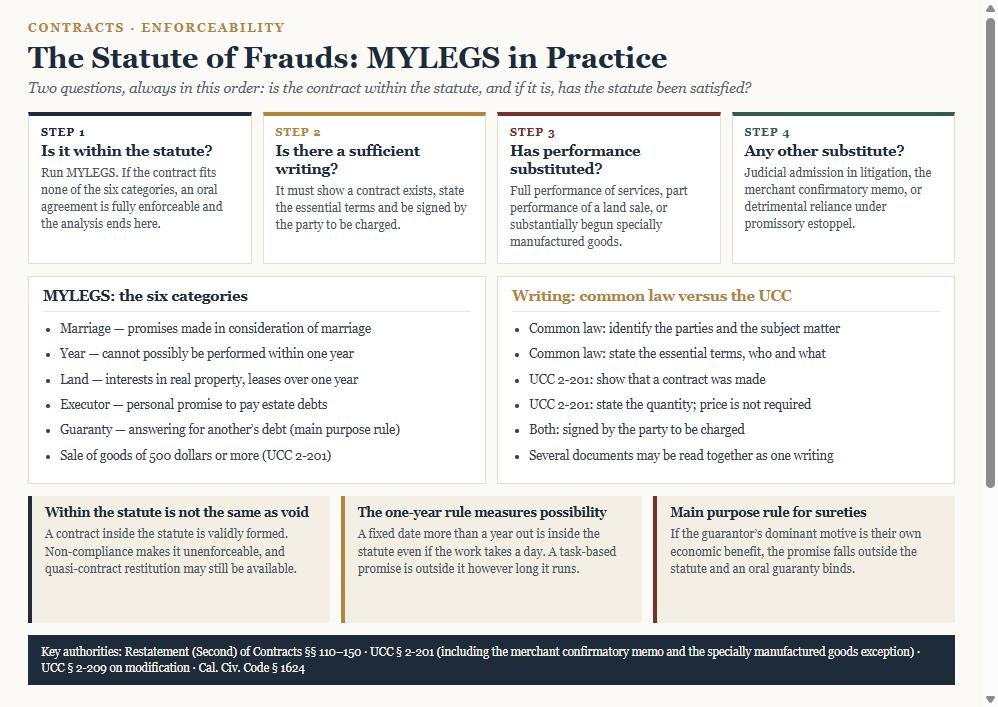
What the statute of frauds actually does
The statute is not a formation rule. A contract within the statute is fully formed the moment offer, acceptance and consideration exist. What the statute withholds is enforceability: a court will not enforce the promise until the writing requirement, or an accepted substitute, has been met.
That distinction has consequences. Because the contract exists, a party who has already conferred a benefit can usually recover its reasonable value in restitution even when the agreement cannot be enforced on its own terms. And because the defect is enforceability rather than validity, the defence can be waived by conduct in litigation.
Step one: MYLEGS, the six categories
Only six kinds of promise fall inside the statute. If the facts do not match one of them, an oral agreement is fully enforceable and you should say so in a sentence and move on.
M — Marriage
Promises made in consideration of marriage are within the statute: a promise to convey property if someone marries, or a prenuptial agreement. Mutual promises to marry each other are not.
Y — Year
A contract that by its terms cannot possibly be performed within one year of formation is within the statute. The test is possibility, not reality. A two-year employment term is inside the statute even if the employee quits in a week; a promise to build a house is outside it even if construction runs for three years, because the obligation is defined by a task rather than a period.
L — Land
Contracts transferring an interest in real property are within the statute, including easements, mortgages and leases longer than one year. Short leases of a year or less fall outside. Because land contracts are the most litigated category, courts developed a specific part performance test, discussed below.
E — Executor
An executor’s or administrator’s promise to pay estate debts out of their own funds is within the statute. A promise to pay estate debts from estate assets is simply the job and needs no writing.
G — Guaranty and suretyship
A promise to answer for another person’s debt is within the statute, subject to the main purpose rule. If the guarantor’s dominant motive is their own economic advantage, for example a supplier guaranteeing a customer’s loan to keep a profitable account alive, the promise falls outside the statute and an oral guaranty binds.
S — Sale of goods for 500 dollars or more
UCC section 2-201 supplies its own, lighter writing requirement for goods sales at or above the threshold. Note that the UCC writing must state the quantity but need not state the price, which reverses the intuition many candidates bring from the common law.
Step two: satisfying the statute
There are four routes. Work through them in order and stop at the first one that succeeds.
A sufficient writing
At common law the writing must identify the parties and the subject matter, state the essential terms, and bear the signature of the party to be charged. It need not be a single document; letters, invoices and emails can be read together. Under the UCC the writing need only indicate that a contract was made, state the quantity, and be signed by the party to be charged.
Between merchants, section 2-201(2) adds the confirmatory memo rule: if one merchant sends a written confirmation of an oral deal and the receiving merchant, having reason to know its contents, does not object within ten days, the statute is satisfied against the receiver even though they signed nothing.
Performance
- Services fully performed. Full performance by either party satisfies the statute, whatever the contract said about duration.
- Services partly performed. Partial performance does not satisfy the statute. The performing party is left with a restitution claim for the reasonable value of what was rendered.
- Goods delivered or paid for. Part performance validates the contract only to the extent actually performed.
- Specially manufactured goods. Once the seller has substantially begun producing goods not suitable for sale to others in the ordinary course of business, the statute is satisfied.
- Land. Courts apply a three-part test and any two of the following suffice: the buyer takes possession, the buyer pays all or part of the price, or the buyer makes substantial improvements.
Judicial admission
If the defendant admits the contract exists in pleadings, testimony or discovery responses, the statute is satisfied. Under the UCC the admission binds only up to the quantity conceded, which makes a careless deposition answer expensive.
Reliance
Where a party has reasonably and detrimentally relied on the oral promise, promissory estoppel can defeat the statute of frauds defence. Courts treat this as an equitable last resort rather than a routine escape hatch, so it belongs at the end of an answer, not the beginning.
| Requirement | Common law | UCC 2-201 |
|---|---|---|
| Must show a contract exists | Yes | Yes |
| Essential terms | Required | Not required |
| Quantity term | Not specifically required | Required |
| Price term | Generally required as an essential term | Not required |
| Signature | Party to be charged | Party to be charged |
| Merchant confirmatory memo | Not available | Available, ten-day objection window |
| Specially manufactured goods exception | Not applicable | Available |
Exam tip: never analyse satisfaction for a contract that was never within the statute. Write one sentence establishing that MYLEGS is not triggered, conclude that the oral agreement is enforceable, and spend the saved lines on the real issue.
Modification and no-oral-modification clauses
A modification must itself satisfy the statute if the modified contract, as modified, falls within it. Raising an oral goods contract from 400 to 600 dollars brings the deal inside section 2-201 and the modification needs a writing. The two systems then diverge on private clauses: common law courts generally ignore a no-oral-modification clause, while UCC section 2-209(2) enforces it, subject to waiver by conduct plus reliance.
California points worth knowing
California codifies its statute of frauds at Civil Code section 1624, and the categories track MYLEGS closely, with the sale-of-goods requirement appearing in the state’s Commercial Code. Two features deserve attention: an agreement authorising an agent to buy or sell real property must be in writing, and California recognises estoppel to prevent unconscionable injury where a party has relied on an oral promise. Treat these as refinements of the general framework rather than a separate system.
Common mistakes that cost points
- Treating a contract within the statute as void. It is formed and valid, merely unenforceable without a writing or substitute.
- Measuring the one-year rule by how long performance actually took instead of what the terms made possible.
- Forgetting the main purpose rule and declaring an oral guaranty unenforceable without checking the guarantor’s motive.
- Requiring a price term in a UCC writing, or forgetting that quantity is the term the UCC does demand.
- Concluding that partial performance of services satisfies the statute. It does not, though restitution remains available.
- Applying the merchant confirmatory memo rule where one party is not a merchant.
- Reaching for promissory estoppel before working through the writing and performance routes.
Frequently asked questions
Does an email or a text message satisfy the statute?
Usually yes. Electronic records and electronic signatures are given the same effect as paper under both federal and state electronic transactions legislation, provided the record shows the terms and can be attributed to the party to be charged. A typed name or an email signature block generally suffices.
Who has to sign?
Only the party against whom enforcement is sought. A writing signed by the seller alone can be enforced against the seller by an unsigned buyer, which regularly surprises candidates.
What happens if nothing satisfies the statute?
The promise cannot be enforced according to its terms, but the performing party is not without recourse. A quasi-contract claim recovers the reasonable value of benefits conferred, and reliance may support an estoppel argument. Say both things; a bare conclusion of unenforceability leaves points on the table.
The statute of frauds in California contracts, 2026
California’s writing requirements are set out in section 1624 of the California Civil Code, and the list contains items a practitioner trained elsewhere will not expect. Alongside the familiar categories of suretyship, leases and agreements not to be performed within a year, California requires a writing for a real estate agent’s or broker’s commission agreement, and for a loan or extension of credit above a statutory threshold made by a person in the business of lending, where the loan is not primarily for personal, family or household purposes.
Transfers of interests in real property require a writing under both the California Civil Code and the California Code of Civil Procedure, which is why Los Angeles County transactions are documented on standard forms and recorded. The exceptions are as important as the rule, and California’s equitable estoppel doctrine is unusually robust: under Monarco v. Lo Greco (1950) a party may be estopped from raising the statute where insisting on it would result in unconscionable injury or unjust enrichment following serious reliance.
The exceptions and their limits:
- Part performance in land contracts. Possession combined with payment and improvements will typically take an oral agreement out of the statute.
- Full performance ends the objection. A completed contract is enforceable regardless of form.
- Estoppel requires serious reliance. Ordinary disappointment is not enough; the injury must be unconscionable.
- Writings may be assembled. Several documents, including emails and signed exchanges, can together satisfy the requirement.
- Electronic signatures are valid. California’s uniform electronic transactions provisions give them the same effect as ink.
- Modifications follow the original. An oral modification of a contract required to be written is generally ineffective unless executed.
In 2026, identify which subsection applies before arguing about exceptions, since the categories are statutory. Read with the parol evidence rule, consideration and the recording acts.
Next steps
The statute of frauds is an enforceability filter, so it only matters once formation is established. Review consideration in contract law first to confirm a bargain exists, then return here to ask whether it can be enforced. Candidates who study the two together stop confusing a missing writing with a missing contract.
For drilling, rewrite one fact pattern six times, changing a single fact each time so that a different MYLEGS category is triggered or defeated. Read the operative text of UCC 2-201 and the statute of frauds overview at Cornell’s Legal Information Institute once you can state the two-step method from memory.
Related guides
 Symbolic Conduct and the O’Brien Test: The Pivot Question
 Piercing the Corporate Veil: A Two-Prong Alter Ego Test
 Personal Jurisdiction: The 3-Step Bar Exam Framework
 Recording Acts: Race, Notice and Race-Notice Explained
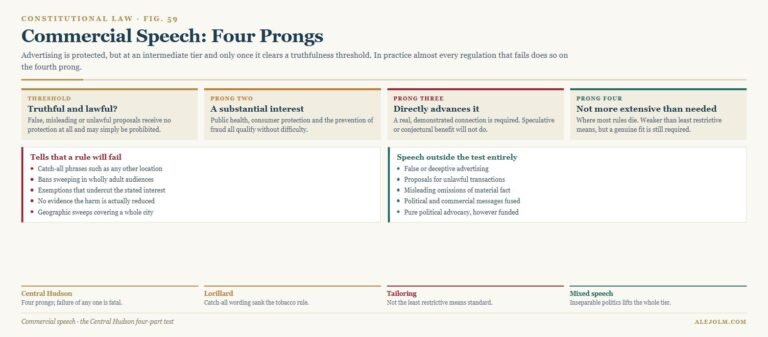 Commercial Speech and the Central Hudson Four-Part Test
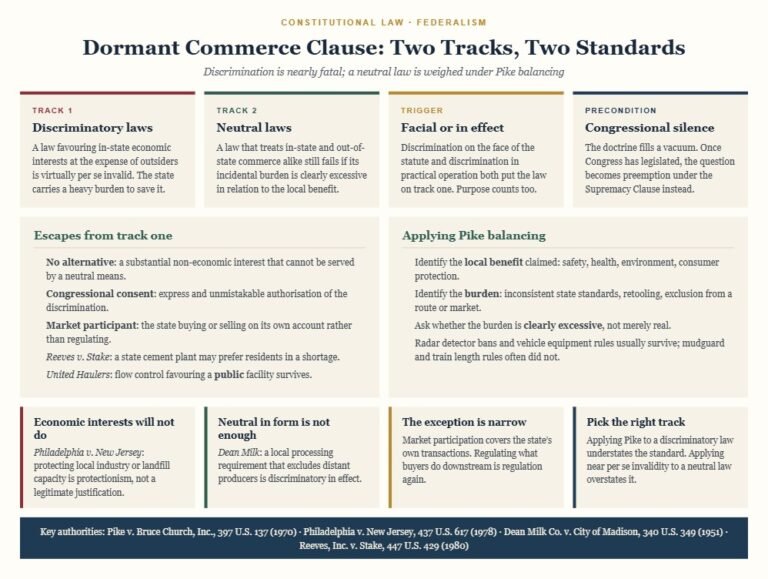 Dormant Commerce Clause: Discrimination vs Pike Balancing
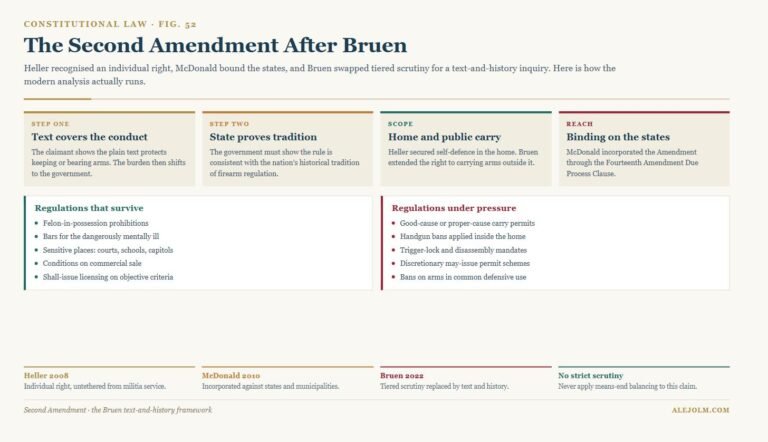 Second Amendment: The Bruen Text-and-History Standard
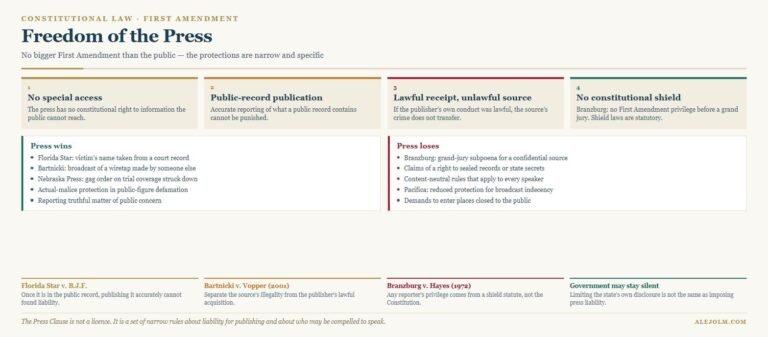 Freedom of the Press: Publication Liability and Limits
 Incorporation Doctrine: Which Rights Bind the States
 The Erie Doctrine Explained: A 4-Step Bar Exam Guide
 The Character Evidence Rules: Propensity Bar and Doorways
 The Youngstown Framework: Presidential Power in 3 Zones