
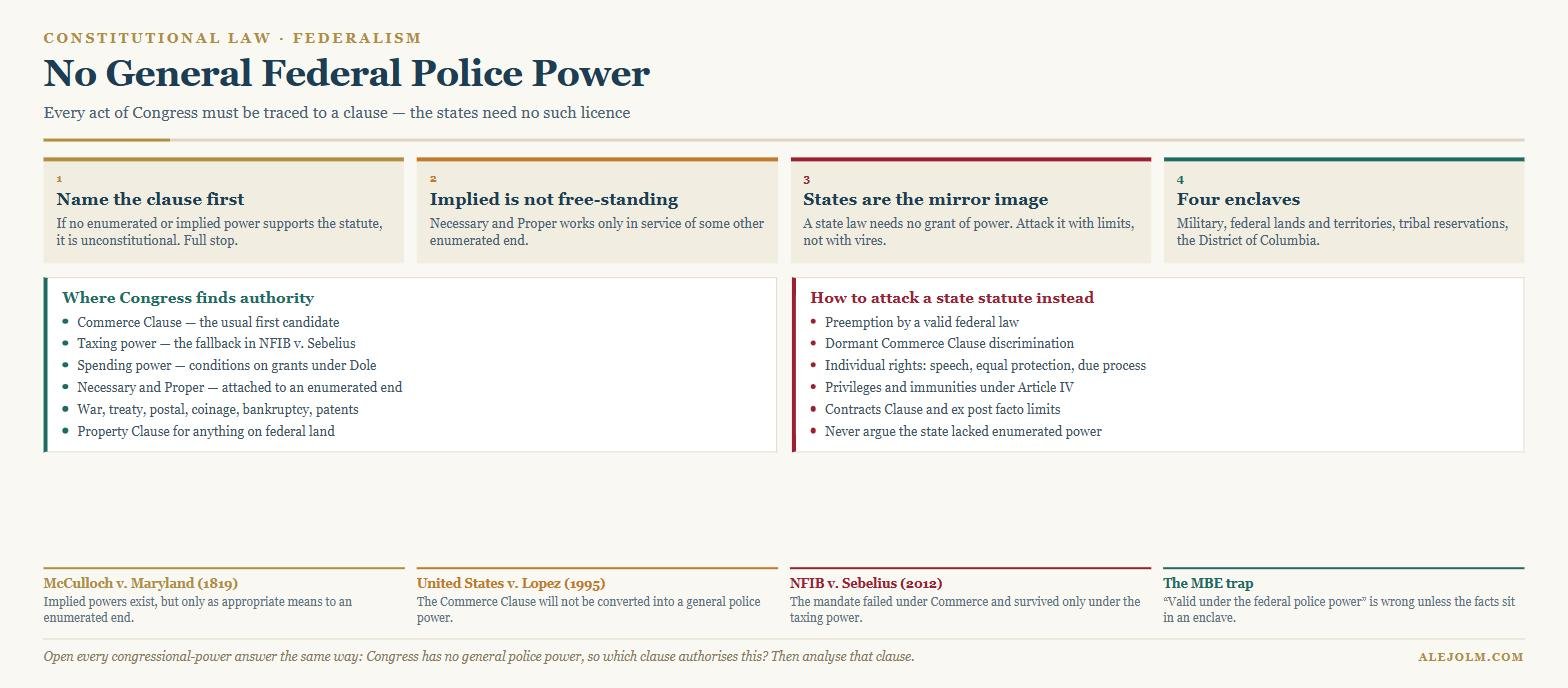
If there is one structural rule worth learning before any other, it is this: Congress has no general police power. The federal government is a government of enumerated powers, which means every statute must be traceable to a specific clause of the Constitution. Where no enumerated or implied power supports the legislation, the legislation is unconstitutional — regardless of how sensible, urgent or popular it is.
The states are the mirror image. Under the reserved powers recognised by the Tenth Amendment, a state legislature possesses a general police power and may legislate for health, safety, welfare and morals without pointing to any grant of authority at all. That asymmetry dictates how each kind of statute is attacked, and confusing the two directions is the single most common structural error in constitutional analysis.
The enumerated-power requirement
The first question in any problem about congressional authority is not whether the statute is wise or whether it burdens anyone unfairly. It is simply: which clause authorises this? If the answer is none, the analysis is complete and the statute falls, without any need to examine individual rights.
Enumerated powers are those granted expressly by the text — the power to regulate interstate commerce, to tax, to spend, to declare war, to establish post offices, to coin money, to enact bankruptcy laws, to secure patents and copyrights. Implied powers derive from those grants through the Necessary and Proper Clause, which is where a great deal of modern legislation actually rests.
There is a trap in the Necessary and Proper Clause that is worth stating plainly, because answers get it wrong constantly. It is not an independent power. It authorises means, not ends. Every invocation of it must be attached to some other enumerated head of power that the legislation is serving. McCulloch v. Maryland (1819) established both halves of this: implied powers genuinely exist, and “necessary” means appropriate or reasonably adapted rather than strictly indispensable — but the means must serve an enumerated end.
The four enclaves
There are four contexts in which the federal government exercises something that genuinely resembles a general police power, and they are worth committing to memory because they convert an otherwise losing argument into a winning one.
- The military and the armed forces. Congress may regulate the conduct, discipline and organisation of the services comprehensively.
- Federal lands and territories. Under the Property Clause, Congress may make all needful rules respecting property of the United States — national parks, forests, military installations, and territories such as Puerto Rico and Guam.
- Native American reservations. Federal authority over tribal affairs is broad and long-established.
- The District of Columbia. Congress legislates for the District as a general legislature would for a state.
The practical use of this list is diagnostic. On a multiple-choice question, an answer justifying a federal statute “under the federal police power” is wrong — unless the facts place the regulated conduct in one of these four settings, in which case it is very likely right. Read the facts for a national park, a base, a territory or the District before dismissing the option.
Exam tip: open every congressional-power answer with the rule itself — “Congress has no general police power, so its action must rest on an enumerated or implied power; the best candidate here is…” — and then analyse that clause properly.
Where Congress actually finds authority
In practice a small number of clauses carry almost all federal legislation. The Commerce Clause is the usual first candidate and covers channels and instrumentalities of interstate commerce and activities substantially affecting it. The taxing power and the spending power are the standard fallbacks, the latter permitting Congress to attach conditions to grants within the limits set by South Dakota v. Dole. Beyond those sit the war and treaty powers, and a catalogue of smaller Article I heads — postal, coinage, bankruptcy, patents and copyrights, admiralty.
Two decisions mark the outer boundary and both are worth knowing precisely. United States v. Lopez (1995) struck down a federal prohibition on possessing a firearm in a school zone, refusing to read the Commerce Clause so broadly that local, non-economic conduct would fall within it — because doing so would have converted the clause into exactly the general police power the Constitution withholds. NFIB v. Sebelius (2012) held that the individual mandate could not rest on the Commerce Clause, since that clause permits the regulation of existing commercial activity but not the compulsion of commerce that does not yet exist; the provision survived only as an exercise of the taxing power.
The lesson is that the enumerated-power requirement is not a formality. Both cases involved legislation with obvious policy appeal, and in both the Court insisted on a genuine fit between the statute and a specific clause. Where the Commerce Clause fails, the taxing and spending powers frequently supply an alternative route to a similar result — which is why a complete answer considers each in turn rather than stopping at the first failure.
The mirror-image rule for state legislation
Because states possess a general police power, the question “what authorises this state statute?” has no purchase. A state needs no enumerated grant to regulate health, safety, welfare or morals, and an argument that it lacked the power to legislate on a subject will simply fail.
State statutes are therefore attacked through limits rather than through absence of authority. The standard grounds are preemption by a valid federal law under the Supremacy Clause; discrimination against or undue burdening of interstate commerce under the dormant Commerce Clause; the individual-rights guarantees — speech, religion, equal protection, due process; the Article IV Privileges and Immunities Clause; and the Article I, Section 10 prohibitions including the Contracts Clause and the ban on ex post facto laws.
The complementary point is that federal power over the states has its own structural limit. Even where Congress is acting within an enumerated power, the anti-commandeering doctrine forbids it from conscripting state legislatures or executive officers to administer a federal programme. So there are two distinct questions in any federalism problem: does Congress have the power at all, and if so, may it exercise it in this particular way?
| Statute | Question to ask |
|---|---|
| Federal law regulating a local activity | Which clause authorises this? |
| Federal law on conduct in a national park | Enclave? |
| Federal law regulating military discipline | Enclave? |
| Federal law for the District of Columbia | Enclave? |
| Federal law compelling people to buy a product | Commerce or tax? |
| Federal law on guns near schools | Commerce? |
| Federal law directing state officials to act | Anti-commandeering |
| State law on health, safety or morals | No power question arises |
Worked example
Congress enacts a statute setting minimum licensing and training requirements for all state and local police officers, together with a certification regime administered by a federal agency. The stated purpose is improving the quality of policing nationwide. A state challenges the statute.
Begin with the enclaves, because if the facts sat in one the analysis would end quickly. They do not: the statute regulates state and municipal officers, not the armed forces, not conduct on federal land, not tribal affairs, and not the District. So Congress must identify an enumerated power. The Commerce Clause is the obvious candidate and it does not work — the training and licensing of state police officers is neither commercial activity nor conduct with the kind of substantial effect on interstate commerce that Lopez requires; accepting the argument would mean any subject of general welfare could be federalised, which is precisely the general police power the Constitution withholds. Nor is this a tax. The statute is unconstitutional as drafted, and there is a second, independent defect: directing state officers to comply with a federal certification regime runs into the anti-commandeering doctrine even if a power could be found.
Change one fact. Suppose Congress instead offered federal law-enforcement grants on condition that recipient states adopt the specified licensing and training standards. Now the spending power supplies the authority, the state retains the choice to refuse the money, and no official is commanded to do anything. Subject to the Dole limits — the condition must be stated unambiguously, relate to the purpose of the spending, and stop short of coercion — the identical policy objective is achieved constitutionally. That contrast between direct regulation and conditioned funding is the practical heart of modern federalism.
Common mistakes that cost points
- Assuming a federal police power exists. It does not, and the argument is only correct inside the four enclaves.
- Treating the Necessary and Proper Clause as an independent power. It authorises means towards an enumerated end and nothing more.
- Asking what authorises a state statute. States need no grant of power; attack the statute through limits instead.
- Forgetting the enclave list, and so rejecting the credited answer on facts involving a park, a base, a territory or the District.
- Stopping at the Commerce Clause when it fails. The taxing and spending powers often supply an alternative route.
- Reading NFIB as upholding the mandate under the Commerce Clause. It expressly did not; the taxing power saved it.
- Overlooking anti-commandeering. Congress may hold the power and still not be able to conscript state officers to exercise it.
- Beginning with individual rights. If no enumerated power supports the statute, the rights analysis is unnecessary.
Frequently asked questions
Why does Congress need to identify a clause at all?
Because the federal government was created with defined powers, and everything not granted was reserved. That structure is not a technicality: it is the mechanism by which the Constitution allocates authority between two levels of government. A statute with no enumerated home is unconstitutional however desirable its objective.
What are the four federal enclaves?
The military and armed forces; federal lands and territories under the Property Clause; Native American reservations; and the District of Columbia. In these settings the federal government exercises authority closely resembling a general police power, which is why an otherwise incorrect answer becomes correct when the facts fall inside one.
How do I challenge a state law if states have a general police power?
Through limits rather than through lack of authority. Consider preemption under the Supremacy Clause, the dormant Commerce Clause, the individual-rights guarantees, Article IV privileges and immunities, and the Article I, Section 10 prohibitions. Arguing the state had no power to legislate on the subject will not succeed.
No federal police power: California’s general authority in 2026
The federal government has no general power to legislate for health, safety, welfare and morals. United States v. Lopez (1995) and United States v. Morrison (2000) enforced that limit by rejecting commerce-based justifications for regulating non-economic local conduct. California, by contrast, possesses exactly the general authority the federal government lacks, and it shares it with its counties.
Article XI, section 7 of the California Constitution authorises counties and cities to make and enforce within their limits all local police, sanitary and other ordinances not in conflict with general laws. That single sentence is the source of most Los Angeles County regulation: health orders, noise and nuisance rules, animal control, business licensing, building standards and encampment regulations all rest on it rather than on any enumerated grant.
How the two systems interact locally:
- Federal criminal law needs a jurisdictional hook. Statutes reach local conduct through commerce, the mails, federal funds or federal property, and the hook must be pleaded and proved.
- County power is limited from above. An ordinance falls if it conflicts with a general state law, which is the most common ground of challenge.
- Charter counties have added authority. Los Angeles County is a charter county, giving it control over its own governmental organisation.
- Enclaves reverse the default. On land under exclusive federal jurisdiction, county police power does not operate.
- Spending substitutes for regulation. Congress influences local policy through conditioned grants precisely because it cannot legislate directly.
- Preemption analysis is two-layered. A county ordinance must survive both state and federal preemption.
In 2026, name the source of authority for every rule you analyse, because the county has general power and Congress does not. Read with the Commerce Clause, the Property Clause and preemption.
Next steps
This rule is the gateway to every congressional-power topic, so read it with the clauses that satisfy it. Work through the Commerce Clause first, then the taxing power and the spending power as the standard alternatives, and be precise about the Necessary and Proper Clause, which supplies means but never an independent end. On the limits side, the anti-commandeering doctrine restricts how a valid power may be exercised, and where conduct occurs on federal land the answer lies in the Property Clause.
The opinions in McCulloch and Lopez are the two most useful to read in full and are freely available through Justia’s Article I collection. Cornell’s Legal Information Institute keeps a concise entry with current citations, and candidates should confirm the tested scope against the outlines published by the State Bar of California.
Related guides
 Recording Acts: Race, Notice and Race-Notice Explained
 Miranda Rights: Custody, Interrogation and Invocation
 The Eleventh Amendment and State Sovereign Immunity
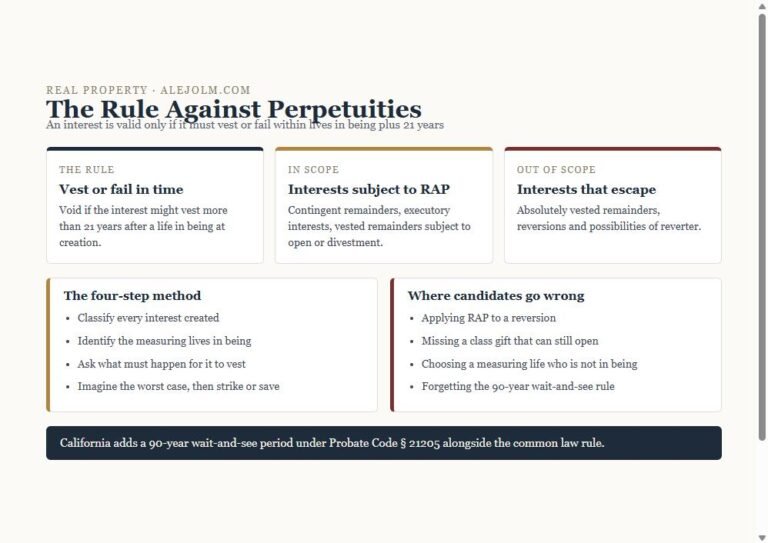 The Rule Against Perpetuities Explained Step by Step
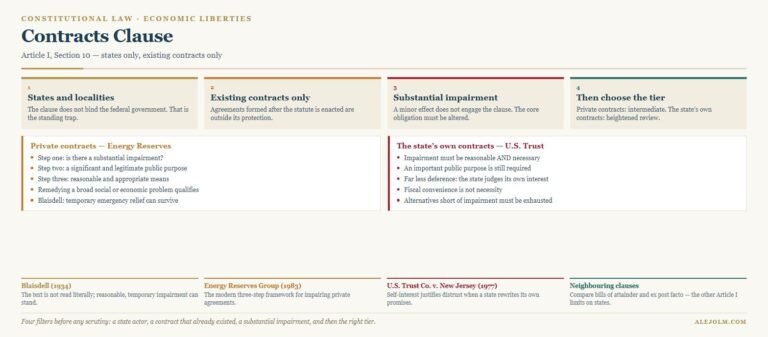 Contracts Clause: When States May Impair Agreements
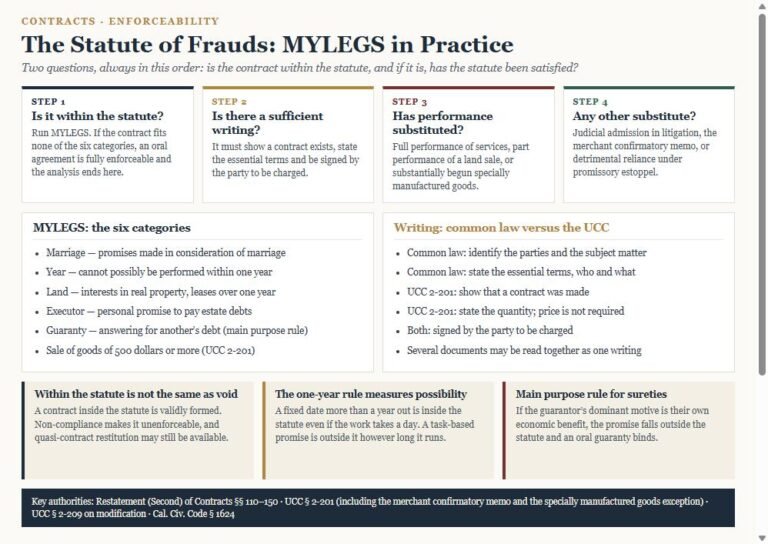 The Statute of Frauds: MYLEGS and How to Satisfy It
 3 Levels of Scrutiny in Constitutional Law Explained
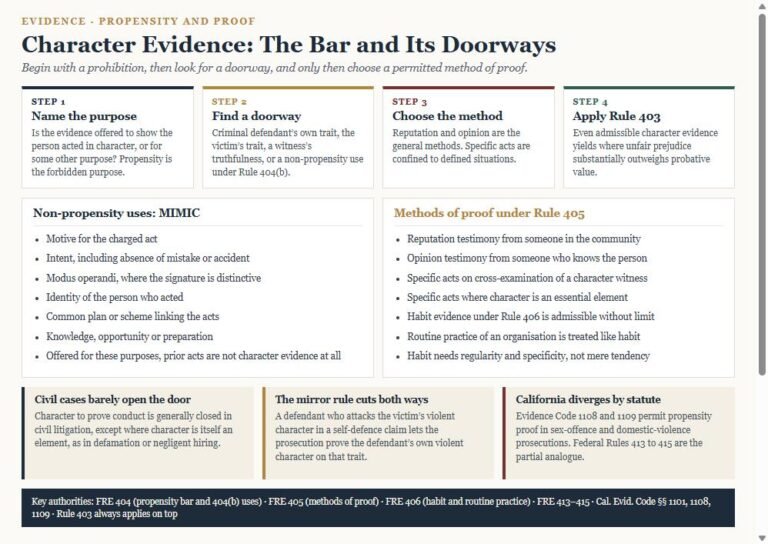 The Character Evidence Rules: Propensity Bar and Doorways
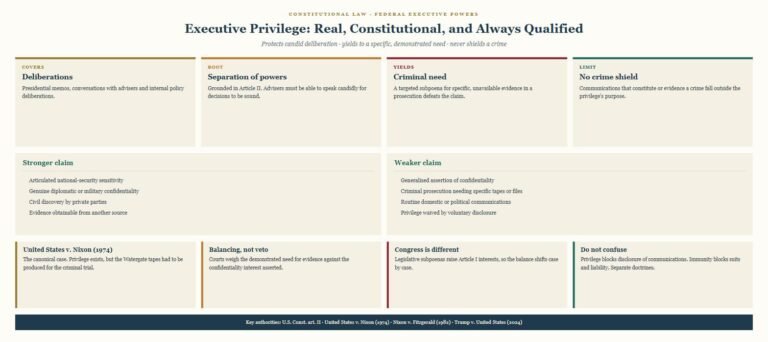 Executive Privilege: A Qualified Right That Must Yield
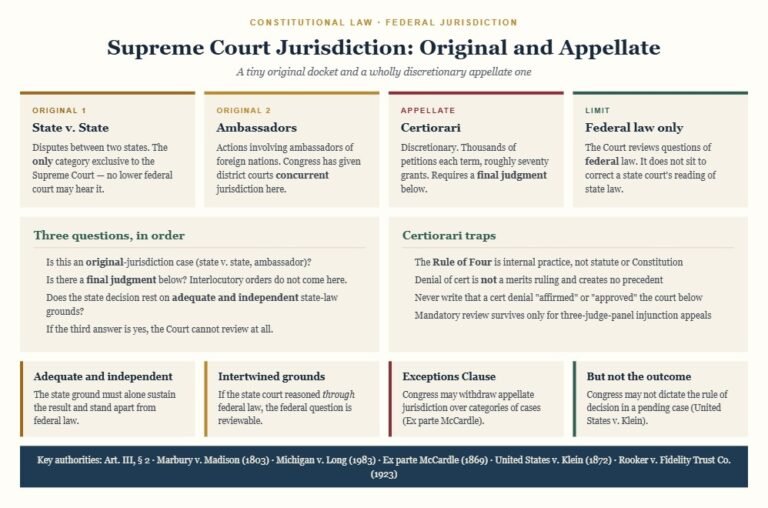 Supreme Court Jurisdiction: Original vs Appellate Power
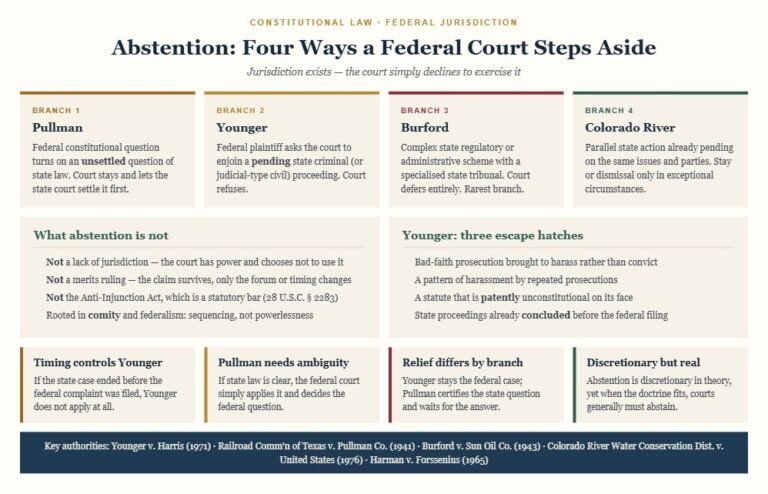 Abstention Doctrine: 4 Ways Federal Courts Step Aside
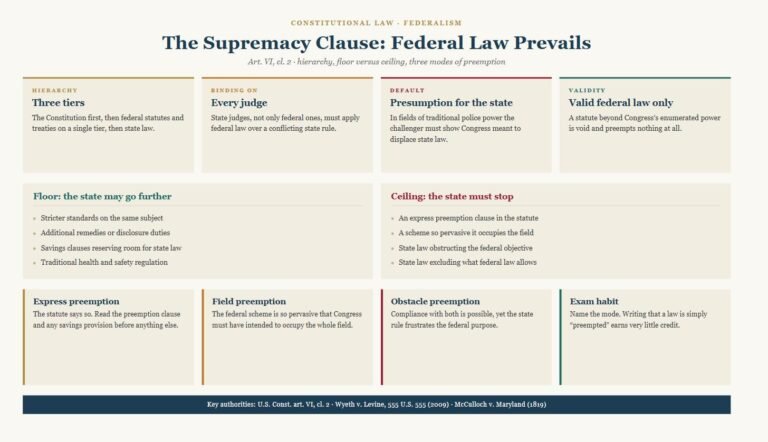 The Supremacy Clause: Floors, Ceilings and Preemption