
The Press Clause has its own words in the First Amendment, which naturally suggests it must carry its own, larger set of rights. It does not. The settled position is that the press enjoys no greater freedom to speak, and no greater right of access to information, than any member of the public. A reporter may go where you may go, see what you may see, and publish what you may publish.
What the Press Clause does supply is a small number of precise rules, and they are worth knowing exactly because they are counter-intuitive in both directions. Publishing information already in a public record cannot be punished, however sensitive. Publishing material a source obtained illegally is protected, provided the publisher’s own conduct was lawful. But a reporter has no constitutional privilege to protect a confidential source from a grand jury. This guide sets out each rule and where it stops.
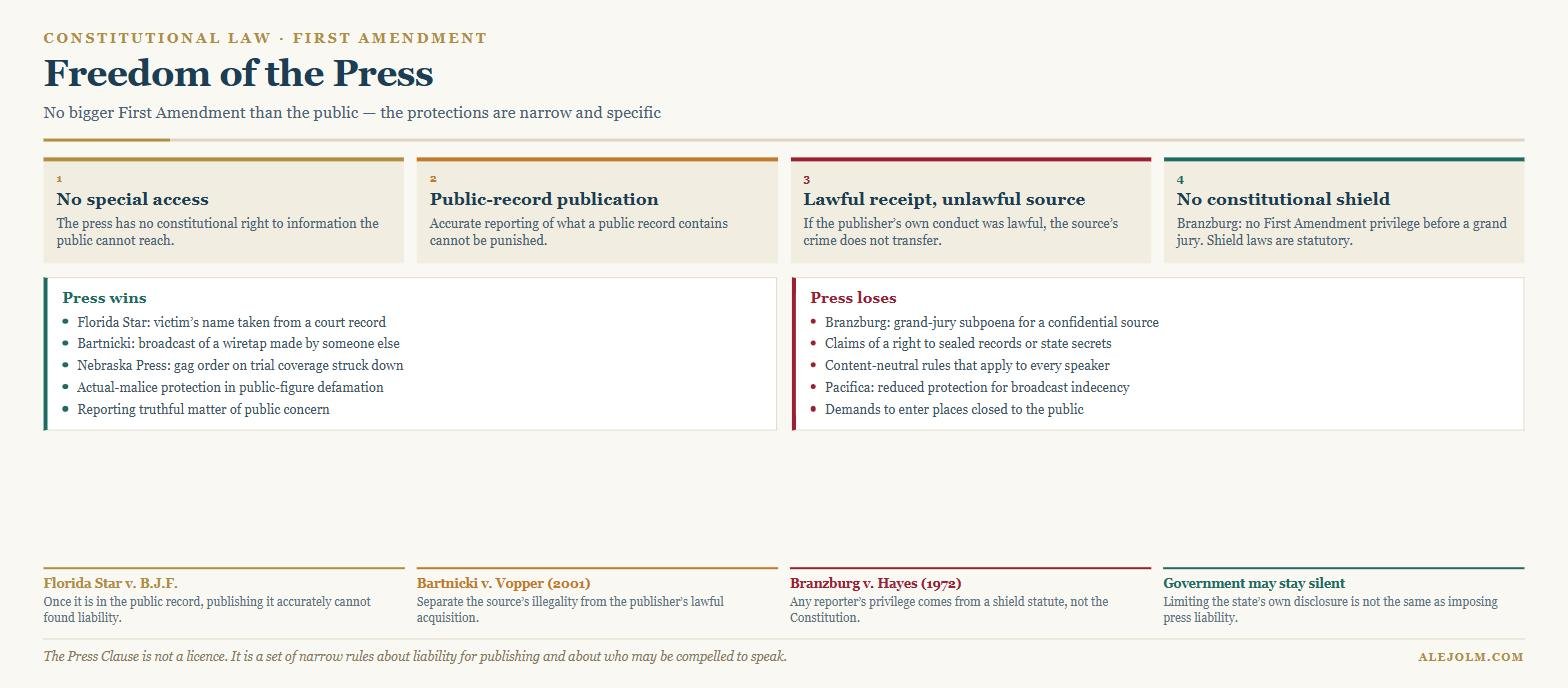
The baseline: no special rights and no special access
Begin from equivalence. Content-based restrictions, content-neutral time, place and manner rules, generally applicable laws, tax obligations, trespass rules — all apply to journalists exactly as they apply to anyone else. There is no press exemption from ordinary law simply because news-gathering becomes harder without one.
The same holds for access. There is no constitutional right to know that exceeds the public’s. Reporters cannot demand classified material, sealed court files, or entry to proceedings closed to everybody. If a courtroom is open to the public it is open to the press; if it is closed, it is closed to both. This point tends to be missed because access litigation exists in volume — but it is largely statutory, brought under freedom-of-information legislation, not under the First Amendment.
There is also a related distinction that repays care. The government may decline to release information it holds. Classifying documents, sealing records and withholding material are exercises of the state’s control over its own disclosure, and they raise no press-liability question at all. Restricting what the press may print once it has the material is an entirely different matter, governed by the rules below.
Public records: accurate publication cannot be punished
Where information sits in a public record, the press may report it accurately without incurring liability, even when the subject matter is acutely private. Florida Star v. B.J.F. is the standard illustration: a newspaper published the name of a sexual-assault victim taken from a police report that had been made publicly available, and liability could not be imposed.
The rationale is about where responsibility for confidentiality lies. If the state wishes sensitive material to remain private, the effective remedy is not to place it in a public file. Once the government has released it, punishing the accurate republication of information the state itself made available achieves very little privacy protection while imposing a substantial burden on reporting. The rule therefore allocates the duty of care to the body that controls the record.
Note the boundaries. The protection covers accurate publication of what the record contains — inaccuracy takes the case into defamation, where the ordinary rules including the actual-malice standard apply. And the rule does not oblige the state to make anything public; it governs the consequences once the state has.
Lawful receipt from an unlawful source
The second rule is easier to state than to accept: a publisher who lawfully obtains truthful information of public concern may publish it even where the original source acquired it by breaking the law. Bartnicki v. Vopper (2001) is the leading case. A telephone conversation was intercepted illegally by an unknown third party, the recording reached a broadcaster, and the broadcaster aired it. Because the broadcaster had not participated in the interception and its own receipt and publication were lawful, it could not be punished.
The doctrine turns on separating two actors. The interceptor committed a crime and is liable for it. The publisher did not, and imposing liability on the publisher would suppress truthful matter of public concern in order to deter a third party the law can punish directly. The chain of illegality does not automatically transfer down to whoever ends up holding the material.
The qualification is the phrase “lawful in itself”. A journalist who commissions the wiretap, participates in the theft, or induces the breach cannot shelter behind the rule, because the acquisition was not lawful. On an exam, the question to ask is always what the publisher did to acquire the material, not what happened before it arrived.
Exam tip: resist the instinct that press facts unlock a more protective doctrine. Start from the assumption that the press has exactly the public’s rights, then check the three narrow rules: public records, lawful receipt, and the gag-order presumption.
Branzburg: no constitutional reporter’s privilege
This is where the intuition of special press rights fails most sharply. In Branzburg v. Hayes (1972) the Court held that reporters have no First Amendment privilege to refuse a grand jury subpoena, to decline to answer relevant questions about criminal conduct they witnessed, or to withhold the identity of a confidential source. The Court accepted that compelled disclosure may chill news-gathering, but concluded that the citizen’s general obligation to give evidence applies to journalists as it does to everyone.
Reporter’s privilege does exist in practice — which is precisely why the constitutional point gets misremembered. Most states have enacted shield statutes, and some federal courts have recognised a narrow, qualified common-law privilege balancing confidentiality against the government’s need for the evidence. But those protections are creatures of statute and common law. They vary by jurisdiction, they can be repealed, and they are qualified rather than absolute. Describing them as constitutional is a straightforward error.
Gag orders and the fair-trial clash
The third rule is the strongest protection the press has, and it belongs to prior restraint doctrine. Under Nebraska Press Association v. Stuart (1976), an order restraining the press from reporting on a pending case carries a nearly insurmountable presumption of unconstitutionality. The Sixth Amendment interest in an impartial jury is genuine, but the state must establish that no less restrictive alternative would protect it.
The list of alternatives is long enough that the burden is almost never met: searching voir dire, emphatic instructions, sequestration, a change of venue, a continuance until coverage subsides. A blanket order forbidding all reporting — even of the defendant’s name and the charges — without findings that each alternative would fail is invalid on its face. Restraints on trial participants, by contrast, are handled through professional-conduct rules and protective orders and are far more readily upheld.
One further asymmetry is worth noting. Broadcast media have historically received somewhat reduced First Amendment protection, the rationale in FCC v. Pacifica Foundation resting on the pervasiveness of broadcasting and the ease of children’s access. That permits indecency regulation which would be plainly unconstitutional applied to print or online publication — though it does not license broadcast restrictions of any breadth the regulator prefers.
| Situation | Governing rule |
|---|---|
| Publishing a name taken from a public record | Florida Star |
| Airing a recording a stranger intercepted illegally | Bartnicki |
| Journalist participates in the illegal interception | Acquisition not lawful |
| Grand jury subpoena for a confidential source | Branzburg |
| Order barring all reporting on a pending trial | Nebraska Press |
| Protective order on lawyers and witnesses | Professional conduct rules |
| Demand for access to sealed records | No special access |
| Indecency rules applied to broadcast | Pacifica |
Worked example
A state trial court seals the record in a criminal case and issues an order prohibiting the press from reporting any detail about it, including the defendant’s name and the charges. The judge explains that the community is small and pre-trial publicity would make an impartial jury impossible. A newspaper challenges the order.
This is a prior restraint on the press and therefore attracts the Nebraska Press presumption of invalidity. Take the state’s interest at its highest: ensuring a fair trial is compelling, and in a small community the concern about jury pooling is not fanciful. The order still fails, for two reasons. First, it is a blanket prohibition covering even the defendant’s identity and the charges — information whose publication is basic to public scrutiny of the criminal process — so it is nowhere near narrowly tailored. Second, and decisively, the court made no findings that the available alternatives would be inadequate. Rigorous voir dire, firm instructions, sequestration, transfer to another county and a continuance were all open, and the state bears the burden of eliminating them. It did not. The order is unconstitutional and the newspaper may report.
Change one fact. Suppose the court had instead issued no order against the press, and a reporter obtained the sealed file because a clerk removed and handed it over in breach of the court’s order. Publication would still very likely be protected under Bartnicki, since the reporter’s own receipt was passive and lawful, and the clerk’s wrongdoing does not transfer. But if the reporter had paid the clerk to take the file, the acquisition would not be lawful in itself and the analysis reverses entirely.
Common mistakes that cost points
- Assuming the press has broader rights than the public. Its protection is co-extensive, with three narrow exceptions.
- Describing reporter’s privilege as constitutional. Branzburg says otherwise; the privilege comes from shield statutes or common law.
- Transferring the source’s illegality to the publisher. Ask only whether the publisher’s own acquisition was lawful.
- Forgetting the “lawful in itself” limit. A journalist who commissions or joins the unlawful acquisition loses the protection.
- Confusing the state withholding its own information with imposing liability on the press. Only the second is a First Amendment problem.
- Treating gag orders as easily justified by fair-trial concerns. The government must eliminate every less restrictive alternative.
- Equating restraints on the press with restraints on lawyers and witnesses. The latter are analysed far more permissively.
- Assuming print rules transfer to broadcast. Pacifica permits indecency regulation that would fail for print or online media.
Frequently asked questions
Does the press have a right of access to information the public cannot get?
No. There is no constitutional right to know beyond the public’s. Reporters cannot compel disclosure of classified material or entry to closed proceedings. Where access rights do exist they generally come from freedom-of-information statutes rather than the First Amendment.
Can a journalist be forced to reveal a confidential source?
Constitutionally, yes. Branzburg v. Hayes holds there is no First Amendment privilege against a grand jury subpoena. Whether the journalist is protected in fact depends on the jurisdiction’s shield statute or a qualified common-law privilege — protections that are real but statutory and variable.
Why can the press publish material a source stole?
Because liability follows conduct. The source committed the offence and can be prosecuted; the publisher, who merely received the material lawfully, did not. Punishing the publisher would suppress truthful information of public concern to deter someone the law can already reach directly. The protection disappears if the publisher took part in the unlawful acquisition.
Press freedom in California: shield law and records access, 2026
California gives journalists stronger protection than federal law requires, and the difference is constitutional rather than merely statutory. Article I, section 2(b) of the California Constitution and section 1070 of the California Evidence Code together create a shield that has been read as an immunity from contempt for refusing to disclose sources or unpublished information, rather than a qualified privilege to be balanced away. After Branzburg v. Hayes (1972) declined to recognise a federal reporter’s privilege in grand jury proceedings, the state provision became the operative protection in California courtrooms.
Access to information is the other half of press practice. The California Public Records Act, now recodified in the California Government Code, governs requests to the County of Los Angeles, the Sheriff’s Department and county departments, and legislation enacted since 2018 has opened categories of peace officer personnel records and audio and video of critical incidents that were previously confidential. Much Los Angeles County reporting on law enforcement now rests on those provisions.
What a Los Angeles practitioner needs to know:
- The shield is not absolute against criminal defendants. Where a defendant’s fair trial rights are genuinely at stake, courts have required disclosure in narrow circumstances.
- It protects unpublished material broadly. Outtakes, notes and unaired footage fall within the provision, not merely source identities.
- Newsroom searches are restricted. Federal and state law both favour subpoenas over search warrants directed at journalists.
- Records denials go to the writ department. A refused request is enforced by petition in the Los Angeles Superior Court, with fees available to a successful requester.
- Exemptions are construed narrowly. The county bears the burden of justifying withholding, and the constitutional access provision reinforces that.
- Publication of lawfully obtained material is protected. The press may generally publish truthful information even where a source obtained it improperly.
In 2026, use the state shield rather than federal doctrine, and pair every access dispute with a records petition. Read with prior restraint, the actual malice standard and the First Amendment framework.
Next steps
Press questions rarely stand alone, so read this with the doctrines it borrows from. Gag orders are governed entirely by prior restraint and licensing, which supplies the presumption and the alternatives analysis. Publication liability for falsity runs through the actual malice standard, the other major constraint on reporting about public figures. Place both inside the First Amendment analysis, and note that many attempts to regulate publication also collapse under vagueness and overbreadth.
The opinions in Branzburg and Bartnicki are the two most useful to read in full and are freely available through Justia’s First Amendment collection. Cornell’s Legal Information Institute keeps a concise entry with current citations, and candidates should confirm the tested scope against the outlines published by the State Bar of California.
Related guides
 Will Execution Requirements: Formalities and Rescue
 Second Amendment: The Bruen Text-and-History Standard
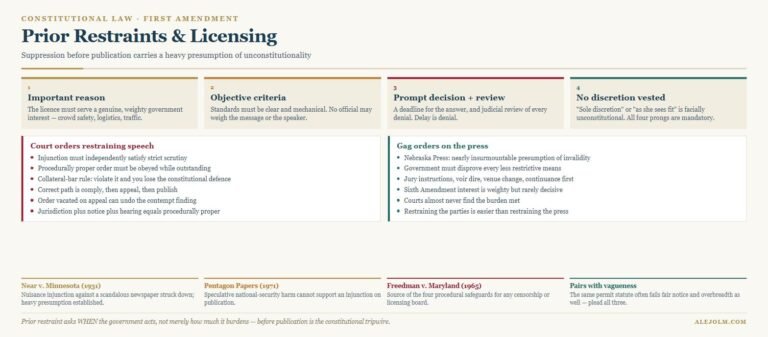 Prior Restraint and Licensing: The Freedman Safeguards
 Bicameralism and Presentment: Two Vetoes Struck Down
 Supreme Court Jurisdiction: Original vs Appellate Power
 Political Question Doctrine: What Courts Will Not Decide
 The Eleventh Amendment and State Sovereign Immunity
 Personal Jurisdiction: The 3-Step Bar Exam Framework
 Recording Acts: Race, Notice and Race-Notice Explained
 Incorporation Doctrine: Which Rights Bind the States
 The Supremacy Clause: Floors, Ceilings and Preemption
 Partner Liability and Authority Under RUPA Explained