
The Bill of Rights was written against the federal government. Read in 1791, it said nothing at all about what a state legislature or a county sheriff could do, and in Barron v. Baltimore (1833) the Supreme Court said so plainly. Almost every constitutional claim brought against a state today therefore depends on a doctrine the founding generation would not have recognised.
Incorporation is the process by which provisions of the Bill of Rights have been applied to state and local government through the Due Process Clause of the Fourteenth Amendment. It is selective rather than wholesale, it has taken a century and a half, and three provisions are still outside it. Knowing which is a matter of memory, but knowing why is what makes the doctrine usable.
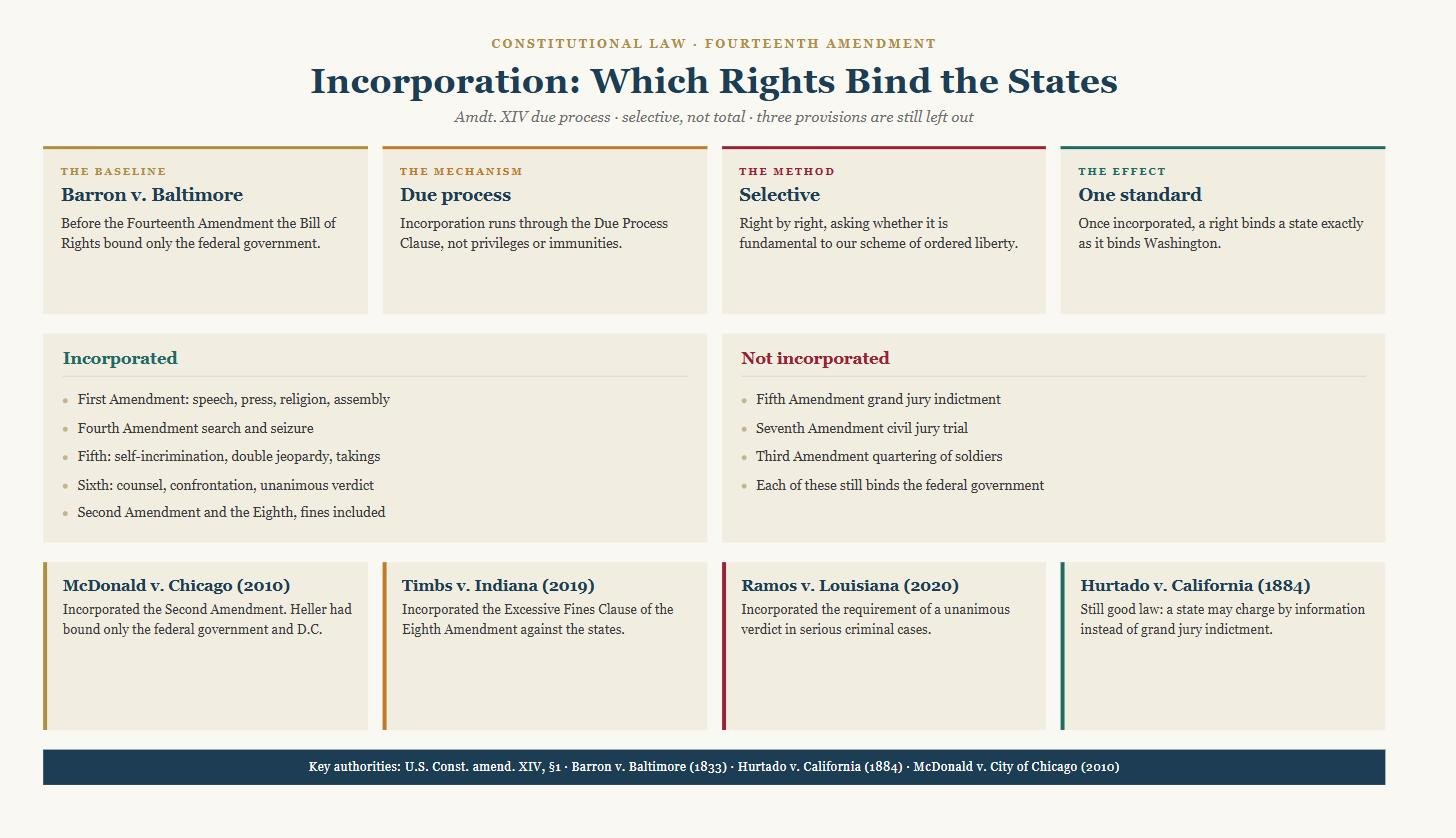
From Barron to the Fourteenth Amendment
The Fourteenth Amendment, ratified in 1868, forbids any state to deprive a person of life, liberty or property without due process of law. On its face that is a procedural guarantee. The obvious candidate for carrying substantive federal rights into the states was the neighbouring Privileges or Immunities Clause, and the Slaughterhouse Cases (1873) closed that door within five years by confining the clause to a thin set of rights of national citizenship.
What was left was “liberty” in the Due Process Clause, and the Court built the whole edifice on it. Over the twentieth century it asked, provision by provision, whether a given guarantee is fundamental to our scheme of ordered liberty and deeply rooted in the nation’s history and tradition. Where the answer was yes, the provision became binding on the states through the Fourteenth Amendment.
Selective, not total, and identical once inside
Two features of the method matter for exams. The first is that incorporation is selective. The Court has never held that the Bill of Rights as a whole applies to the states, and a right that has not been incorporated simply does not constrain state government, however important it may look.
The second is that incorporation is not a watered-down version of the federal right. Once a provision is incorporated, it applies to the states with the same content and the same standard as it applies to the federal government. There is no state-specific discount. Ramos v. Louisiana (2020) makes the point vividly: having concluded that the Sixth Amendment requires unanimity, the Court held that states must deliver unanimity too, and overruled the compromise that had allowed some of them not to.
Exam tip: if a fact pattern raises an unincorporated right, the identity of the defendant decides the case. Grand jury indictment is guaranteed against a federal prosecution and unavailable against a state one on precisely the same facts.
What is in, and what is out
| Provision | Status against the states |
|---|---|
| Speech, press, religion, assembly | Incorporated |
| Fourth Amendment search and seizure | Incorporated |
| Privilege against self-incrimination | Incorporated |
| Right to counsel | Incorporated — Gideon v. Wainwright |
| Unanimous verdict in serious criminal cases | Incorporated — Ramos v. Louisiana (2020) |
| Excessive fines | Incorporated — Timbs v. Indiana (2019) |
| Right to keep and bear arms | Incorporated — McDonald v. Chicago (2010) |
| Grand jury indictment | Not incorporated — Hurtado v. California |
| Civil jury trial under the Seventh Amendment | Not incorporated |
| Third Amendment quartering of soldiers | Never addressed by the Court |
The two exclusions that get tested are the grand jury and the civil jury. A state may begin a felony prosecution by information supported by a preliminary hearing, and a state may try a civil case to a judge alone, without offending the federal Constitution. Its own constitution may say otherwise, and most do, but that is a state-law question.
Incorporation is not the same as substantive due process
Both doctrines live in the word “liberty”, and they are often confused. Incorporation takes an existing textual guarantee and applies it to a new set of defendants. Substantive due process recognises rights that appear nowhere in the Bill of Rights at all — the privacy interest in Griswold v. Connecticut (1965), the marriage right in Obergefell v. Hodges (2015). One is a channel; the other is a source.
There is also a mirror-image doctrine worth knowing. Because the Fourteenth Amendment binds only the states, the Court has read an equal protection component into the Fifth Amendment’s Due Process Clause so that the federal government is held to the same anti-discrimination rule. Bolling v. Sharpe (1954), the companion to Brown that dealt with the District of Columbia, is the case. Reverse incorporation is the usual label.
Worked example
State C authorises prosecutors to charge felonies by information, following a preliminary hearing at which the defendant may appear and cross-examine, with no grand jury involved. A defendant charged that way argues the Fifth Amendment entitles him to an indictment.
He loses. The Fifth Amendment grand jury clause has never been incorporated; Hurtado v. California (1884) held as much and has not been disturbed. So the question is not whether State C complied with the Fifth Amendment but whether its own procedure satisfies Fourteenth Amendment due process, and a preliminary hearing with notice and an opportunity to be heard comfortably does. Note what the answer depends on: not the fairness of grand juries, but the incorporation ledger.
Change one fact. Suppose the prosecution is federal. Now the same procedure is unconstitutional, because the Fifth Amendment applies directly to the federal government and requires an indictment for infamous crimes. Identical facts, opposite results, and the only variable is who is prosecuting.
Common mistakes that cost points
- Assuming the whole Bill of Rights binds the states. Three provisions do not.
- Routing incorporation through the Privileges or Immunities Clause. That is a concurring position, not the doctrine.
- Applying a softer version of an incorporated right to a state. The standard is identical.
- Confusing incorporation with substantive due process. One channels a text; the other creates a right.
- Forgetting that state constitutions often supply what the federal Constitution does not, particularly on civil juries.
- Overlooking reverse incorporation when the defendant is the federal government and the claim is discrimination.
Frequently asked questions
Why does incorporation run through due process rather than privileges or immunities?
Because the Slaughterhouse Cases read the Privileges or Immunities Clause almost out of existence in 1873, and the Court has never revisited that holding. Due process was the available route, and a century of precedent now rests on it.
Is the Third Amendment incorporated?
The Supreme Court has never had occasion to decide. One court of appeals has assumed it applies to the states, but there is no controlling holding, which is why it belongs on the unincorporated side of the ledger for exam purposes.
Does incorporation apply to local governments as well as states?
Yes. Cities, counties, school boards and other subdivisions exercise state power, so anything binding on a state is binding on them. That is why so many leading cases are captioned against a municipality.
Incorporation and California’s Truth in Evidence rule, 2026
Incorporation makes most of the Bill of Rights applicable to California through the Fourteenth Amendment, and the federal standard operates as a floor that the California Constitution may exceed. California does exceed it in several areas, but there is one striking exception that every practitioner in the Los Angeles Superior Court must know.
Article I, section 28 of the state constitution, added by initiative in 1982 and often called the Truth in Evidence provision, bars California courts from excluding relevant evidence except as required by federal law. In In re Lance W. (1985) the California Supreme Court held that this abolished the independent state exclusionary remedy, so a search that violates the California Constitution but satisfies the Fourth Amendment produces admissible evidence. California may still interpret its own constitution more protectively; it simply cannot suppress evidence on that basis.
Where California gives more, and where it does not:
- Search and seizure remedies track federal law exactly. Suppression motions under section 1538.5 of the California Penal Code are decided by federal standards.
- Privacy is expressly protected. Article I, section 1 creates an enumerated privacy right with no federal textual counterpart, enforceable in civil actions.
- Speech protection is broader. The Pruneyard line reaches private property in a way federal doctrine does not.
- Jury unanimity was already required. California demanded unanimous criminal verdicts long before Ramos v. Louisiana (2020) imposed it nationally.
- Excessive fines are incorporated. Timbs v. Indiana (2019) applies to county fines, fees and forfeitures, an active area given the scale of county assessments.
- Grand jury indictment is not incorporated. California proceeds by information after a preliminary hearing in most felony cases.
For 2026, ask whether you want a broader right or a broader remedy, because California grants the first far more readily than the second. Read with substantive due process, the Second Amendment and Miranda rights.
Next steps
Read this before the state action doctrine, which is the threshold every Fourteenth Amendment claim must cross, then the right to travel for what the Privileges or Immunities Clause still does, the three levels of scrutiny for the standards that follow, and Miranda rights for an incorporated guarantee in operation.
For primary sources, read McDonald v. City of Chicago on Justia and Barron v. Baltimore also on Justia, review the Fourteenth Amendment on Cornell Legal Information Institute, and confirm current subject coverage with the State Bar of California.
Related guides
 Government Employee Speech: Garcetti and Pickering Rules
 Advisory Opinions: Article III and Declaratory Relief
 The Eleventh Amendment and State Sovereign Immunity
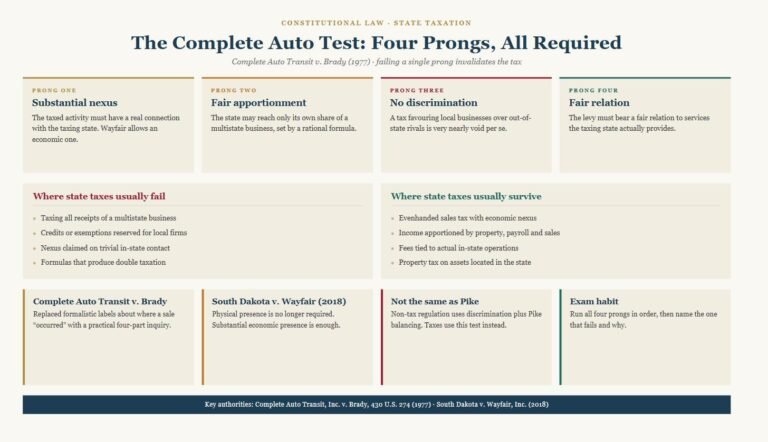 The Complete Auto Test: Taxing Interstate Commerce
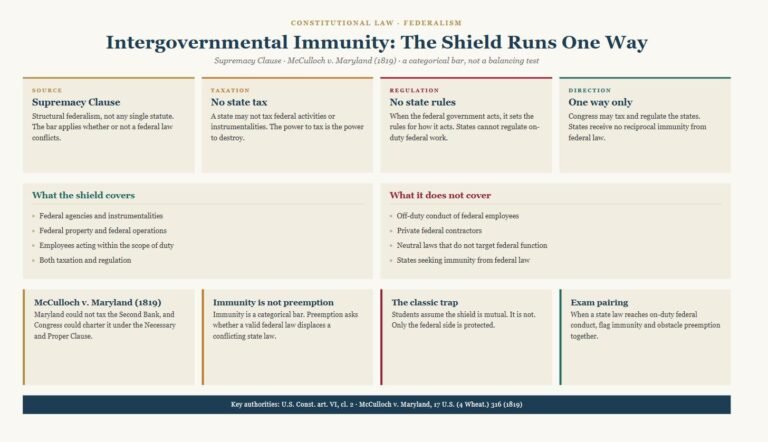 Intergovernmental Immunity: The Shield Runs One Way
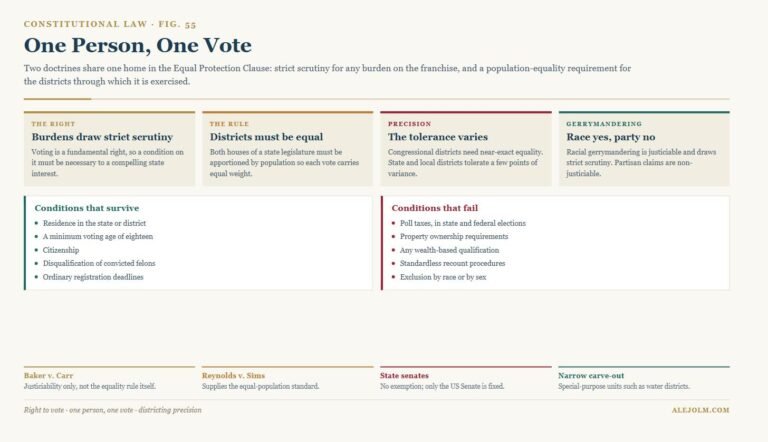 One Person, One Vote: Voting Rights Under Equal Protection
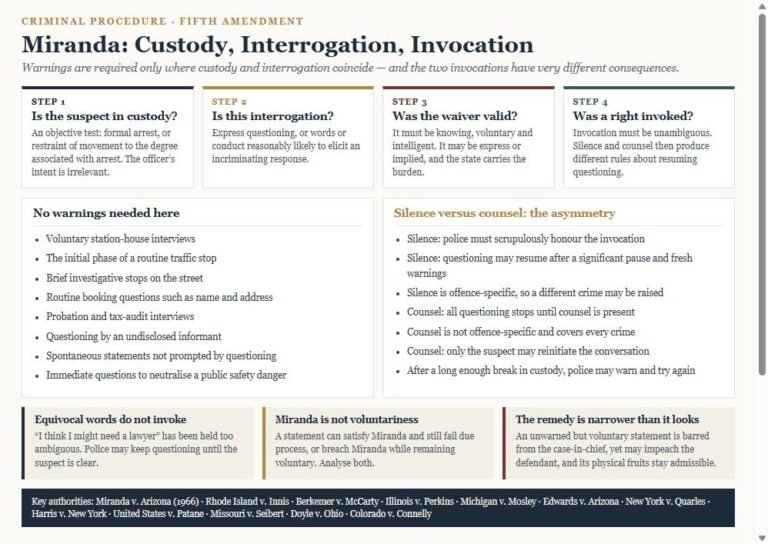 Miranda Rights: Custody, Interrogation and Invocation
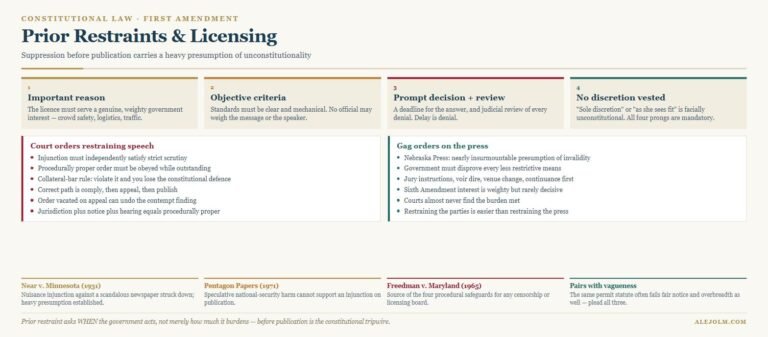 Prior Restraint and Licensing: The Freedman Safeguards
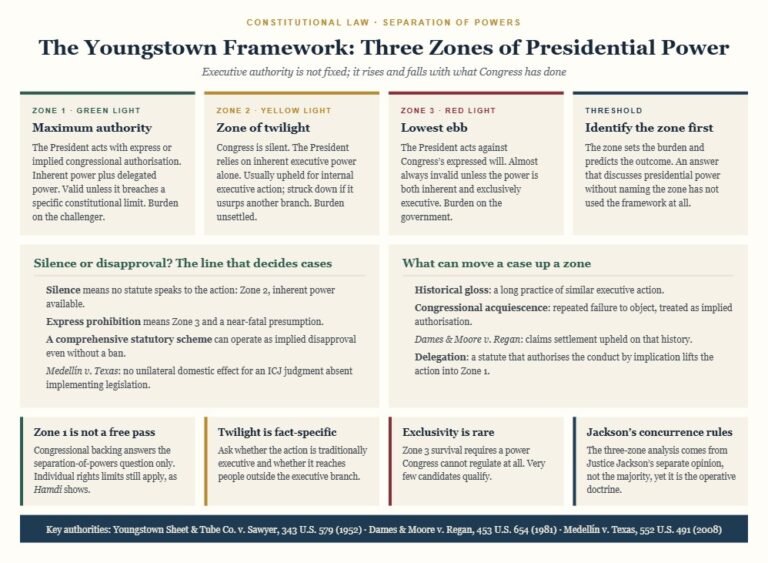 The Youngstown Framework: Presidential Power in 3 Zones
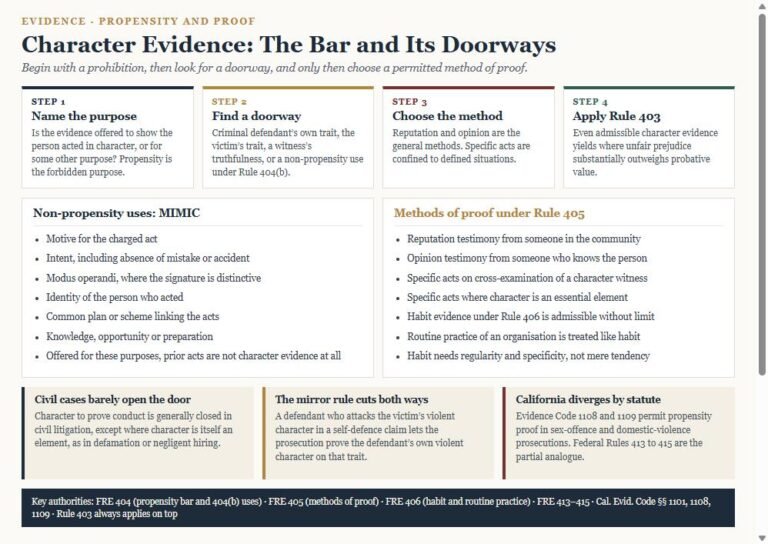 The Character Evidence Rules: Propensity Bar and Doorways
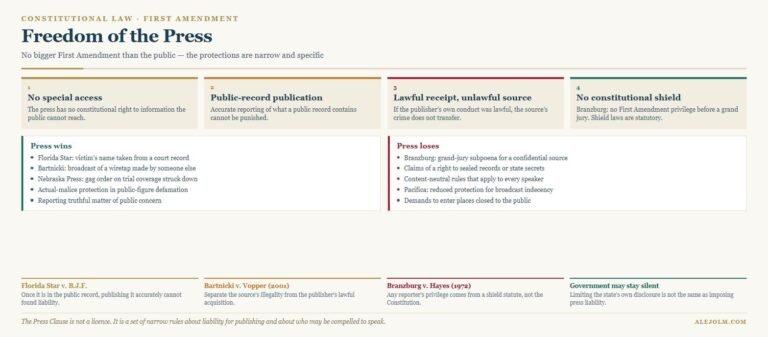 Freedom of the Press: Publication Liability and Limits
 Partner Liability and Authority Under RUPA Explained