
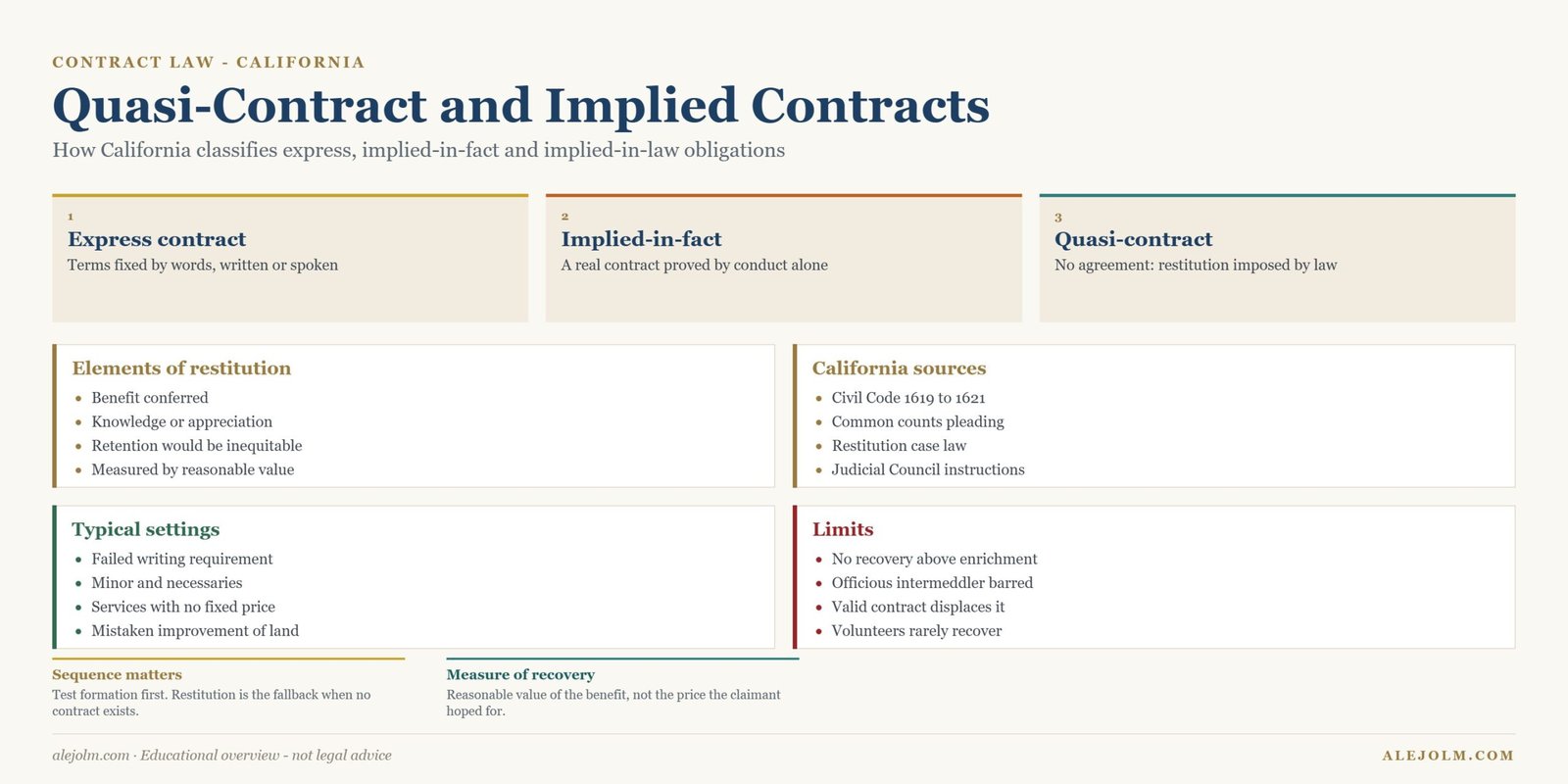
Quasi-contract is the label California courts use for an obligation that the law imposes when no genuine agreement was ever reached, yet one party has been enriched at another expense in circumstances that make retention unfair. It is not a contract in any real sense. It is a restitutionary remedy, and it sits alongside two genuine contract categories: the express contract, whose terms are stated in words, and the implied-in-fact contract, whose terms are proved by conduct.
California codifies the basic taxonomy in the Civil Code, which divides contracts into express and implied and then defines the implied contract as one whose existence and terms are manifested by conduct. This guide explains how the three categories differ, how a claimant pleads and proves restitution in a California trial court, what the measure of recovery looks like, and how the doctrine plays out in ordinary Los Angeles County disputes over unpaid services, mistaken improvements and agreements that fail a writing requirement.
The three categories, distinguished
An express contract is created by language. The parties speak or write the terms, and a court enforces what they said. An implied-in-fact contract is created by conduct that objectively signals agreement even though nothing was said about the essential terms. The regular customer who walks into a familiar shop, takes goods from the shelf and is billed at the usual rate has an implied-in-fact contract. Both are true contracts and both carry the full remedial toolkit of contract law.
A quasi-contract, sometimes called a contract implied in law, is different in kind. Nobody agreed to anything. The law steps in because the defendant has received something of value in circumstances where keeping it without payment would be unjust. Because consent is absent, the recovery is not the bargain price. It is the reasonable value of what the defendant actually gained.
Why the distinction changes the outcome
Defences that defeat a true contract do not automatically defeat restitution. A writing requirement, indefiniteness or incapacity can knock out a contract claim while leaving a restitution claim intact. That is precisely why the doctrine exists: to prevent a formal rule from becoming an instrument of enrichment.
Elements a California claimant must establish
- A measurable benefit. Money, goods, services, improvements or the discharge of an obligation the defendant owed.
- Receipt by the defendant. The benefit must have reached the party from whom restitution is sought, not merely have been intended for that party.
- Knowledge or appreciation. The defendant knew of the benefit, or had reason to know, at a time when objection was still possible.
- Inequity in retention. The circumstances must make it unfair to keep the benefit without paying for it.
- Absence of an enforceable contract. Where a valid agreement governs the same subject matter, the agreement controls and restitution drops out.
- No officious conferral. A volunteer who forces a benefit on an unwilling recipient generally recovers nothing.
California pleading practice still reflects the old common counts, so a restitution claim frequently appears as a count for money had and received, for goods sold and delivered, or for the reasonable value of services rendered. The substance is the same set of elements described above.
| Feature | Express | Implied-in-fact | Quasi-contract |
|---|---|---|---|
| Source of terms | Words of the parties | Conduct of the parties | Imposed by law |
| Mutual assent | Present and stated | Present and inferred | Absent |
| Measure of recovery | Contract price | Contract price | Reasonable value of benefit |
| Effect of writing defence | Claim may fail | Claim may fail | Claim survives |
| Typical proof | Signed document | Course of dealing | Evidence of enrichment |
A worked example
A contractor in Glendale agrees orally to remodel a kitchen for a homeowner. Work begins, the homeowner pays nothing, and the agreement turns out to be unenforceable because it fails a statutory writing requirement for home improvement work. The contractor cannot sue on the contract. He can still seek the reasonable value of the labour and materials actually incorporated into the house, because the homeowner received and knowingly accepted a benefit that it would be unfair to keep for free.
Change the facts. The contractor arrives at the wrong address in Burbank while the owner is away on holiday, resurfaces the driveway and leaves. The owner returns to find completed work she never requested and had no chance to refuse. Here the appreciation element is weak and the officious intermeddler principle is strong, so a California court is far more likely to deny restitution. The difference between the two outcomes is opportunity to object, not the value of the work.
Quasi-contract in California and Los Angeles County in 2026
Restitution claims are a routine feature of Los Angeles Superior Court civil filings, particularly in construction, professional services and family financial disputes. Because they do not depend on a signed writing, they are often the only viable theory once a contract claim collapses, and defendants should expect them to be pleaded in the alternative in almost every well drafted complaint.
Practitioners should keep the limitation period in view. A claim on an obligation not founded on a writing carries a shorter period than one on a written contract, and restitution counts are generally treated as unwritten obligations. Delay is therefore expensive in a way that it is not for a signed agreement.
- Plead in the alternative. Contract and restitution counts can and usually should be pleaded together.
- Prove value, not price. Expert or market evidence of reasonable value carries the claim.
- Document acceptance. Emails and site photographs establish the appreciation element.
- Watch the shorter limitation period. Unwritten obligations expire sooner than written ones.
- Check licensing rules. Statutes can bar recovery by unlicensed contractors even in restitution.
- Consider offsets. Defects and delay reduce the net enrichment a court will recognise.
For 2026, confirm the current California authority on restitution, common counts and the applicable limitation periods directly with current authority, since these continue to develop.
Common mistakes to avoid
- Calling it a contract. Quasi-contract is a remedy, and describing it as an agreement invites confusion about consent.
- Pleading it where a contract governs. A valid agreement on the same subject matter displaces restitution entirely.
- Confusing it with an implied-in-fact contract. Conduct that shows real agreement creates a true contract, not a restitution claim.
- Ignoring the appreciation element. A benefit conferred while the recipient was absent and unaware is often unrecoverable.
- Claiming the hoped-for price. Recovery is capped by the defendant enrichment, not the claimant expectation.
- Missing the limitation period. Treating a restitution count as though it enjoyed the longer written-contract period is a costly error.
Frequently asked questions
Is a quasi-contract the same as an oral contract?
No. An oral contract is a genuine agreement that happens not to be written down. A quasi-contract involves no agreement at all; the obligation is imposed by law to reverse unjust enrichment.
Can I recover if the other side never asked for the work?
Sometimes, but it is difficult. California is reluctant to reward a person who confers a benefit without request, and the claim is strongest where the recipient watched the work proceed and said nothing.
How is the amount calculated?
By the reasonable value of the benefit the defendant received, typically established through market rates, invoices for comparable work or expert testimony, and reduced by any offsetting harm.
Does a failed writing requirement destroy the claim?
Not necessarily. A writing defence can defeat enforcement of the agreement while leaving intact a claim for the reasonable value of performance already rendered.
Can a minor be liable in restitution?
Yes, for necessaries such as food, clothing, shelter and medical care. Liability rests on restitution principles rather than on the minor capacity to contract.
Related guides
- Contract formation in California
- Consideration in contract law
- The statute of frauds
- Promissory estoppel
- Capacity and legality
- Remedies for breach of contract
- Unconscionability
- Rescission of a contract
Next steps
If a deal has broken down and you are unsure whether a contract ever formed, map the facts against both theories before choosing one. Reading our guide to contract formation and then remedies for breach will show which route offers the stronger recovery on your facts.
For primary sources, read California Civil Code section 1621 and the civil jury instructions published by the Judicial Council of California.