
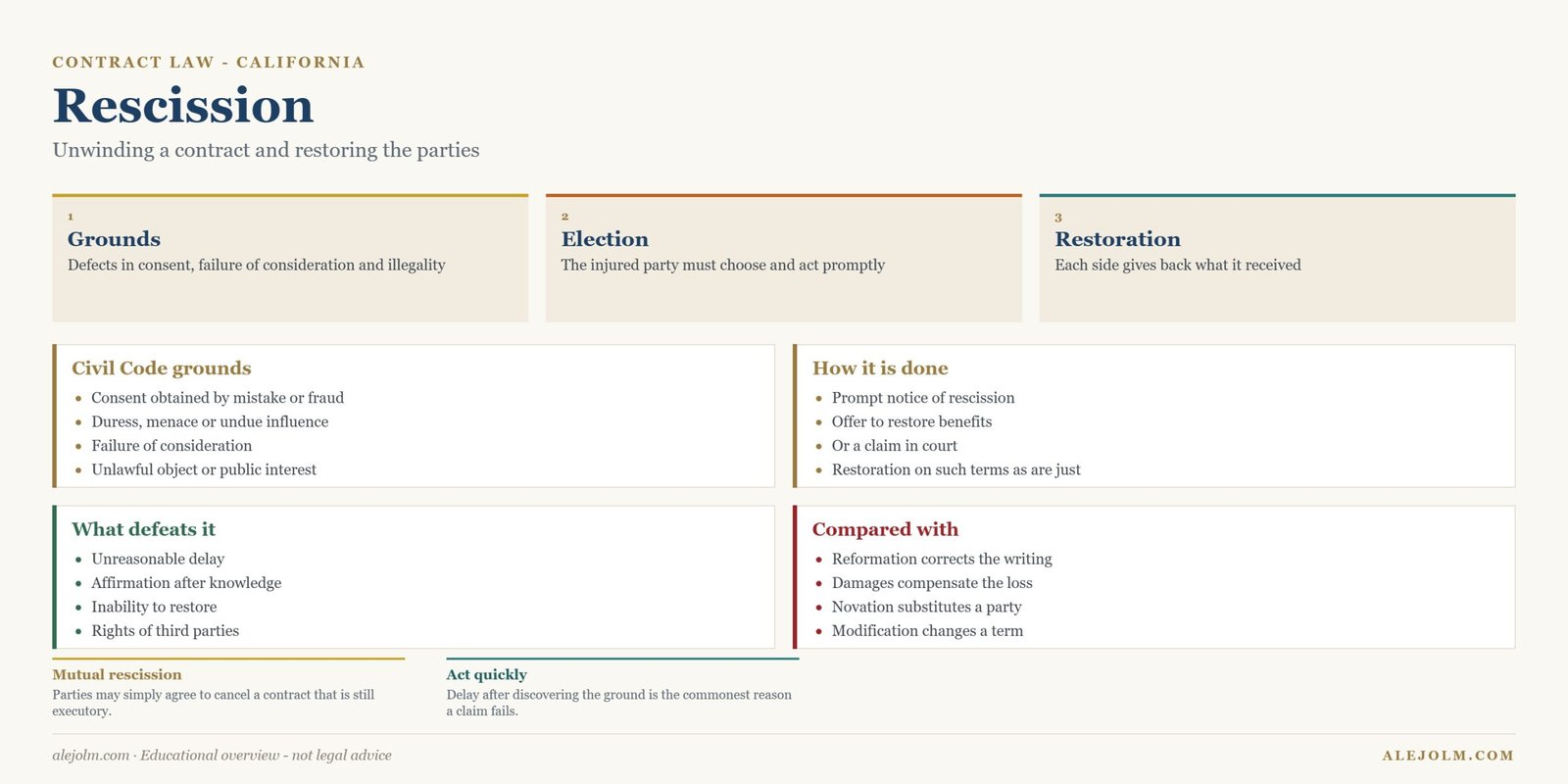
Rescission cancels a contract and restores the parties as nearly as possible to the positions they occupied before it was made. California sets out the grounds in the Civil Code: consent obtained by mistake, fraud, duress, menace or undue influence, failure of consideration, and unlawful objects or purposes affecting the public interest.
Rescission is elective. A contract that is voidable remains fully effective until the injured party chooses to undo it, and that choice must be made promptly and communicated. This guide sets out the grounds, the procedure, the restoration obligation, the defences that most often defeat a claim, and how rescission differs from reformation and from an ordinary damages action.
Grounds for rescission
- Mistake. A mutual mistake about a basic assumption, or a unilateral mistake the other side knew about or exploited.
- Fraud or misrepresentation. A false statement of material fact that induced the agreement.
- Duress, menace or undue influence. Consent that was not freely given.
- Failure of consideration. Where the consideration fails entirely or in a material part through the fault of the other party.
- Illegality. Where the object is unlawful or the contract is contrary to the public interest.
- Incapacity. Where a minor or a person lacking capacity disaffirms.
Mutual rescission
Separately from unilateral rescission for a defect, the parties may simply agree to cancel. Because each side gives up its right to enforce the other performance, the agreement is supported by consideration, and it does not require the same formality as the original contract. Mutual rescission is generally available only while obligations remain outstanding on both sides.
How rescission is effected
California allows a party to rescind by giving notice of rescission and restoring, or offering to restore, everything of value received, subject to the other party doing the same. Alternatively a party may bring proceedings and ask the court to adjudge the contract rescinded, and the court may require restoration on such terms as justice requires. Either route depends on promptness.
| Remedy | What it does | When it fits |
|---|---|---|
| Rescission | Cancels and restores | Consent was defective |
| Reformation | Corrects the document | The writing misstates the deal |
| Damages | Compensates the loss | The contract is valid but broken |
| Restitution | Returns the benefit | Where value has been conferred |
| Cancellation | Voids the instrument | Where a document clouds title |
A worked example
A buyer in Long Beach purchases a small business after being told that a major customer contract had been renewed for three years, when the seller knew it had already been terminated. On discovering the truth two weeks after closing, the buyer immediately notifies the seller of rescission, offers to return the business and demands the price back. That is a properly exercised rescission on the ground of fraud.
Change the timing. Suppose the buyer discovered the truth within two weeks but continued to operate the business for a further year, drew profits from it and only then sought rescission. The delay and the continued enjoyment of the benefit amount to affirmation, the right to rescind is lost, and the buyer is left to a claim in damages.
Rescission in California and Los Angeles County in 2026
Rescission claims in Los Angeles County cluster in three settings: sales of businesses and franchises, residential property transactions where a disclosure obligation was breached, and elder financial abuse cases involving transfers of property. In each the practical question is usually not whether a ground exists but whether the claimant acted quickly enough and can still restore what it received.
California also allows a claim for damages alongside rescission in appropriate cases, so that a party who cannot be fully restored may recover the shortfall. Where third parties have acquired rights in good faith and for value, however, the courts will not unwind the transaction at their expense.
- Give written notice at once. The date of notice frequently decides the case.
- Offer restoration. A conditional offer, subject to the other side doing likewise, is sufficient.
- Stop taking the benefit. Continued use of what you received undermines the claim.
- Preserve the asset. An inability to restore can defeat rescission.
- Consider pleading damages in the alternative. It protects the position if rescission is refused.
- Watch third party rights. A good faith purchaser may block the remedy.
For 2026, confirm the current California authority on rescission, restoration and relief from delay directly with current authority, since these continue to develop.
Common mistakes to avoid
- Waiting to see how things develop. Delay is the most common reason rescission fails.
- Continuing to perform. Taking the benefit after discovery affirms the contract.
- Assuming restoration must precede notice. An offer to restore is generally enough.
- Confusing rescission with reformation. One cancels the deal, the other corrects the paperwork.
- Seeking both rescission and expectation damages. The two measures are inconsistent.
- Overlooking third parties. Rights acquired in good faith may survive the rescission.
Frequently asked questions
What are the grounds for rescission in California?
The Civil Code lists mistake, fraud, duress, menace and undue influence affecting consent, failure of consideration, and unlawful objects or purposes contrary to the public interest.
How quickly must I act?
Promptly after discovering the ground. There is no fixed period, but continued performance or enjoyment of the benefit will usually be treated as affirmation.
Do I have to return what I received first?
You must restore or offer to restore what you received, conditional on the other party doing the same. Where exact restoration is impossible the court may adjust the terms.
Can I claim damages as well?
California permits a claim for consequential damages alongside rescission in appropriate cases, though you cannot recover the benefit of a bargain you have chosen to undo.
Can both parties simply agree to cancel?
Yes. Mutual rescission is itself a contract, supported by each side giving up its rights, and is generally available while obligations remain outstanding on both sides.
Related guides
- Misrepresentation and fraud
- Mistake of fact
- Duress and undue influence
- Capacity and legality
- Accord and satisfaction
- Novation
- Remedies for breach of contract
- Quasi-contract and restitution
Next steps
If you have discovered a serious defect in how a contract was obtained, the first decision is whether you want out or want compensation. Our guides to misrepresentation and fraud and remedies for breach set out both routes.
For primary sources, read California Civil Code section 1689 and the civil jury instructions published by the Judicial Council of California.