
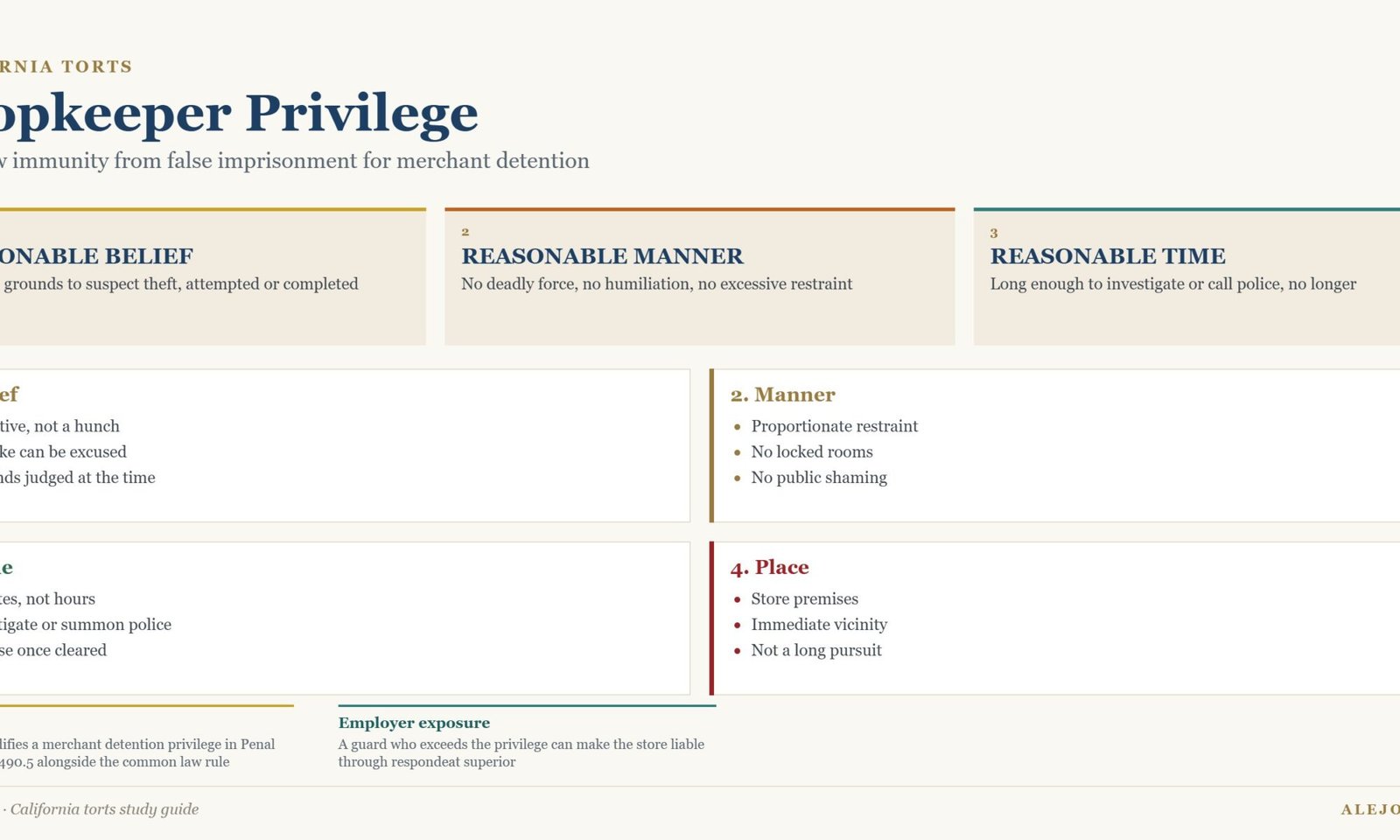
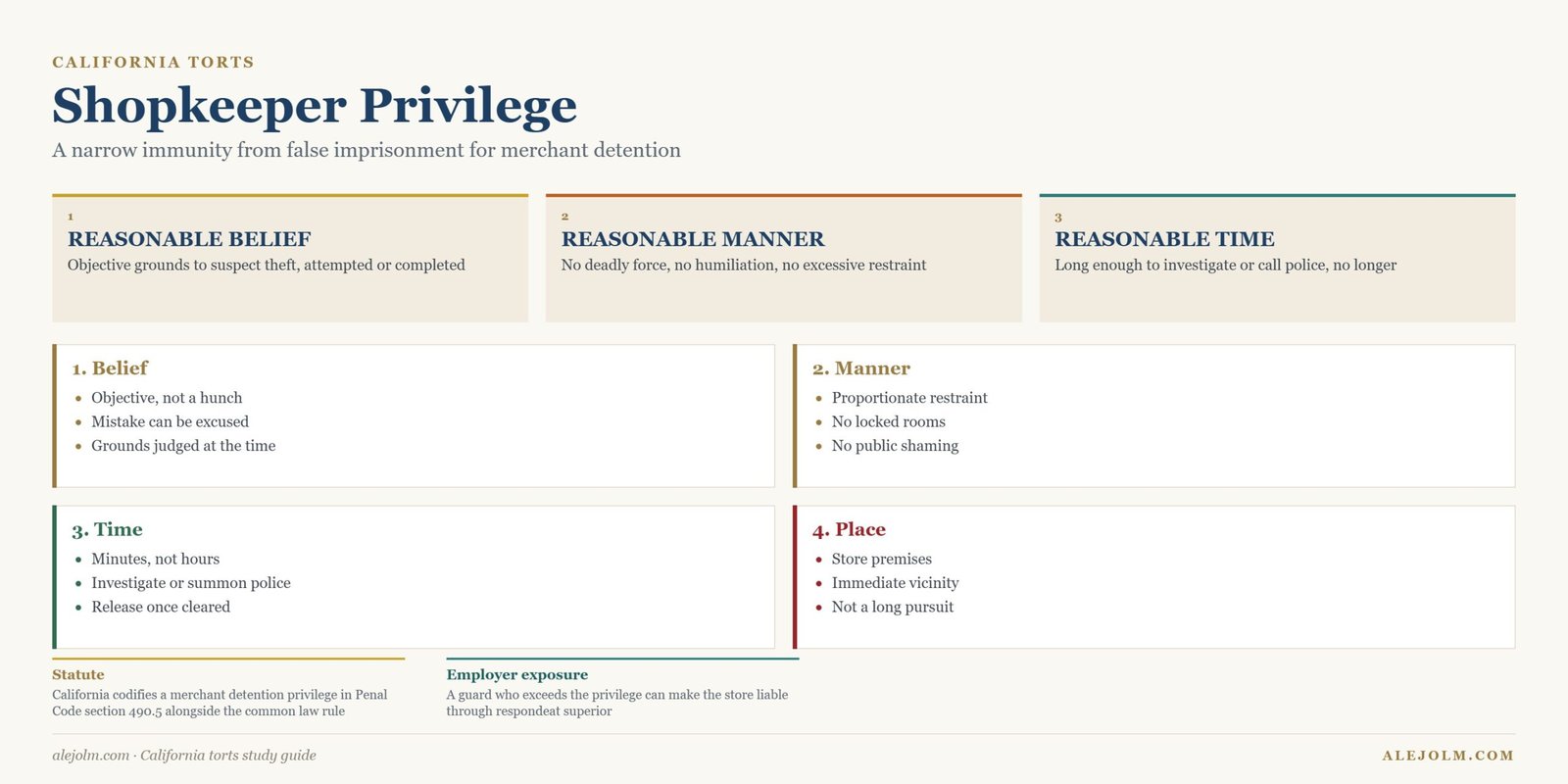
Shopkeeper privilege allows a merchant who reasonably believes a person has taken or attempted to take store property to detain that person on the premises, in a reasonable manner, for a reasonable time. It is a complete defence to false imprisonment, but only while all three of those conditions hold. If any one fails, the detention becomes an ordinary tort.
California codifies a merchant detention right in the Penal Code and the same three tests are applied. This guide explains each prong, sets out how long a detention can last, shows where stores most often go wrong, and explains the defamation and vicarious liability claims that frequently travel alongside a failed detention.
Why the privilege exists
Without it, a merchant who stopped a suspected shoplifter and turned out to be wrong would face automatic liability for false imprisonment. That would make any intervention irrational, since certainty is impossible at the moment of the stop. The privilege bridges the gap between suspicion and the arrival of police, and it is limited to exactly that purpose.
Because the justification is investigatory, the privilege collapses the moment the purpose is served. A merchant who continues to hold someone after police confirm no theft occurred, or who detains a person to teach a lesson, has stepped outside it even though the initial stop was lawful.
The three prongs
Reasonable belief
The belief must be objectively reasonable in the circumstances, not a subjective hunch or a reaction to how someone looks. Concealment of goods, a triggered security alarm, or a direct observation by staff will usually supply the grounds. A reasonable mistake is protected: the merchant does not have to be right, only reasonable.
Reasonable manner
Deadly force is absolutely prohibited. Beyond that, the restraint must be proportionate to the situation. Locking a suspect in a windowless room, shouting an accusation across a busy shop floor, or applying physical force beyond what is needed to keep the person present will each defeat the privilege even when the belief and the duration were sound.
Reasonable time
The detention must last only as long as investigation or summoning police requires, which in practice is usually measured in a small number of minutes. Once that window closes, the merchant must either hand the matter to police or release the person. Holding someone while an internal process grinds on is not protected.
- Objective grounds — the belief must rest on facts a reasonable person would rely on.
- Purpose limited — detention is for investigation and to summon police, nothing else.
- Premises based — the privilege covers the store and its immediate vicinity.
- Proportionate restraint — force beyond what is needed defeats the defence.
- Short duration — a brief period, ended as soon as the position is clear.
- No coercion — the privilege does not authorise searching, punishing or extracting a confession.
| Feature | Shopkeeper privilege | Citizen arrest privilege |
|---|---|---|
| Trigger | Reasonable belief of theft | Stricter, often actual commission of the offence |
| Location | Store premises | Anywhere |
| Offences covered | Theft of store property | Crimes generally, with felony and misdemeanour rules |
| Effect of mistake | Reasonable mistake protected | Mistake far more dangerous |
Claims that travel with a failed detention
A detention that exceeds the privilege supports a false imprisonment claim, and often more. Public accusations made during the stop can support defamation, though good faith reports of suspected theft made to store staff or to police usually attract a qualified privilege that is lost only where the accuser acted with malice or reckless disregard for the truth.
Because security staff are normally employees, an excessive detention exposes the store itself through respondeat superior, even where no manager took part. A detained customer also remains an invitee, so the ordinary duty to keep the detention area reasonably safe continues to apply.
A worked example
A supermarket in Los Angeles sees a customer place two items into a bag and walk past the tills. A staff member stops him just inside the doors, explains what was seen, asks him to wait near the office and calls police, who arrive within ten minutes. The belief was grounded in direct observation, the manner was calm and the time was short. The privilege applies even if the items turn out to have been paid for earlier.
Change one fact. Suppose the staff member instead took the customer into a stockroom, locked the door and kept him there for an hour while a manager reviewed footage. Belief may still be reasonable, but the manner and the duration both fail. The privilege is lost entirely and the store faces a false imprisonment claim alongside vicarious liability for the conduct of its employee.
Shopkeeper privilege in California and Los Angeles County in 2026
California addresses merchant detention directly in Penal Code section 490.5, which allows a merchant with probable cause to believe that goods have been unlawfully taken to detain the person for a reasonable time to conduct an investigation in a reasonable manner. The statute also addresses limited authority to examine goods believed to be unlawfully taken.
In Los Angeles County the practical question is almost always whether the manner and duration stayed within bounds, since the belief prong is usually satisfied by camera footage or direct observation. Store training records and written detention policies frequently become central evidence.
- Statutory basis — Penal Code section 490.5 supplies the California merchant detention privilege.
- Probable cause — the statute frames the belief prong in probable cause terms.
- Reasonable time and manner — both remain independently required.
- Employee conduct — respondeat superior exposes the store to liability for guard excesses.
- Defamation overlay — accusations attract only a qualified privilege that malice destroys.
- Premises duty — the detained customer remains an invitee for premises liability purposes.
For 2026, confirm the current California authority on merchant detention, permissible duration and the scope of the qualified reporting privilege directly with current authority, since these continue to develop.
Common mistakes to avoid
- Relying on a hunch — the belief must be objectively reasonable, not a feeling about a customer.
- Chasing far off the premises — the privilege is tied to the store and its immediate vicinity.
- Ignoring the manner prong — locked rooms, public shaming and unnecessary force sink otherwise valid stops.
- Detaining too long — once investigation is complete, the person must be released or handed to police.
- Searching or interrogating — the privilege permits detention, not a search or a coerced admission.
- Confusing it with citizen arrest — the two privileges have different triggers, scopes and consequences for mistakes.
Frequently asked questions
How long can a store detain someone in California?
Only for a reasonable time, which normally means the few minutes needed to investigate or call police. There is no fixed number, and a detention that continues after the purpose is served falls outside the privilege.
What if the store was wrong and nothing was stolen?
A reasonable mistake is generally protected. The prong asks whether the belief was reasonable at the time, not whether it was correct, so a merchant with genuine grounds does not lose the defence merely because the suspicion proved unfounded.
Can a store search a suspected shoplifter?
The privilege authorises detention rather than a search of the person. California law addresses limited examination of goods believed to be unlawfully taken, but a physical search of a customer raises serious additional risk and should not be assumed to be covered.
Is the store liable for what a security guard does?
Usually yes. Guards are ordinarily employees acting within the scope of employment when detaining suspected shoplifters, so respondeat superior makes the store answerable for an excessive or unlawful detention.
Can the customer also sue for defamation?
Sometimes. Accusations made loudly in public can be defamatory, although good faith reports to store personnel or police normally attract a qualified privilege. That privilege is lost where the accusation was made with malice or reckless disregard for the truth.
Related guides
 Privilege of Arrest
- False Imprisonment
- Premises Liability
- Vicarious Liability
- Recapture of Chattels
- Defence of Property
- Respondeat Superior
- Defamation
Next steps
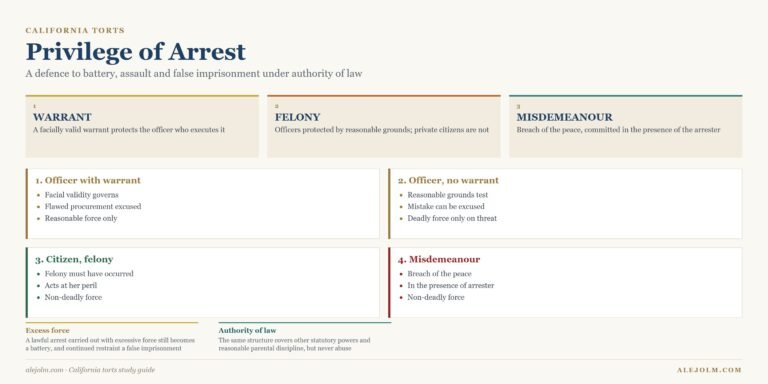
Read this with false imprisonment, which supplies the underlying claim, and then privilege of arrest for the wider and stricter self-help power.
For primary sources, read California Penal Code section 490.5 and the civil jury instructions published by the Judicial Council of California.