
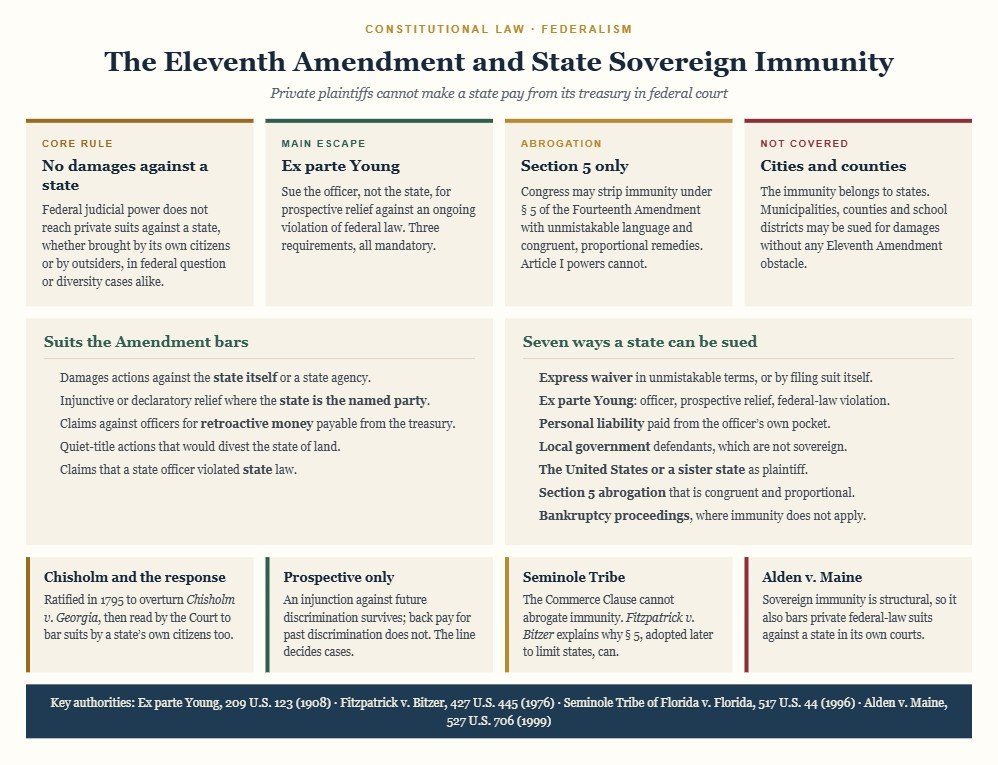
The Eleventh Amendment answers a question that arises before any constitutional violation is examined: can this defendant be sued here at all? Its practical rule is short. A private plaintiff cannot obtain money from a state treasury in federal court. Everything else in the doctrine is a set of routes around that bar, and each route has conditions that examiners test relentlessly.
This guide explains the core prohibition, the three requirements of Ex parte Young, why only § 5 of the Fourteenth Amendment can abrogate immunity, and the defendants who never enjoy the protection at all.
Where the rule came from
In 1793 the Supreme Court allowed a South Carolina citizen to sue Georgia for a debt in Chisholm v. Georgia. The reaction was immediate, and the Eleventh Amendment was ratified two years later to remove federal jurisdiction over suits against a state by citizens of another state or of a foreign state. The text does not mention suits by a state’s own citizens, but the Court has long read the Amendment to cover them, on the view that it confirms a background principle of sovereignty rather than creating a narrow textual exception.
That reading matters, because it explains Alden v. Maine. If immunity is structural rather than purely textual, it is not confined to federal courthouses, and private federal-law damages claims against a state are barred in the state’s own courts too.
What the Amendment bars
The bar reaches more than damages actions with the state named as defendant. It also covers injunctive or declaratory relief where the state itself is the party, claims against officers for retroactive money payable from public funds, actions that would divest the state of title to land, and claims that a state officer has violated state law. It applies in federal question and diversity cases alike, which distinguishes it from the ordinary jurisdictional analysis.
Ex parte Young: the officer suit
The most important exception is a legal fiction with a practical purpose. A plaintiff may sue a named state official to stop an ongoing violation of federal law, and the court treats the officer as stripped of state authority for that purpose. Three requirements must all be satisfied.
- The defendant is an officer, not the state. Naming the department or the state loses the case at the threshold. Name the commissioner, the governor or the director.
- The relief is prospective. An order to stop future conduct or to comply going forward is permitted. Compensation for past conduct is not.
- The violation alleged is of federal law. A claim that the officer breached state law falls outside the doctrine entirely.
| Relief sought | Against whom | Result |
|---|---|---|
| Back pay for benefits wrongly denied | State agency | Barred; the money would come from the treasury |
| Order to reinstate the claim going forward | Named commissioner | Permitted under Ex parte Young |
| Damages from the officer personally | Named officer | Permitted; the treasury is not exposed |
| Injunction against a city policy | Municipality | Permitted; no state immunity applies |
Exam tip: when a fact pattern asks for both back pay and an injunction, split the analysis. The retroactive claim usually fails and the prospective claim usually survives, provided the plaintiff has named the right defendant.
Congressional abrogation runs through Section 5 alone
Congress can subject states to private suit, but only by exercising its enforcement power under § 5 of the Fourteenth Amendment, and only with language that unmistakably says so. Two cases fix the framework. Seminole Tribe of Florida v. Florida held that an Article I power cannot abrogate immunity, overruling earlier authority to the contrary. Fitzpatrick v. Bitzer explains the asymmetry: the Fourteenth Amendment was adopted after the Eleventh and was designed specifically to limit state power, so its enforcement clause carries an authority the original Article I powers do not.
There is a second filter. Under City of Boerne v. Flores, § 5 legislation must be congruent and proportional to the constitutional violations it addresses. A statute that sweeps far beyond any pattern of unconstitutional state conduct is not enforcement but redefinition, and abrogation fails with it.
The examinable consequence is stark. Two identical statutes authorising damages against states will produce opposite results depending on the power invoked: enacted under the Commerce Clause the abrogation fails, enacted under § 5 with a proportionate remedy it succeeds.
Who is not protected
Sovereign immunity belongs to states. Counties, cities, school districts and other subdivisions are not sovereign and may be sued for damages in federal court without any Eleventh Amendment obstacle. Nor does the Amendment stand in the way when the United States sues a state, or when one state sues another.
And immunity presupposes a governmental defendant. A private party has no sovereign immunity claim at all, which is why the threshold question in many fact patterns is whether the conduct is attributable to government in the first place.
A worked example
An injured worker sues a state department of labour in federal court, alleging that his workers’ compensation claim was denied without due process. He seeks fifty thousand dollars in back benefits and an order reinstating the claim.
- The damages claim fails. The defendant is the state agency and the money would come from the treasury.
- The injunction may succeed, but only if he amends to name the commissioner personally, frames the relief prospectively, and rests the claim on federal due process rather than state procedure.
- If Congress had purported to authorise the damages claim under the Commerce Clause, that would not help. Abrogation must come from § 5.
- If the defendant were a county board rather than a state agency, the whole problem disappears.
Common mistakes that cost points
- Applying Ex parte Young to a claim for retroactive damages.
- Naming the state or its agency and then invoking the officer-suit exception.
- Assuming counties, cities and school districts share the state’s immunity.
- Allowing abrogation under the Commerce Clause or the Spending Power instead of § 5.
- Forgetting the congruence and proportionality filter on valid § 5 legislation.
- Using Ex parte Young for an alleged violation of state law.
- Overlooking that Alden v. Maine extends the protection into state courts.
- Treating the Amendment as a merits defence rather than a jurisdictional bar.
Frequently asked questions
Can a state waive its immunity by accepting federal funds?
Only if the waiver is knowing and the statute says so clearly. Courts require unmistakable language before treating participation in a federal programme as consent to private damages suits, and a general condition attached to funding is usually not enough.
Does the Eleventh Amendment apply to claims against state officials in their official capacity?
An official-capacity damages claim is treated as a claim against the state and is barred. An official-capacity claim for prospective injunctive relief is the Ex parte Young situation and proceeds. Individual-capacity damages claims paid by the officer are outside the bar altogether.
Is the doctrine really about the Eleventh Amendment?
Partly. The Amendment supplies the text, but the modern doctrine rests on state sovereignty as a structural feature of the Constitution, which is why it extends beyond the literal words to suits by a state’s own citizens and to state court proceedings.
Eleventh Amendment immunity and Los Angeles County in 2026
The single most useful thing to know about this doctrine in a Los Angeles context is that it does not protect the county. Eleventh Amendment immunity extends to the State of California and to entities that are arms of the state, but counties and cities are political subdivisions and have never enjoyed that protection. That rule, settled since Lincoln County v. Luning (1890), is why civil rights litigation against Los Angeles County and its Sheriff’s Department proceeds in federal court while identical claims against a state agency would be dismissed.
The line between protected and unprotected defendants therefore does most of the work. The California Department of Corrections and Rehabilitation, the state courts and the Regents of the University of California are treated as arms of the state. The County of Los Angeles, the City of Los Angeles, school districts and local special districts are not. Getting the characterisation right at the pleading stage determines whether damages are available at all.
The framework a Los Angeles practitioner actually applies:
- Sue the county as an entity under Monell. Because there is no immunity, the county is directly liable for damages caused by its own policy or custom, without any need for the Ex parte Young workaround.
- Use Ex parte Young against state officials. Prospective injunctive relief against a named state officer is available even though the state itself is immune, but retrospective damages are not.
- California has not broadly waived its immunity. The Government Claims Act consents to suit in state court on specified terms; it is not consent to federal jurisdiction.
- Present a claim before suing the county. Government Code section 911.2 imposes a six-month presentation deadline for injury and property damage claims, and this applies regardless of the federal immunity analysis.
- Section 1983 does not abrogate state immunity. Congress did not do so, and a state is not a “person” under the statute in any event.
- Sheriff’s Department claims turn on the function. Whether a sheriff acts for the county or the state can depend on the specific duty at issue, so analyse the role rather than the title.
In 2026 the drill is to identify the defendant’s legal character first and the claim second. Read alongside the state action doctrine, which asks whether a defendant is governmental at all, and standing, which controls who may bring the claim.
Next steps
Work the doctrine backwards from the remedy. Ask who pays, whether the relief looks forward or back, and whether the defendant is a state or a subdivision. Then connect it to the other structural limits on federal adjudication: the party requirement in Standing in Federal Court: The 3-Part Article III Test, the questions courts refuse to answer in Political Question Doctrine: What Courts Will Not Decide, and the choice-of-law problem in The Erie Doctrine Explained: A 4-Step Bar Exam Guide.
For primary sources, read Ex parte Young, Seminole Tribe of Florida v. Florida and Alden v. Maine. Cornell’s note on sovereign immunity collects the surrounding rules.
Related guides
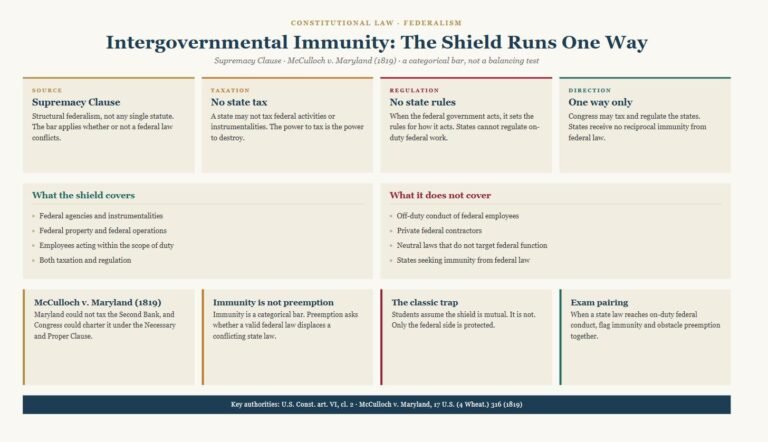 Intergovernmental Immunity: The Shield Runs One Way
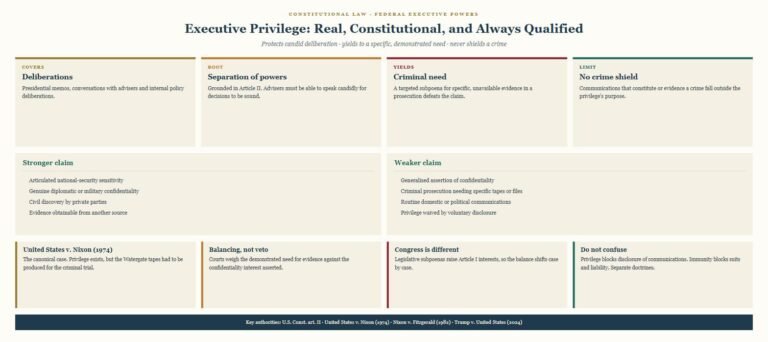 Executive Privilege: A Qualified Right That Must Yield
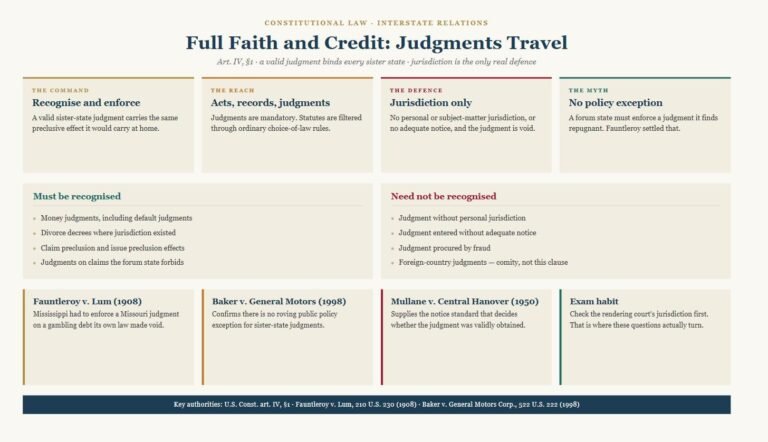 Full Faith and Credit: Recognising Sister-State Judgments
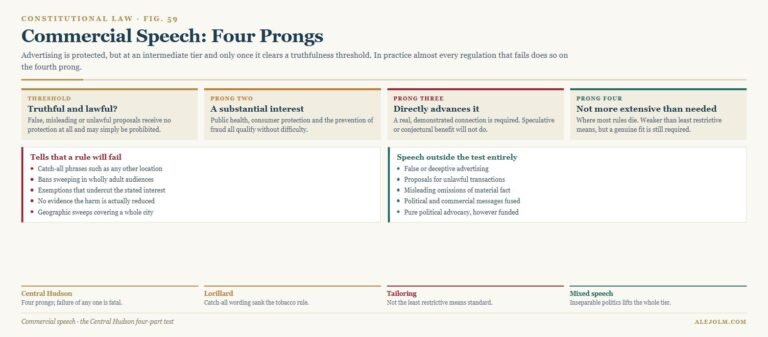 Commercial Speech and the Central Hudson Four-Part Test
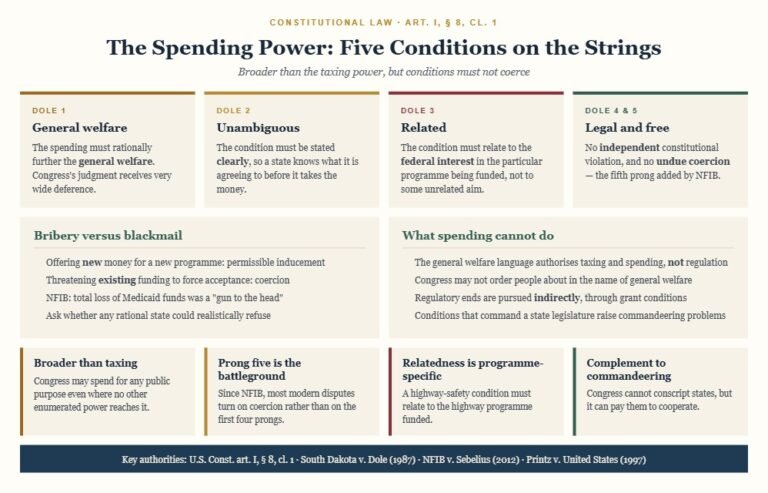 The Spending Power and the Five Dole Test Conditions
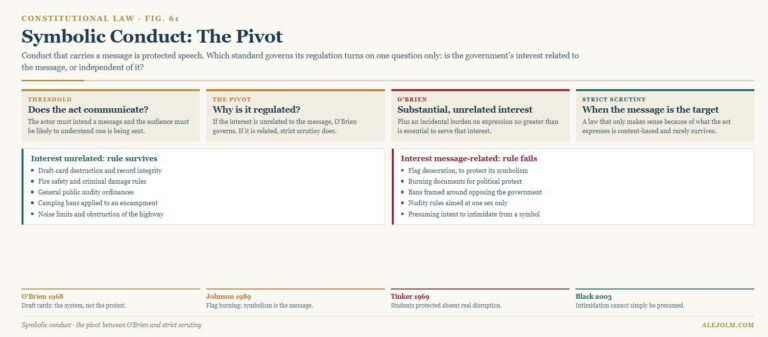 Symbolic Conduct and the O’Brien Test: The Pivot Question
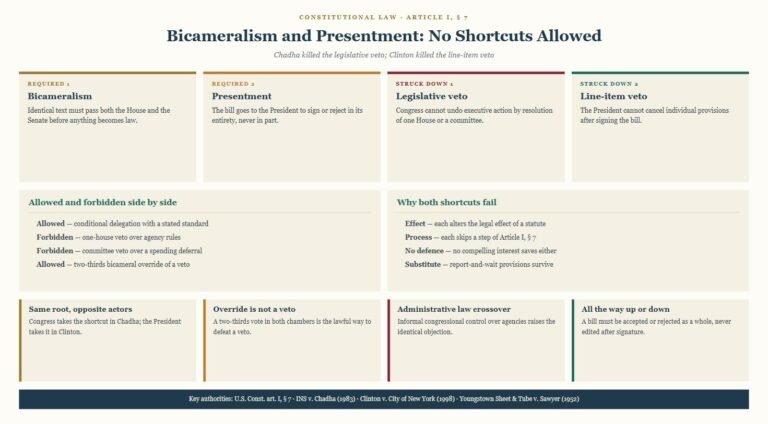 Bicameralism and Presentment: Two Vetoes Struck Down
 Incorporation Doctrine: Which Rights Bind the States
 Government Employee Speech: Garcetti and Pickering Rules
 No Federal Police Power: Enumerated Powers and Enclaves
 The Statute of Frauds: MYLEGS and How to Satisfy It
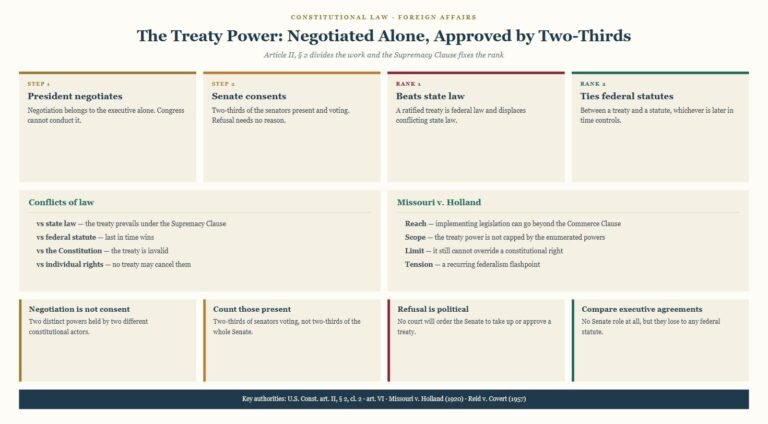 The Treaty Power: Senate Advice and Consent Explained