
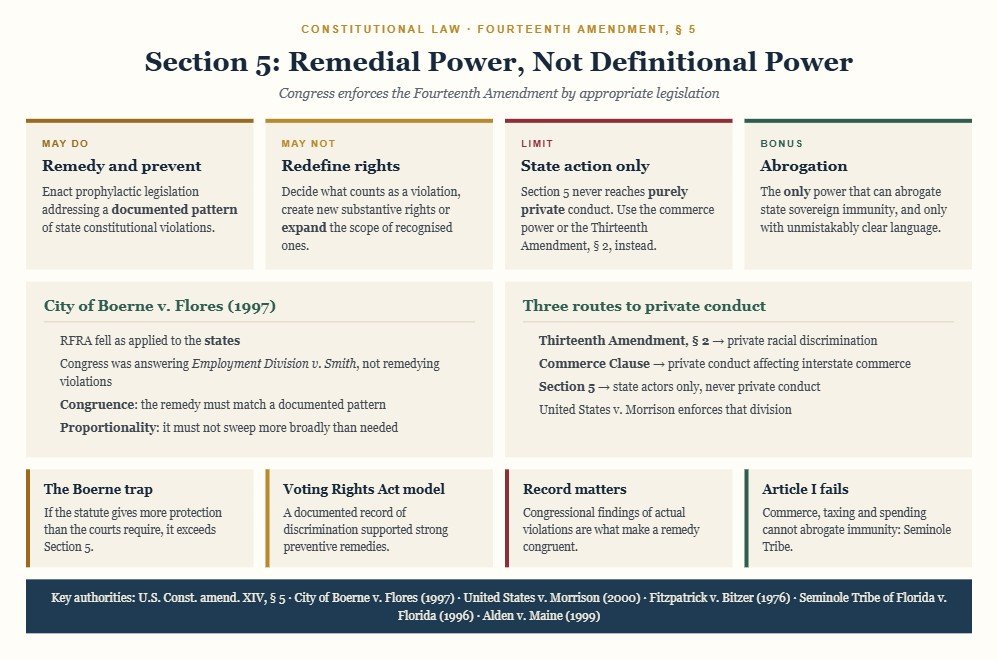
The section 5 enforcement power lets Congress enforce the substantive guarantees of the Fourteenth Amendment by appropriate legislation. It is a remedial power rather than a definitional one, which is the single idea from which every answer follows. Congress may prevent and repair violations that the courts have recognised; it may not decide what the Constitution means.
This guide explains the congruence and proportionality test from City of Boerne v. Flores, the state-action limit that keeps private conduct outside section 5, the three-way split for reaching private actors, and the reason section 5 is the only power that can abrogate state sovereign immunity.
Remedial, not definitional
Interpreting the Fourteenth Amendment is a judicial function. Section 5 gives Congress the complementary role of making that interpretation effective, by legislating against the conditions that produce violations. A statute that adds protection beyond the judicially recognised right is not enforcement but revision.
City of Boerne v. Flores drew the line. Congress enacted the Religious Freedom Restoration Act to restore strict scrutiny for laws burdening religious exercise after Employment Division v. Smith had held that neutral laws of general applicability do not offend the Free Exercise Clause. As applied to the states, the Act failed: Congress was disagreeing with the Court’s reading rather than remedying a documented pattern of intentional religious discrimination.
Exam tip: remedy, do not redefine. If the statute protects more than the case law requires, section 5 will not support it.
The congruence and proportionality test
Boerne produced a two-part inquiry. Congruence asks whether the legislation is matched to an established pattern of unconstitutional state conduct, which is why the congressional record matters so much. Proportionality asks whether the remedy is tailored, or whether it sweeps far beyond what the recorded problem requires.
Why the Voting Rights Act is the model
Congress compiled an extensive record of racial discrimination in voting by particular jurisdictions, conduct the courts had long condemned. Strong preventive measures, including preclearance and bail-in and bail-out mechanisms, were congruent with that record and proportional to its severity. The statute did not redefine the right to vote free of racial discrimination; it made an existing right enforceable in practice.
Where prophylactic legislation fails
Preventive measures are permitted, but not automatically. A sweeping national remedy resting on a thin or anecdotal record fails proportionality, and a statute aimed at conduct the courts have never held unconstitutional fails congruence. Both defects are fatal, and both are usually visible from the statute’s own findings.
State action only
Section 5 enforces the Fourteenth Amendment, and the Fourteenth Amendment reaches state action. It follows that section 5 cannot authorise Congress to regulate purely private conduct however compelling the justification. United States v. Morrison applied that limit to the civil remedy in the Violence Against Women Act, which was directed at private violence rather than at unconstitutional state action.
The practical consequence is a three-way split worth memorising. Private racial discrimination can be reached under section 2 of the Thirteenth Amendment. Private conduct affecting interstate commerce can be reached under the commerce power. Section 5 reaches state actors, and nothing else.
| Target of the statute | Correct power | Why |
|---|---|---|
| State officials discriminating by race in voting | Section 5 | Remedies recognised state violations |
| Private racial discrimination in contracting | Thirteenth Amendment, § 2 | Badges and incidents of slavery |
| Private conduct with substantial commercial effects | Commerce Clause | Economic activity in the aggregate |
| Private violence with no state involvement | Neither section 5 nor commerce | Morrison rejects both routes |
| Damages suit against a state for constitutional violations | Section 5 abrogation | Only section 5 can lift immunity |
Section 5 and sovereign immunity
Section 5 has one further and uniquely important feature. It is the sole enumerated power capable of abrogating state sovereign immunity. Fitzpatrick v. Bitzer explains why: the Fourteenth Amendment was adopted after the Eleventh and expressly limits state sovereignty, whereas the Article I powers predate it and coexist with it.
Seminole Tribe of Florida v. Florida completes the picture by holding that Congress cannot abrogate immunity through an Article I power, and Alden v. Maine extends immunity to suits brought in the state’s own courts. Abrogation also requires unmistakably clear statutory language and a remedy that is itself congruent and proportional, so the Boerne test does double duty.
Worked example: two civil rights statutes
Congress enacts a statute requiring states to accommodate all sincere religious practices unless refusal is narrowly tailored to a compelling interest. Courts have held that neutral, generally applicable laws do not violate free exercise, and no record of intentional state discrimination supports the statute. The measure redefines the right rather than remedying violations, so it exceeds section 5.
Now suppose Congress finds, on a detailed record, that several states systematically fail to provide counsel in serious criminal prosecutions, a right the courts recognised in Gideon v. Wainwright. A statute setting minimum legal-aid standards addresses documented violations of an existing right and is tailored to the implementation failures found. That measure is congruent and proportional and falls within section 5.
Common mistakes that cost points
- Confusing remedial with definitional power, which is the mistake Boerne was decided to correct.
- Assuming any preventive statute qualifies. Prophylaxis must still be congruent and proportional.
- Using section 5 against private defendants, which Morrison forbids.
- Attempting abrogation of sovereign immunity through the commerce, taxing or spending power.
- Forgetting that abrogation language must be unmistakably clear on the face of the statute.
- Ignoring the congressional record, which is the evidence of congruence.
- Treating a broad remedy as proportional merely because the underlying right is important.
- Overlooking the alternative powers available when the defendant is private rather than governmental.
Frequently asked questions
Can Congress overrule a constitutional decision by statute?
No. It can respond by legislating within its powers, as it did by applying RFRA to the federal government, but it cannot change the meaning the Court has given the Fourteenth Amendment.
Does section 5 legislation need to name the offending states?
No, but the remedy must fit the documented problem. Measures targeted at jurisdictions with a proven record are easier to defend than nationwide remedies.
Why can Congress apply RFRA to itself?
Because the objection in Boerne was to imposing a redefined standard on the states. Congress may impose stricter statutory standards on federal action without invoking section 5 at all.
Section 5 enforcement power and Los Angeles County voting, 2026
Congress may enforce the Fourteenth Amendment by appropriate legislation, but since City of Boerne v. Flores (1997) the remedy must be congruent and proportional to identified constitutional violations rather than a redefinition of the right itself. The most visible application in Los Angeles County is not litigation at all: it is the ballot you receive.
Federal voting rights legislation requires covered jurisdictions with sufficiently large language minority populations to provide election materials and assistance in those languages. Los Angeles County, the largest local election jurisdiction in the country, is subject to those obligations and delivers ballots and voter information in a substantial number of languages through the Los Angeles County Registrar-Recorder/County Clerk. That programme is an exercise of congressional enforcement power over an area states would otherwise control.
The framework, and what changed:
- Preclearance is dormant. Shelby County v. Holder (2013) invalidated the coverage formula, ending preclearance for the handful of California counties that had been covered. Los Angeles County was not among them, but the decision reshaped the national landscape.
- Results-based claims survive. The nationwide prohibition on discriminatory voting practices remains enforceable through litigation.
- California added its own statute. The California Voting Rights Act makes at-large election systems vulnerable without requiring the showings federal law demands, and it has forced district-based elections in many county municipalities.
- Congruence limits substance. Congress may remedy violations but cannot expand the underlying right, which is why some federal statutes fail as applied to states.
- Abrogation of state immunity needs clarity. Valid Section 5 legislation can subject states to damages suits, but only if Congress says so unmistakably.
- Counties are not immune anyway. Suits against Los Angeles County do not require abrogation because it is a political subdivision.
In 2026 the analysis runs: identify the constitutional violation, then measure the remedy against it. Read with equal protection, the franchise amendments and the Eleventh Amendment.
Next steps
Section 5 connects the individual-rights and federalism halves of the syllabus. Read The Eleventh Amendment and State Sovereign Immunity for the abrogation context, State Action Doctrine: The Government Conduct Threshold for the state-action limit, and The Commerce Clause: 3 Categories and 2 Hard Limits for the alternative route to private conduct.
For primary sources, read City of Boerne v. Flores and United States v. Morrison at Justia, the annotation to section 5 of the Fourteenth Amendment at Cornell LII, and the examination scope published by the State Bar of California.
Related guides
 Symbolic Conduct and the O’Brien Test: The Pivot Question
 Alienage Classifications: Strict Scrutiny and Its Pockets
 The Necessary and Proper Clause: Congress’s Multiplier
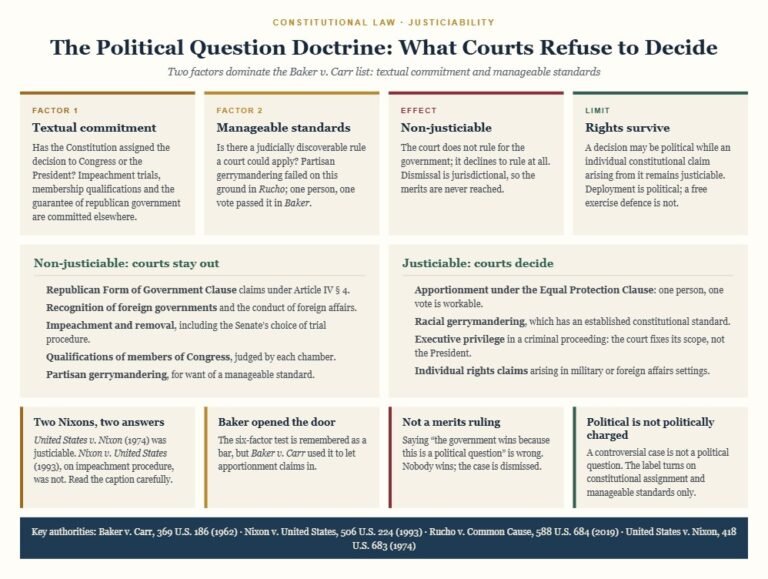 Political Question Doctrine: What Courts Will Not Decide
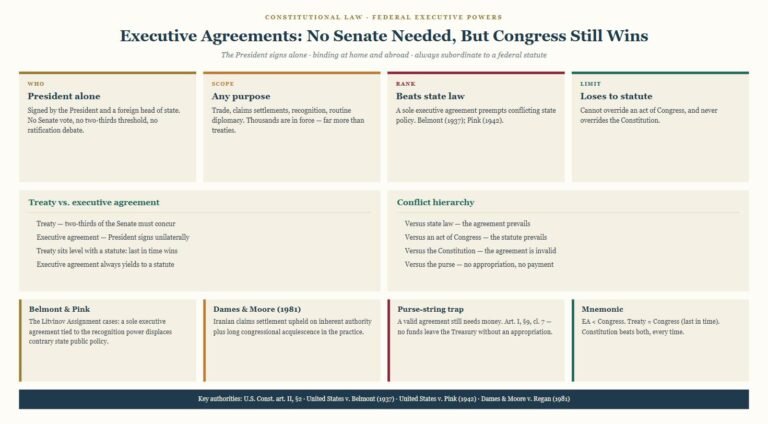 Executive Agreements: The President’s Sole Foreign Power
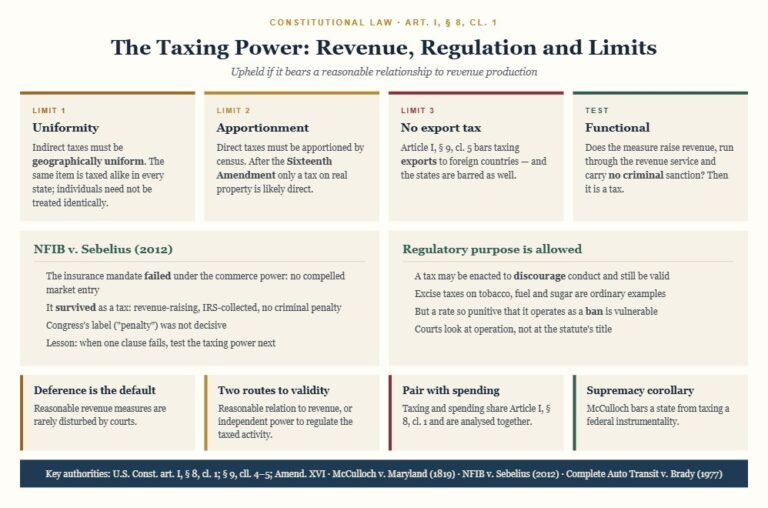 Congress’s Taxing Power: When a Penalty Is Really a Tax
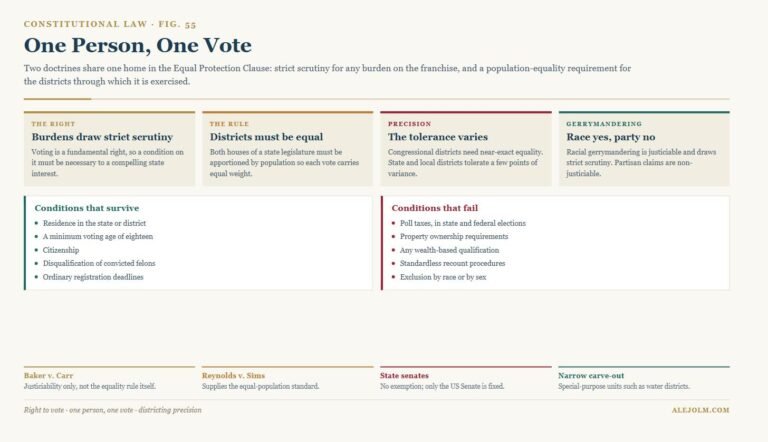 One Person, One Vote: Voting Rights Under Equal Protection
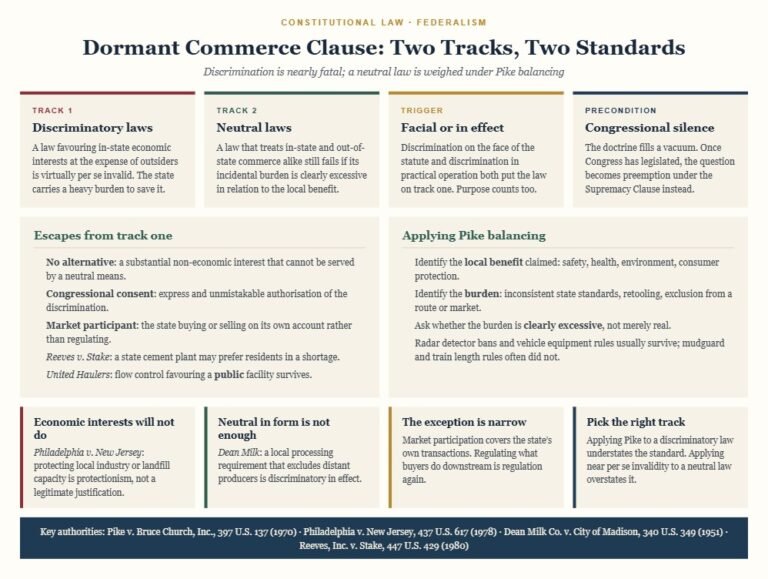 Dormant Commerce Clause: Discrimination vs Pike Balancing
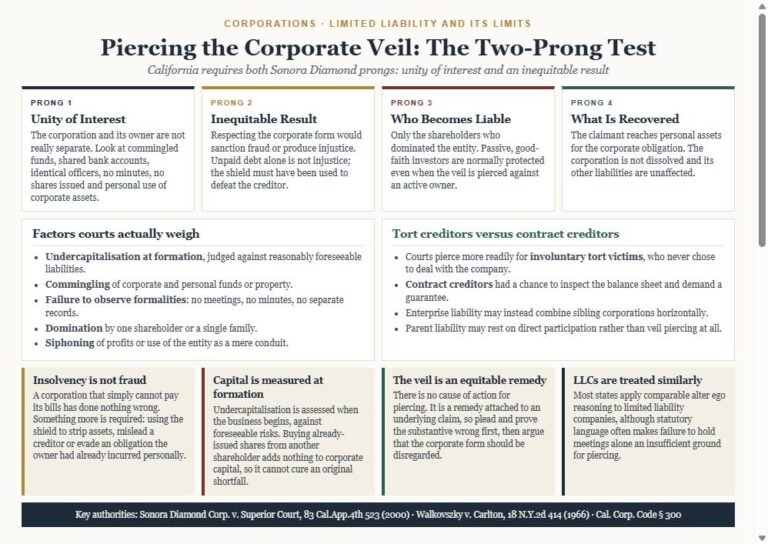 Piercing the Corporate Veil: A Two-Prong Alter Ego Test
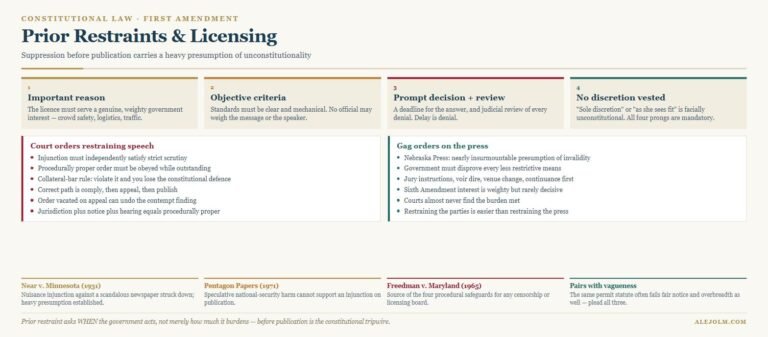 Prior Restraint and Licensing: The Freedman Safeguards
 Personal Jurisdiction: The 3-Step Bar Exam Framework
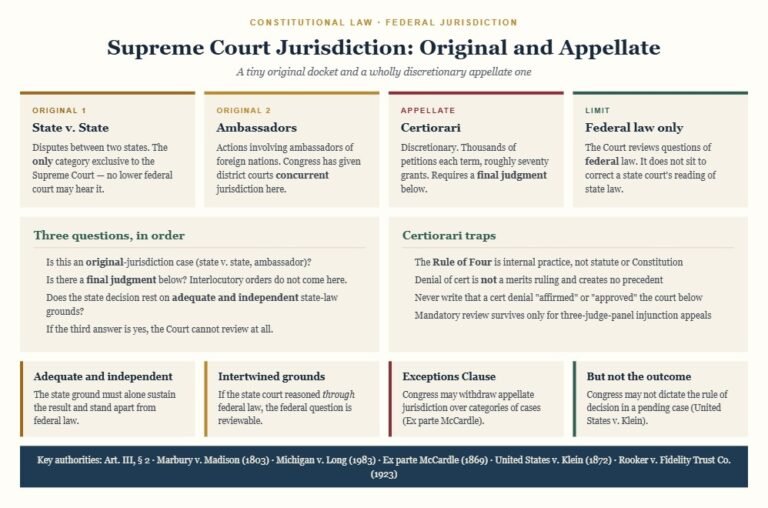 Supreme Court Jurisdiction: Original vs Appellate Power