
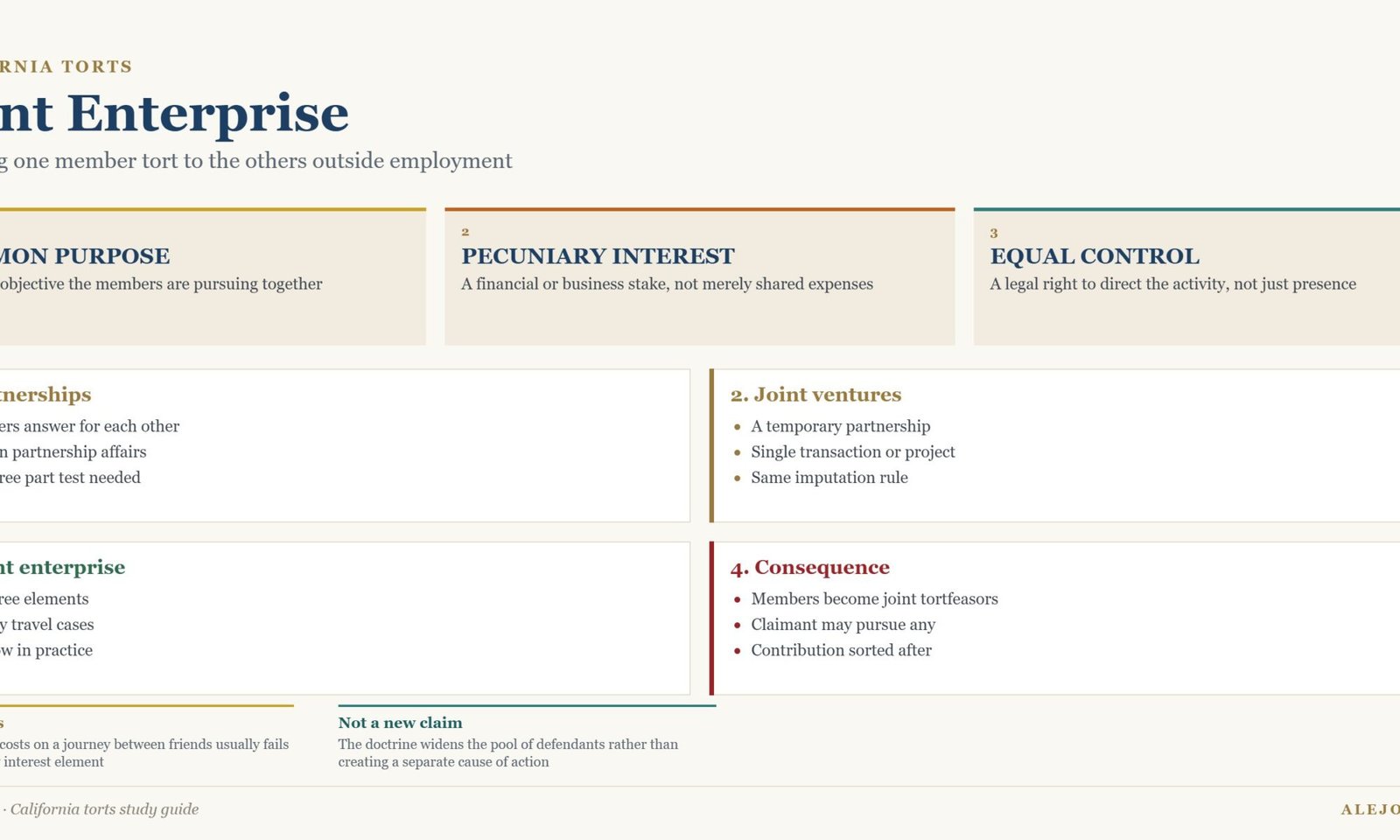
Joint enterprise is one of the imputation doctrines that operate outside the employment relationship. Where it applies, the tort of one member is attributed to the others, so an injured claimant can look beyond the person who actually caused the harm. It sits alongside partnership and joint venture liability, which achieve the same result through an existing business relationship.
The doctrine is narrow and is most often encountered in vehicle and travel cases. It requires a common purpose, a shared pecuniary interest and an equal right of control, and the second and third of those are where most claims fail. This guide explains each element, distinguishes true partnerships, and shows how the doctrine plays out in a Los Angeles County journey.
Partnerships and joint ventures
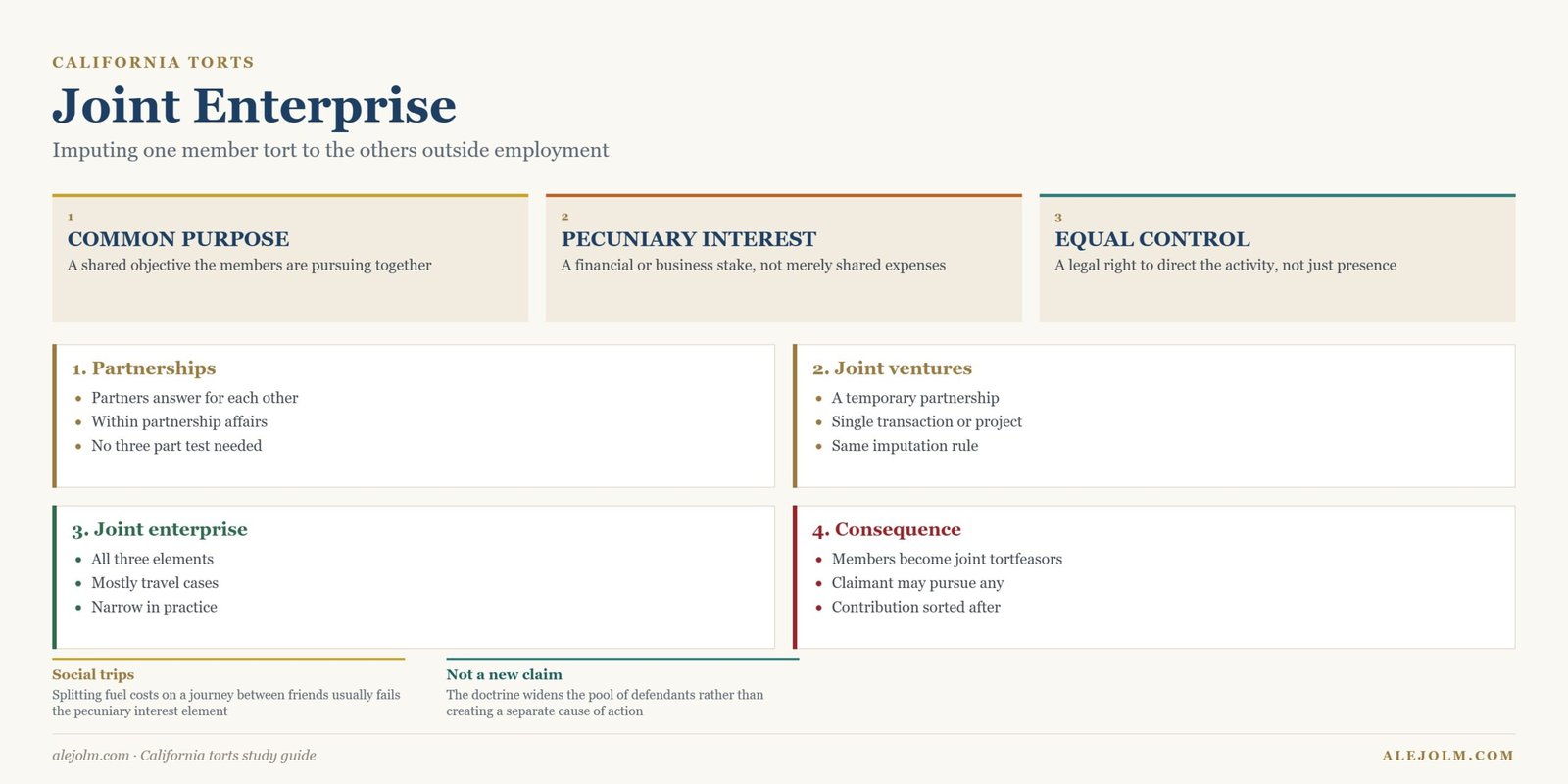
General partners are vicariously liable for tortious conduct by another partner committed in the ordinary course of the business of the partnership or with its authority. A joint venture is in substance a temporary partnership formed for a particular transaction or project, and the same imputation applies unless a corporate form has been used to confine responsibility.
Where the facts already establish a partnership or a joint venture, the three part joint enterprise test is unnecessary. The relationship itself supplies the basis for imputation, and running the narrower test only introduces confusion.
The three elements of joint enterprise
- Common purpose — the members are pursuing a shared objective rather than travelling together by coincidence.
- Shared pecuniary interest — a financial or business stake in the undertaking.
- Equal right of control — each member has a legal right to direct how the activity is carried out.
- All three required — satisfying two of the three defeats the doctrine.
- Furtherance — the tort must be committed in furtherance of the enterprise.
- Narrow scope — courts apply the doctrine sparingly outside commercial settings.
The pecuniary interest element
This is where most claims collapse. Sharing the cost of fuel on a trip is not usually enough. Courts generally require a business or profit motive rather than incidental cost splitting on a social outing, so friends driving to an event together do not become liable for the driving of whoever is at the wheel.
Contrast two estate agents who drive clients to view properties together and share the resulting commission. That arrangement carries a genuine shared financial stake, and the element is satisfied.
The equal right of control element
Presence is not control. Each member must have an actual legal right to direct how the activity is conducted, such as a right to take the wheel or to determine the route. A passenger who contributes to expenses but has no say over the decisions of the driver does not have the required right, and the doctrine does not apply.
| Relationship | Basis for imputation | Elements to prove | Typical context |
|---|---|---|---|
| Partnership | The partnership itself | Existence and ordinary course | Business firms |
| Joint venture | Temporary partnership | Existence and scope | Single project |
| Joint enterprise | Three part test | Purpose, pecuniary interest, control | Vehicle and travel cases |
| Respondeat superior | Employment | Employee and scope of employment | Workplace |
The consequence of a finding
Members of a joint enterprise who are held liable become joint tortfeasors as against the injured third party. The claimant can pursue any member for the judgment, and questions of contribution and indemnity between the members are sorted out afterwards. California also apportions non-economic damages among defendants according to fault, which affects how the final exposure falls.
It is worth emphasising that the doctrine does not create a new cause of action. It widens the pool of defendants available on an existing claim, which matters most where the person who actually caused the harm is uninsured or without means.
A worked example
Four friends drive from Los Angeles to a concert in one car, splitting the cost of fuel. The driver runs a red light and injures the occupant of another vehicle. There is a common purpose and shared expenses, but no business or profit motive and no right in the passengers to direct the driving. The pecuniary interest and control elements both fail, so the passengers are not liable.
Change the purpose. Suppose the same four are estate agents driving to show a property, with an agreement to share the commission, and any of them may take over the driving as they rotate through a long day of viewings. Now a common purpose, a shared financial stake and an equal right of control are all present, and the negligence of whoever is driving can be imputed to the others.
Joint enterprise in California and Los Angeles County in 2026
California addresses partnership liability in its enactment of the Uniform Partnership Act, under which partners are liable for wrongful acts committed in the ordinary course of the business of the partnership. Joint venture liability rests on the same principle. Joint enterprise itself remains a common law doctrine applied cautiously by California courts, which have been reluctant to impute driving negligence to passengers on social trips.
California also has its own statutory rules on vehicle owner liability, which impose a capped liability on an owner who permits another to drive, and those provisions often provide a more reliable route to a solvent defendant than joint enterprise does.
- Partnership statute — partners answer for wrongs committed in the ordinary course of the business.
- Joint ventures — treated as temporary partnerships for imputation purposes.
- Judicial caution — California courts apply joint enterprise narrowly, especially to social journeys.
- Owner liability — statutory permissive use liability provides a separate capped route.
- Several liability — non-economic damages are apportioned by fault among defendants.
- Contribution — members held liable can seek contribution among themselves.
For 2026, confirm the current California authority on partnership liability, permissive use provisions and the scope of joint enterprise directly with current authority, since these continue to develop.
Common mistakes to avoid
- Treating cost sharing as a pecuniary interest — most courts require a business or profit motive.
- Equating presence with control — each member needs an actual right to direct the activity.
- Running the test where a partnership exists — the relationship already supplies the imputation.
- Satisfying only two elements — all three are required and the doctrine fails without any one.
- Treating it as a separate claim — it enlarges the defendants on an existing claim.
- Forgetting contribution — members found liable remain able to seek adjustment among themselves.
Frequently asked questions
Are passengers liable for the driving in California?
Usually not. A social journey with shared fuel costs lacks the business or profit motive courts require, and passengers rarely have a legal right to direct how the vehicle is driven, so joint enterprise does not apply.
What makes a joint venture different?
A joint venture is an actual business relationship formed for a particular transaction or project. Where one exists, liability is imputed on that basis and there is no need to prove the three elements of joint enterprise separately.
Does the doctrine create a new cause of action?
No. It attributes an existing tort to additional defendants. The claimant still has to prove the underlying negligence or other wrong committed by the member who caused the harm.
What does equal right of control mean in practice?
A legal entitlement to direct the conduct of the activity, such as the ability to take the wheel or decide the route. A practical ability to make a suggestion, or simply being in the vehicle, is not sufficient.
Can a claimant recover the whole judgment from one member?
For economic loss, generally yes, because members held liable are joint tortfeasors. California apportions non-economic damages by fault, and members who pay more than their share can pursue contribution from the others.
Related guides
 Damages in Negligence
 Joint Tortfeasors
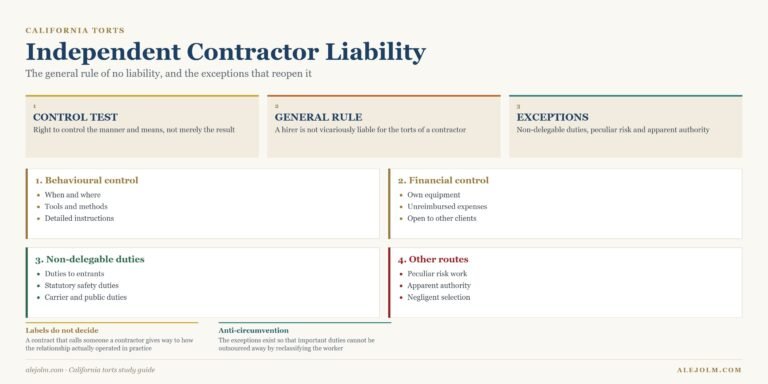 Independent Contractor Liability
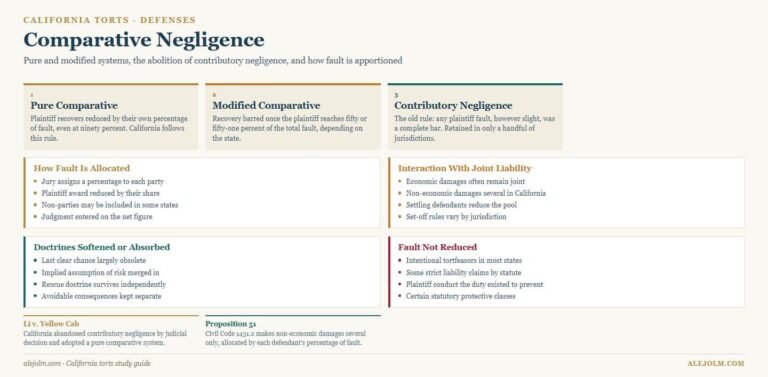 Comparative Negligence
- Vicarious Liability
- Negligent Entrustment
- Respondeat Superior
- Elements of Negligence
Next steps
Read this with vicarious liability for the wider framework of imputed responsibility, and then joint tortfeasors for what happens once several defendants are liable together.
For primary sources, read California Corporations Code section 16306 and the civil jury instructions published by the Judicial Council of California.