
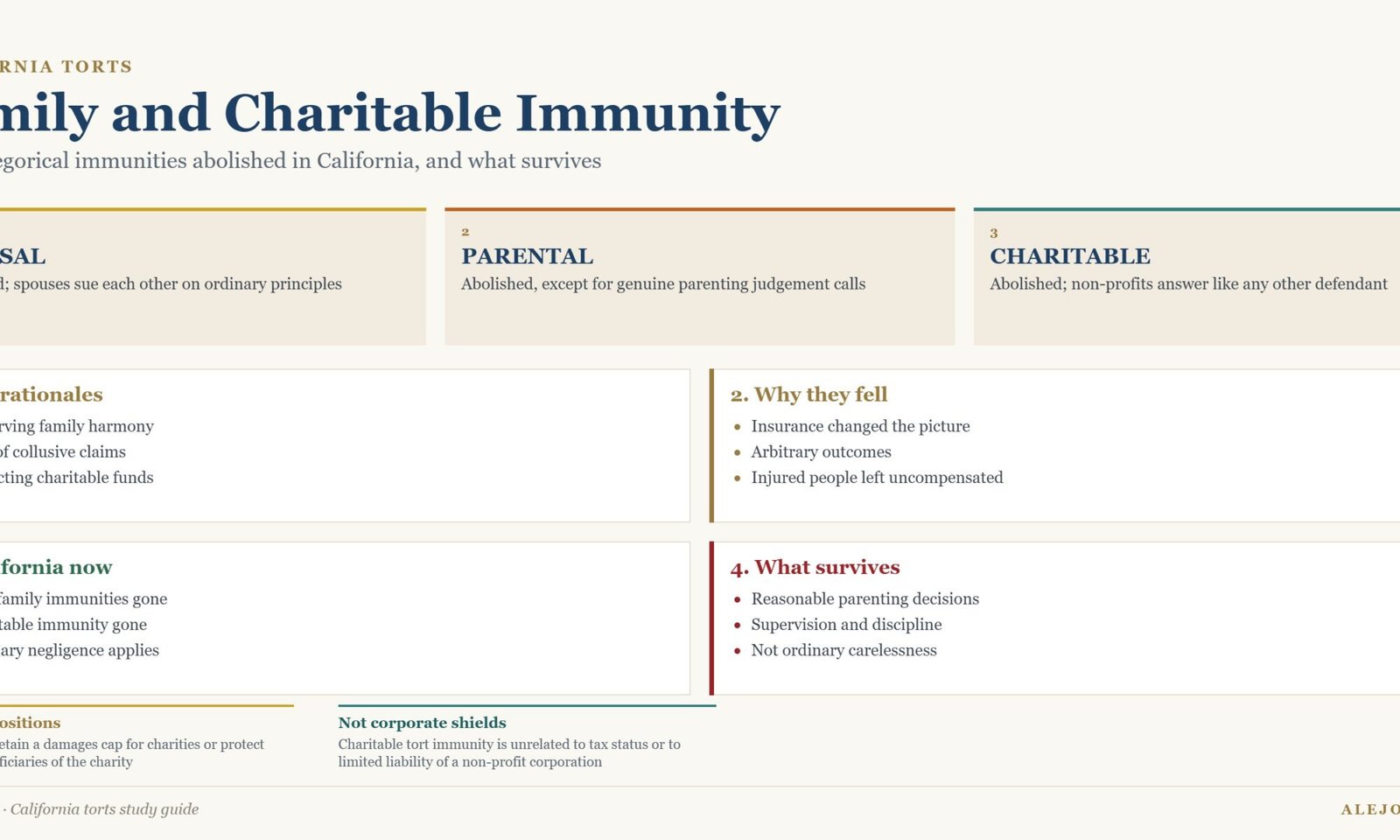
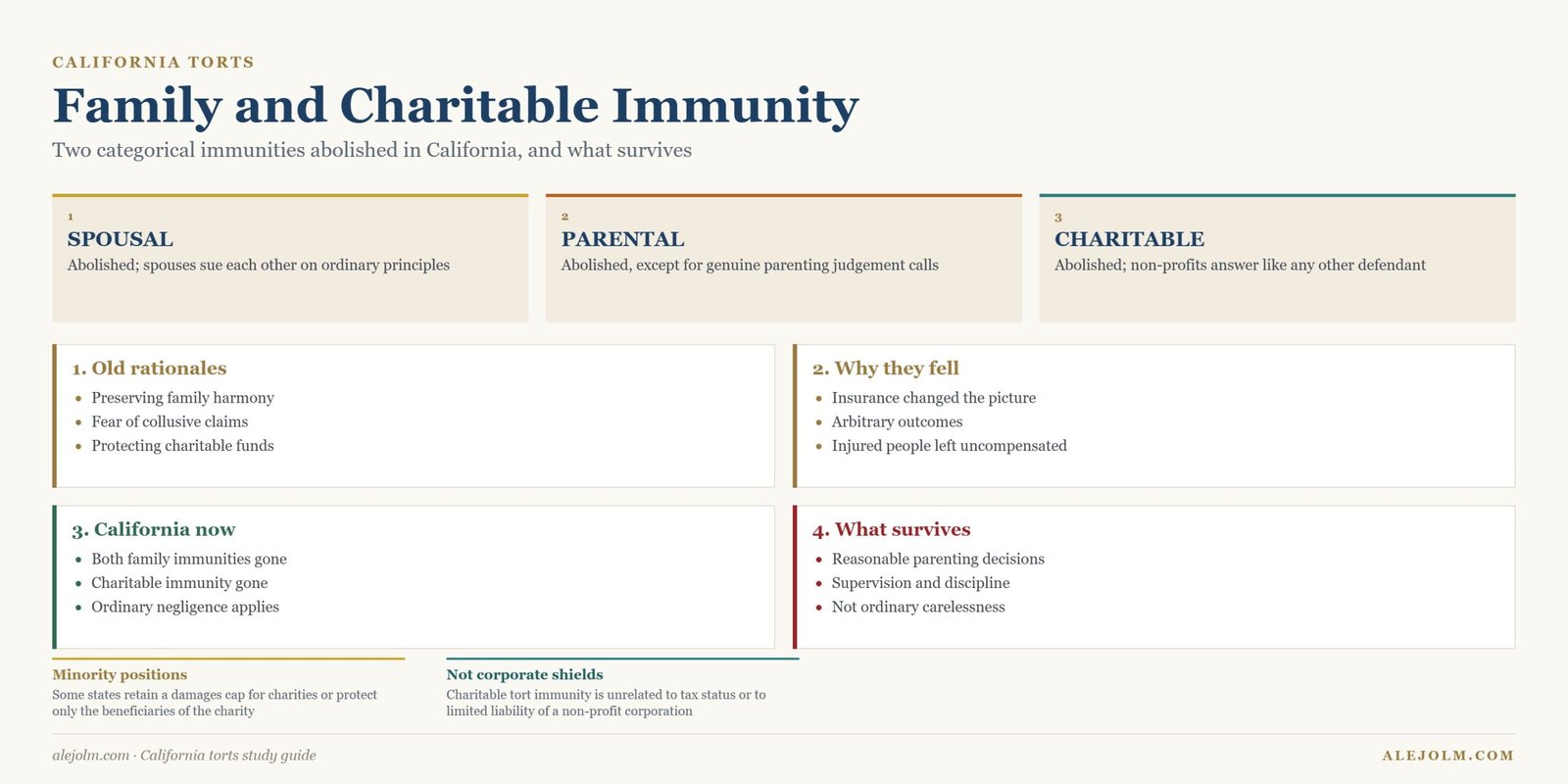
Family and charitable immunity were two categorical bars that once prevented tort claims purely because of who the parties were. A spouse could not sue a spouse, a child could not sue a parent, and a charity could not be sued at all. Both doctrines have been dismantled in most of the United States, and both are abolished in California.
Knowing that they are gone is only half the point. The reasons they were abolished explain what replaced them, and one narrow protection genuinely survives in California for reasonable parenting decisions. This guide sets out the old rules, why they collapsed, what the position is now, and how the surviving exception is applied.
Intra-family immunity
The common law barred actions between spouses and between a parent and a minor child. Two justifications were offered. The first was that litigation would destroy family harmony. The second was that where insurance stood behind the claim, family members might collude to shift a loss onto an insurer.
Neither reason held up. Family harmony is rarely improved by leaving an injured person uncompensated, and the presence of insurance is a reason to allow recovery rather than to forbid it. The rule also produced arbitrary results. A parent driving carelessly with a neighbouring child in the car would be liable to that child but not to their own, which is difficult to justify on any principle.
Charitable immunity
The charitable doctrine rested on the idea that funds given for beneficent purposes should not be diverted to satisfy tort judgments. That reasoning placed the entire cost of institutional carelessness on the individual who happened to be injured, which is an odd way to allocate a loss. Most states abolished it outright.
A minority retain modified protection in one of two forms. Some impose a statutory cap on damages recoverable against a charity. Others limit the protection to claims brought by the beneficiaries of the charity, leaving strangers free to recover in full. California retains neither.
| Immunity | Common law rule | California position | Practical effect |
|---|---|---|---|
| Spousal | No action between spouses | Abolished | Ordinary negligence applies |
| Parent and child | No action by child against parent | Abolished | Ordinary negligence applies |
| Parenting discretion | Part of parental immunity | Narrow protection survives | Judgement calls not second guessed |
| Charitable | Charity not liable in tort | Abolished | Non-profits liable like any defendant |
The surviving parental exception
California, like many states, still declines to impose ordinary negligence liability on genuine parenting judgement calls. Decisions about supervision, discipline, how much independence to allow and which medical options to choose involve weighing considerations that courts are poorly placed to second guess. Subjecting them to a reasonable person standard would in effect regulate parenting itself.
The protection is much narrower than the old blanket rule. A parent who drives carelessly with a child in the car, or who negligently maintains the family home, is liable exactly as any other defendant would be. Only the discretionary parenting decision is protected, and even then only where it was made in good faith and within the range of reasonable approaches.
- Supervision choices — how closely a child is watched in a given setting.
- Discipline decisions — reasonable methods of correction within lawful limits.
- Medical choices — selecting among reasonable treatment options.
- Independence — how much freedom to allow at a given age.
- Not ordinary conduct — driving, maintenance and other everyday activities are fully actionable.
- Good faith required — the protection covers genuine judgement, not indifference.
What applies instead
Once the immunities are removed, ordinary tort principles govern. A charity is liable for the negligence of its employees within the scope of employment on the same respondeat superior basis as any commercial organisation, and it can be directly liable for negligent hiring, retention or supervision. A family member is liable for careless conduct on the ordinary standard, subject to the narrow parenting exception.
It is worth separating charitable tort immunity from concepts that sound similar but are unrelated. Tax exempt status concerns revenue treatment. The limited liability of a non-profit corporation concerns whether directors and members are personally answerable for corporate obligations. Neither has anything to do with whether the organisation can be sued in tort.
A worked example
A child is injured in Los Angeles when a parent, running late, drives through a junction without stopping. The old rule would have barred the claim entirely. In California the parent is liable on ordinary negligence principles, and the claim proceeds against whatever insurance responds, exactly as it would for any other injured passenger.
Change the conduct. Suppose instead the parent allowed a ten year old to walk two blocks to a friend house alone, and the child was injured crossing a road. That is a supervision judgement rather than an act of carelessness, and California would not impose an ordinary negligence standard on the decision itself, although any separate careless act remains actionable.
Family and charitable immunity in California and Los Angeles County in 2026
California abolished interspousal immunity and parental immunity through its own decisions, replacing the categorical bars with the general duty of ordinary care found in Civil Code section 1714. Charitable immunity was likewise rejected, so hospitals, religious organisations, schools and other non-profits in Los Angeles County are exposed to the same claims as any other institution.
The practical significance today is mostly evidential. Claims between family members are scrutinised for the same reasons the old collusion argument was raised, and insurers frequently examine household exclusions in policies, which can limit coverage even where liability is clear.
- General duty — Civil Code section 1714 supplies the ordinary standard of care.
- Spousal claims — permitted without any special bar.
- Parent and child claims — permitted, subject to the narrow discretion exception.
- Non-profit defendants — liable in tort like any other organisation.
- Household exclusions — insurance terms may still restrict recovery in family claims.
- Institutional duties — charities face negligent hiring and supervision claims directly.
For 2026, confirm the current California authority on parental discretion, household insurance exclusions and institutional liability directly with current authority, since these continue to develop.
Common mistakes to avoid
- Applying a blanket spousal bar — it is abolished in California and in most states.
- Applying a blanket parental bar — only genuine parenting judgement calls retain protection.
- Assuming charities cannot be sued — non-profits are ordinary tort defendants in California.
- Overextending the parenting exception — careless driving and poor maintenance are fully actionable.
- Confusing tort immunity with tax status — the concepts are unrelated.
- Ignoring insurance terms — coverage exclusions can matter even where liability is established.
Frequently asked questions
Can spouses sue each other in California?
Yes. Interspousal tort immunity is abolished, so a claim between spouses proceeds on ordinary negligence or intentional tort principles in the same way as any other claim.
Can a child sue a parent?
Yes, subject to a narrow exception. Ordinary careless conduct by a parent is actionable, while genuine parenting judgement calls about supervision, discipline and similar matters are not measured against an ordinary negligence standard.
Are charities immune from tort claims in California?
No. Charitable immunity is abolished, so a non-profit organisation is liable for the negligence of its employees within the scope of employment and can face direct claims for negligent hiring, retention or supervision.
Do any states still recognise these immunities?
A minority retain modified charitable protection through a damages cap or by limiting protection to claims by beneficiaries of the charity, and a few preserve narrow family protections. The modern majority position, and the California position, is abolition.
Does insurance affect these claims?
It can. Liability is determined without regard to insurance, but many household policies contain exclusions for claims between resident family members, which may limit the practical value of a claim even where fault is clear.
Related guides
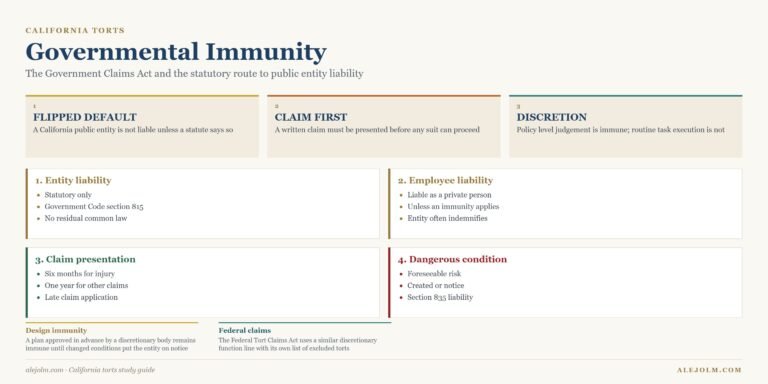 Governmental Immunity
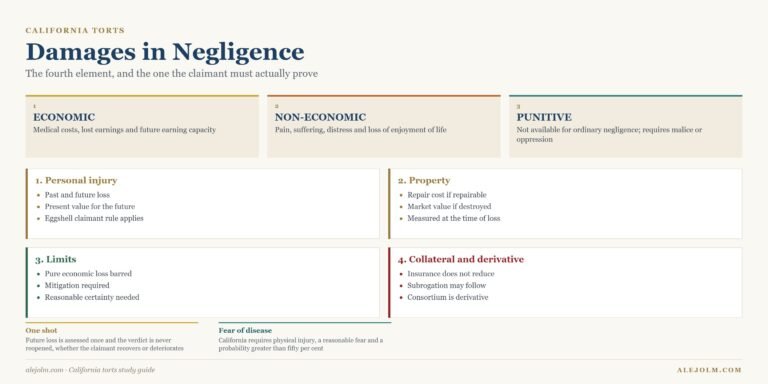 Damages in Negligence
- Legal Incapacity
- Duty of Care
- Elements of Negligence
- Vicarious Liability
- Respondeat Superior
- Special Standards of Care
Next steps
Read this with governmental immunity, the third categorical immunity and the only one that remains substantial, and then duty of care for the standard that applies once an immunity is removed.
For primary sources, read California Civil Code section 1714 and the civil jury instructions published by the Judicial Council of California.