
A creditor wins fifty thousand dollars in one state and the debtor moves to another. Does the second state have to collect it? The answer is yes, and it is one of the few answers in constitutional law that arrives without balancing, tiers of scrutiny or a weighing of interests.
Article IV, Section 1 requires each state to give full faith and credit to the public acts, records and judicial proceedings of every other state. In practice the clause is the constitutional engine behind interstate preclusion: a valid judgment carries into every other state the same effect it carries at home. The doctrine has exactly one serious escape hatch, and it is not the one candidates reach for.
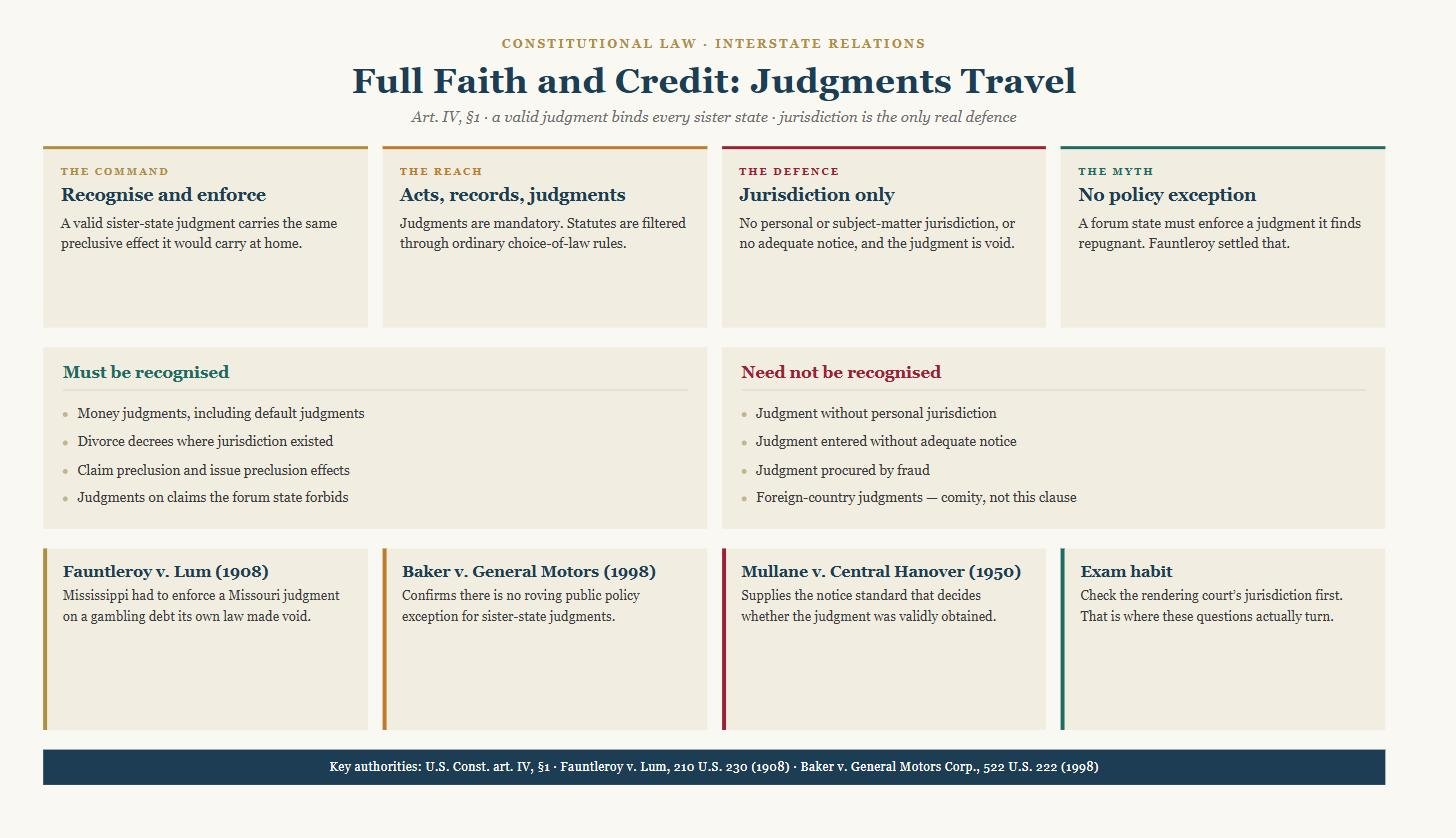
The command, and how far it reaches
The obligation is one of recognition rather than application. A forum state is not required to decide cases under a sister state’s substantive law. What it must do is treat a sister state’s judgment as conclusive, giving it the preclusive effect it would have in the rendering state. If the judgment bars relitigation of a claim there, it bars relitigation here. If it forecloses a particular issue there, it forecloses that issue here.
That includes default judgments, which surprises people. A defendant who ignores a properly constituted suit does not gain anything by moving; the judgment travels with him. It also includes decrees of status. A divorce granted where the court had jurisdiction over the marriage is effective everywhere, and so, as a general matter, are wills admitted to probate and property characterisations made by a competent court.
Judgments versus public acts
The clause covers acts, records and judgments, but it does not treat them alike. Judgments receive the strong, mandatory version of the obligation. “Public acts” — statutes and other legislative determinations — are handled through ordinary choice-of-law analysis, where a forum state may sometimes decline to apply another state’s law that offends its own strong public policy.
This distinction explains a good deal of the history around recognition of sister-state marriages. Arguments that a state could refuse to recognise a marriage celebrated elsewhere were public-acts arguments, sounding in conflict of laws rather than judgment recognition. Obergefell v. Hodges (2015) resolved the question in the marriage context on due process and equal protection grounds, not full faith and credit ones, which is itself a useful reminder of where the clause does and does not do the work.
The only real defence: jurisdiction and notice
A judgment is entitled to recognition only if it was validly rendered, and validity means the rendering court had personal jurisdiction over the defendant and subject-matter jurisdiction over the case, and that the defendant received notice adequate under Mullane v. Central Hanover Bank & Trust Co. (1950). A judgment lacking any of those is void where it was entered, and the clause does not resurrect it elsewhere.
So the forum state may inquire into the rendering court’s jurisdiction, and that is where contested cases are actually won. It may not, however, reopen the merits. Whether the contract was breached, whether the damages were excessive, whether the rendering court read its own law correctly — all of that is closed.
Exam tip: a question that sets out a judgment and then dwells on the defendant’s contacts with the rendering state is not testing full faith and credit at all. It is testing personal jurisdiction, with the clause supplying the consequence.
The public policy myth
The single most common error in this area is inventing a public policy exception for judgments. There is none. Fauntleroy v. Lum (1908) required Mississippi to enforce a Missouri judgment arising out of a gambling contract that Mississippi law declared void and unenforceable, and Baker v. General Motors Corp. (1998) confirmed that no roving policy exception exists. A forum state’s distaste for the underlying claim is constitutionally irrelevant once a competent court has entered judgment on it.
| Scenario | Must the forum state recognise it? |
|---|---|
| Money judgment, defendant appeared and lost | Yes, with full preclusive effect |
| Default judgment, defendant properly served and subject to jurisdiction | Yes |
| Judgment on a claim the forum state’s own law forbids | Yes — Fauntleroy v. Lum |
| Judgment the forum state considers contrary to its public policy | Yes — Baker v. General Motors |
| Judgment rendered without personal jurisdiction | No — the judgment is void |
| Judgment rendered without constitutionally adequate notice | No — Mullane failure |
| Judgment of a foreign country | Not under this clause; comity governs |
Worked example
A seller from State A sues a State B buyer over goods delivered to and received in State B. The buyer is served with process while spending three days in State A on unrelated business, does not appear, and a default judgment for fifty thousand dollars is entered. The seller now seeks to enforce it in State B.
State B need not enforce it. Work the sequence: the clause requires recognition of a valid judgment, and validity depends on the rendering court’s jurisdiction. The buyer’s only connection with State A was a brief visit having nothing to do with the transaction, and the transaction itself was performed in State B. That falls well short of the minimum contacts International Shoe requires, and no consent or general presence supplies the gap. Because State A lacked personal jurisdiction, its judgment is void and travels nowhere. The seller must sue again in State B.
Change one fact. Suppose the buyer had appeared in State A, contested jurisdiction, lost that argument, and then lost on the merits. Now the judgment is fully entitled to recognition. Having litigated jurisdiction once, the buyer cannot litigate it again in the enforcement forum; the jurisdictional ruling is itself preclusive.
Common mistakes that cost points
- Inventing a public policy exception for judgments. It exists for public acts, never for judgments.
- Assuming a default judgment is weaker than a contested one. It is not, provided jurisdiction and notice were sound.
- Reopening the merits in the enforcement forum. Only validity is open.
- Treating the clause as a choice-of-law rule. It requires recognition of judgments, not application of sister-state statutes.
- Applying the clause to foreign-country judgments, which depend on comity and state recognition statutes.
- Allowing a defendant who already litigated and lost the jurisdictional question to raise it a second time.
Frequently asked questions
Can a judgment be modified in the enforcing state?
Not as to matters already decided. Some decrees, particularly for custody and support, are inherently modifiable prospectively, and federal statutes govern which state may modify them. But the accrued and adjudicated portions stand.
What role does Congress play?
The clause expressly authorises Congress to prescribe by general law how such acts and proceedings shall be proved and what effect they shall have. It has used that power, most visibly in the statutes governing interstate enforcement and modification of custody and support orders.
Does the clause apply to arbitration awards?
Indirectly. An award confirmed into a judgment by a state court becomes a judgment like any other and travels accordingly. An unconfirmed award is enforced through arbitration statutes rather than through this clause.
Full faith and credit in California courts, 2026
California must give full faith and credit to the judgments of other states, and the mechanics are statutory. The Sister State Money Judgments Act, at section 1710.10 and following of the California Code of Civil Procedure, lets a judgment creditor obtain a California judgment by application rather than by filing a fresh action, and the Los Angeles Superior Court processes these routinely. The grounds for resisting entry are narrow: lack of jurisdiction in the rendering court, lack of finality, satisfaction, or the running of the enforcement period.
The doctrine is far more forgiving toward laws than toward judgments, and California exploits that difference deliberately. A California court need not apply another state’s statute where doing so would offend California public policy, and the Legislature has enacted several provisions premised on that freedom.
The friction points a Los Angeles practitioner should know:
- Non-compete covenants are void here. Section 16600 of the California Business and Professions Code voids most restraints on practising a lawful profession, and recent legislation makes out-of-state non-competes unenforceable against California employees and creates a private remedy.
- Choice of law clauses do not rescue them. California courts have declined to enforce sister-state law selected by contract where it conflicts with this policy.
- Judgments are different from statutes. A final sister-state judgment enforcing a non-compete has a much stronger claim to recognition than the underlying law does.
- Family orders follow uniform acts. Custody is governed by the jurisdictional rules of the California Family Code implementing the interstate custody and support acts, which supply their own recognition regime.
- California shield legislation limits cooperation. Statutes restrict state assistance with out-of-state proceedings targeting healthcare lawful in California, an area of active constitutional argument.
- Default judgments invite jurisdictional attack. The one reliable defence is that the rendering court lacked personal jurisdiction.
In 2026, classify what you are being asked to recognise: a judgment, which is nearly always entitled to effect, or a law, which is not. Read with personal jurisdiction, res judicata and collateral estoppel and the Erie doctrine.
Next steps
Read this with res judicata and collateral estoppel, which supplies the preclusive effect the clause carries across borders, then the personal jurisdiction framework, which decides nearly every contested case, and the Article IV Privileges and Immunities Clause, its sibling provision in the same article.
For primary sources, read Fauntleroy v. Lum on Justia and Baker v. General Motors Corp. also on Justia, review Article IV on Cornell Legal Information Institute, and confirm current subject coverage with the State Bar of California.
Related guides
 The Necessary and Proper Clause: Congress’s Multiplier
 The Youngstown Framework: Presidential Power in 3 Zones
 Marbury v. Madison and the Power of Judicial Review
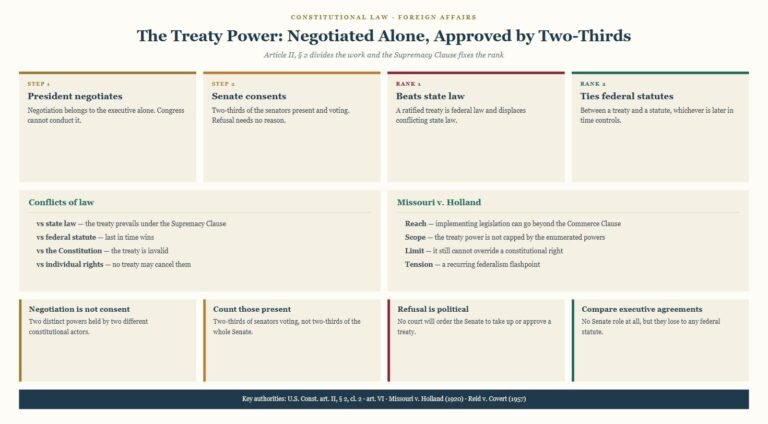 The Treaty Power: Senate Advice and Consent Explained
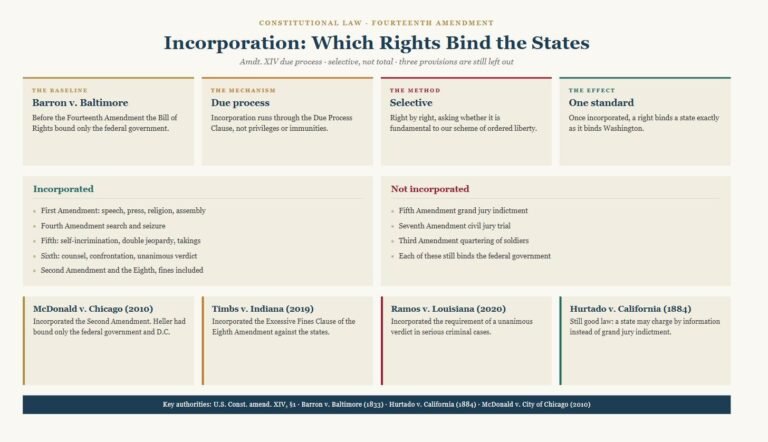 Incorporation Doctrine: Which Rights Bind the States
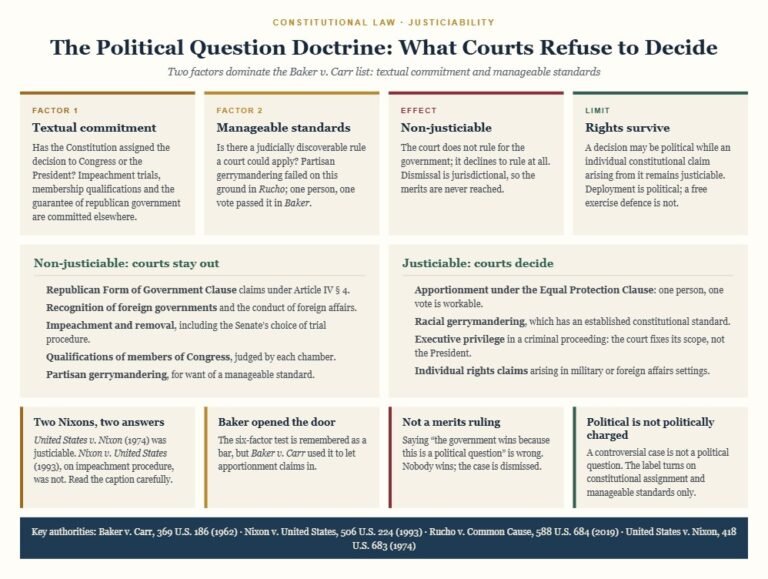 Political Question Doctrine: What Courts Will Not Decide
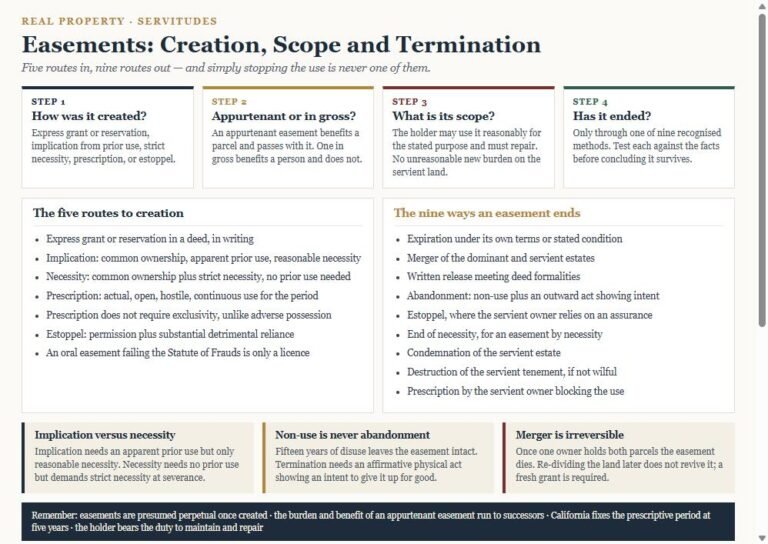 Easements Explained: Creation, Scope and Termination
 Partner Liability and Authority Under RUPA Explained
 Ripeness and Mootness: Timing Rules in Federal Court
 Speech or Debate Clause: Absolute but Narrow Immunity
 Campaign Finance and Anonymous Speech: The Core Rules
 Contracts Clause: When States May Impair Agreements