
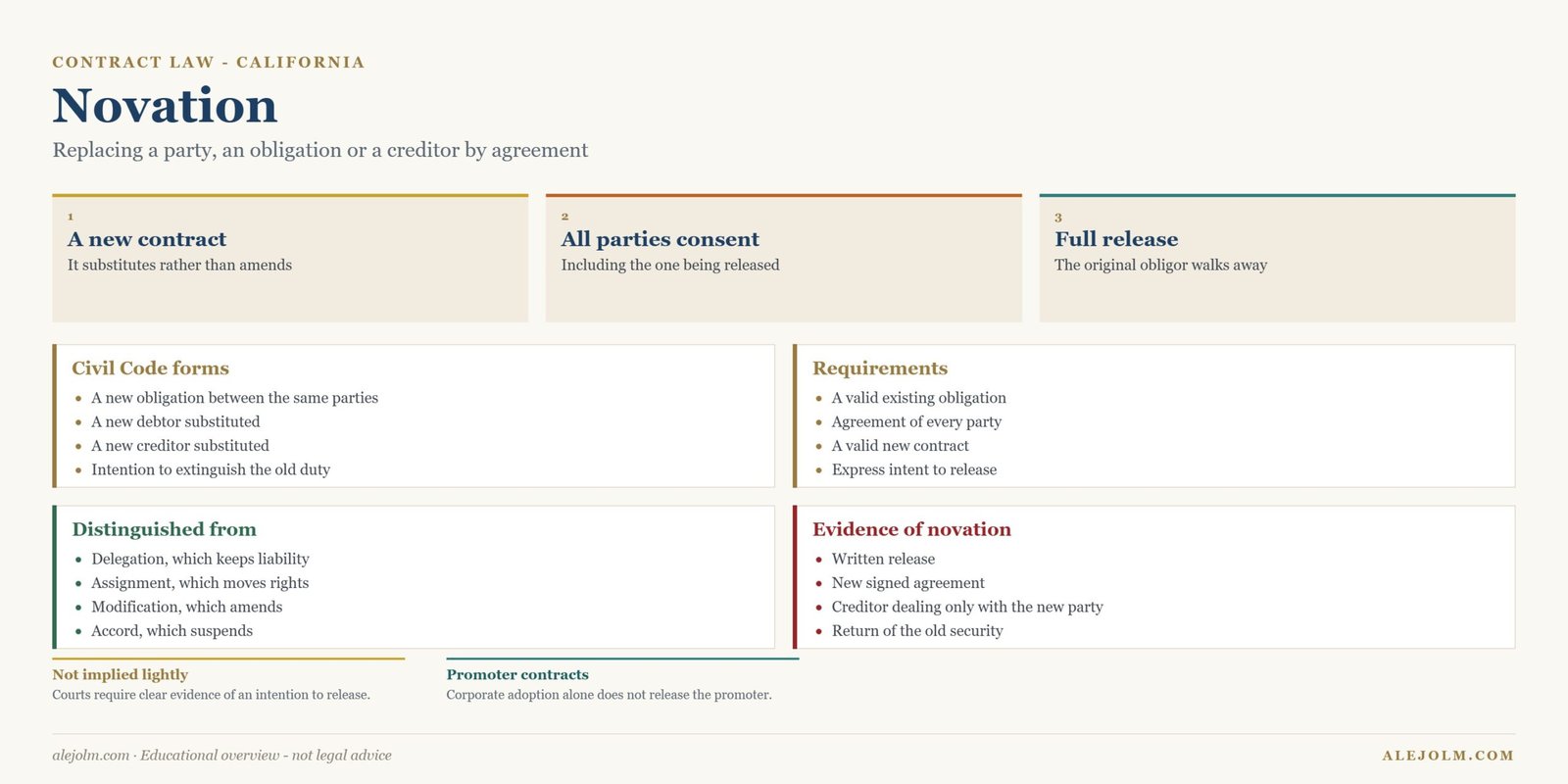
Novation is the substitution of a new obligation for an existing one, with the intention of extinguishing the old. California recognises three forms in the Civil Code: a new obligation between the same parties, the substitution of a new debtor, and the substitution of a new creditor. Each requires the consent of everyone affected.
The point that matters commercially is the release. A novation frees the original obligor completely, which is precisely why courts will not find one unless the intention to release is clear. Where the paperwork is ambiguous, the arrangement is usually a delegation instead, and the original party remains on the hook. This guide explains the difference and how to document it.
The requirements
- A valid existing obligation. There must be something to replace.
- Agreement of all parties. The creditor, the outgoing obligor and the incoming obligor must all consent.
- A valid new contract. The substitute obligation must itself satisfy the requirements of formation.
- Intention to extinguish. The parties must mean to discharge the old duty, not merely add a new performer.
- Consideration. Usually supplied by the mutual exchange of release and new promise.
- Clear evidence. Courts do not infer a release from silence or from acceptance of performance.
Novation, delegation and assignment
A delegation transfers the burden of performing but leaves the delegating party liable if the delegate fails. An assignment transfers the benefit of a contract and leaves the assignor obligations untouched. A novation does something neither of them does: it releases the original party altogether and creates a fresh contractual relationship in its place.
The test in practice
Ask what the creditor said. Words to the effect that the outgoing party is released, discharged or no longer responsible point to novation. Words merely accepting that someone else will do the work point to delegation. Continuing to hold security given by the original obligor is strong evidence that no release was intended.
| Arrangement | Original party liability | Consent of the creditor |
|---|---|---|
| Assignment of rights | Unaffected | Usually not required |
| Delegation of duties | Continues | Not required to be valid |
| Novation | Discharged | Essential |
| Modification | Continues on new terms | Required |
| Accord and satisfaction | Suspended then discharged | Required |
A worked example
A landlord in Culver City agrees that an incoming operator will take over a commercial lease. The landlord signs a document releasing the outgoing tenant, returns the original deposit and enters a fresh lease with the new operator on the same terms. That is a novation, and the outgoing tenant has no further liability when the new operator later defaults.
Change the paperwork. Suppose the landlord simply consents to an assignment, keeps the original deposit and says nothing about release. Now the outgoing tenant remains liable as a guarantor of performance, and the landlord may pursue it when the new operator stops paying. The commercial arrangement looked identical; the legal consequences are entirely different.
Novation in California and Los Angeles County in 2026
Commercial leasing is the most common setting in Los Angeles County, followed by business sales where a buyer takes over supply and service agreements. Counterparties frequently assume that consent to an assignment carries a release. It does not, and outgoing tenants and sellers who want a clean exit must ask for a release in terms.
The promoter scenario is the other recurring point. Where someone contracts on behalf of a company that has not yet been formed, the company later adopting the contract does not by itself release the promoter. A novation, agreed by the counterparty, the company and the promoter, is required.
- Ask for the word release. Consent to assign is not the same thing.
- Get every party to sign. A two party document cannot effect a novation.
- Deal with security. Retained deposits and guarantees suggest no release was intended.
- Record the date. Liability for events before the novation is often preserved.
- Check guarantor positions. A guarantor may be discharged by a novation it did not agree to.
- Do not rely on adoption. A company adopting a promoter contract does not release the promoter.
For 2026, confirm the current California authority on novation, release and assignment consents directly with current authority, since these continue to develop.
Common mistakes to avoid
- Assuming acceptance of a substitute performer releases you. It usually creates a delegation only.
- Omitting a party. Every affected party must consent for a novation to work.
- Relying on oral assurances. A release should be recorded in writing.
- Forgetting pre novation liabilities. They are commonly carved out.
- Confusing novation with accord. An accord suspends a duty; a novation replaces it.
- Ignoring guarantors. Substituting the principal obligor can discharge a guarantee.
Frequently asked questions
What is the difference between a novation and an assignment?
An assignment transfers benefits and leaves the assignor obligations in place. A novation replaces the contract itself and releases the original obligor.
Does the other party have to agree?
Yes. A novation cannot be effected without the consent of every party affected, including the party being asked to accept a new obligor.
Can a novation be oral?
It can in principle, but proving the intention to release is far harder without a written record, and the underlying obligation may itself require a writing.
Does a novation discharge a guarantee?
It often does, because a guarantor is generally not liable for a new obligation it never agreed to guarantee. Lenders usually require a fresh guarantee.
Is a company adopting a promoter contract a novation?
No. Adoption makes the company liable but does not release the promoter. A separate novation agreed by all three parties is needed for that.
Related guides
- Delegation of duties
- Assignment of rights
- Accord and satisfaction
- Modification of a contract
- Rescission of a contract
- Third party beneficiaries
- Consideration in contract law
- Remedies for breach of contract
Next steps
If you are handing a contract to someone else, decide at the outset whether you want a clean exit or are content to remain a backstop. Our guides to delegation of duties and assignment of rights explain what happens if you do not obtain a release.
For primary sources, read California Civil Code section 1530 and the civil jury instructions published by the Judicial Council of California.