
After a jury returns a verdict, two very different motions are available. Judgment as a matter of law under Rule 50 asks the court to say that no reasonable jury could have reached that result. A new trial motion under Rule 59 concedes the jury could have, but asks for a second one because something went wrong.
The difference is not academic. One produces final judgment for the moving party; the other produces a retrial. The standards, the evidence the judge may consider, and the consequences on appeal all diverge. This guide sets out both, together with the timing traps that forfeit appellate review and the California analogues used in Los Angeles.
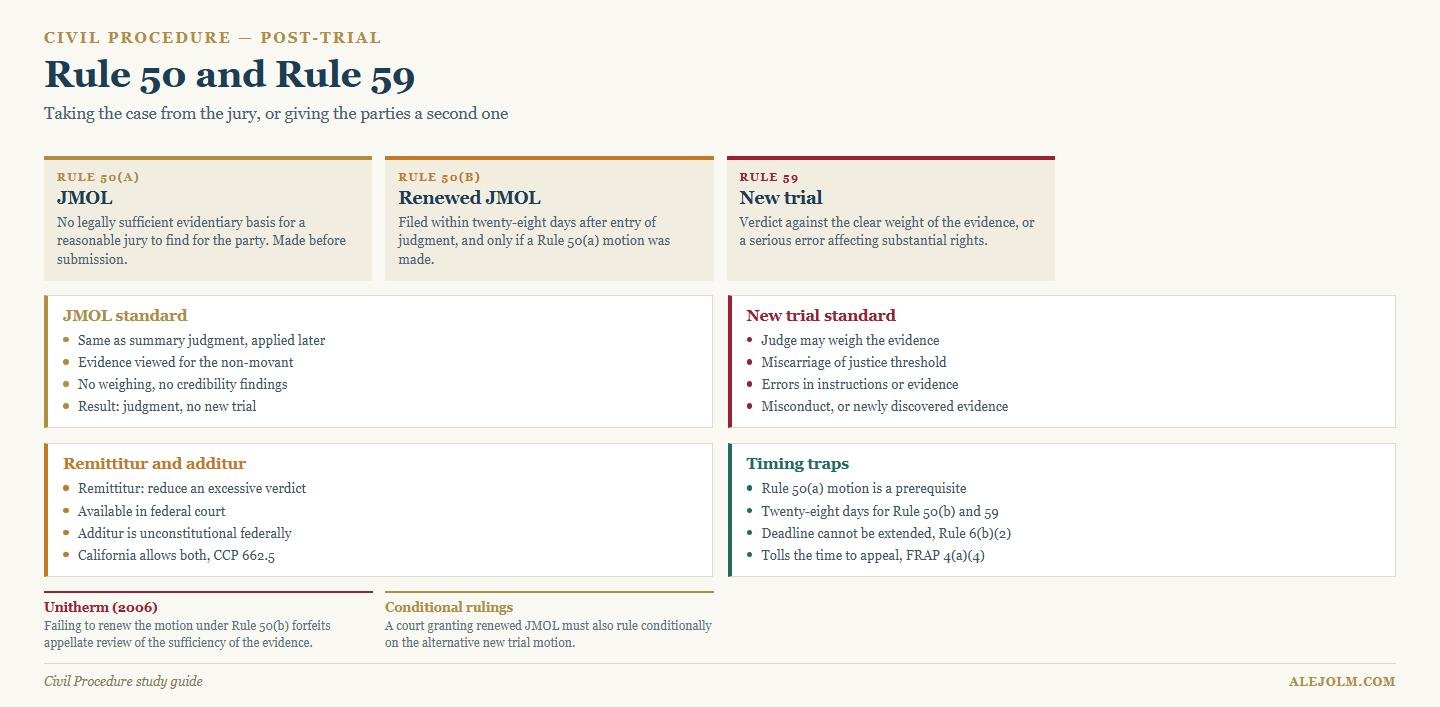
Judgment as a matter of law
Rule 50(a) permits a motion after a party has been fully heard on an issue during a jury trial, where the court finds that a reasonable jury would not have a legally sufficient evidentiary basis to find for that party. The standard mirrors summary judgment: the evidence is viewed in the light most favourable to the non-movant, all reasonable inferences are drawn in that party’s favour, and the court neither weighs evidence nor makes credibility findings. What has changed is the timing — the court now has a full trial record rather than a paper one.
Rule 50(b) allows the motion to be renewed no later than twenty-eight days after entry of judgment. The renewal is only available if a Rule 50(a) motion was made before the case went to the jury, because the Seventh Amendment re-examination clause permits post-verdict judgment only as a reserved ruling on the earlier motion. Unitherm Food Systems v. Swift-Eckrich (2006) confirms that failing to renew forfeits appellate review of evidentiary sufficiency altogether.
New trial
Rule 59 allows a new trial for any reason for which one has historically been granted. The main grounds are that the verdict is against the clear weight of the evidence, that damages are excessive or inadequate, that evidentiary or instructional error affected substantial rights, that counsel or jury misconduct occurred, or that newly discovered evidence has emerged which could not reasonably have been found earlier.
Crucially, on a Rule 59 motion the judge may weigh the evidence and assess credibility. That is the essential difference from Rule 50. The threshold is nonetheless high: the judge must be convinced that leaving the verdict in place would result in a miscarriage of justice, not merely that she would have decided differently.
Remittitur and additur
Where damages are excessive, a federal court may condition denial of a new trial on the plaintiff’s acceptance of a reduced figure. That is remittitur, and it is permissible because the plaintiff consents. Additur — conditioning denial on the defendant accepting an increased award — was held unconstitutional in Dimick v. Schiedt (1935), because it adds to a verdict the jury never returned. California, whose civil jury right rests on the state constitution, permits both under Code of Civil Procedure section 662.5.
The two motions compared
| Feature | Rule 50, JMOL |
|---|---|
| Question | Could a reasonable jury find this way? |
| Weighing evidence | Not permitted |
| Credibility findings | Not permitted |
| Remedy | Judgment for the movant |
| Prerequisite | Rule 50(a) motion before submission |
| Deadline | 28 days after entry of judgment |
| Extension | Not available, Rule 6(b)(2) |
A worked example
A jury awards $4 million in a products case. The defendant moved for judgment as a matter of law at the close of the plaintiff’s case but not at the close of all evidence, and now files a renewed Rule 50(b) motion together with a Rule 59 motion arguing the award is excessive.
The Rule 50(b) motion is in trouble. Many courts hold that a motion made only at the close of the plaintiff’s case is not preserved once the defendant puts on evidence, and Unitherm means the sufficiency argument may be unavailable even on appeal. The Rule 59 motion is unaffected: no prior motion is required, the judge may weigh the evidence on excessiveness, and the likely outcome is remittitur — a reduced figure the plaintiff may accept or refuse in favour of a new trial on damages.
Post-trial motions in California and Los Angeles County in 2026
California has parallel devices with different names and, more importantly, different deadlines. The motion for judgment notwithstanding the verdict lives in Code of Civil Procedure section 629 and uses the same evidentiary sufficiency standard as Rule 50, and like the federal rule it generally requires that a motion for nonsuit or directed verdict have been made first. The motion for new trial lives in sections 656 to 663a, and section 657 enumerates the grounds exhaustively — irregularity in the proceedings, jury misconduct, accident or surprise, newly discovered evidence, excessive or inadequate damages, insufficiency of the evidence, and error in law.
Two California features have no federal counterpart. First, the trial court must specify the grounds and, where the ground is insufficiency of the evidence or excessive damages, must file a written statement of reasons; a failure to do so is fatal on appeal, and the appellate courts enforce this strictly. Second, section 660 imposes a hard jurisdictional deadline: the power to rule on a new trial motion expires by operation of law, and an order made afterwards is void. Section 662.5 then allows both remittitur and additur, so a Los Angeles judge may condition denial on either party accepting an adjusted figure.
Practical points for a 2026 Los Angeles trial:
- Move for nonsuit and directed verdict on the record. Preservation for a later JNOV depends on it, and an oral motion should be specific about the element that fails.
- Calendar the notice of intention immediately. California requires a notice of intention to move for new trial within a short window measured from notice of entry of judgment, and the deadline cannot be extended.
- Draft the statement of reasons for the court. Where you are the prevailing movant, a proposed order that complies with section 657 protects the ruling on appeal.
- Use additur where the verdict is too low. This is genuinely unavailable in federal court and is one of the clearest advantages of the state forum for plaintiffs.
- Watch the automatic denial. If the court does not rule within the statutory period the motion is denied by operation of law, which starts the appellate clock.
- Confirm the current deadlines. The interaction between notice of entry of judgment, the new trial period and the time to appeal has been litigated repeatedly; verify the current rules before relying on any timetable.
For 2026, the lesson in both systems is that post-trial rights are built during trial. The motion you did not make before the case went to the jury is the argument you cannot make afterwards. Continue with the civil jury trial right, summary judgment and preclusion doctrine.
Common mistakes to avoid
- Skipping the Rule 50(a) motion. Without it there is no renewal and, after Unitherm, no appellate sufficiency review.
- Weighing evidence in a Rule 50 brief. That argument belongs in the Rule 59 motion.
- Assuming the deadline can be extended. Rule 6(b)(2) forbids extending the twenty-eight days for Rules 50, 52 and 59.
- Asking for additur in federal court. It is unconstitutional there, though available in California.
- Forgetting the conditional ruling. A court granting renewed JMOL must also rule conditionally on the alternative new trial motion so the appellate court can dispose of the case.
Frequently asked questions
What is the standard for judgment as a matter of law?
Whether a reasonable jury would have a legally sufficient evidentiary basis to find for the party on that issue, with the evidence viewed in the light most favourable to the non-movant and without weighing credibility.
Why must a Rule 50(a) motion precede a Rule 50(b) motion?
Because the Seventh Amendment re-examination clause permits post-verdict judgment only as a reserved ruling on the motion made before submission. Without the earlier motion there is nothing to reserve.
Can a judge weigh the evidence on a new trial motion?
Yes. That is the central difference from Rule 50. The judge may weigh evidence and assess credibility, but must find that the verdict amounts to a miscarriage of justice.
What is remittitur?
A conditional order reducing an excessive verdict: the new trial is denied if the plaintiff accepts the reduced figure. Federal courts may order remittitur but not additur.
What are the California equivalents?
A motion for judgment notwithstanding the verdict under Code of Civil Procedure section 629 and a motion for new trial under sections 656 to 663a, with a mandatory statement of reasons and a hard jurisdictional deadline.
Related guides
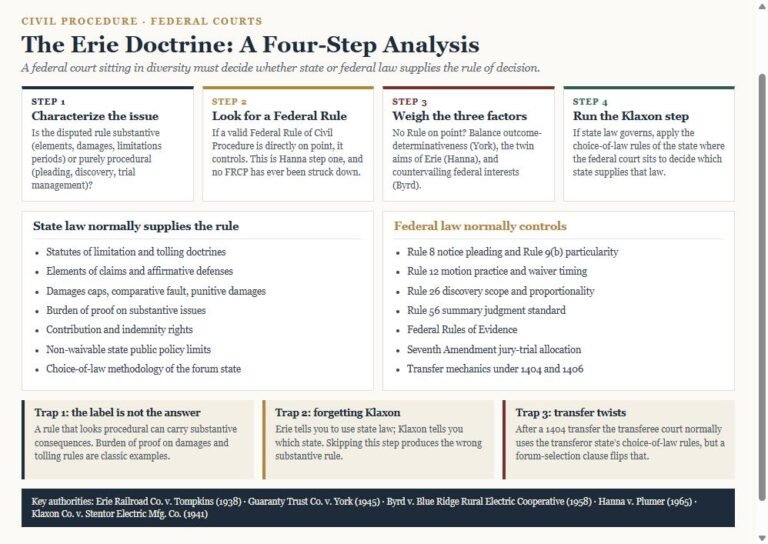 The Erie Doctrine Explained: A 4-Step Bar Exam Guide
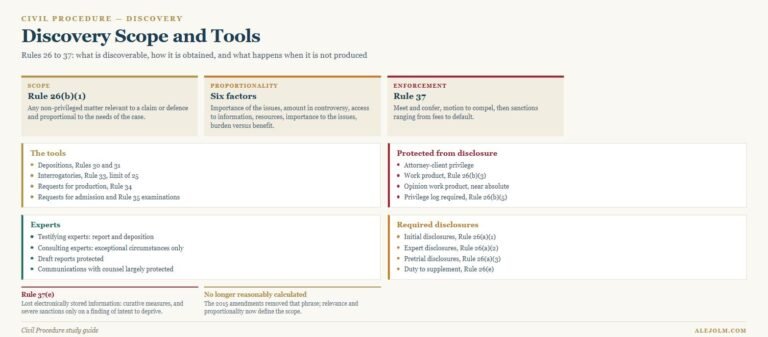 Federal Discovery Rules: Scope, Tools and Sanctions
- Federal Pleading Standards After Twombly and Iqbal
- The IRAC Method: How to Structure a Bar Exam Answer
- Summary Judgment Under Rule 56: Standard and Proof
- Products Liability: The Three Defect Theories Explained
- Procedural Due Process: Notice, Hearing and Mathews
- Res Judicata vs Collateral Estoppel: Bar Exam Guide
- The Four Elements of Negligence: Bar Exam Breakdown
- Access to the Courts: When Filing Fees Are Unconstitutional
- The Seventh Amendment Right to a Jury Trial Explained
Next steps
Once post-trial motions are resolved the judgment becomes final, and finality is what gives it binding force in later cases. Read res judicata and collateral estoppel next, and the civil jury trial right for the constitutional backdrop.