
Abnormally dangerous activities form the narrowest branch of strict liability. Where an activity qualifies, the defendant answers for the harm it causes without any inquiry into care, competence or precaution. The claim is not that the defendant did anything badly. It is that the activity should not be carried on at the neighbours expense.
Two questions decide these cases. Does the activity meet the Restatement description, and did the harm flow from the specific danger that made it dangerous? Everything else, including how carefully the defendant behaved, is beside the point.
The six factors
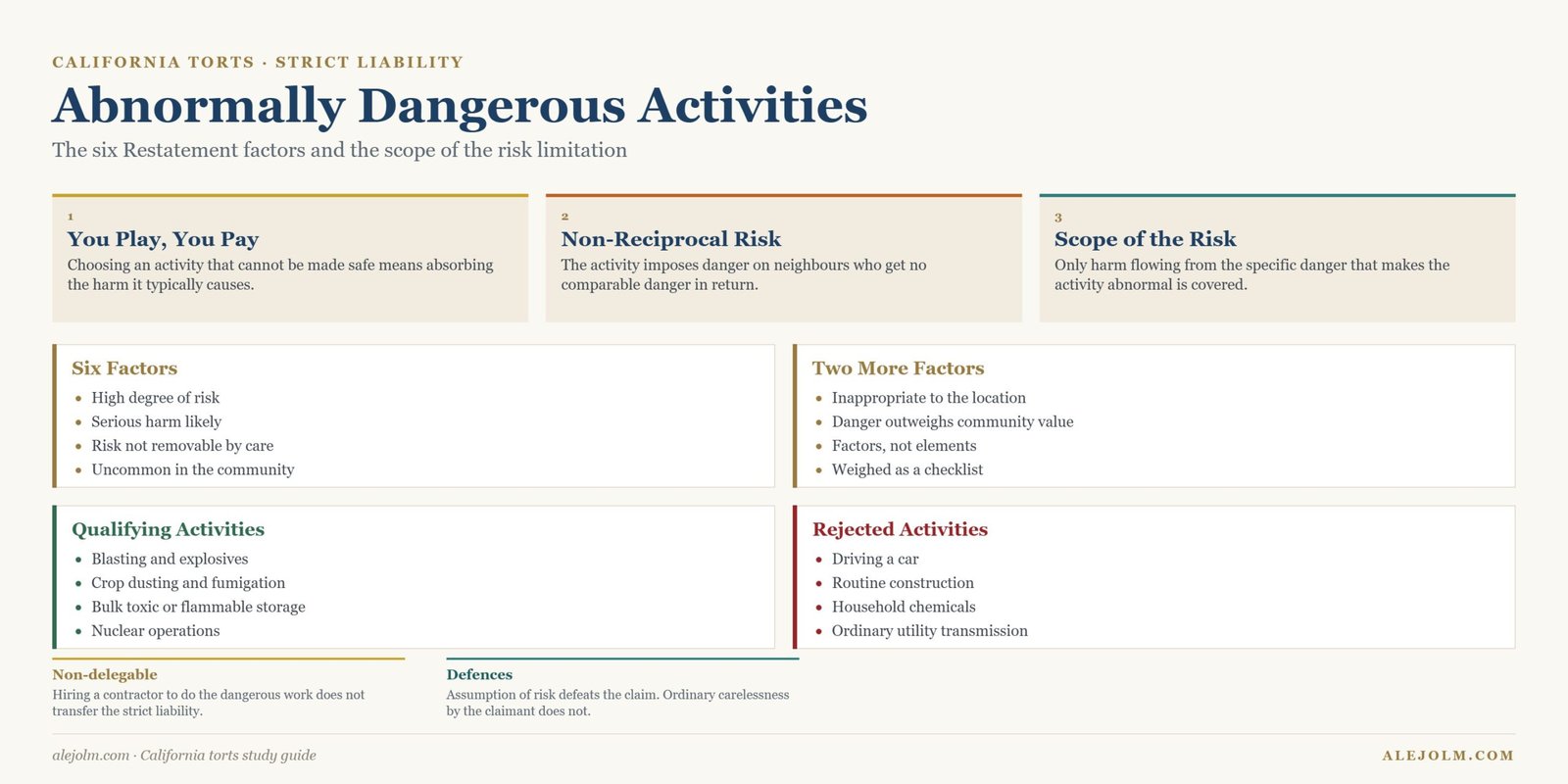
The Restatement sets out six considerations: a high degree of risk of harm, a likelihood that any harm will be serious, an inability to eliminate the risk by the exercise of reasonable care, the fact that the activity is not a matter of common usage, its inappropriateness to the place where it is carried on, and the extent to which its danger outweighs its value to the community. They are factors rather than elements, so no single one is decisive, but the third and fourth carry most of the weight.
The reason those two dominate is that they capture what makes the doctrine coherent. If reasonable care can remove the danger, negligence is the right tool. If the activity is woven into ordinary community life, imposing no-fault liability on it would tax everyone for something everyone does.
Non-reciprocal risk
The best explanation of the doctrine is an idea about the distribution of danger. Driving imposes risk, but the risk is reciprocal: today a pedestrian, tomorrow a driver, and everyone benefits from the system that produces the danger. Blasting is different. A contractor who detonates explosives imposes a serious risk on neighbours who receive nothing comparable in return and have no way to protect themselves. Strict liability shifts the cost of that non-reciprocal risk onto the person who chose to create it and who profits from it.
Activities that qualify and activities that do not
Blasting and the use of explosives is the paradigm. Crop dusting, fumigation with toxic chemicals, the bulk storage of flammable or poisonous substances, the transport of certain hazardous materials, and nuclear operations are conventional members of the category. Courts consistently refuse to extend it to driving, ordinary construction, the storage of household quantities of chemicals, and, in most jurisdictions, to public utilities carrying on the activities that make them utilities.
| Activity | Abnormally dangerous? | Reason |
|---|---|---|
| Blasting in a built up area | Yes | Irreducible risk, uncommon, inappropriate to the place |
| Driving a car | No | Common usage and reciprocal risk |
| Crop dusting near housing | Usually | Drift cannot be eliminated by care |
| Routine construction | No | Common and controllable by reasonable care |
| Keeping a tiger | Yes | Wild animal, serious harm, uncommon |
Scope of the risk
This is the limitation most often missed. Liability attaches only where the harm results from the danger that made the activity abnormally dangerous. A lorry carrying dynamite that runs a red light and strikes a pedestrian has caused an ordinary road accident, and the case is governed by negligence. If the cargo detonates and injures bystanders, that is the dynamite risk and strict liability applies. Ordinary proximate cause limits also survive, so a genuinely unforeseeable intervening force can still cut liability off.
Non-delegable duty and defences
A defendant cannot escape by hiring a contractor. Strict liability follows the activity rather than the identity of the person performing it, which is why a landowner who engages a blasting firm remains answerable. On defences, assumption of risk is a genuine answer where the claimant knowingly and voluntarily encountered the specific danger. Ordinary carelessness by the claimant is not a bar, although in comparative jurisdictions it reduces recovery.
A worked example
A fumigation company tents a house and releases a toxic gas. Despite following every protocol, the gas seeps through a shared wall and injures the neighbours. The activity involves a serious risk that cannot be eliminated by care, it is not a matter of common usage, and it is being carried on in a residential terrace. The harm is exactly the gas risk. Liability follows without any inquiry into the company procedures.
Change the facts so that a technician reverses the van into the neighbour car. That is ordinary negligence. The activity is dangerous, but the harm has nothing to do with the danger that made it so.
Abnormally Dangerous Activities in California and Los Angeles County in 2026
California applies the Restatement factors and treats the classification as a question of law for the court, which is why so many of these disputes are resolved before trial. The state has recognised blasting, the handling and storage of hazardous materials in quantity, and certain pest control and fumigation operations as candidates, while declining to treat common commercial and industrial activities as abnormally dangerous merely because they are risky.
Comparative fault applies, so a claimant own conduct apportions rather than bars recovery. In Los Angeles County the doctrine surfaces in demolition and construction work in dense neighbourhoods, in hazardous materials incidents around the ports and industrial corridors, in fumigation and pest control claims, and in pipeline and fuel storage litigation. Utility related fire claims are usually litigated on negligence and inverse condemnation theories rather than under this doctrine.
- Question of law. Whether an activity is abnormally dangerous is decided by the court, which makes early motions decisive.
- Restatement factors. California weighs all six, with irreducible risk and common usage doing most of the work.
- Scope of the risk. The harm must flow from the danger that justified no-fault treatment.
- Non-delegable. Engaging a contractor does not shift the liability away from the party carrying on the activity.
- Comparative fault. Claimant fault reduces recovery proportionately rather than defeating the claim.
- Utilities. Activities that are inherent to public utility service are generally analysed under negligence and inverse condemnation.
For 2026, confirm the current California authority on the classification of particular activities, the treatment of utility operations, and the interaction with comparative fault directly with current authority, since these continue to develop.
Common mistakes to avoid
- Asking whether the defendant was careful. Reasonable care is irrelevant. That is the point of the doctrine.
- Ignoring the scope of the risk. Unrelated harm during a dangerous activity is an ordinary negligence case.
- Stopping at dangerous. Many dangerous activities are common, and common usage removes them from the category.
- Delegating the liability. A contractor performing the work does not relieve the party carrying it on.
- Treating claimant carelessness as a bar. Only knowing assumption of risk does that; carelessness apportions.
- Confusing it with products liability. One is about an activity, the other about a defective thing sold.
Frequently asked questions
What makes an activity abnormally dangerous?
A high degree of risk of serious harm that reasonable care cannot eliminate, in an activity that is not a matter of common usage, is inappropriate to its location, and whose danger outweighs its value to the community.
Is careful conduct a defence?
No. Strict liability attaches to the activity rather than to the quality of the conduct, so a defendant who took every precaution is still answerable for harm within the risk.
Why is driving not abnormally dangerous?
Because it is a matter of common usage and the risk is reciprocal. Everyone benefits from and participates in the activity, so negligence rather than strict liability supplies the standard.
Can liability be avoided by using a contractor?
No. The duty is non-delegable, so the party carrying on the activity remains strictly liable even where an independent contractor performs the work.
What defences are available?
Assumption of risk is a genuine defence where the claimant knowingly and voluntarily encountered the specific danger. Ordinary carelessness reduces recovery in comparative fault states rather than barring it.
Related guides
- Strict Liability in Tort Law: Liability Without Fault
- Products Liability: The Three Defect Theories Explained
- The Four Elements of Negligence: Bar Exam Breakdown
- Proximate Cause: Foreseeability and Superseding Causes
- Assumption of Risk in California: Primary and Secondary
- Vicarious Liability: Respondeat Superior and Scope of Work
- Trespass to Land in California: Elements and Remedies
- Comparative Negligence in California: How Fault Is Split
Next steps
Read our guide to strict liability for the wider category this doctrine belongs to, then products liability, the branch that produces far more litigation.
For primary sources, read California Health and Safety Code section 25249.5 and the strict liability instructions published by the Judicial Council of California.