
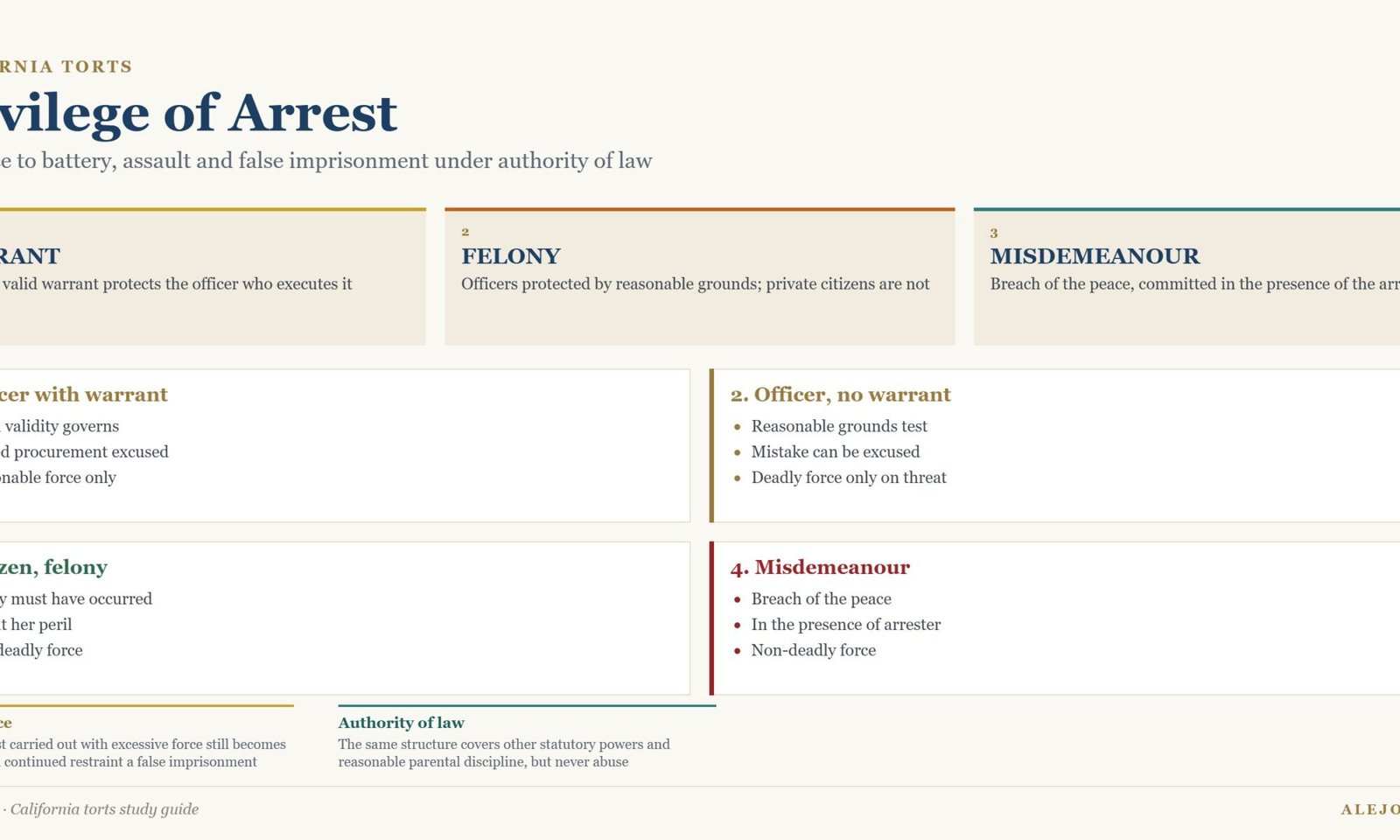
Privilege of arrest is the defence that makes an otherwise tortious seizure lawful. Without it, every arrest would be a battery and every period of custody a false imprisonment. The privilege is not one rule but a small matrix of them, and which cell applies depends on whether there was a warrant, whether the offence was a felony or a misdemeanour, and whether the person acting was an officer or a private citizen.
California addresses arrest powers by statute, including the separate provisions governing arrests by private persons. This guide walks through each category, explains the sharp difference between officers and citizens on warrantless felony arrests, sets out the limits on force, and places the privilege alongside the narrower merchant detention rule.
Why the categories matter
The privilege exists because society needs people to be able to restrain others in defined circumstances without facing automatic liability. That justification is strongest where a court has already reviewed the grounds, weaker where an officer acts on the street, and weakest where a private person acts on their own judgement. The law reflects that gradient by tightening the requirements as the safeguards fall away.
Arrest under a warrant
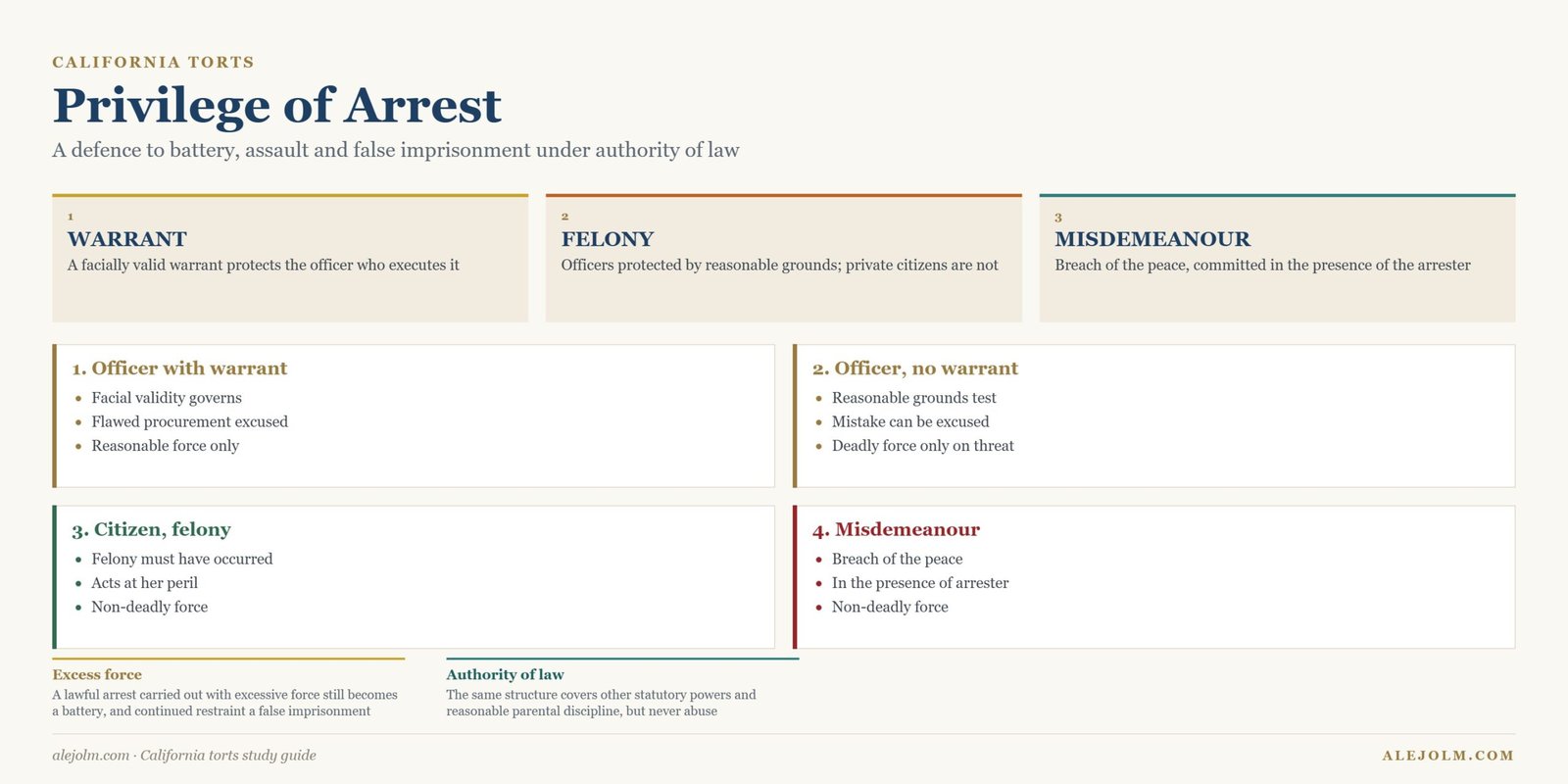
An officer executing a facially valid arrest warrant is protected even if probable cause was in fact lacking or the warrant was obtained through a flawed process. What matters is whether the document appeared regular on its face. The officer is entitled to rely on the judicial decision rather than to re-examine it, and only reasonable force may be used in carrying it out.
Warrantless felony arrest
By a police officer
An officer acting without a warrant is protected where there were reasonable grounds to believe both that a felony had been committed and that the person arrested committed it. A reasonable but mistaken belief on either point does not defeat the privilege. That allowance reflects the practical reality that officers must decide quickly on incomplete information.
By a private citizen
A private person faces a stricter rule. Reasonable grounds suffice as to whether this particular person committed the offence, but the felony must actually have been committed. If no felony occurred, the citizen has no privilege however reasonable the belief was. The traditional shorthand is that citizens act at their peril, and it is the single most important distinction in this area.
Warrantless misdemeanour arrest
For misdemeanours, officer and citizen are treated alike at common law. The arrest is privileged only where the offence involved a breach of the peace and was committed in the presence of the person making the arrest. That requirement defeats most situations built on second-hand reports, because the arrester did not witness anything. Only reasonable, non-deadly force may be used.
| Situation | Who acts | Requirement | Effect of a reasonable mistake |
|---|---|---|---|
| Warrant arrest | Officer | Facially valid warrant | Protected |
| Warrantless felony | Officer | Reasonable grounds as to offence and person | Protected |
| Warrantless felony | Private citizen | Felony actually committed | Not protected as to the offence |
| Misdemeanour | Either | Breach of the peace in the presence of the arrester | Rarely protected |
Limits on force
The privilege justifies the seizure, not unlimited force in achieving it. Force must be reasonable in the circumstances, and deadly force is reserved for a suspect who poses an immediate serious or deadly threat. Force used merely to prevent escape does not reach that standard.
Excess force converts a lawful arrest into a battery, and restraint continued beyond what the privilege permits becomes false imprisonment. The two questions are analytically separate: an arrest can be entirely proper and the manner of carrying it out still tortious.
Authority of law more generally
Arrest sits inside a wider category in which conduct that would otherwise be tortious is excused because the law authorises it. Statutory detention powers and acts performed under lawful orders fall within it, as does reasonable parental discipline, judged against the age of the child and the nature of the misconduct. Discipline that crosses from correction into abuse is never privileged, and no disciplinary purpose rescues it.
A worked example
A shop assistant in Los Angeles is told by another customer that a man in the car park has just stolen a wallet from a handbag. The assistant runs out, grabs the man and holds him until police arrive. No wallet is found and no theft occurred. Because a private citizen must be right that the offence actually happened, and because nothing was witnessed personally, no privilege applies and the man has claims for battery and false imprisonment.
Change the actor. Suppose an officer, told the same thing by an apparently credible witness who described the theft in detail, made the same arrest on the same information. If the grounds were reasonable, the officer remains protected even though the belief proved wrong, provided the force used was proportionate.
Privilege of arrest in California and Los Angeles County in 2026
California sets out arrest powers by statute, with separate provisions for peace officers and for arrests by private persons. The private person provisions are narrow, and California also imposes obligations on anyone who makes such an arrest to deliver the person to a magistrate or peace officer without unnecessary delay.
California has also legislated on the use of force by peace officers, tightening the circumstances in which deadly force is permitted. In Los Angeles County, claims arising from arrests frequently combine state tort theories with civil rights claims, and the governmental immunity framework shapes which defendants can be sued and on what terms.
- Statutory powers — the Penal Code sets out arrest authority separately for officers and private persons.
- Citizen arrest limits — the offence must actually have occurred for a felony arrest by a private person.
- Prompt delivery — a private person making an arrest must hand the person over without unnecessary delay.
- Use of force statutes — California restricts deadly force by peace officers to defined circumstances.
- Immunities — the Government Claims Act shapes claims against public entities and employees.
- Parallel claims — battery, false imprisonment and civil rights theories are commonly pleaded together.
For 2026, confirm the current California authority on arrest powers, use of force standards and public entity immunity directly with current authority, since these continue to develop.
Common mistakes to avoid
- Treating officers and citizens alike — only the officer is protected by a reasonable but mistaken belief that a felony occurred.
- Allowing citizen arrests on second-hand reports — misdemeanour arrests require a breach of the peace in the presence of the arrester.
- Questioning a facially valid warrant — the executing officer is protected even where the warrant was flawed in its procurement.
- Assuming any force is privileged — deadly force is limited to suspects posing an immediate serious threat.
- Ignoring the duration — restraint continued after the privilege ends becomes false imprisonment.
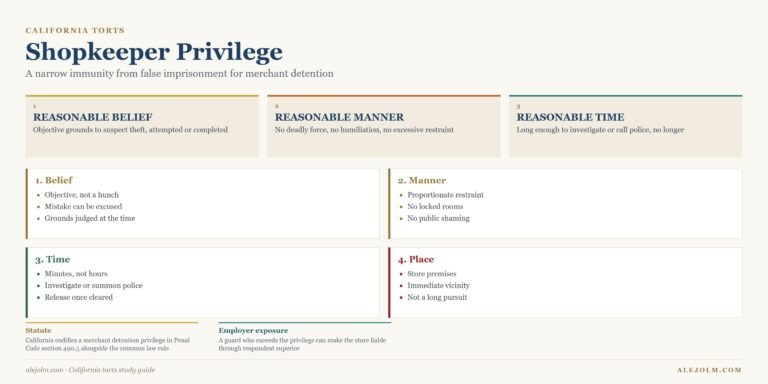
- Confusing it with merchant detention — the shopkeeper privilege is narrower in place but more forgiving about mistakes.
Frequently asked questions
Can a private person make an arrest in California?
Yes, but within narrow statutory limits. A private person may arrest for a public offence committed or attempted in their presence, and for a felony in defined circumstances, with an obligation to hand the person over to a magistrate or peace officer without unnecessary delay.
What happens if a citizen is mistaken about whether a crime occurred?
The privilege generally fails. Unlike an officer, a private person is not protected by a reasonable but mistaken belief that a felony was committed, which is why the traditional formulation says citizens act at their peril.
Does a valid arrest justify any amount of force?
No. The privilege covers the seizure, not the manner of it. Force must be reasonable, and using more than the situation requires makes the arrester liable for battery even though the arrest itself was lawful.
Is an officer liable if the warrant turns out to be defective?
Generally not, where the warrant was valid on its face. The executing officer may rely on the appearance of regularity, and defects in how the warrant was obtained do not strip the privilege from the person carrying it out.
How does this differ from the shopkeeper privilege?
The merchant privilege is confined to store premises and short investigatory detentions for suspected theft, but it protects a reasonable mistake. The arrest privilege reaches crimes generally and any location, yet demands more of a private person acting without a warrant.
Related guides
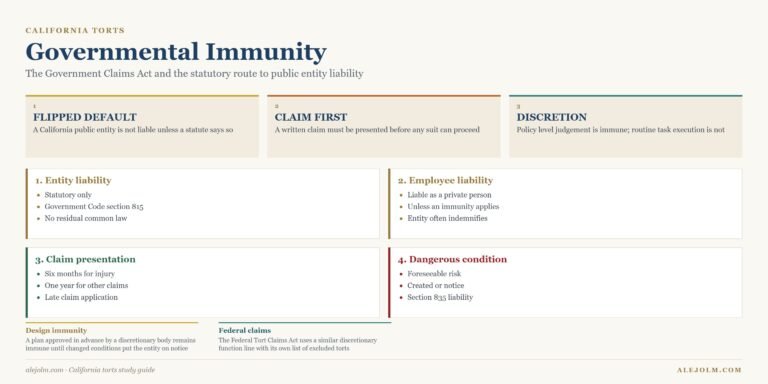 Governmental Immunity
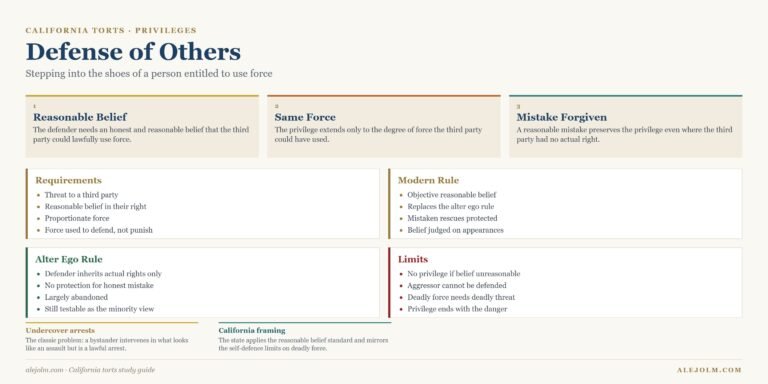 Defence of Others
 Shopkeeper Privilege
- Assault
- Self-Defence
- Malicious Prosecution
- Battery
- False Imprisonment
Next steps
Read this with false imprisonment, the claim the privilege defends against, and then shopkeeper privilege for the retail specific alternative.
For primary sources, read California Penal Code section 837 and the civil jury instructions published by the Judicial Council of California.