
The tort of battery protects bodily integrity. It occurs when someone intentionally causes a harmful or offensive contact with the person of another. There is no requirement that the plaintiff be injured, no requirement that the defendant intend injury, and no requirement that the contact be violent. A deliberate shove, an unwanted kiss and a spit in the face are all batteries.
That breadth is deliberate. The law treats unconsented physical contact as a wrong in itself, and a plaintiff who suffers no measurable harm can still recover nominal damages. This guide covers each element, the contacts that qualify, the defenses that defeat the claim, and how battery is litigated in California.
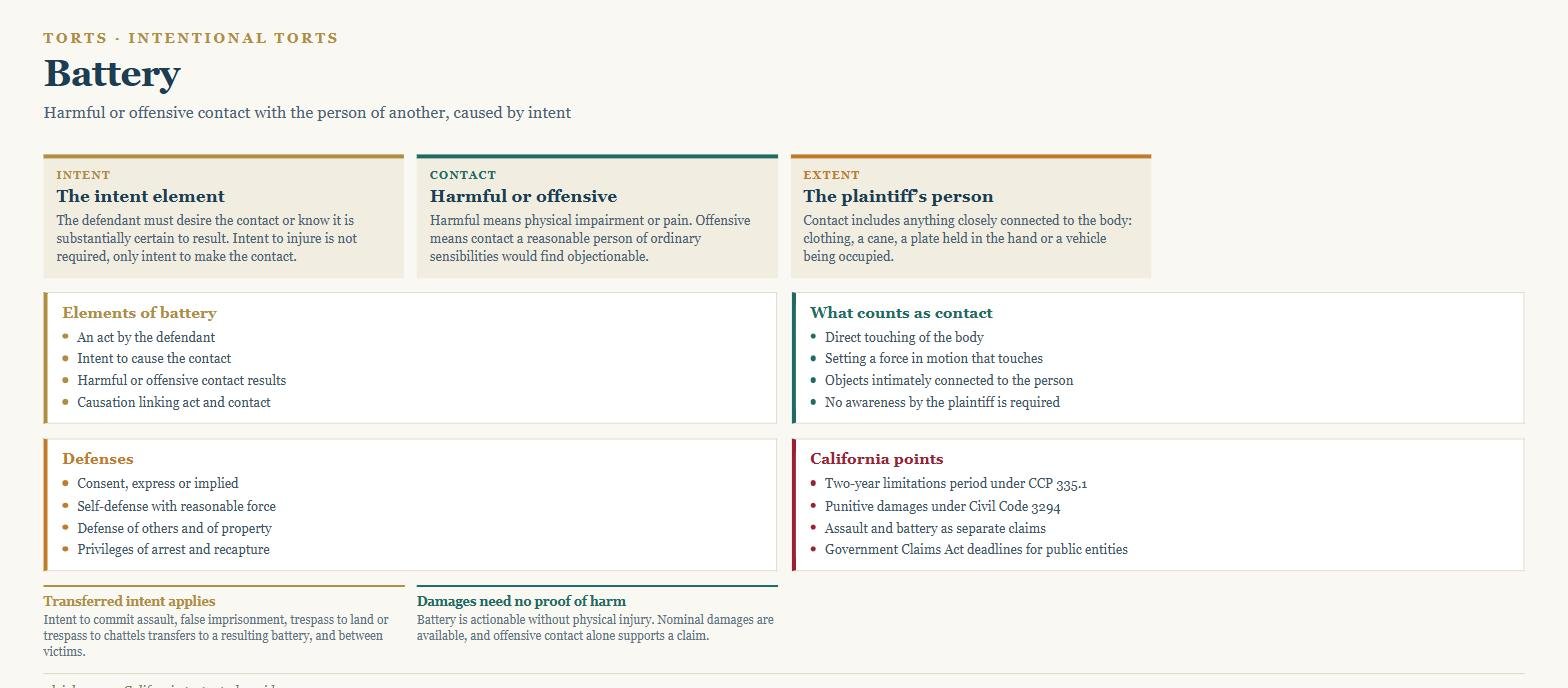
The intent element
Battery is an intentional tort, but the required intent is narrower than most people assume. The defendant must intend the contact, not the harm. Someone who playfully pulls a chair out from under a colleague intends the contact and is liable for a battery, even though injury was the last thing on their mind.
Intent is satisfied in two ways. Purpose means the defendant acted for the very purpose of causing the contact. Knowledge to a substantial certainty means the defendant knew the contact was virtually certain to follow from what they did, even if they did not want it. Recklessness is not enough, which is what separates battery from negligence.
Transferred intent
Transferred intent operates in two directions. If the defendant intends to strike A but hits B, the intent transfers to B. And if the defendant intends one of the five traditional trespassory torts, meaning battery, assault, false imprisonment, trespass to land or trespass to chattels, but accomplishes a different one, the intent transfers to that tort. A person who throws a rock intending only to frighten commits a battery if the rock connects.
Harmful or offensive contact
Harmful contact causes physical impairment, pain or illness. Offensive contact is measured objectively: would a reasonable person of ordinary sensibilities find it objectionable? The reasonable person standard protects defendants from unusually squeamish plaintiffs, but the standard shifts if the defendant knew of the plaintiff’s particular sensitivity and proceeded anyway.
Contact with the plaintiff’s person includes anything so closely connected to the body that it is treated as part of it. Snatching a plate from someone’s hand, grabbing a purse being carried, striking a cane being leaned on and kicking a wheelchair being occupied are all batteries. The defendant also need not touch the plaintiff personally; setting a force in motion, such as releasing a dog or throwing an object, is enough.
A plaintiff who is asleep or unconscious can still be battered, because awareness is not an element.
| Feature | Battery |
|---|---|
| Interest protected | Bodily integrity |
| Contact required | Yes |
| Plaintiff awareness | Not required |
| Typical proof | The contact and its offensiveness |
| Damages without injury | Nominal damages available |
| Transferred intent | Applies |
Defenses
- Consent: express or implied by conduct or custom. Participants in contact sports consent to contacts within the ordinary scope of the game, but not to deliberate rule violations intended to injure.
- Self-defense: reasonable force to prevent imminent harmful contact, proportionate to the threat, with deadly force permitted only against a threat of death or serious bodily injury.
- Defense of others: the same privilege exercised on behalf of a third person under threat.
- Defense of property: reasonable non-deadly force to prevent a tortious interference with property, never deadly force to protect property alone.
- Shopkeeper’s privilege: a merchant with reasonable cause may detain a suspected shoplifter for a reasonable time in a reasonable manner.
- Arrest and recapture: narrow privileges permitting force in specified circumstances, both of which carry significant risk if the underlying belief proves wrong.
A worked example
During a dispute at a Downtown Los Angeles bar, a patron swings at another man’s face intending to frighten rather than to connect. The punch misses but the follow-through knocks a glass out of a bystander’s hand, cutting her wrist. The bystander sues for battery. The patron argues he never intended to touch her and never intended any contact with anyone.
He is liable. Intending to place the first man in apprehension of imminent contact is intent to commit assault, and transferred intent converts that into intent for the resulting battery. The intent also transfers between victims, so the fact that the bystander was not the target is irrelevant. Knocking the glass counts as contact because an object being held is treated as part of the person, and the resulting cut supplies harm. Note that his subjective lack of hostility toward the bystander does not help him: battery measures intent as to the contact, not as to the consequences.
Battery Claims in California and Los Angeles County in 2026
California recognises civil battery as a distinct cause of action from criminal battery under Penal Code section 242. A criminal conviction is neither necessary nor sufficient, though a conviction can have preclusive effect on issues actually litigated. The civil claim is usually pleaded alongside assault and, where the conduct was extreme, intentional infliction of emotional distress.
The limitations period is two years under Code of Civil Procedure section 335.1, the general personal injury statute. Where the defendant is a public entity or public employee, the Government Claims Act imposes a far shorter deadline: a written claim must ordinarily be presented to the entity within six months of accrual, and failing to do so bars the lawsuit entirely. This trips up a large number of excessive force claims against law enforcement in Los Angeles County.
Punitive damages are available under Civil Code section 3294 where the plaintiff proves by clear and convincing evidence that the defendant acted with oppression, fraud or malice, which a deliberate battery often satisfies. Los Angeles Superior Court routes most of these cases to its personal injury hub departments, and the amount in controversy determines whether the case is filed as a limited or unlimited civil matter, which in turn changes the discovery limits and the trial procedures that apply.
- CCP 335.1: two years from the date of the contact for personal injury battery claims.
- Government Claims Act: present a written claim to a public entity within six months, or the action is barred.
- Civil Code 3294: punitive damages on clear and convincing proof of oppression, fraud or malice.
- Penal Code 242: the criminal offence is separate; a civil action can proceed regardless of the outcome.
- Medical battery: treatment substantially different from what was consented to is battery, not merely negligence.
- PI hub assignment: Los Angeles routes personal injury cases to dedicated departments with their own procedures.
For 2026, confirm the current Government Claims Act presentation deadlines and the applicable limited civil case threshold before filing, since both have been the subject of legislative change. Related reading: assault in tort law, the elements of negligence and the transferred intent doctrine.
Common mistakes to avoid
- Requiring intent to injure. The defendant only needs to intend the contact, which is why practical jokes so often produce liability.
- Assuming injury is necessary. Offensive contact without harm is actionable and supports nominal damages.
- Missing the Government Claims Act deadline. Six months, not two years, applies against public entities.
- Overlooking implied consent. Custom, context and participation in an activity can supply consent without a word being spoken.
- Using deadly force to protect property. That privilege does not exist, and mechanical devices such as spring guns are never permitted.
Frequently asked questions
What are the elements of battery?
An act by the defendant, intent to cause a harmful or offensive contact, a harmful or offensive contact with the plaintiff’s person, and causation. Injury and awareness are not required.
Do I have to be injured to sue for battery?
No. Offensive contact alone is actionable, and a plaintiff who suffers no physical harm can still recover nominal damages and, in appropriate cases, punitive damages.
What is transferred intent?
A doctrine that moves the defendant’s intent from the intended victim to the actual victim, and from one trespassory tort to another. Intending to frighten someone can therefore create battery liability.
How long do I have to file a battery claim in California?
Generally two years under Code of Civil Procedure section 335.1. Against a public entity or employee, a written claim must usually be presented within six months under the Government Claims Act.
Is consent a complete defense?
It is, but only within its scope. Consent to ordinary contact in a sport does not extend to a deliberate blow intended to injure outside the rules of the game.
Related guides
- Assault in Tort Law: Apprehension of Imminent Harm
- The Transferred Intent Doctrine in Tort Law Explained
- The Four Elements of Negligence: Bar Exam Breakdown
- Intentional Infliction of Emotional Distress Explained
- False Imprisonment and the Shopkeeper’s Privilege
- Self-Defense and Defense of Others in Tort Law
- Consent as a Defense to Intentional Torts Explained
- Premises Liability in California and Los Angeles County
- Defamation Elements, Fault Standards and Privileges
- Malicious Prosecution Claims: Elements and Defences
- Limited vs Unlimited Civil Cases in California Courts
Next steps
Read assault in tort law for the companion tort that protects peace of mind, and the transferred intent doctrine for how intent moves between victims and torts. California statutes are published at California Legislative Information, and the standard jury instructions are available from the California Courts.