

Personal jurisdiction is the question of whether a court has power over the parties in front of it — concretely, whether a defendant can constitutionally be forced to defend a lawsuit in the forum state. It rests on the Due Process Clause, and unlike subject matter jurisdiction it is a waivable defence that disappears if it is not raised at the first opportunity.
Bar answers lose points here for one reason above all others: candidates jump straight to minimum contacts. The disciplined approach is a three-step sequence, and this guide walks through each step, the case law behind it, and the traps that decide close questions.

What personal jurisdiction actually asks
There are three kinds of power a court can assert. Keep them distinct, because the analysis differs.
- In personam — power over the specific person or entity. This is the dominant modern focus.
- In rem — power over property located in the forum. The property’s presence is the basis of jurisdiction.
- Quasi in rem — power over a person’s interest in forum property, with recovery capped at the value of that property. Since Shaffer v. Heitner it still requires minimum contacts.
The three-step framework
- Is there a traditional basis for jurisdiction?
- If not, does a long-arm statute reach this defendant?
- If it does, is exercising jurisdiction constitutional under due process?
Steps two and three are cumulative, not alternatives. A statute that reaches the defendant still fails if due process is not satisfied, and a defendant with abundant forum contacts cannot be sued if no statute authorises it.
Step 1: the traditional bases
These predate International Shoe and remain independently sufficient today. If one applies, you do not need minimum contacts at all.
Physical presence at the time of service
So-called tag jurisdiction was upheld in Burnham v. Superior Court (1990), and even transient presence counts. Two narrow exceptions matter: fraud or force used to lure the defendant into the state, and immunity for non-residents who are present only to attend another proceeding.
Domicile
For individuals, domicile is the true, fixed and permanent home. For corporations it is the state of incorporation. Domicile supports jurisdiction over any claim, related to the forum or not.
Consent
Consent can be express, through a general appearance or a forum-selection clause, or implied, as with non-resident motorist statutes. One point is frequently tested: a special appearance made solely to contest jurisdiction is not consent.
Step 2: the long-arm statute
This is the step most often skipped, and skipping it is a graded error. Most states use enumerated-act statutes listing specific categories of conduct, such as transacting business or committing a tortious act in the state. You must match the defendant’s conduct to a category before moving on.
California is the notable outlier: its long-arm statute reaches to the full constitutional limit, so the statutory step collapses into the due process analysis. Do not assume every state works that way.
Watch the narrow reading. A category like “committing any tortious act in the state” looks limitless, but courts often require that the act itself occurred in the forum, not merely that the injury was felt there.
Step 3: due process and minimum contacts
International Shoe Co. v. Washington (1945) supplies the constitutional test. The defendant must have such contacts with the forum that jurisdiction does not offend traditional notions of fair play and substantial justice. It breaks into two halves.
Purposeful availment
The defendant must have deliberately reached into the forum so that being haled into its courts is foreseeable. Foreseeability alone is not enough: World-Wide Volkswagen Corp. v. Woodson (1980) holds that a product arriving through a consumer’s unilateral act is not purposeful availment.
Reasonableness: the fair-play factors
Even sufficient contacts must yield a reasonable result. Asahi Metal Industry Co. v. Superior Court (1987) confirms the factors apply independently, and in Asahi itself jurisdiction was unreasonable.
- The burden on the defendant, which weighs heavily for foreign defendants.
- The forum state’s interest in adjudicating the dispute.
- The plaintiff’s interest in convenient and effective relief.
- The interstate judicial system’s interest in efficient resolution.
- The shared interest of the states in substantive social policies.
Specific versus general jurisdiction
The threshold depends on whether the claim grows out of the forum contact. This distinction carries a large share of the marks on any personal jurisdiction question.
| Specific jurisdiction | General jurisdiction | |
|---|---|---|
| Relationship to claim | Claim arises from or relates to the forum contact | Claim may be entirely unrelated |
| Threshold | Lower — a single purposeful contact can suffice | Very high — defendant must be “at home” |
| Corporate test | Purposeful availment plus reasonableness | State of incorporation and principal place of business |
| Leading case | International Shoe; Burger King v. Rudzewicz | Daimler AG v. Bauman |
Daimler AG v. Bauman (2014) tightened general jurisdiction considerably. Note the California wrinkle: state courts there may assert general jurisdiction on substantial, continuous and systematic contacts, potentially broader than the federal “at home” standard.
Internet contacts and the Zippo sliding scale
Active or interactive commercial websites that target forum residents support jurisdiction. Passive, purely informational sites do not. The more the site solicits and transacts with people in the forum, the stronger the case for purposeful availment.
Waiver: the trap that decides many questions
Personal jurisdiction, venue and defects in process or service must be raised in the defendant’s first Rule 12 motion or first responsive pleading, whichever comes first, or they are waived permanently under Rule 12(h)(1).
Contrast subject matter jurisdiction, which can never be waived and may be raised at any time, including on appeal. If a fact pattern has a defendant answering on the merits and then objecting to the forum, the objection is gone.
Common mistakes that cost points
- Skipping the long-arm statute and analysing due process directly.
- Treating every long-arm statute as reaching the constitutional limit.
- Confusing foreseeability with purposeful availment.
- Using general jurisdiction language for a claim that plainly arises from the forum contact.
- Forgetting the reasonableness factors once contacts are established.
- Missing the waiver point when the defendant litigated the merits first.
Frequently asked questions
Does a defendant have to be served in the forum state?
No. Service inside the forum is one traditional basis, but domicile, consent or minimum contacts each support jurisdiction independently of where service occurs.
Can a corporation be sued anywhere it does business?
Not for unrelated claims. Doing business supports specific jurisdiction for claims arising from that business, but general jurisdiction requires the corporation be at home in the forum.
Is a forum-selection clause always enforced?
It is strong evidence of consent and is usually enforced in commercial contracts, but courts will refuse where the clause is unreasonable or the product of overreaching.
Personal jurisdiction: three landmark California cases, 2026
California has generated an unusual share of the governing authority on this topic, which makes it a rewarding jurisdiction in which to study it. Asahi Metal Industry Co. v. Superior Court (1987) came from a California products case and produced the split over whether placing goods in the stream of commerce suffices. Burnham v. Superior Court (1990) upheld jurisdiction based on personal service on a defendant temporarily present in California. And Daimler AG v. Bauman (2014), filed in California by Argentine plaintiffs, established that general jurisdiction requires a corporation to be essentially at home in the forum, which normally means its place of incorporation or principal place of business.
California’s long-arm statute, section 410.10 of the California Code of Civil Procedure, is refreshingly simple: it authorises jurisdiction on any basis not inconsistent with the state or federal constitutions. There is no enumerated list to work through, so the entire analysis is constitutional, and a motion to quash service brought in the Los Angeles Superior Court goes directly to minimum contacts.
Applying the framework in county practice:
- General jurisdiction is narrow. Substantial California operations are not enough after Daimler; the company must be at home here.
- Specific jurisdiction needs relatedness. Ford Motor Co. v. Montana Eighth Judicial District Court (2021) confirmed the claim need not arise from the forum contacts, only relate to them.
- The defendant bears no initial burden. On a motion to quash, the plaintiff must prove the facts supporting jurisdiction by a preponderance.
- Consent by registration is limited. Registering to do business in California has not generally been treated as consent to general jurisdiction.
- Forum selection clauses are enforceable. But California voids them in some employment contracts and refuses to enforce clauses that evade its non-compete policy.
- Venue is a separate question. Choosing among California counties is governed by venue rules, not by minimum contacts.
For 2026, treat the statute as a formality and spend your analysis on contacts, relatedness and reasonableness. Read with the Erie doctrine, full faith and credit and res judicata.
Next steps
Personal jurisdiction pairs naturally with venue, transfer and removal, and it shares a constitutional foundation with the due process material on the Constitutional Law syllabus. If you want to review how courts calibrate constitutional review generally, see our guide to the three levels of scrutiny, and for an applied constitutional problem read our analysis of the Citizenship Clause after Trump v. Barbara.
For statutory text and quick doctrinal checks, the Legal Information Institute and the text of Rule 12 are the fastest references.
Practise by writing only the three steps for twenty fact patterns before drafting a full answer. Once the sequence is automatic, the reasonableness discussion is where you earn the higher marks.
Related guides
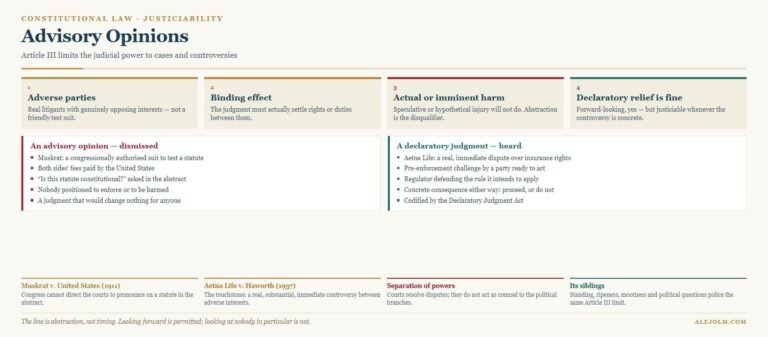 Advisory Opinions: Article III and Declaratory Relief
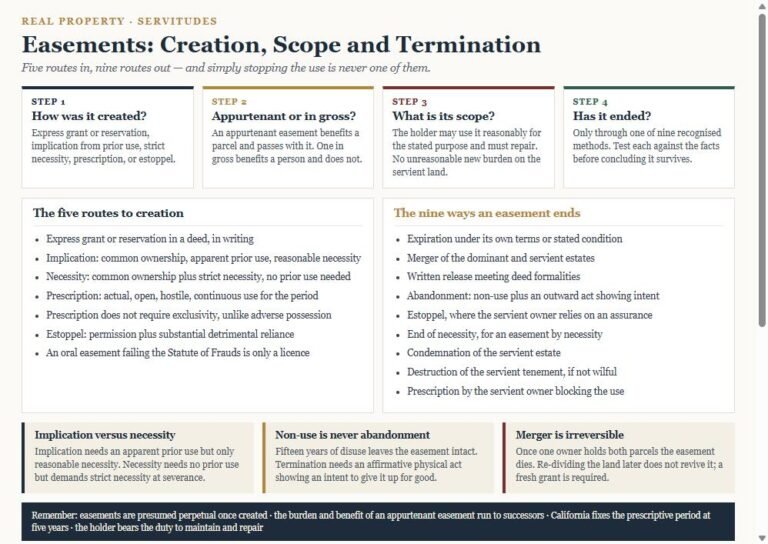 Easements Explained: Creation, Scope and Termination
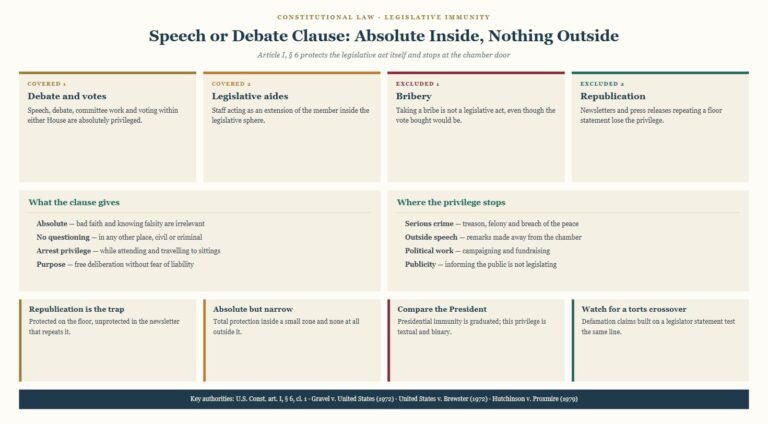 Speech or Debate Clause: Absolute but Narrow Immunity
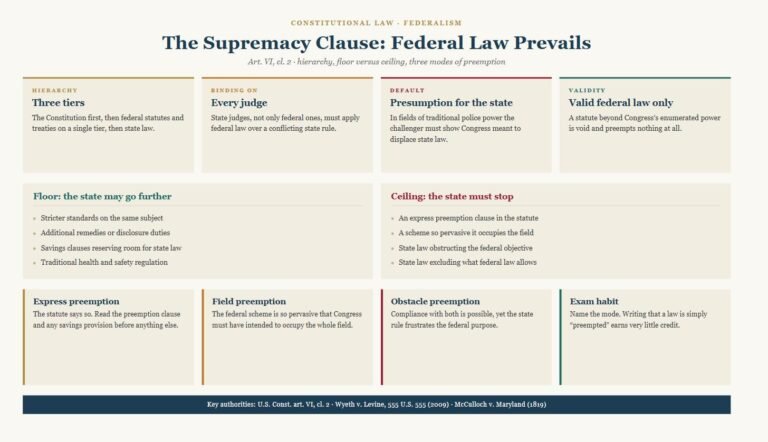 The Supremacy Clause: Floors, Ceilings and Preemption
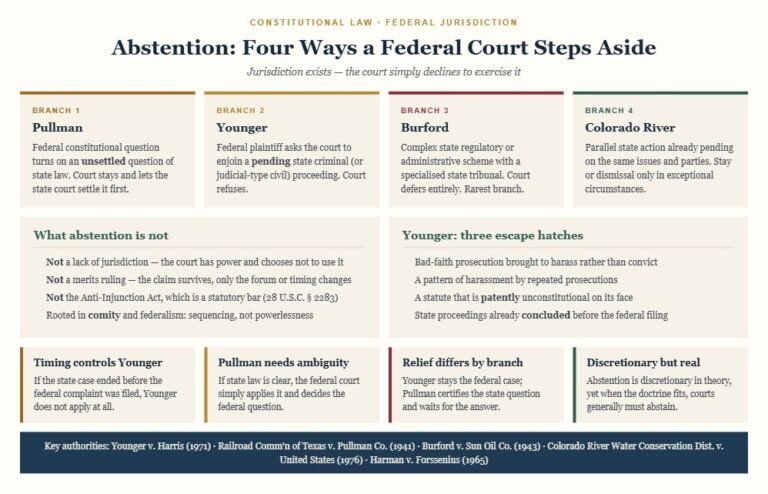 Abstention Doctrine: 4 Ways Federal Courts Step Aside
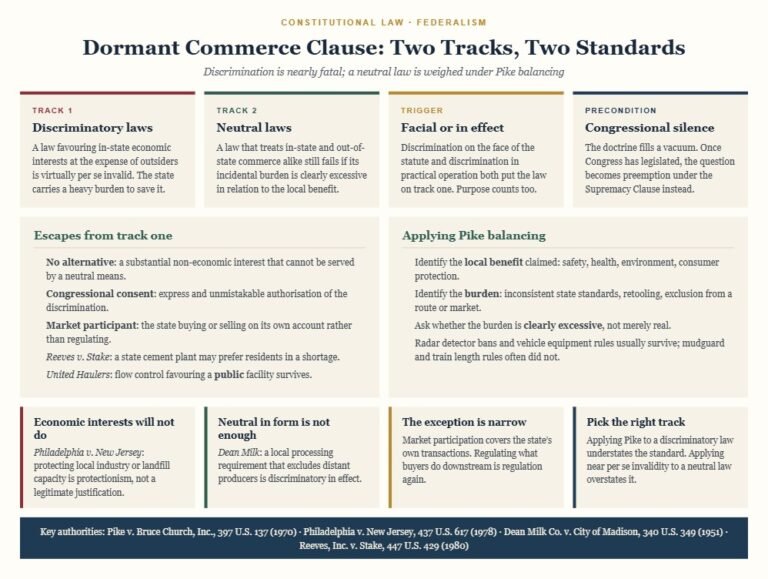 Dormant Commerce Clause: Discrimination vs Pike Balancing
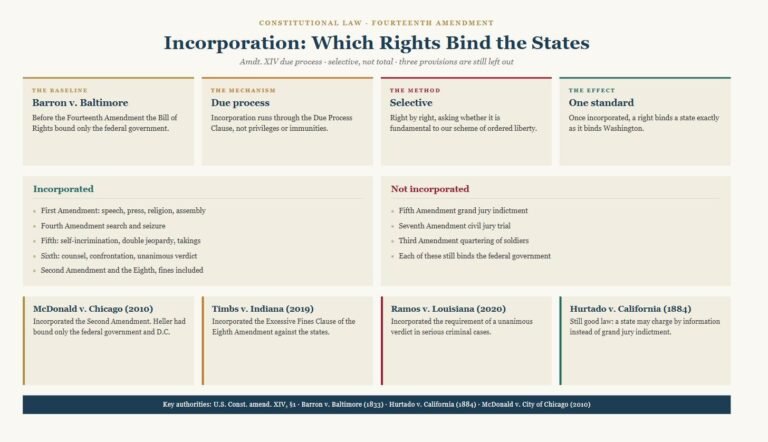 Incorporation Doctrine: Which Rights Bind the States
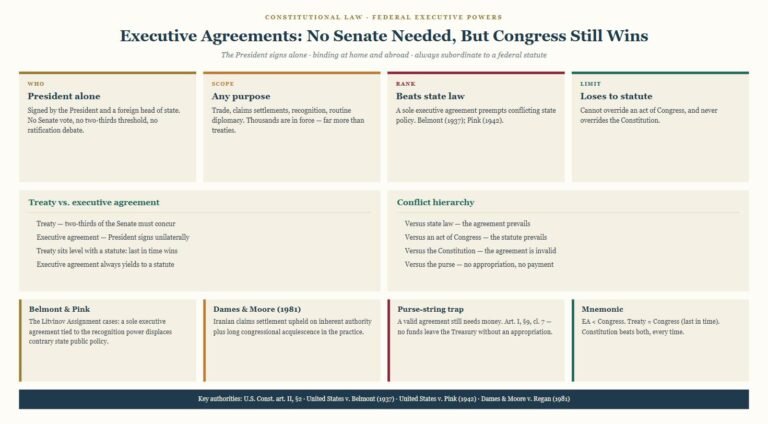 Executive Agreements: The President’s Sole Foreign Power
 Marbury v. Madison and the Power of Judicial Review
 Full Faith and Credit: Recognising Sister-State Judgments
 The Spending Power and the Five Dole Test Conditions
 Bicameralism and Presentment: Two Vetoes Struck Down