
Federal question jurisdiction is the gateway most litigants assume is wide open and most often find closed. Section 1331 of title 28 lets district courts hear civil actions “arising under” the Constitution, laws or treaties of the United States. The phrase sounds generous. The rule courts built on top of it is not.
This guide walks through the well-pleaded complaint rule, the narrow Grable exception, the complete preemption doctrine, and the strategic consequences for plaintiffs who would rather stay in state court. It ends with how the question plays out between the Los Angeles Superior Court and the Central District of California in 2026.
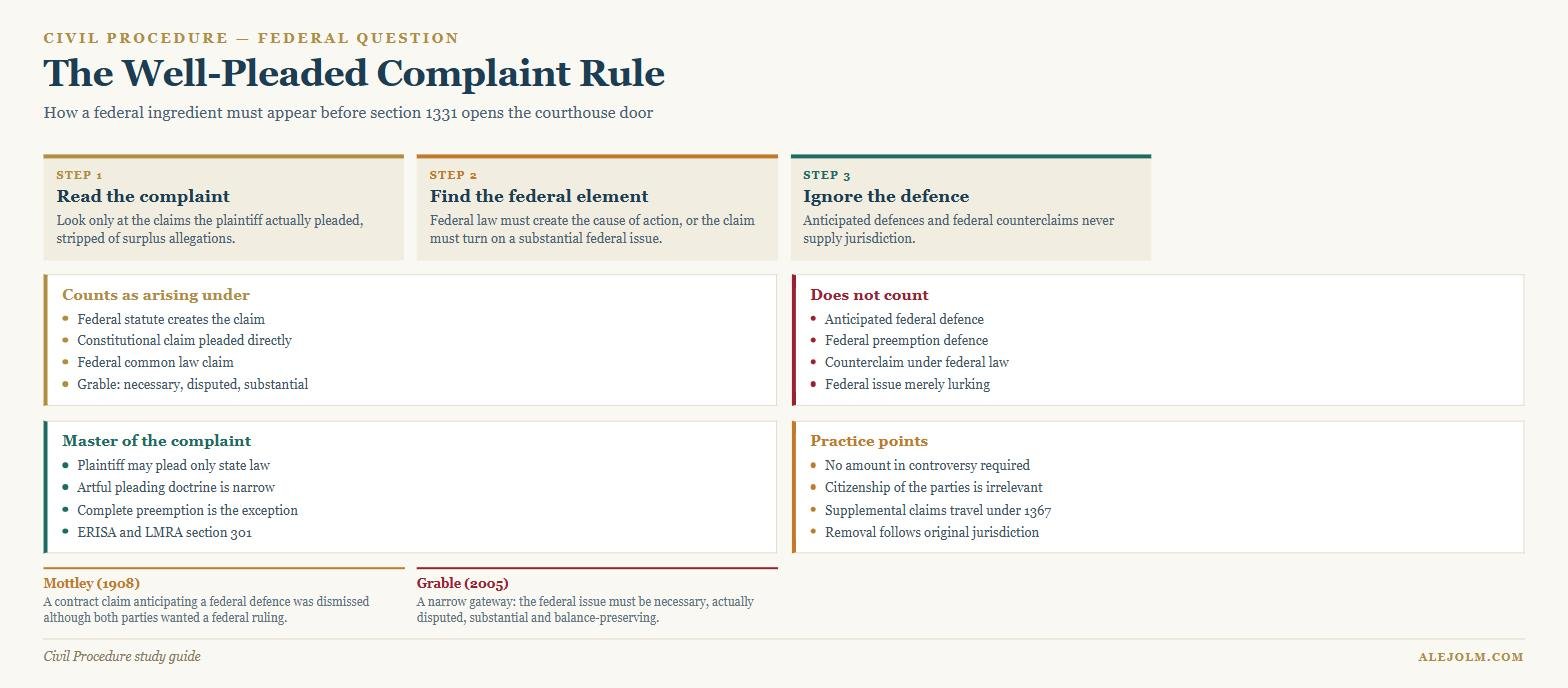
The well-pleaded complaint rule
Louisville & Nashville R.R. v. Mottley (1908) remains the cleanest illustration. The Mottleys sued a railroad for reneging on lifetime passes, expecting the railroad to defend by pointing to a new federal statute banning free passes. Both sides wanted a federal ruling. The Supreme Court dismissed for want of jurisdiction anyway, because the federal question lived in the anticipated defence rather than in the claim.
The operating instruction is mechanical. Take the complaint. Strip out everything that is not part of the plaintiff’s own cause of action — background, anticipated defences, rhetorical flourishes. What remains must contain a federal ingredient. If it does not, section 1331 is unavailable no matter how much federal law will eventually dominate the case.
When does a claim arise under federal law?
The ordinary route
In the overwhelming majority of cases the answer is supplied by American Well Works v. Layne & Bowler (1916): a suit arises under the law that creates the cause of action. A claim under Title VII, section 1983, the Sherman Act, the Lanham Act or the Securities Exchange Act qualifies immediately. No amount in controversy is required and the citizenship of the parties is irrelevant.
The narrow route
A state-law claim can occasionally qualify. Grable & Sons Metal Products v. Darue Engineering (2005) requires four things at once: the federal issue must be necessarily raised, actually disputed, substantial to the federal system as a whole, and capable of resolution in federal court without disturbing the congressionally approved balance between state and federal responsibilities. Gunn v. Minton (2013) shows how demanding the third and fourth elements are — a legal malpractice claim embedded in patent law failed because the federal interest was backward-looking and case-specific.
Complete preemption
A handful of federal statutes so thoroughly occupy their field that any claim within their scope is federal from birth, whatever label the plaintiff uses. Section 301 of the Labor Management Relations Act, section 502(a) of ERISA and sections 85 and 86 of the National Bank Act are the recognised examples. This is a jurisdictional doctrine and must not be confused with ordinary preemption, which is a defence and does not support removal.
Plaintiff as master of the complaint
Because the rule looks only at the pleading, a plaintiff who prefers a state forum may simply decline to plead the federal theory. Courts respect that choice; the artful pleading doctrine lets a judge look past the label only where the claim is completely preempted or where federal law is genuinely essential. This is why so many employment, consumer and civil rights complaints filed in state court contain no reference to federal statutes at all.
Federal question and diversity compared
| Feature | Federal question |
|---|---|
| Statute | 28 U.S.C. § 1331 |
| Amount in controversy | None |
| Citizenship of parties | Irrelevant |
| Source of the claim | Federal law, or Grable |
| Forum defendant rule on removal | Does not apply |
| Law applied to the merits | Federal |
A worked example
A Los Angeles delivery driver sues a logistics company in superior court for unpaid wages under the California Labor Code and for wrongful termination in violation of public policy. The employer plans to argue that the federal Motor Carrier Act preempts the state meal-break rules and removes the case.
Removal fails. The complaint pleads only state law, and preemption under the Motor Carrier Act is ordinary preemption — a defence, not complete preemption. Under the well-pleaded complaint rule there is no federal question on the face of the pleading, so the district court must remand. The employer keeps the preemption argument, but litigates it before a state judge.
Federal question jurisdiction in California and Los Angeles County in 2026
Two features of California practice make this doctrine unusually consequential in Los Angeles. The first is concurrent jurisdiction: state courts of general jurisdiction must entertain federal claims unless a valid excuse exists, a rule running from Testa v. Katt (1947) through Haywood v. Drown (2009). A section 1983 claim can be filed in the Stanley Mosk Courthouse and tried by a Los Angeles jury without ever touching the federal system, and Felder v. Casey (1988) blocks a state from burdening that claim with its own notice-of-claim conditions.
The second is the sheer overlap between California and federal employment, housing and civil rights statutes. A Los Angeles plaintiff can almost always choose between the Fair Employment and Housing Act and Title VII, between the Unruh Civil Rights Act and the Americans with Disabilities Act, between the Bane Act and section 1983. Because those state statutes are frequently more generous, plaintiff-side firms in Los Angeles routinely plead the state theory alone, keep the case in the superior court, and rely on the well-pleaded complaint rule to defeat removal to the Central District of California.
Getting that strategy right requires attention to detail. Practical points for Los Angeles filings in 2026:
- Do not quote federal statutes decoratively. A stray reference to Title VII inside a FEHA cause of action gives a removing defendant an argument it should never have had.
- Separate exhaustion tracks. A right-to-sue letter from the California Civil Rights Department supports the state claim; an EEOC letter supports the federal one. Attaching the wrong exhibit can suggest a federal claim was intended.
- Treat preemption as a defence. Motor Carrier Act, FAA and NLRA preemption arguments belong in a demurrer or motion for judgment, not in a notice of removal.
- Know the completely preempted statutes. ERISA section 502(a) and LMRA section 301 really do convert state claims into federal ones, and Los Angeles benefit and union disputes hit both regularly.
- Watch the thirty-day clock in both directions. A defendant has thirty days from the paper that first shows removability; a plaintiff has thirty days from removal to move to remand for anything other than a jurisdictional defect.
- Ask for fees on an improper removal. Section 1447(c) allows costs and fees where removal lacked an objectively reasonable basis, and Central District judges do award them.
For 2026, the practical question in Los Angeles is rarely whether a federal question exists in the abstract. It is whether the pleading you filed put one on the page. Read your own complaint the way a removal lawyer will. Continue with subject matter jurisdiction, federal preemption and the Supremacy Clause.
Common mistakes to avoid
- Reading the answer. Jurisdiction is tested on the complaint alone, before any responsive pleading exists.
- Counting a counterclaim. Holmes Group v. Vornado (2002) confirms that a federal counterclaim does not create arising-under jurisdiction.
- Stretching Grable. Most embedded federal issues are case-specific and fail the substantiality element.
- Confusing the two preemptions. Ordinary preemption defeats a claim; complete preemption relocates it.
- Forgetting supplemental claims. Once a federal claim anchors the case, section 1367 usually carries the related state claims along with it.
Frequently asked questions
Does the federal question have to be the main issue in the case?
No. It only has to appear in a claim the plaintiff pleaded. A single federal cause of action can anchor a case dominated by state-law issues, which then travel under supplemental jurisdiction.
Can a state court decide a federal claim?
Yes. State courts have concurrent jurisdiction over most federal claims and must hear them absent a neutral and valid excuse. Only a few statutes give the federal courts exclusive jurisdiction.
What is the difference between arising under in Article III and in section 1331?
Article III reaches any case in which federal law forms an ingredient, which is broader. Section 1331 has been read much more narrowly, and it is the statute that controls in the district court.
Is there an amount in controversy requirement?
No. Congress removed it in 1980, so a federal claim worth a few hundred dollars still supports section 1331 jurisdiction.
What happens if the federal claim is dismissed early?
The court may decline supplemental jurisdiction over the remaining state claims under section 1367(c)(3) and remand or dismiss them, which is the usual outcome when dismissal comes before substantial proceedings.
Related guides
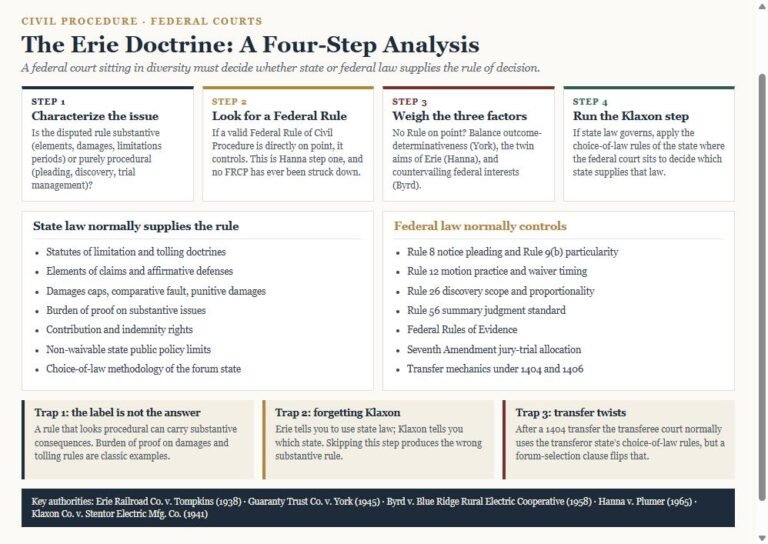 The Erie Doctrine Explained: A 4-Step Bar Exam Guide
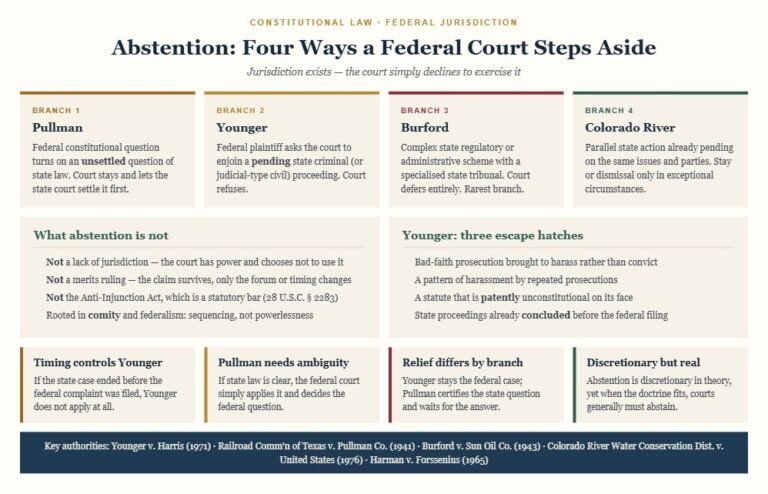 Abstention Doctrine: 4 Ways Federal Courts Step Aside
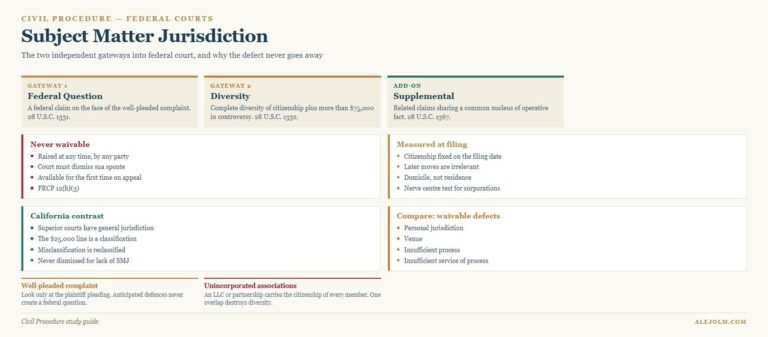 Subject Matter Jurisdiction in Federal Court Explained
 Personal Jurisdiction: The 3-Step Bar Exam Framework
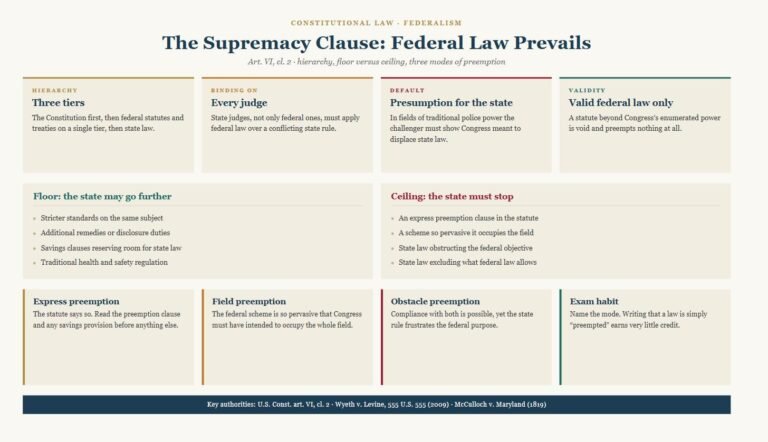 The Supremacy Clause: Floors, Ceilings and Preemption
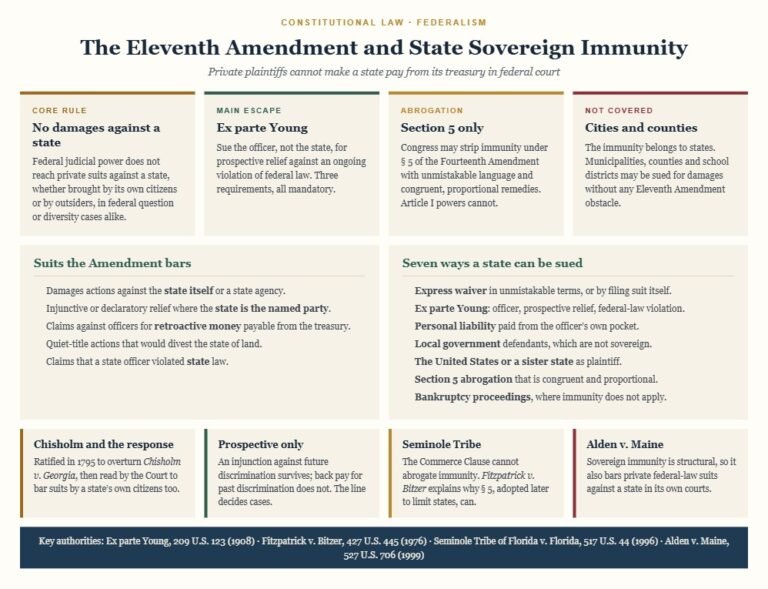 The Eleventh Amendment and State Sovereign Immunity
- Standing in Federal Court: The 3-Part Article III Test
- The Commerce Clause: 3 Categories and 2 Hard Limits
- Access to the Courts: When Filing Fees Are Unconstitutional
- Federal Preemption: The Three-Step Ladder Explained
- The IRAC Method: How to Structure a Bar Exam Answer
Next steps
Once you can spot a federal question on the face of a complaint, move to the second gateway. Diversity jurisdiction asks about the parties rather than the claim, and it comes with a citizenship calculation that trips up more filings than any other rule in civil procedure.