
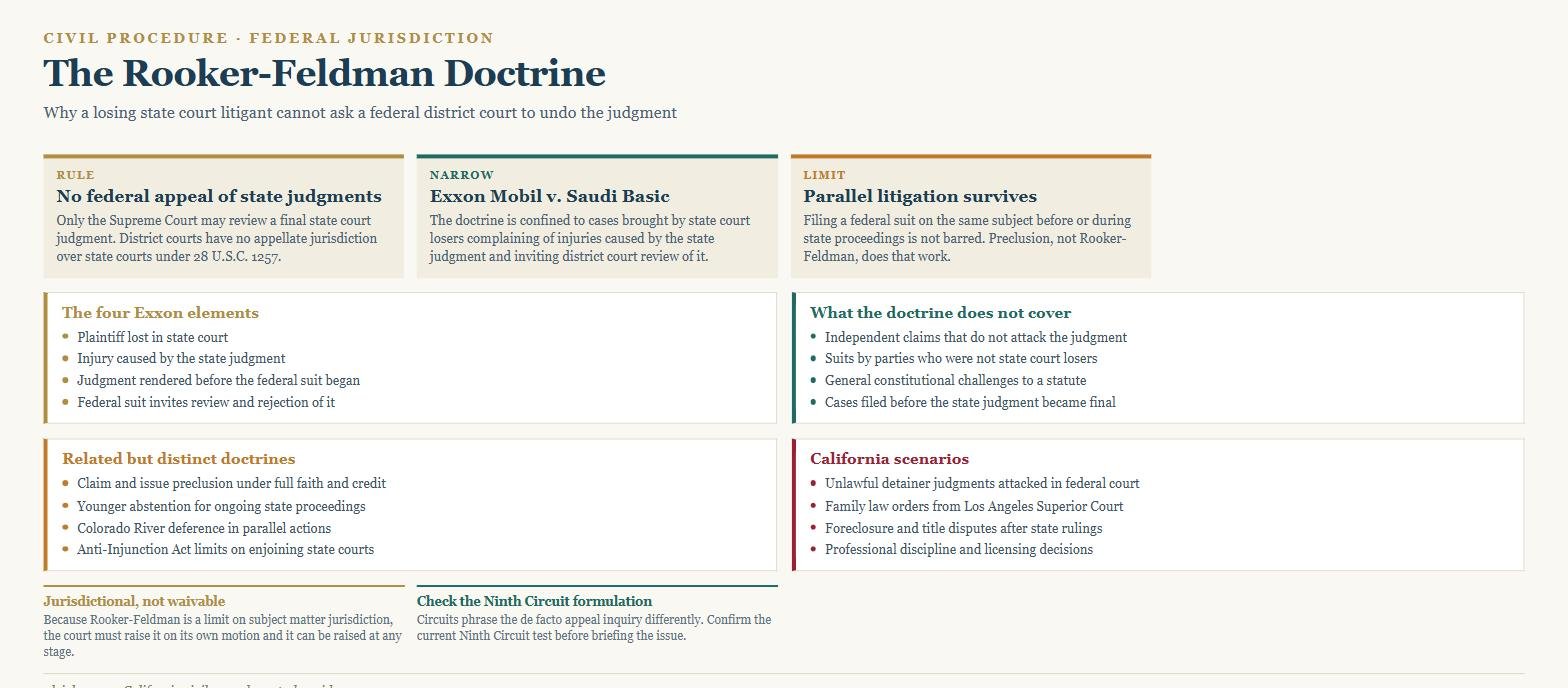
The Rooker-Feldman doctrine is the rule that a party who loses in state court cannot turn around and file a federal district court case asking to have the state judgment set aside. Congress gave appellate review of final state judgments to the Supreme Court alone under 28 U.S.C. section 1257, and a district court that entertained such a challenge would be acting as an appellate court it has no authority to be.
For decades the doctrine was applied far more broadly than that description suggests, sweeping in any federal claim that was in some way entangled with prior state litigation. The Supreme Court put a stop to that, and the modern doctrine is narrow. Understanding exactly how narrow is what separates a viable federal filing from a jurisdictional dismissal.
The two cases behind the name
Rooker v. Fidelity Trust Co. in 1923 involved parties who had lost in the Indiana courts and then sued in federal district court to have the judgment declared void. The Court held that no federal court other than the Supreme Court had power to reverse or modify the state judgment. District of Columbia Court of Appeals v. Feldman in 1983 applied the same principle to bar applicants challenging individual bar admission decisions, while allowing a general challenge to the rule itself to proceed.
That last distinction is the doctrine in miniature. Attacking the judgment entered against you is barred. Attacking the rule or statute in general terms, in a way that does not require the federal court to undo any particular judgment, is not.
Exxon Mobil and the four elements
Exxon Mobil Corp. v. Saudi Basic Industries Corp. in 2005 sharply curtailed the doctrine, describing it as confined to cases brought by state court losers complaining of injuries caused by state court judgments rendered before the district court proceedings commenced and inviting district court review and rejection of those judgments. Lower courts have distilled that sentence into four elements, all of which must be present.
- State court loser: the federal plaintiff must have been a losing party in the earlier state proceeding.
- Injury caused by the judgment: the harm must flow from the judgment itself, not from independent conduct by the defendant.
- Timing: the state judgment must have been rendered before the federal action was filed.
- Invitation to review: the federal suit must effectively ask the district court to reject or nullify the state ruling.
Fail any one of these and the doctrine does not apply. That does not mean the federal case survives, because preclusion may still bar it, but the analysis is different and the outcome sometimes is too.
The independent claim exception
The most important escape hatch is the independent claim. If the federal plaintiff alleges an injury caused by the defendant’s own wrongful conduct rather than by the judgment, Rooker-Feldman does not apply even if the state court considered and rejected the same theory. A plaintiff who says a lender committed fraud is asserting an independent claim; a plaintiff who says the foreclosure judgment was wrongly entered and should be voided is not.
Courts draw this line by asking what relief would actually require. If granting the federal remedy would necessarily mean the state judgment was erroneous and must be undone, the claim is a de facto appeal. If the federal remedy can coexist with the state judgment standing, the claim is independent.
| Scenario | Rooker-Feldman applies? |
|---|---|
| Suit to vacate a state foreclosure judgment | Yes |
| Fraud claim against the lender for its own conduct | No |
| Federal suit filed before the state judgment issued | No |
| Non-party challenges a judgment affecting its interests | No |
| Facial constitutional challenge to a state rule | No |
| Relitigating an issue the state court decided | No |
A worked example
A tenant loses an unlawful detainer trial in the Los Angeles Superior Court and is evicted. She then files a federal action against the landlord alleging that the eviction was racially motivated in violation of the Fair Housing Act and section 1982, seeking damages but not possession of the unit and not asking that the unlawful detainer judgment be vacated.
Rooker-Feldman should not bar this case. The claimed injury is the landlord’s discriminatory conduct, not the judgment itself, and damages can be awarded without disturbing the eviction order. Had she instead asked the district court to set aside the unlawful detainer judgment and restore her tenancy, all four Exxon elements would be present and dismissal for lack of subject-matter jurisdiction would follow. Note that the landlord will almost certainly raise issue preclusion as to any fact actually litigated in the unlawful detainer trial, which is a separate and frequently successful defence.
The Rooker-Feldman Doctrine in California and Los Angeles County in 2026
The Ninth Circuit applies Rooker-Feldman through a de facto appeal framework: the district court first asks whether the federal action is in substance an appeal from the state judgment, and only if it is does the court also refuse to hear issues inextricably intertwined with that appeal. Because Los Angeles Superior Court is the largest trial court in the United States, an enormous volume of state judgments feeds into the Central District of California, and Rooker-Feldman motions appear constantly.
The recurring fact patterns are predictable. Unlawful detainer defendants file federal civil rights actions after losing possession. Homeowners attack non-judicial foreclosures after a state court has already ruled. Parties dissatisfied with family law orders from the Stanley Mosk Courthouse seek federal due process relief. Licensees disciplined by a state board look to the district court after an adverse administrative mandamus ruling under Code of Civil Procedure section 1094.5.
In most of these cases the correct route is not a new federal action at all. It is a timely appeal within the California appellate system, followed if necessary by a petition for certiorari to the Supreme Court. California unlawful detainer appeals go to the Appellate Division of the Superior Court, and civil appeals from Los Angeles County go to the Second District Court of Appeal. Missing those deadlines cannot be cured by refiling in federal court.
- De facto appeal test: the Ninth Circuit asks first whether the suit is in substance an appeal from the state ruling.
- Section 1094.5: administrative mandamus in Superior Court is the California route to review agency decisions, not a federal filing.
- Unlawful detainer appeals: go to the Appellate Division of the Los Angeles Superior Court on a short deadline.
- Preclusion runs in parallel: full faith and credit gives California judgments the same effect in federal court that they have in state court.
- Raise it early: the doctrine is jurisdictional, so the court can and will consider it sua sponte.
- Plead independent injury clearly: identify the defendant’s own conduct, separate from the judgment, in the complaint itself.
For 2026, confirm the current Ninth Circuit formulation of the de facto appeal test before briefing, since the phrasing has been refined more than once, and check the current California appellate deadlines, which differ sharply between limited and unlimited civil cases. See also full faith and credit, res judicata and collateral estoppel and limited versus unlimited civil cases.
Common mistakes to avoid
- Treating Rooker-Feldman as a preclusion doctrine. It is a limit on jurisdiction; preclusion is an affirmative defence with different rules and different exceptions.
- Applying it to parallel litigation. Exxon Mobil confirmed that a federal case filed before the state judgment is unaffected.
- Ignoring the non-party rule. Someone who was not a party to the state case is not a state court loser and is not barred.
- Dressing up an appeal as a civil rights claim. Courts look at the substance of the relief sought, not the labels in the caption.
- Forgetting that it is jurisdictional. It cannot be waived, conceded or forfeited, and it can surface for the first time on appeal.
Frequently asked questions
What does the Rooker-Feldman doctrine actually prohibit?
It prohibits a federal district court from hearing a case brought by someone who lost in state court, where the injury complained of was caused by the state judgment and the relief sought would require rejecting that judgment.
Is Rooker-Feldman the same as res judicata?
No. Rooker-Feldman removes the district court’s subject-matter jurisdiction entirely, while res judicata is a defence that a party must raise and can waive.
Can I file in federal court while my state case is still pending?
Rooker-Feldman does not bar it, because no judgment has been rendered. However, Younger abstention or Colorado River deference may still cause the federal court to stay or dismiss.
Does the doctrine apply to state administrative decisions?
Generally not to the agency decision itself, but once a California court reviews the agency by administrative mandamus, the resulting judgment can trigger the doctrine.
What should I do instead if I lost in state court?
Pursue the state appellate remedy on time, and if a federal question was properly raised and preserved, petition the United States Supreme Court for certiorari.
Related guides
- Full Faith and Credit: Recognising Sister-State Judgments
- Res Judicata vs Collateral Estoppel: Bar Exam Guide
- Abstention Doctrine: 4 Ways Federal Courts Step Aside
- Subject Matter Jurisdiction in Federal Court Explained
- Removal and Remand: Moving a Case to Federal Court
- The Final Judgment Rule and Interlocutory Appeal Routes
- Limited vs Unlimited Civil Cases in California Courts
- Federal Question Jurisdiction and the Well-Pleaded Rule
- Diversity Jurisdiction: Citizenship and Amount Rules
- The Erie Doctrine Explained: A 4-Step Bar Exam Guide
- Minimum Contacts and Due Process in California Courts
Next steps
Compare the jurisdictional bar with the preclusion rules in res judicata and collateral estoppel, and read the abstention doctrines for the situations where a federal court declines to act even though it has jurisdiction. Ninth Circuit opinions are published by the United States Court of Appeals for the Ninth Circuit, and California appellate procedure is set out by the California Courts.