

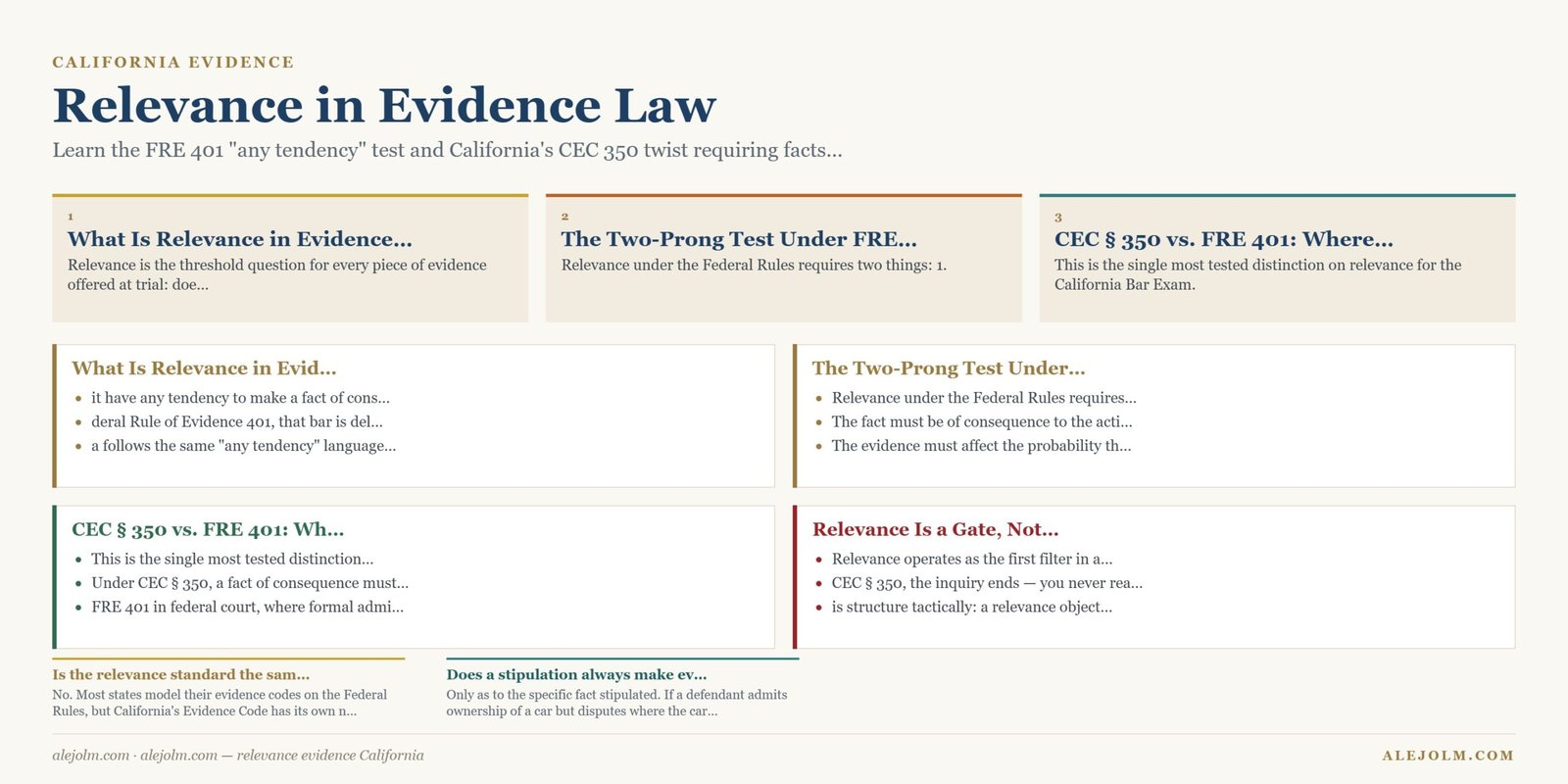
What Is Relevance in Evidence Law?
Relevance is the threshold question for every piece of evidence offered at trial: does it have any tendency to make a fact of consequence more or less probable than it would be without the evidence? Under Federal Rule of Evidence 401, that bar is deliberately low — a single brick doesn’t need to prove the whole wall. California follows the same “any tendency” language in Evidence Code § 350, but adds a wrinkle federal law doesn’t have.
If you’re studying for the California Bar Exam, relevance looks like the easiest topic in the Evidence subject. It isn’t. Examiners love it precisely because students assume it’s simple and skip past the one place California diverges from the Federal Rules.
The Two-Prong Test Under FRE 401
Relevance under the Federal Rules requires two things:
- The fact must be of consequence to the action under the applicable substantive law.
- The evidence must affect the probability that the fact is true.
Neither prong requires conclusive proof. Evidence that only slightly increases or decreases the likelihood of a fact still clears FRE 401. That’s the point of the “any tendency” standard — it screens out evidence with zero logical connection to the case, not evidence that merely fails to win the case by itself.
CEC § 350 vs. FRE 401: Where California Diverges
This is the single most tested distinction on relevance for the California Bar Exam. Under CEC § 350, a fact of consequence must also be in dispute. If a party has formally admitted or stipulated to a fact, evidence relating to that fact is no longer relevant in California — even though the same evidence would still satisfy FRE 401 in federal court, where formal admissions don’t remove a fact from the relevance analysis the same way.
| Feature | Federal Rule (FRE 401) | California (CEC § 350) |
|---|---|---|
| Core test | Any tendency to make a fact more/less probable | Same “any tendency” language |
| Fact must be “of consequence” | Yes | Yes |
| Fact must be “in dispute” | No — stipulations don’t remove relevance | Yes — an admitted fact becomes irrelevant |
| Effect of a party’s stipulation | Evidence may still be offered; FRE 403 governs | Evidence is excluded as irrelevant, not just discretionarily limited |
| Companion prejudice rule | FRE 403 | CEC § 352 (nearly identical language) |
The practical consequence: in a California case, once a defendant stipulates to owning a vehicle, evidence about that ownership becomes inadmissible as irrelevant. A federal prosecutor facing the same stipulation could still offer the evidence and rely on FRE 403 balancing instead. On a multiple-choice question, this is exactly the kind of trap that separates a passing answer from a failing one.
Relevance Is a Gate, Not a Guarantee
Relevance operates as the first filter in any admissibility analysis. If evidence fails FRE 401 or CEC § 350, the inquiry ends — you never reach hearsay, privilege, authentication, or character-evidence rules. Trial lawyers use this structure tactically: a relevance objection, if it succeeds, avoids the need to fight a harder battle later.
When you draft a bar exam essay answer on Evidence, start every analysis with: “Is the evidence relevant under FRE 401 / CEC § 350?” If it’s not, say so and move on — don’t waste time discussing hearsay exceptions for evidence that was never going to get in the door.
Relevant but Still Excludable: FRE 403 and CEC § 352
Passing the relevance threshold doesn’t guarantee admission. Under FRE 403, a judge may exclude relevant evidence if its probative value is substantially outweighed by the danger of unfair prejudice, confusion of the issues, misleading the jury, undue delay, or needless cumulative evidence. California’s § 352 uses nearly identical language.
The key word is “substantially.” General prejudice — the fact that evidence hurts your opponent’s case — is not enough. Every piece of effective evidence is prejudicial in that broad sense. The rule targets unfair prejudice: evidence that invites a decision on an improper basis, like pure emotion or propensity reasoning.
Worked Example: The Borrowed-Money Hypothetical
Dana is charged with embezzling $40,000 from her employer, Coastal Realty. Her defense is that she had the owner’s consent to move the funds. The prosecution wants to introduce evidence that five years earlier, Dana borrowed $2,000 from her brother and never repaid him.
Walk through the analysis:
- Fact of consequence: Whether Dana had consent to move the funds — the borrowed-money evidence doesn’t speak to consent directly.
- Any tendency: The prosecution might argue it shows a pattern of taking money without repayment, but the connection between a personal loan from a family member and workplace embezzlement is thin.
- In dispute (California only): If Dana has stipulated that she moved the funds and only disputes consent, evidence about the movement of funds is now irrelevant in California, even though it might still clear FRE 401 federally.
- Conclusion: The evidence is likely excluded — the link to any fact of consequence is too speculative, and if offered to suggest Dana is generally untrustworthy with money, it edges toward improper propensity reasoning.
A strong exam answer names the specific fact of consequence, explains the probability link (or its absence), and — if the jurisdiction is California — flags the “in dispute” requirement explicitly.
Common Mistakes to Avoid
- Treating “relevant” and “admissible” as synonyms. Relevant evidence can still be excluded by FRE 403/CEC § 352, hearsay, privilege, or other rules.
- Skipping the CEC § 350 “in dispute” requirement on a California fact pattern. This is the most commonly missed point on relevance questions.
- Failing to name the specific fact of consequence. “This is relevant to credibility” is not an analysis — identify exactly what fact the evidence makes more or less probable.
- Confusing “prejudicial” with “excludable.” The standard requires that probative value be substantially outweighed by unfair prejudice, not merely that some prejudice exists.
FAQ
Is the relevance standard the same in every state?
No. Most states model their evidence codes on the Federal Rules, but California’s Evidence Code has its own numbering and its own additions, including the “in dispute” requirement in CEC § 350 that has no federal analogue.
Does a stipulation always make evidence irrelevant in California?
Only as to the specific fact stipulated. If a defendant admits ownership of a car but disputes where the car was parked at a given time, evidence about the car’s location remains relevant and in dispute.
Why does the bar exam test relevance so heavily?
Because it’s the analytical starting point for the entire Evidence subject. Examiners use it to test whether you understand the structure of admissibility analysis, not just isolated rules.
Key Takeaways
- FRE 401 and CEC § 350 share the same “any tendency” test, but California requires the fact of consequence to also be in dispute.
- Relevance is a threshold gate — if evidence fails it, you never reach hearsay, privilege, or other admissibility rules.
- Relevant evidence can still be excluded under FRE 403 or CEC § 352 if probative value is substantially outweighed by unfair prejudice.
- On California Bar Exam fact patterns, always check whether a stipulation has removed a fact from dispute before analyzing relevance further.
- Name the specific fact of consequence in your analysis — vague relevance claims lose points.
This article is educational and is not legal advice. Consult a licensed California attorney about your situation.
Related guides
- prior acts and habit evidence
- best evidence rule in California
- confrontation clause and hearsay
- negotiation and compromise offers