
A Charitable Trust Has No One Beneficiary — So Who Sues to Enforce It?
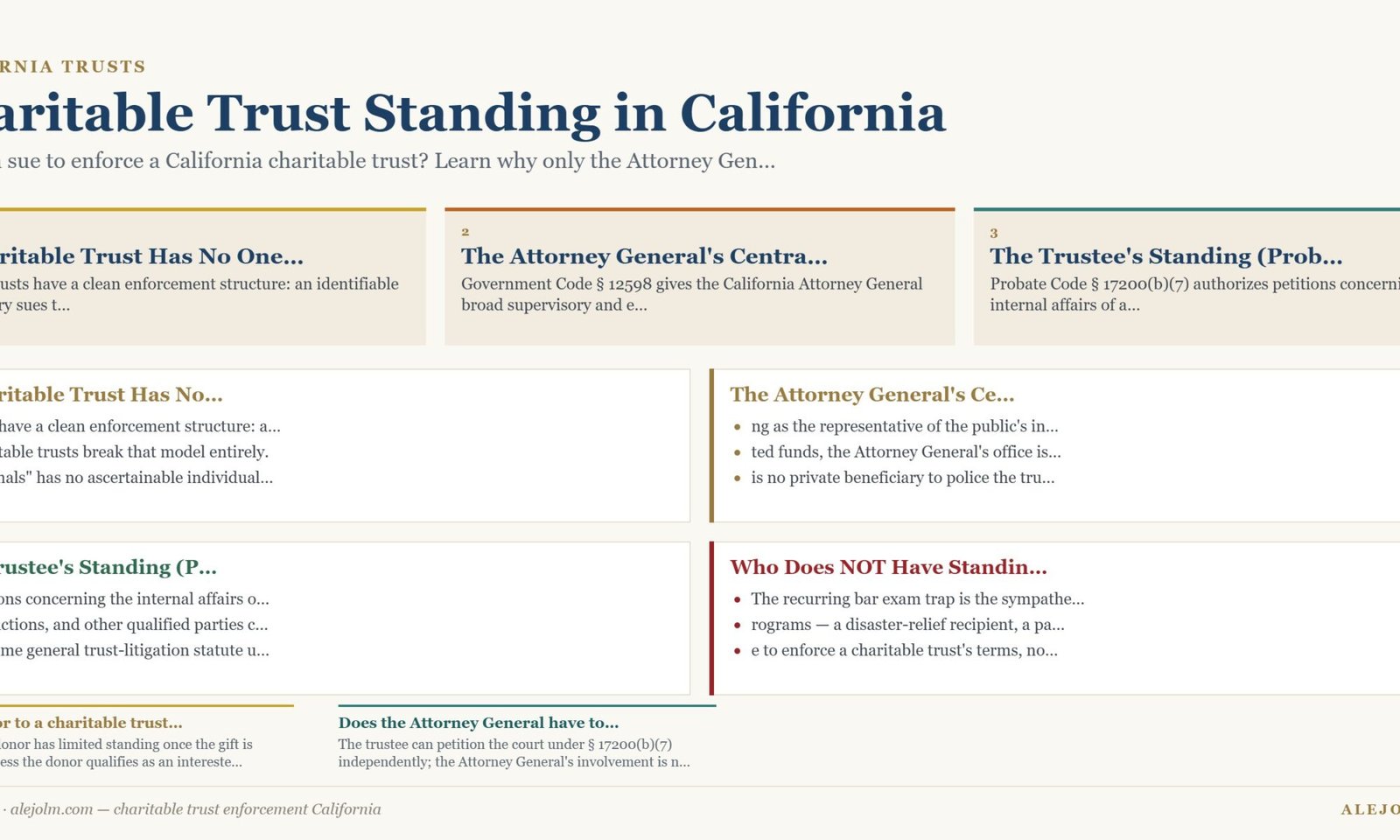
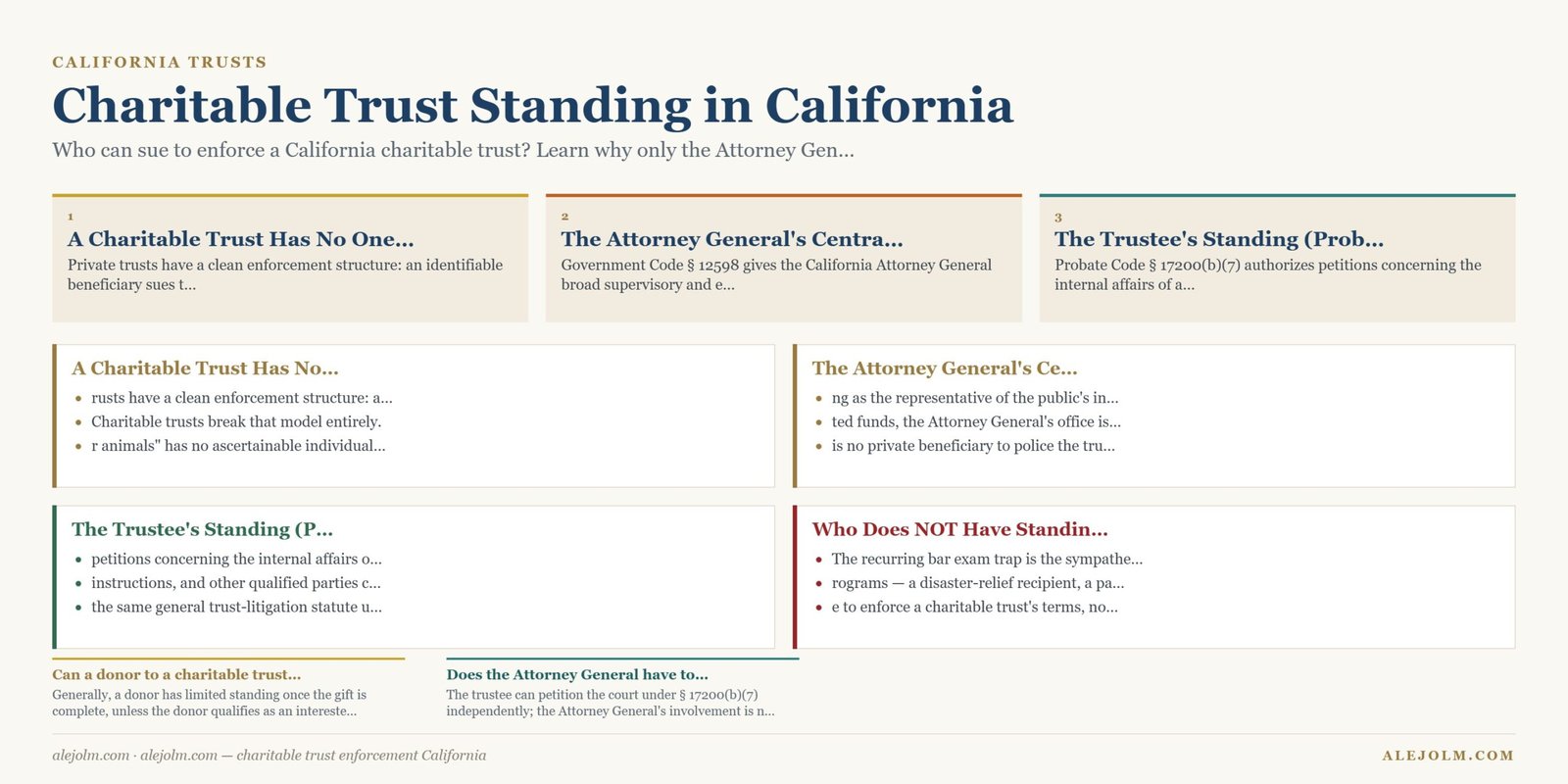
Private trusts have a clean enforcement structure: an identifiable beneficiary sues the trustee if something goes wrong. Charitable trusts break that model entirely. A trust “for the relief of disaster victims” or “for the care of shelter animals” has no ascertainable individual beneficiary, so ordinary beneficiary standing simply does not exist. California fills that gap with a specific statutory scheme.
Because a charitable trust lacks ascertainable beneficiaries, standing to enforce it rests on the California Attorney General (Gov. Code § 12598), the trustee, and qualified beneficiaries or other interested persons (Prob. Code § 17200(b)(7)) — not on members of the public who merely benefit incidentally.
The Attorney General’s Central Role (Gov. Code § 12598)
Government Code § 12598 gives the California Attorney General broad supervisory and enforcement powers over charitable trusts, acting as the representative of the public’s interest in seeing charitable assets used for their intended purposes. This is the primary enforcement mechanism for charitable trusts in California — when a charity misuses restricted funds, the Attorney General’s office is the expected plaintiff, not a random donor or member of the public.
This authority reflects the underlying theory of charitable trusts: because there is no private beneficiary to police the trustee, the state steps into that role on behalf of society generally.
The Trustee’s Standing (Prob. Code § 17200(b)(7))
Probate Code § 17200(b)(7) authorizes petitions concerning the internal affairs of a trust, including instructing and compelling the trustee to act. A trustee of a charitable trust can petition the court for instructions, and other qualified parties can petition to compel the trustee to comply with the trust’s terms. This is the same general trust-litigation statute used for private trusts, extended to charitable trust administration.
Qualified beneficiaries and other interested persons — a category that can include a co-trustee, a named charitable organization that is the intended recipient, or a person with a special interest distinguishable from the general public — may also have standing to petition under this framework.
Who Does NOT Have Standing: The Incidental Beneficiary
The recurring bar exam trap is the sympathetic plaintiff who lacks standing. A member of the public who happens to benefit from a charity’s programs — a disaster-relief recipient, a park visitor, a museum patron — is only an incidental beneficiary. Incidental beneficiaries generally cannot sue to enforce a charitable trust’s terms, no matter how directly they were affected by the charity’s misconduct.
The same trio that has standing to enforce a charitable trust generally — Attorney General, trustee, and charitable organization — also holds standing to invoke the cy pres doctrine when a charitable purpose becomes impossible or impracticable to carry out.
| Party | Standing to enforce? |
|---|---|
| California Attorney General | Yes — primary enforcement authority under Gov. Code § 12598 |
| Trustee | Yes — may petition under Prob. Code § 17200(b)(7) |
| Named charitable organization / qualified interested person | Yes, in appropriate circumstances |
| Incidental member of the public who benefits | No — lacks standing |
Worked Example
Wynn’s irrevocable trust directs a charity to spend trust income “solely on disaster relief.” Instead, the charity diverts most of the income to pay ordinary administrative overhead unrelated to disaster response. A local resident who once received disaster aid from the charity sues to force compliance.
The resident is an incidental beneficiary and lacks standing. The proper plaintiffs are the California Attorney General or the trustee, either of whom can sue to enforce the trust’s specific terms. On the merits, the diversion of income to overhead breaches the trust; funds diverted to non-charitable use, or any surplus that cannot be applied to the stated purpose, pass back to the settlor’s estate (or the estate’s residuary beneficiaries) by resulting trust, since the terms were not framed broadly enough to invoke cy pres for a mere change in how the money was spent rather than an impossibility of the underlying purpose.
Common Mistakes to Avoid
- Letting a sympathetic individual sue. No matter how directly a member of the public was affected, incidental beneficiaries lack standing under California law.
- Forgetting the Attorney General’s role. Many students default straight to “the trustee” and skip the Attorney General, who is often the primary or sole realistic plaintiff for a public charitable trust dispute.
- Confusing charitable trust standing with cy pres standing. They share the same trio of proper parties (AG, trustee, charitable organization), but standing to sue for breach and standing to invoke cy pres are conceptually distinct issues that should both be addressed if raised.
- Skipping the resulting trust analysis. Diverted or surplus charitable funds that cannot be redirected under cy pres often pass back by resulting trust — an easy point to miss after resolving standing.
Frequently Asked Questions
Can a donor to a charitable trust sue to enforce its terms after the gift is made?
Generally, a donor has limited standing once the gift is complete, unless the donor qualifies as an interested person under Prob. Code § 17200(b)(7) or the trust instrument reserves enforcement rights to the donor.
Does the Attorney General have to sue, or can the trustee act alone?
The trustee can petition the court under § 17200(b)(7) independently; the Attorney General’s involvement is not required for every internal-affairs petition, though the Attorney General typically must be notified of charitable trust proceedings and often participates.
What is the three-part test for a valid charitable trust in California?
Run through: (1) is there a recognized charitable purpose? (2) does the trust provide a public benefit? (3) who has standing to enforce it — the Attorney General, the trustee, and the charitable organization.
Key Takeaways
- California Gov. Code § 12598 gives the Attorney General primary enforcement authority over charitable trusts on behalf of the public.
- Prob. Code § 17200(b)(7) lets the trustee (and qualified interested persons) petition regarding a charitable trust’s internal affairs.
- Incidental beneficiaries — members of the public who merely benefit from a charity’s work — generally lack standing to sue.
- The same trio (Attorney General, trustee, charitable organization) that can enforce the trust also holds standing to invoke cy pres.
- Diverted or surplus charitable funds that cannot be redirected under cy pres typically revert by resulting trust.
This article is educational and is not legal advice. Consult a licensed California attorney about your situation.
Mostrando SEO-04-trusts.md.
Related guides
- trustee duties
- rule against perpetuities
- settlor’s creditors and the revocable trust
- self-settled asset protection trust