
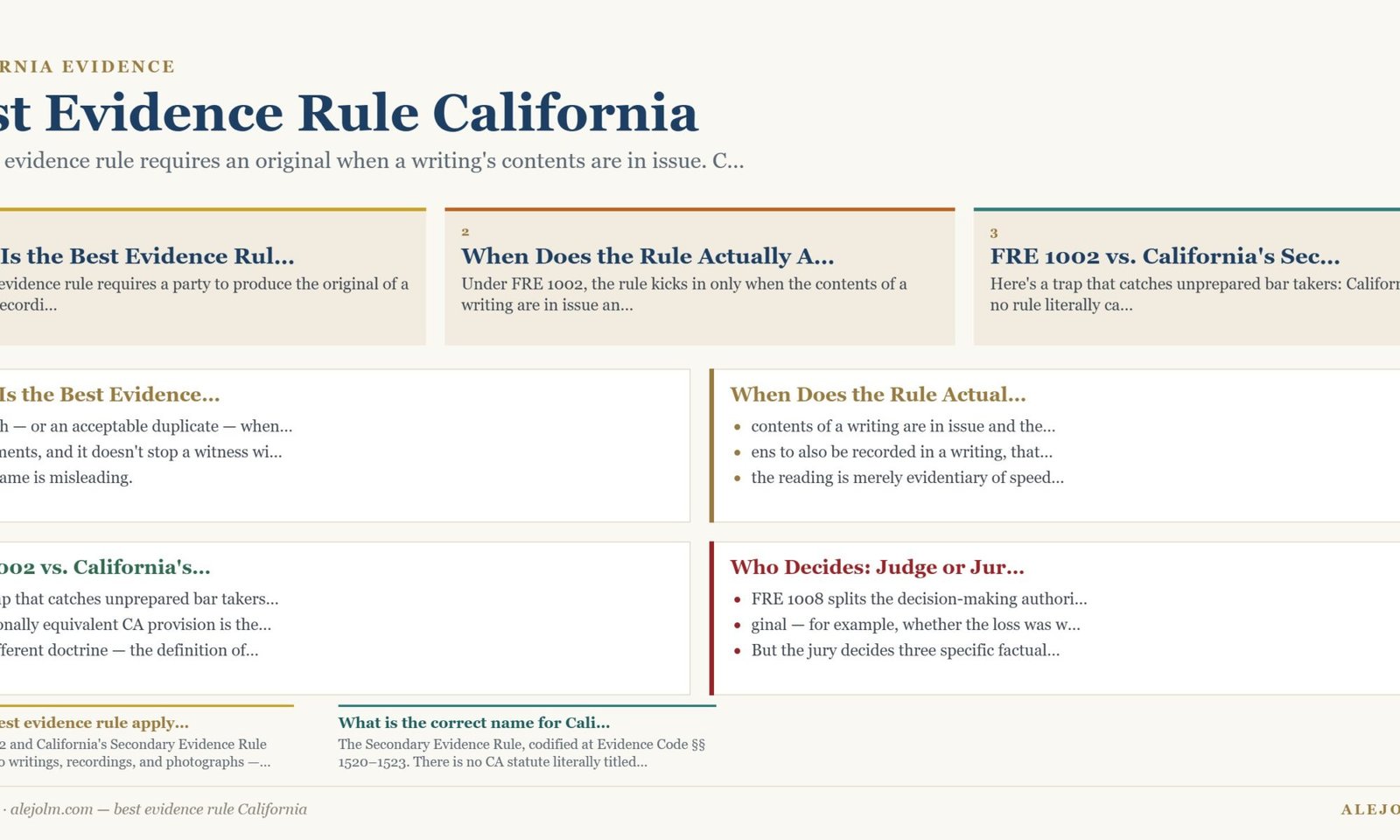
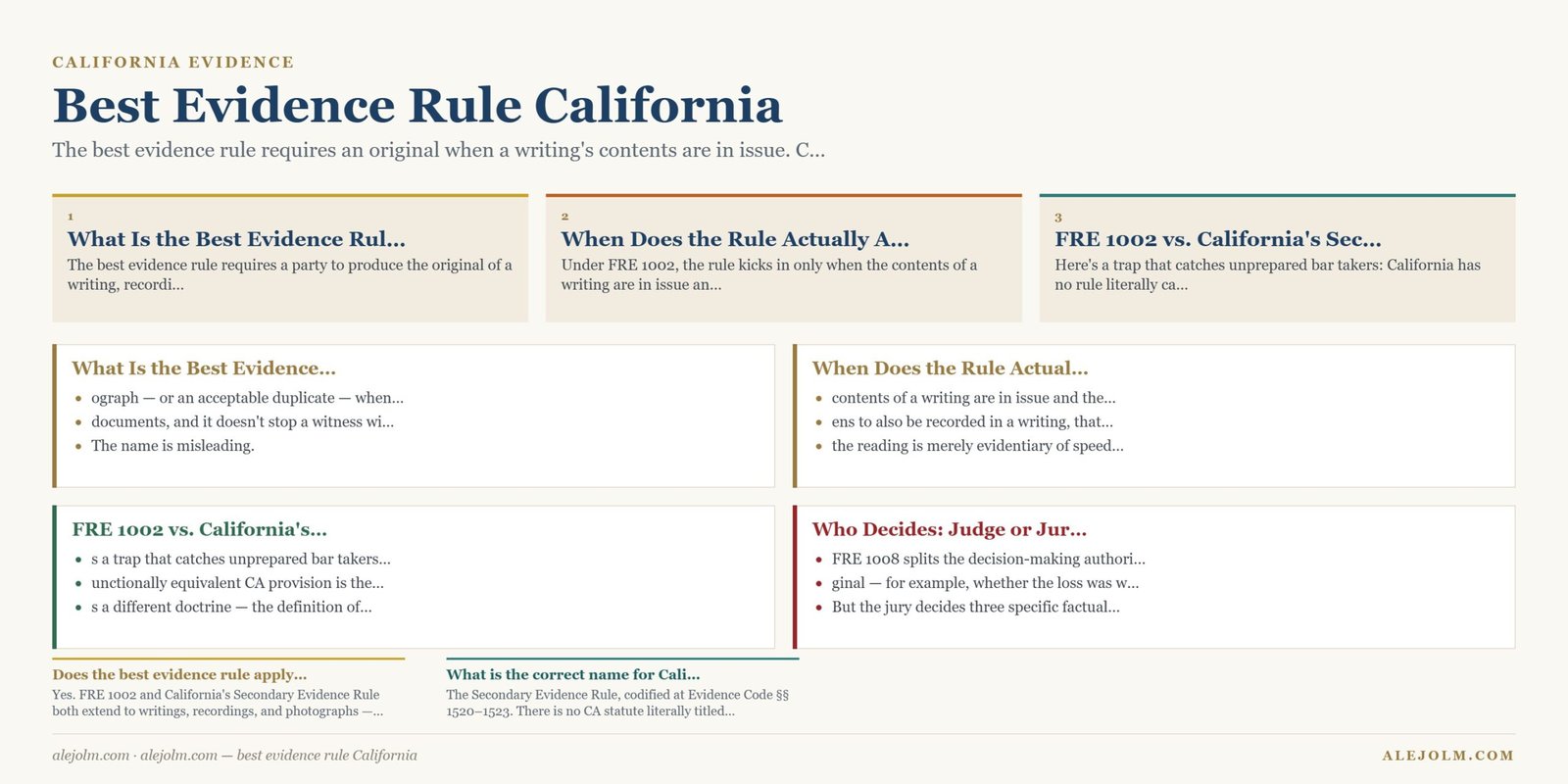
What Is the Best Evidence Rule?
The best evidence rule requires a party to produce the original of a writing, recording, or photograph — or an acceptable duplicate — when the contents of that document are actually in issue in the case. It doesn’t apply to collateral documents, and it doesn’t stop a witness with independent knowledge from simply testifying about what happened.
The name is misleading. Most students assume it means “the best possible evidence must always be used.” It doesn’t — it’s a narrow rule triggered only when a document’s specific language or content is disputed.
When Does the Rule Actually Apply?
Under FRE 1002, the rule kicks in only when the contents of a writing are in issue and the witness’s knowledge comes exclusively from the document itself. If a witness has independent personal knowledge of a fact that happens to also be recorded in a writing, that witness can testify from memory without ever producing the document.
Classic example: a police officer can testify to a speedometer reading from memory without producing the physical speedometer, because the reading is merely evidentiary of speed — the document (or device) isn’t itself the subject of the dispute. But if the parties are fighting over the exact wording of a contract clause, the original or an acceptable duplicate must be produced.
FRE 1002 vs. California’s Secondary Evidence Rule
Here’s a trap that catches unprepared bar takers: California has no rule literally called the “best evidence rule.” The functionally equivalent CA provision is the Secondary Evidence Rule, codified at Evidence Code §§ 1520–1523. (CEC § 1400 is a different doctrine — the definition of authentication — so don’t confuse it with the best evidence concept.)
| Feature | Federal Rule (FRE 1002–1004) | California (CEC §§ 1520–1523) |
|---|---|---|
| Statutory name | “Best Evidence Rule” | “Secondary Evidence Rule” |
| Duplicates | Presumptively admissible under FRE 1003, but can be challenged on authenticity grounds | Broadly admissible under § 1521, including handwritten copies (which FRE treats differently) |
| Bad-faith requirement for lost originals | Yes — FRE 1004(1) bars secondary evidence if loss/destruction resulted from proponent’s bad faith | No — California does not require a bad-faith showing to admit secondary evidence of a lost original |
| Applies in criminal cases despite Prop 8? | N/A (federal rule) | Yes — Proposition 8 does not override the Secondary Evidence Rule |
| Digital records | Treated cautiously under older case law | CA has more readily treated digital images/emails as originals in modern case law |
The bad-faith distinction is worth memorizing on its own: under federal law, if a party destroyed the original in bad faith, secondary evidence is barred. California imposes no such bad-faith requirement before admitting secondary evidence of a lost document — a meaningfully different rule that shows up in fact patterns involving destroyed emails or missing paperwork.
Who Decides: Judge or Jury?
FRE 1008 splits the decision-making authority in a way many students get backward. The trial judge decides, under FRE 104(a), whether an excuse exists for failing to produce the original — for example, whether the loss was without bad faith, or whether the document is genuinely unobtainable. But the jury decides three specific factual questions:
- Whether the writing ever existed
- Whether the item offered is actually the original
- Whether the secondary evidence accurately reflects the writing’s content
Most students assume the judge resolves every best-evidence dispute. FRE 1008 says otherwise, and bar examiners test this allocation directly.
Duplicates vs. Other Secondary Evidence
Not all copies are treated the same way. A duplicate — a mechanical, photographic, or digital reproduction that accurately reproduces the original — is admissible to the same extent as an original under FRE 1003, with no excuse required, unless a genuine question about authenticity exists. Other secondary evidence (like a handwritten summary of a lost document, under federal law) requires a valid excuse under FRE 1004: the original is lost or destroyed without bad faith, unobtainable by judicial process, in the opposing party’s possession after notice, or the writing is collateral to the case.
California blurs this distinction further by treating handwritten copies as acceptable duplicates under § 1521 — something the Federal Rules do not permit.
Worked Example: The Disputed Contract Price
Priya sues a contractor for breach of contract, claiming the agreed price was $50,000. At trial, Priya testifies from memory: “I remember the price was $50,000.” Defense counsel objects under the best evidence rule.
Walk through the analysis:
- Is the writing’s content in issue? Yes — the parties dispute the actual contract price term, not just whether a contract existed.
- Does Priya have independent knowledge? Her memory is derived from having read the contract, not from an independent transaction she witnessed separately — so her testimony functions as testimony about the contract’s contents.
- Rule triggered: The objection is proper. Priya must produce the original contract or an acceptable duplicate rather than testify to its terms from memory alone.
- California variation: If Priya has a legible handwritten copy she made at signing, CEC § 1521 would admit it without needing to show any excuse — a result the Federal Rules would not permit for a non-duplicate handwritten copy.
Common Mistakes to Avoid
- Applying the rule when contents aren’t truly in issue. If a document merely corroborates testimony about facts the witness knows independently, the rule doesn’t apply.
- Treating all copies the same. Duplicates need no excuse; other secondary evidence does, under federal law.
- Assuming California requires a bad-faith showing. It doesn’t — this is a genuine CA/federal divergence.
- Forgetting the jury’s role. FRE 1008 reserves three specific factual questions to the jury, not the judge.
FAQ
Does the best evidence rule apply to photographs and recordings?
Yes. FRE 1002 and California’s Secondary Evidence Rule both extend to writings, recordings, and photographs — not just paper documents.
What is the correct name for California’s version of this rule?
The Secondary Evidence Rule, codified at Evidence Code §§ 1520–1523. There is no CA statute literally titled the “best evidence rule.”
Can a party just summarize voluminous records instead of producing every original?
Yes, under FRE 1006, voluminous documents may be presented through a summary, chart, or calculation, provided the originals are made available to the opposing party for examination.
Key Takeaways
- The best evidence rule applies narrowly — only when a writing’s contents are actually in issue and the witness’s knowledge derives exclusively from the document.
- California’s equivalent is the Secondary Evidence Rule (CEC §§ 1520–1523), not a rule called “best evidence” — and it doesn’t require showing the original was lost without bad faith.
- FRE 1008 splits authority: the judge decides whether an excuse for non-production exists; the jury decides whether the writing existed, whether an item is the original, and whether secondary evidence is accurate.
- Duplicates are generally admissible without excuse; other secondary evidence requires a valid excuse under FRE 1004.
- California treats handwritten copies as acceptable duplicates — a genuine divergence from federal practice.
This article is educational and is not legal advice. Consult a licensed California attorney about your situation.
Related guides
- relevance and probative value in California
- prior acts and habit evidence
- confrontation clause and hearsay